
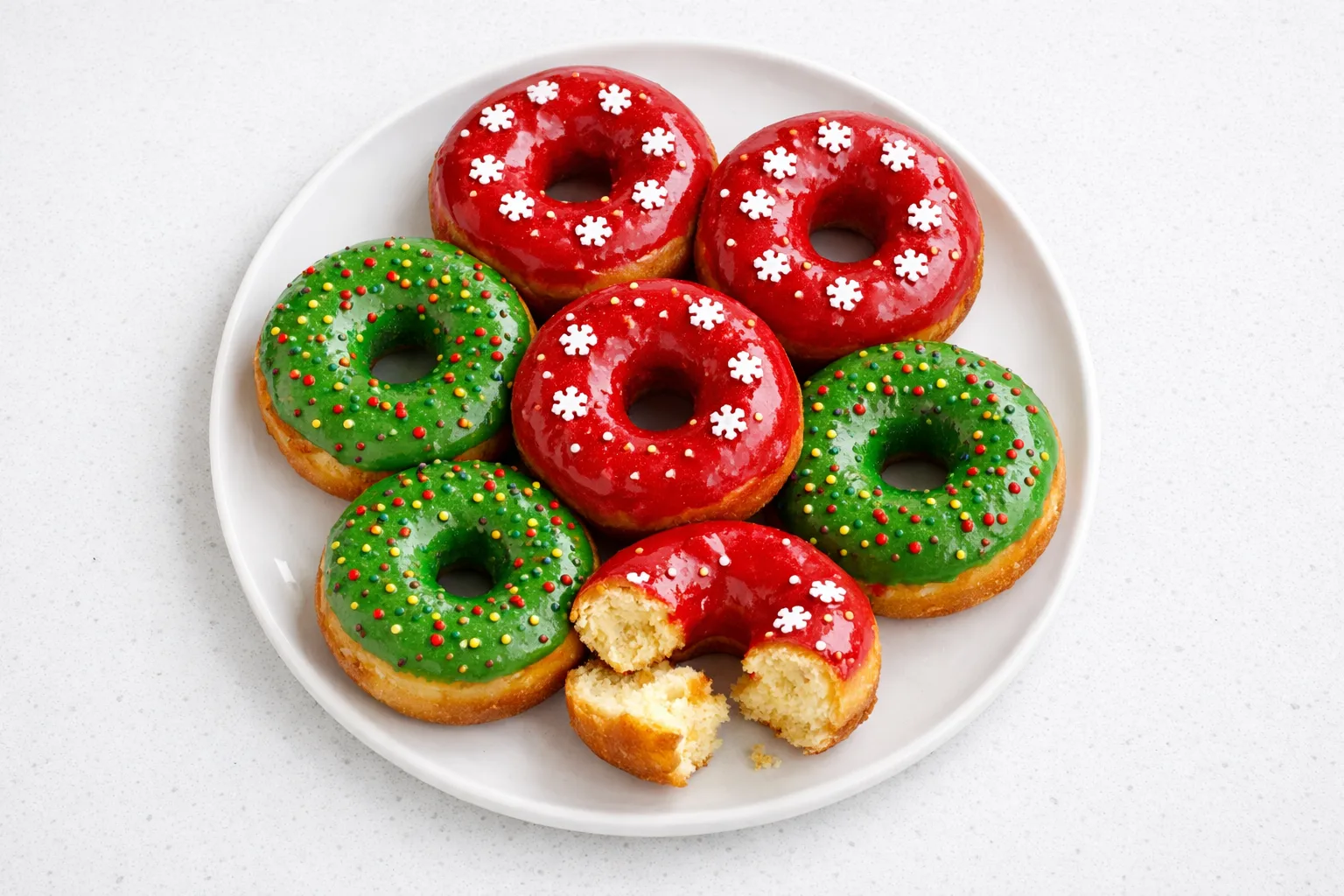
Christmas donuts have become a genuine holiday morning ritual in American homes, occupying the same slot as cinnamon rolls or pancakes: the treat that signals a special day before gifts are opened. These are yeast-raised donuts, not cake donuts, which matters. Yeast gives you the puffy, cloud-like interior that holds a glaze without going soggy, and the slight tang that balances all that sweet topping.
The decorating is where christmas donut recipes live or die. A thin, set glaze in red and green lets the color come through cleanly without becoming sticky or tacky after 20 minutes on a rack. The sprinkle window is short: you have about 60 seconds after dipping before the glaze skins over, so have everything staged before the first donut hits the glaze bowl.
This recipe makes 12 full-size donuts plus the donut holes. You can do all the frying the night before Christmas Eve and glaze on Christmas morning, which is the smarter move for anyone who would rather not stand over a fryer at 7 a.m.
Equipment
Instructions
Tap each step to track your progress
- 1
In the bowl of a stand mixer, combine the warm milk, 1 tablespoon of the sugar, and the yeast. Stir gently and let sit for 8 to 10 minutes until foamy and fragrant. If the mixture does not foam, your yeast is dead or your milk was too hot; start over with fresh yeast.
- 2
Add the remaining sugar, eggs, salt, nutmeg, and cinnamon to the yeast mixture. Mix briefly with the dough hook on low to combine. Add the flour in two additions, mixing on low until a shaggy dough forms.
- 3
With the mixer on medium, add the softened butter a few cubes at a time, waiting for each addition to be fully incorporated before adding the next. This takes about 3 to 4 minutes. Increase speed to medium-high and knead for 5 minutes until the dough is smooth, slightly tacky, and pulls cleanly from the sides of the bowl.
- 4
Transfer the dough to a lightly oiled bowl, cover with plastic wrap, and let rise at room temperature for 1 to 1.5 hours until doubled in size. If your kitchen is cold, place the bowl in an oven with just the light on.
- 5
Turn the risen dough onto a lightly floured surface. Gently press it to about 1/2 inch thickness, using a rolling pin only if needed. Do not over-work it. Cut out rounds with a 3-inch cutter, then cut holes with a 1-inch cutter. Place on parchment-lined baking sheets. Re-roll scraps once only. Let the cut donuts rest, uncovered, for 20 to 30 minutes until slightly puffed.
- 6
While the donuts rest, heat 2 inches of neutral oil in a heavy-bottomed pot (Dutch oven works best) to 350 degrees F. Use a thermometer; oil temperature is the most critical variable. Have a wire rack set over a baking sheet ready beside the stove.
- 7
Fry donuts in batches of 2 to 3, never crowding the pot. Cook for 60 to 75 seconds per side until deep golden brown. The oil will drop in temperature with each batch; bring it back to 350 degrees F before adding the next batch. Transfer to the wire rack and cool for at least 10 minutes before glazing.
- 8
Make the glazes: whisk powdered sugar, milk, and vanilla together until smooth. Divide into two bowls. Add red gel food coloring to one bowl a little at a time, stirring until you reach a rich red. Add green gel to the other bowl and do the same. The glaze should be thick enough to coat the back of a spoon but still flow slowly off it. Add milk by the teaspoon if too thick; add powdered sugar by the tablespoon if too thin.
- 9
Stage all your sprinkles in small bowls before you start glazing. Working one donut at a time, hold it by the bottom and dip the top surface into the glaze, letting excess drip off for 2 seconds. Flip right-side up onto the rack and immediately scatter sprinkles over the wet glaze. Repeat with remaining donuts, alternating red and green glaze. Let set for 15 minutes before serving.
Tips & Tricks
Use gel food coloring, not liquid
Liquid food coloring thins the glaze and makes it harder to get a saturated red or green. Gel coloring is concentrated: start with a small amount, about a toothpick-tip worth, and add gradually until you reach the color you want.
Stage everything before you start frying
Cooling rack, thermometer, slotted spoon or spider strainer, paper towels, glaze bowls, sprinkle bowls: have all of it in position before the oil heats up. Frying moves fast and you cannot step away to hunt for a missing bowl.
The second rest matters
That 20 to 30 minute rest after cutting is not optional. It allows the gluten to relax and the yeast to do a partial second rise, which gives you the puffiness and the characteristic ring shape after frying.
Make the dough the night before
After the first rise, punch down the dough, wrap it tightly, and refrigerate overnight. On Christmas morning, pull it out 30 minutes before shaping to take the chill off. Cold dough is actually easier to work with and the overnight fermentation improves flavor.
Keep the oil clean
Use a slotted spoon or spider to remove any stray bits of dough from the oil between batches. Burnt fragments raise the smoke point and will turn subsequent donuts darker faster.
Troubleshooting
My donuts came out dense and greasy
The oil was not hot enough, or the donuts went into cold oil after each batch dropped the temperature. Always bring the oil back to 350 degrees F between batches. Greasy donuts absorb oil rather than frying quickly and forming a crust.
The dough is not rising
Either the yeast was old, the milk was too hot and killed it, or the kitchen is too cold. Test yeast freshness before using by checking that it foams within 10 minutes in warm milk with a pinch of sugar. Dough rises best between 75 and 80 degrees F.
My glaze is running off and pooling under the donut
The glaze is too thin, or the donuts are still too warm. Let donuts cool for at least 10 minutes after frying. The glaze should drip off a spoon in a slow, ribbon-like stream, not pour freely. Thicken with powdered sugar one tablespoon at a time.
The sprinkles are sinking into the glaze
You waited too long. The glaze sets quickly, especially in a dry room. Keep glazed donuts moving: dip, flip, sprinkle immediately. If working in a large batch, have a helper add sprinkles while you glaze.
The donuts are browning too fast on the outside but still raw inside
The oil is too hot. At temperatures above 365 degrees F, the outside fries before the interior cooks through. Maintain 350 degrees F with a thermometer, not by eye.
Variations
Baked Christmas Donuts
For a lighter option without frying, use a donut pan. Thin the dough slightly by adding 2 extra tablespoons of milk after the butter is incorporated, creating a thick batter. Pipe or spoon into a greased donut pan and bake at 375 degrees F for 10 to 12 minutes until risen and just set. Baked donuts are less puffy than fried and have a finer crumb, but the glaze and decoration are identical. Excellent for younger kids to help with.
Spiced Eggnog Glaze
Replace the milk in both glazes with full-fat eggnog and add 1/4 teaspoon freshly grated nutmeg. Skip the food coloring and top with a dusting of cinnamon and nutmeg. The glaze will be pale ivory and tasted unmistakably of the holiday season. Works best as a single unified glaze rather than split red and green.
Chocolate Peppermint
Add 2 tablespoons of Dutch-process cocoa to each glaze along with 1/4 teaspoon peppermint extract, and increase powdered sugar by 1/4 cup to compensate for the extra dry ingredient. Top with crushed candy canes while the glaze is wet. The bittersweet chocolate-peppermint combination reads as genuinely festive without relying on food coloring.
Dairy-Free Adaptation
Replace whole milk in the dough with oat milk (full-fat) and use the same volume of vegan butter (stick-style, like Miyoko's). For the glazes, use oat milk in place of whole milk. The dough rises slightly slower but produces donuts with the same soft crumb. Add the dairy-free:dietary tag if serving to guests with restrictions.
Serving & Gifting
Christmas donuts are best eaten within 2 hours of glazing, so time your Christmas morning accordingly. Arrange on a wide platter or tiered cake stand, alternating red and green glazes for a graphic holiday look. Serve alongside strong coffee, hot chocolate, or a pot of Christmas tea. For a party or cookie swap, wrap individual donuts in squares of wax paper tied with a twist of red string.
Storage & Freezing
Unglazed fried donuts keep at room temperature in an airtight container for up to 24 hours; glaze and decorate just before serving. Glazed donuts are best the day they are made. The raw dough can be made through the first rise, then punched down, wrapped tightly in plastic wrap, and refrigerated overnight; bring to room temperature and proceed with cutting and the second rest the next morning. Do not freeze glazed or decorated donuts.
Common Questions
Can I make christmas donuts without a stand mixer?
Yes, but it takes effort. Mix the dough by hand until shaggy, then knead on a lightly floured surface for 8 to 10 minutes until smooth and elastic. Adding the butter by hand is messier; press the softened butter in small pieces into the dough and keep kneading until absorbed. The result is identical.
How far in advance can I make christmas donuts?
The safest make-ahead method is to fry the donuts the day before, store them unglazed in an airtight container overnight, and glaze on Christmas morning. Fully decorated donuts do not hold well beyond the same day; the glaze turns tacky and the sprinkles start to bleed color.
What is the best oil for frying donuts?
Neutral oils with a high smoke point work best: vegetable oil, canola oil, or refined peanut oil. Avoid olive oil (too low a smoke point, wrong flavor) and coconut oil (it solidifies when it hits cold donuts). You need at least 1 quart to get 2 inches of depth in a standard Dutch oven.
Can I make these as cake donuts instead of yeast donuts?
You can use a cake donut batter in a donut pan and bake them, but the texture is quite different: denser, more muffin-like, less pillowy. The glaze and decoration work the same way regardless of which base you choose. See the Baked Christmas Donuts variation above.
Why are my christmas donuts not as fluffy as bakery donuts?
Bakery donuts typically use a higher-fat dough with more butter and sometimes added shortening, plus professional fryers that maintain exact oil temperature. At home, the most common culprits are underdeveloped gluten (not kneading long enough), underproofing (not letting the dough rise fully), or oil that is too hot or too cold.
Can I use store-bought donut dough?
Refrigerated biscuit dough (like Pillsbury Grands) works as a shortcut and produces a passable fried donut. The texture is biscuit-like rather than yeast-raised, but the glaze and decorating process is exactly the same. Not traditional, but a workable option for christmas morning when time is short.