
Christmas Pickle: The Odd Tradition Nobody Can Explain
Every December, millions of Americans hide a glass pickle in their Christmas tree and tell their kids it's an ancient German custom. There's just one problem: Germans have no idea what they're talking about.
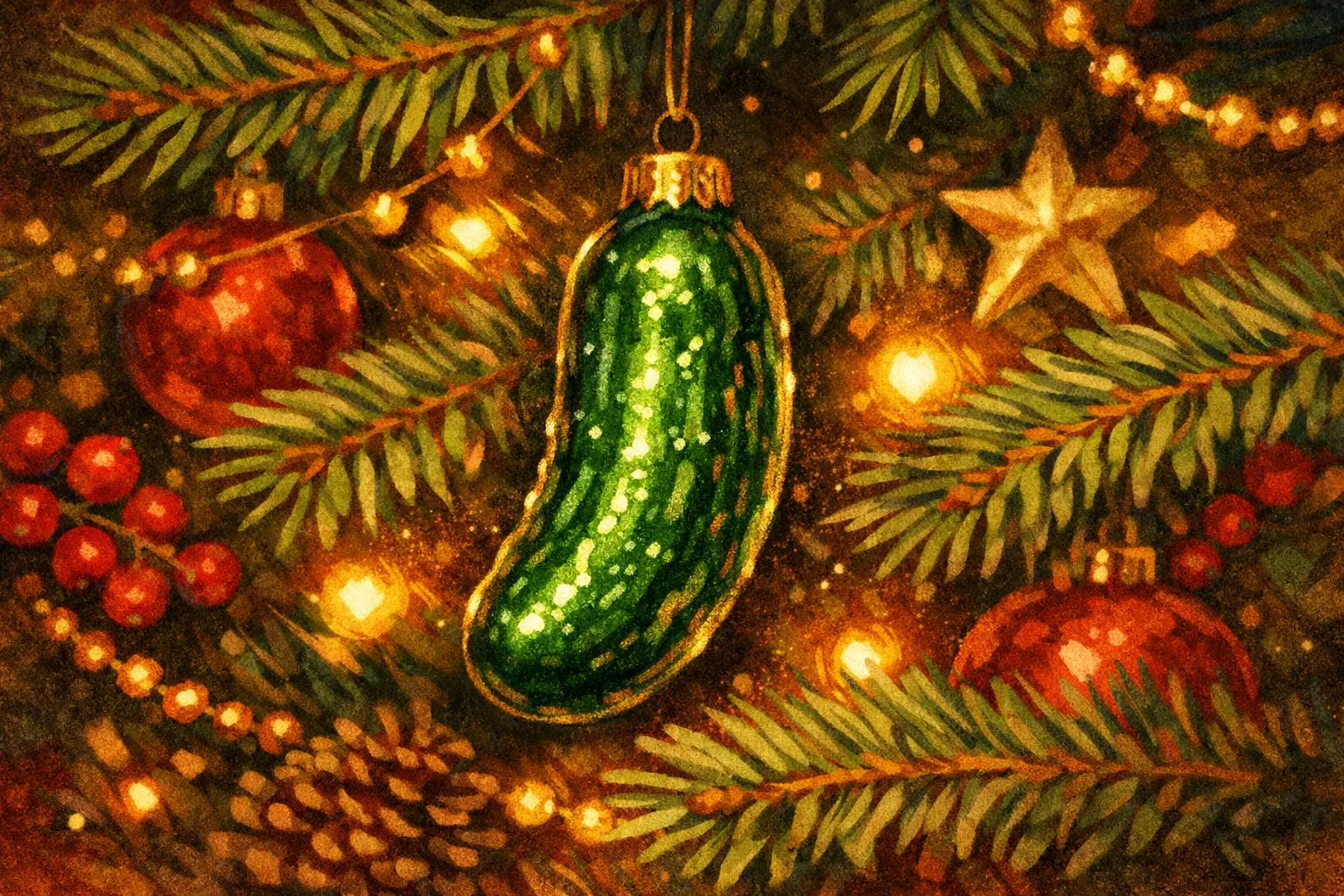
The Christmas pickle is one of the strangest ornaments you'll find on an American Christmas tree. A small glass pickle, usually dark green and about the size of a thumb, gets hidden among the branches on Christmas Eve. The first person to spot it on Christmas morning receives an extra gift or, depending on the family, a year of good luck. Millions of households across the United States practice this tradition. And nearly all of them believe it came from Germany.
Contents
- 1. What Is the Christmas Pickle Tradition?
- 2. Is the Christmas Pickle Really German?
- 3. The Real Origin of the Christmas Pickle
- 4. The Civil War Legend of the Christmas Pickle
- 5. The St. Nicholas and Two Boys Story
- 6. The Lauscha Connection: Where the Ornaments Were Actually Made
- 7. Berrien Springs: The Christmas Pickle Capital of the World
- 8. Why the Christmas Pickle Story Stuck
- 9. Frequently Asked Questions
It didn't.
In a 2016 YouGov survey of 2,057 Germans, 91 percent had never heard of the Weihnachtsgurke, the so-called "Christmas pickle." Only 6 percent of German families with children practiced anything resembling the custom. The Christmas pickle is about as German as fortune cookies are Chinese: a tradition invented in one country and confidently attributed to another.
What Is the Christmas Pickle Tradition?
The rules are simple. On Christmas Eve, someone (usually a parent) hides a pickle-shaped glass ornament deep in the branches of the Christmas tree. Because the pickle is green and the tree is green, finding it takes genuine effort. On Christmas morning, children search the tree, and whoever spots the pickle first gets a reward.
In some families, the reward is a small extra present. In others, the finder is simply declared lucky for the coming year. Some families let the pickle-finder open the first gift. The specifics vary, but the core idea stays the same: the pickle is hidden, the pickle is found, somebody wins.

The tradition has spread well beyond the families who originally practiced it. Old World Christmas, one of the largest ornament companies in the United States, lists the pickle among its best-selling items year after year. You can find Christmas pickle ornaments at Target, Walmart, Amazon, and virtually every holiday shop in the country.
Is the Christmas Pickle Really German?
No. And this is the most interesting part of the whole tradition: almost nobody in Germany has ever heard of it.
The word "Weihnachtsgurke" exists in German, but it was borrowed back from American English, not the other way around. When German journalists first wrote about the custom, they treated it as an amusing American curiosity. The idea that hiding a pickle in a Christmas tree is an ancient Bavarian practice has no basis in German folklore, German Christmas customs, or German historical records.
This hasn't stopped ornament manufacturers from printing "Old German Tradition" on their packaging for decades. The legend is too good, too charming, and too commercially useful to let a few facts get in the way.
There's an ironic twist to the story. Because American tourists keep asking about the Weihnachtsgurke when they visit German Christmas markets, some German vendors have started selling pickle ornaments. The tradition has been successfully exported to the country it supposedly came from.
The Real Origin of the Christmas Pickle
If the tradition isn't German, where did it actually come from? The honest answer is that nobody knows for certain. But the most credible explanation points to late 19th-century American retail.
In 1880, F.W. Woolworth opened his first successful five-and-dime store in Lancaster, Pennsylvania. Within a decade, he was importing glass Christmas ornaments from Lauscha, a small town in Thuringia, Germany, where glassblowers had been producing decorative objects since the 1590s. By 1890, Woolworth's stores were selling these ornaments by the millions.
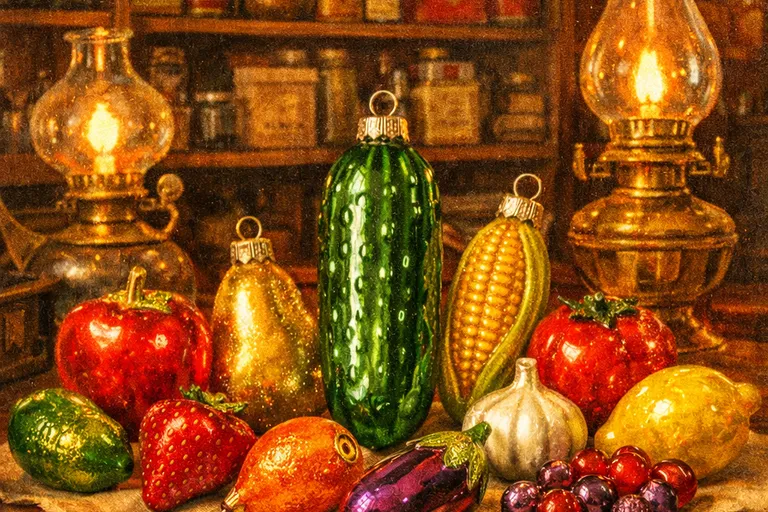
The glassblowers of Lauscha didn't just make balls and stars. They produced ornaments shaped like fruits, vegetables, animals, and all manner of everyday objects. Pickles, cucumbers, and gherkins were part of a broader catalog of novelty shapes that included carrots, mushrooms, fish, and even Santa Claus figures.
Here's where the theory gets plausible. Vegetable-shaped ornaments weren't the most popular items in the catalog. Some retail historians suggest that salespeople invented the "German pickle tradition" story to help sell the less appealing inventory. Tell a customer it's just a glass pickle, and it stays on the shelf. Tell them it's a cherished German tradition with a game attached, and suddenly it's the most interesting ornament in the store.
The Civil War Legend of the Christmas Pickle
The most emotionally compelling origin story involves a Bavarian-born soldier named John C. Lower. Born in Germany, Lower emigrated to the United States and enlisted in the 103rd Pennsylvania Infantry during the Civil War. In April 1864, he was captured and sent to Camp Sumter in Andersonville, Georgia, one of the most brutal prisoner-of-war camps in American history.
According to the Lower family's account, passed down through generations, Private Lower was starving and close to death on Christmas Eve 1864. He begged a Confederate guard for something to eat, and the guard gave him a pickle. Lower later told his children that the pickle gave him enough strength and hope to survive. After the war, he began hiding a pickle ornament on his family's Christmas tree each year. Whoever found it would receive good luck for the coming year.
The U.S. National Archives confirms that a John C. Lower survived imprisonment at Andersonville and lived until 1923, dying at age 81. The pickle story itself can't be independently verified beyond the family's oral tradition, but the basic facts of Lower's military service check out.
Even if the Lower story is true, it would explain only one family's tradition, not a national custom. The gap between a single family in Pennsylvania hiding a pickle in their tree and millions of Americans doing the same thing requires a much bigger engine than word of mouth. That engine was almost certainly commercial.
The St. Nicholas and Two Boys Story
A second legend, less widely told, involves St. Nicholas rescuing two Spanish boys who had been kidnapped by an innkeeper and stuffed inside a barrel of pickles. St. Nicholas found the barrel, tapped it with his staff, and the boys emerged alive and well.
This story borrows heavily from an existing medieval legend about St. Nicholas and three boys trapped in a barrel of brine, which appears in French and Belgian folklore. The pickle detail seems to have been grafted on later, almost certainly to give the Christmas pickle tradition a more respectable pedigree than "a Woolworth's clerk made it up."

The Lauscha Connection: Where the Ornaments Were Actually Made
The glass pickle ornament itself has genuinely German roots, even if the tradition attached to it does not. Lauscha, a town of about 3,000 people in the Thuringian Forest, has been a center of glassblowing since 1597. In the 1840s, local glassblowers began making Christmas ornaments, and by the 1860s, a craftsman named Hans Greiner developed a technique for producing thin-walled glass ornaments that could be made quickly and affordably.
The ornaments were blown into molds, then silvered on the inside and hand-painted on the outside. Pickle molds were among hundreds of shapes produced for export. Between the 1870s and 1939, Lauscha's workshops exported vast quantities of glass ornaments to the United States, with Woolworth's as one of the biggest buyers.
Today, companies like Marolin still produce hand-blown glass pickle ornaments in Germany. They're sold as collector's items and novelty gifts, often with a tag explaining the "traditional" story that Germans themselves never practiced.
Berrien Springs: The Christmas Pickle Capital of the World
If the Christmas pickle needed a hometown, it found one in Berrien Springs, Michigan. In 1992, this small town in the state's southwestern corner began hosting an annual Christmas Pickle Festival, complete with a pickle parade led by a "Grand Dillmeister." In 1995, Pickle Packers International (yes, that's a real organization) officially designated Berrien Springs the "Christmas Pickle Capital of the World."
The festival folded in the early 2000s, but in 2021, the Village of Berrien Springs, the local library, and the Berrien County Historical Association brought it back. The revived festival drew nearly 2,000 visitors in its first year and now features pickle-themed games, a vendor alley, and the famous Pickle Fling.
Michigan's connection to the pickle makes geographical sense. The state has long been one of the country's top pickle-producing regions. The Christmas pickle gave Berrien Springs something that hundreds of other small American towns would love to have: a quirky, media-friendly identity.
Why the Christmas Pickle Story Stuck
Plenty of made-up traditions die out. The Christmas pickle didn't. It thrived. And the reason has less to do with pickles than with how traditions actually work.
The tradition solves a real problem for families: how to add one more moment of excitement to Christmas morning. The search for the pickle creates a game out of looking at the tree. Kids pay attention to every branch. Adults get to play along. The reward is small enough that losing doesn't sting. The whole thing takes five minutes and costs nothing beyond the initial ornament purchase.
The fake German backstory helped, too. Americans in the late 1800s and early 1900s had enormous respect for German Christmas customs, and for good reason. Germans gave the world the modern Christmas tree, Advent calendars, and some of the finest ornaments ever produced. Claiming German heritage for the pickle tradition gave it instant credibility in an era when "imported from Germany" was the gold standard for Christmas goods.
By the time anyone thought to check whether Germans actually did this, millions of families were already hiding pickles in their trees. At that point, the tradition was real regardless of its origins. A practice doesn't need an ancient pedigree to be meaningful. It just needs people who keep doing it.
Frequently Asked Questions
What is the meaning of the Christmas pickle?
The Christmas pickle is a glass ornament hidden in a Christmas tree on Christmas Eve. The first person to find it on Christmas morning traditionally receives an extra gift or is said to have good luck for the coming year. The "meaning" is essentially a holiday game that adds a small layer of excitement to Christmas morning, not a deeply symbolic custom.
Is the Christmas pickle tradition really from Germany?
No. Despite being widely marketed as a German tradition, the Christmas pickle is virtually unknown in Germany. A 2016 YouGov survey found that 91 percent of Germans had never heard of the Weihnachtsgurke. The tradition most likely originated in the United States in the late 1800s, possibly as a marketing invention to sell glass pickle ornaments imported from German glassblowing workshops.
What is the Civil War story behind the Christmas pickle?
The legend involves Private John C. Lower, a Bavarian-born soldier in the 103rd Pennsylvania Infantry who was imprisoned at Andersonville during the Civil War. On Christmas Eve 1864, he reportedly begged a guard for food and received a pickle, which he credited with saving his life. He later started hiding a pickle ornament on his family's Christmas tree each year. His military records are verified, though the pickle story itself comes from family oral tradition.
Where can you buy a Christmas pickle ornament?
Christmas pickle ornaments are widely available at major retailers like Target, Walmart, and Amazon, as well as specialty ornament companies like Old World Christmas. Hand-blown glass versions are still made in Lauscha, Germany, by companies such as Marolin. Prices range from a few dollars for mass-produced versions to $20 or more for artisan glass ornaments.
Where is the Christmas Pickle Capital of the World?
Berrien Springs, Michigan, was designated the "Christmas Pickle Capital of the World" in 1995 by Pickle Packers International. The town has hosted a Christmas Pickle Festival since 1992, which was revived in 2021 after a hiatus. The festival features pickle-themed games, a vendor market, and the Pickle Fling.
How do you play the Christmas pickle game?
On Christmas Eve, one person hides a glass pickle ornament deep in the branches of the Christmas tree. Because the green pickle blends in with the green branches, it's difficult to spot. On Christmas morning, family members search the tree. The first person to find the pickle wins a small extra gift or is declared to have good luck for the year ahead.