
 Spain
Spain 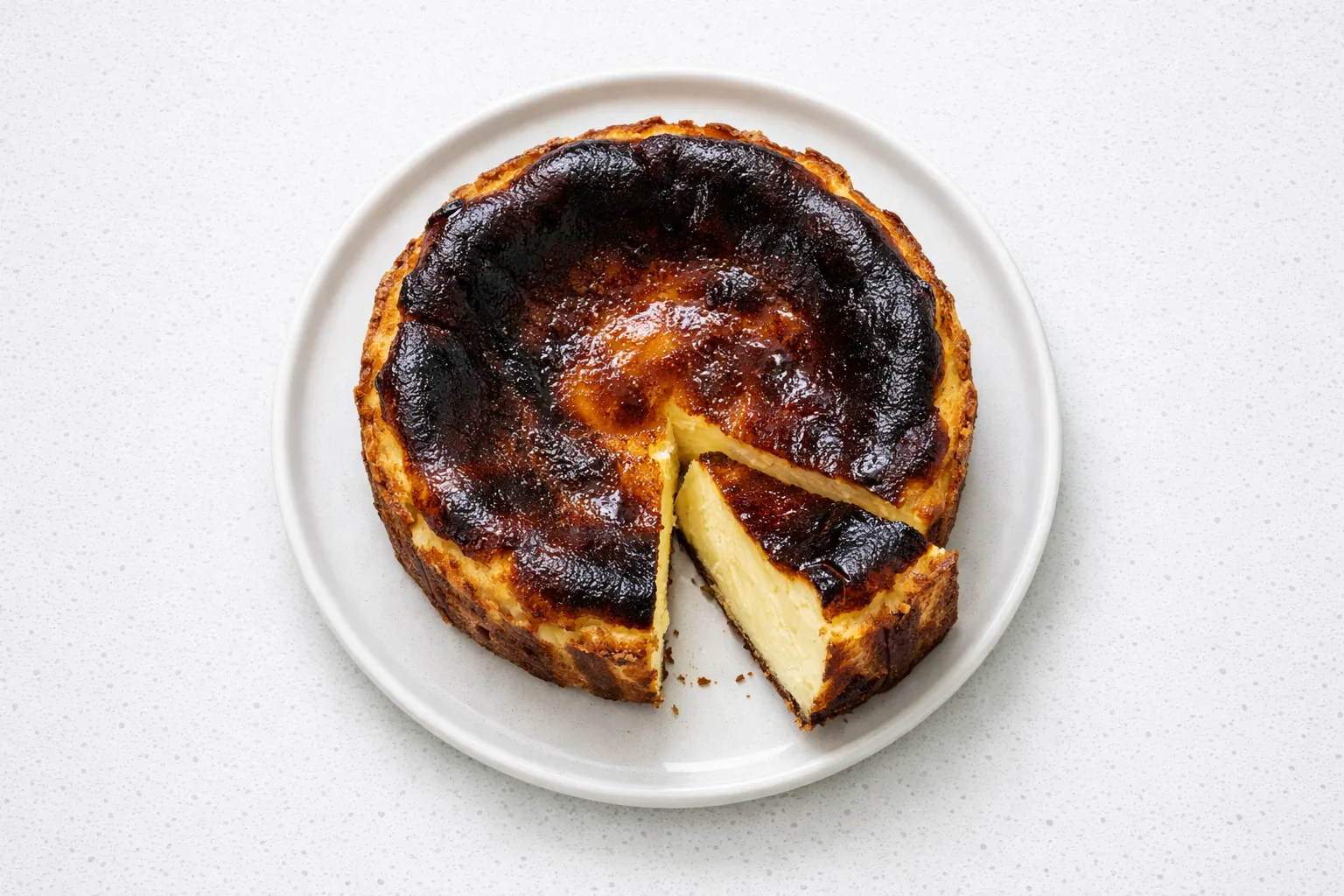
The Basque cheesecake was born at La Vina, a pintxos bar in San Sebastian, where chef Santiago Rivera spent years deliberately burning his tarta de queso because customers loved how the caramelized crust tasted against the liquid-set cream cheese interior. There is no water bath, no crust, no cracking anxiety. The oven runs hot on purpose. The center stays soft on purpose. This is a Christmas dessert that looks dramatic, tastes extraordinary, and asks almost nothing of you technically.
Spain celebrates Christmas with long family meals that end in sweets, and this cheesecake fits that tradition perfectly: it can be made the day before, tastes better at room temperature than cold, and carries well to the table without any last-minute fussing. The recipe calls for full-fat cream cheese and heavy cream with nothing else to get in the way. Use good ingredients and a hot oven, and the chemistry handles everything.
What makes this version work at Christmas specifically is the texture contrast: a slightly bitter, deeply caramelized exterior gives way to a trembling, barely-set vanilla custard center that tastes like the best burnt caramel you have ever had. It is not subtle. It is not delicate. It is exactly the right thing to put on the table after a Christmas feast.
Equipment
Instructions
Tap each step to track your progress
- 1
Take the cream cheese and eggs out of the refrigerator at least 1 hour before baking. Cold cream cheese will not blend smoothly and will leave lumps you cannot fix later. Preheat your oven to 450°F (230°C) with a rack in the center.
- 2
Line a 10-inch (25cm) springform pan with two large sheets of parchment paper, overlapping them at 90 degrees so the entire interior is covered and the paper extends at least 2 inches above the rim. Press the paper into the corners loosely; rough folds are fine and create the signature rustic look.
- 3
In a stand mixer fitted with the paddle attachment, beat the room-temperature cream cheese on medium speed for 3 full minutes until completely smooth and no visible lumps remain. Stop and scrape down the bowl twice during this time.
- 4
Add the sugar and beat on medium speed for another 2 minutes. The mixture should look glossy and slightly lightened.
- 5
Add the eggs one at a time on low speed, waiting about 10 seconds between each addition and scraping the bowl after every second egg. Do not rush this step; adding eggs too fast causes the batter to break.
- 6
With the mixer on low, pour in the heavy cream in a slow, steady stream. Add the vanilla and salt. Mix just until combined, about 30 seconds.
- 7
Sift the flour directly over the batter and fold it in by hand with a rubber spatula using about 10 slow strokes, just until no flour streaks remain. Avoid over-mixing at this stage or the cheesecake will bake up too firm.
- 8
Pour the batter into the prepared pan. It should come to within about 1 inch of the top of the parchment. Tap the pan gently on the counter twice to release any trapped air bubbles.
- 9
Bake at 450°F (230°C) for 50 to 60 minutes. At 50 minutes the top should be a deep, dark mahogany brown, almost burnt looking, and the center 3 inches should still wobble noticeably when you shake the pan. If the top has not darkened enough by 45 minutes, move the rack up one position for the final 10 minutes.
- 10
Remove from the oven and let the cheesecake cool completely in the pan at room temperature, at least 2 hours. The center will continue to set as it cools. Refrigerate for at least 4 hours (overnight is better) before unmolding and slicing.
Tips & Tricks
Room temperature ingredients are non-negotiable
Cold cream cheese will not break down under the paddle and you will end up with a lumpy batter that bakes unevenly. Set the cream cheese and eggs out 1 full hour before you start.
Trust the wobble test, not the timer
Every oven is different. The correct doneness is a top that is deeply dark (not golden, not light brown, but nearly black in places) and a center 3 to 4 inches across that shakes visibly when you rock the pan. It looks frighteningly underdone. That is correct. The refrigerated set firms it to a smooth, sliceable custard.
Do not line the pan too neatly
Tight parchment with pressed-flat folds produces a smooth side that looks too controlled for this recipe. Leave the parchment loose and crinkled. The irregular ridged edge is part of the look and tells your guests it was made by hand.
Make it the day before
The texture is noticeably better after overnight refrigeration. The center sets more evenly, the caramel flavor on top deepens, and the interior becomes silkier. This makes it ideal Christmas prep: done the day before, no last-minute oven time needed.
Use full-fat everything
This is not a recipe where reduced-fat cream cheese or light cream performs acceptably. The fat content is what gives the interior its specific smooth, trembling texture. Low-fat substitutes produce a grainy, overly firm result that misses the entire point of the recipe.
Troubleshooting
The center is completely liquid after cooling
The oven temperature was too low or the baking time was too short. An oven that reads 450°F but actually runs at 400°F will underbake the cheesecake. Use an oven thermometer to verify, and add 10 to 15 minutes to the bake time. The cheesecake also needs a full 4-hour refrigerated set to firm the center; it will look liquid coming out of the oven and that is normal.
The top is not browning at all
Your oven temperature is running cold, or you opened the oven too early. Resist opening the oven before 40 minutes. If the top is pale at 45 minutes, switch the oven to the broil setting for 3 to 5 minutes, watching constantly so it does not tip from caramelized to truly acrid.
The batter has lumps in it
The cream cheese was too cold when mixed. Lumps at this stage cannot be fixed by extra mixing; they will bake in. For future batches, ensure the cream cheese sits at room temperature for at least 1 hour. If you are in a hurry, cut it into 1-inch cubes and microwave on low (20%) power in 15-second increments until just soft to the touch.
The cheesecake cracked across the top
Cracks are not typical of this recipe because there is no water bath and the batter is high in fat and cream. If cracking occurs, it usually means the flour was over-mixed after adding (developing gluten) or the eggs were beaten too aggressively once added. The burnt surface usually hides minor cracks anyway, and the recipe is intentionally rustic.
It sticks to the parchment
This happens when the paper does not extend high enough above the rim and the batter bonds to the pan sides above the parchment. Ensure the parchment extends at least 2 inches above the pan edge. Let the cheesecake cool completely before attempting to unmold; warm cheesecake tears easily.
Variations
Lemon and Honey Basque Cheesecake
Replace the granulated sugar with 1 1/4 cups (250g) of mild honey and add the zest of 2 large lemons to the batter in step 4. The honey caramelizes faster than sugar, so watch the color carefully from 40 minutes onward. The flavor is floral and slightly tart, a good contrast to very rich Christmas mains.
Gluten-Free Adaptation
Replace the all-purpose flour with 1/4 cup (30g) of cornstarch (cornflour). Sift it in the same way and fold gently. The texture difference is minimal; the cheesecake will be marginally creamier and equally stable once set. Confirm your cream cheese brand is certified gluten-free if baking for someone with celiac disease.
Orange and Cardamom
Add 2 tsp finely grated orange zest and 1/2 tsp ground cardamom with the vanilla in step 6. Both spices are traditional in Spanish holiday baking and they amplify the caramelized top note. Do not increase the cardamom above 1/2 tsp or it will overpower the cream cheese.
Mini Basque Cheesecakes
Divide the full batter among 12 parchment-lined individual ramekins (6 oz each), filling about 3/4 full. Bake at 450°F for 18 to 22 minutes until dark on top and still jiggly. Individual portions are easier to serve at a buffet and look impressive plated with a spoonful of quince paste or fig jam alongside.
Serving & Gifting
Serve the Basque cheesecake at room temperature or slightly cool, not straight from the refrigerator, because the caramel notes on the top mute significantly when cold. Dust with no powders and add no garnish; the two-tone of near-black top and ivory slice is the entire visual. Pair with a glass of Pedro Ximenez sherry or a strong espresso. For the Christmas table, quince paste (membrillo) on the side is traditional and excellent.
Storage & Freezing
Refrigerate covered loosely with cling film for up to 5 days; the flavor deepens on day two and three. Do not freeze a baked cheesecake, the cream content causes ice crystals that wreck the smooth texture on thawing. The unbaked batter can be refrigerated overnight in the lined pan before baking, which is useful for Christmas prep. Let the pan come back to room temperature for 20 minutes before putting it in the oven.
Common Questions
Why is Basque cheesecake burnt on top?
The high oven temperature (450°F/230°C) caramelizes the sugars and proteins in the cream cheese batter before the interior fully sets. This Maillard and caramelization reaction creates a complex, slightly bitter, deeply flavorful crust that contrasts with the cold, sweet custard interior. It is intentional, and it is what makes this recipe unlike any other cheesecake.
Can I make basque cheesecake without a springform pan?
You can use a deep 9 or 10-inch round cake pan with high sides (at least 3 inches), but you must line it very thoroughly with parchment so you can lift the cheesecake out. A springform pan is strongly preferred because the latch release means no risk of tearing the cold cheesecake when unmolding.
How do I know when the basque cheesecake is done baking?
The top should be a deep dark brown, almost black at the edges, and the center 3 to 4 inches should wobble noticeably when you shake the pan. It will look drastically underdone but firms up completely after 4 to 6 hours of refrigeration. If the top is still golden at 50 minutes, it needs more time.
Is basque cheesecake supposed to be creamy in the middle?
Yes, completely. The correct interior texture is a smooth, soft custard that holds a clean slice but is clearly creamy and slightly trembling rather than dense and rubbery. If your slice is firm all the way through, it was overbaked. Slightly underdone is always better than overdone with this recipe.
Can I add toppings to basque cheesecake?
The recipe is traditionally served completely plain; the scorched top is the presentation. If you want a pairing, serve quince paste (membrillo), fresh figs, or a small spoonful of cherry compote on the side of each slice rather than on top. Adding anything on top of the cheesecake hides the caramelized crust which is the entire point.
How long does basque cheesecake last in the fridge?
Up to 5 days covered loosely in the refrigerator, and the flavor improves through day 3. Do not freeze it once baked; the high cream content does not survive freezing and thawing. Make it 1 to 2 days ahead for best results.