
Orthodox Christmas: Why Millions Celebrate on January 7
Every year, millions of Christians celebrate Christmas not on December 25, but on January 7. The reason is a calendar split that happened over 400 years ago, and the traditions that survived it are among Christianity's oldest.
Orthodox Christmas falls on January 7 in most years, not because Eastern Christians picked a different date for Christ's birth, but because they follow a different calendar. The feast is still December 25. It just happens to land on January 7 by the Gregorian calendar that most of the world now uses. That thirteen-day gap between the two Christmases traces back to a papal decree in 1582 and the churches that chose to ignore it.
Contents
- 1. Why Is Orthodox Christmas on January 7?
- 2. Russian Orthodox Christmas Traditions
- 3. Greek Orthodox Christmas: December 25, Not January 7
- 4. Eastern Orthodox Christmas Traditions Around the World
- 5. The Julian Calendar and "Old Christmas Day"
- 6. Orthodox Christmas Fasting and the Nativity Fast
- 7. Frequently Asked Questions
Roughly 260 million Orthodox Christians worldwide observe this later date, including congregations in Russia, Serbia, Ethiopia, Egypt, Georgia, and parts of Ukraine. Their Christmas celebrations are often quieter and more liturgically focused than the commercial spectacle familiar in the West, but no less deeply felt.
Why Is Orthodox Christmas on January 7?
The answer comes down to two competing calendars. In 1582, Pope Gregory XIII introduced the Gregorian calendar to correct a drift in the older Julian calendar, which had been losing about 11 minutes per year since Julius Caesar introduced it in 46 BC. By the sixteenth century, the calendar was ten days behind the astronomical year.
Most of Catholic and Protestant Europe adopted the Gregorian reform within a few generations. The Orthodox churches did not. They viewed the change as a Roman Catholic innovation and saw no reason to follow Rome's lead on how to count days.
By the twentieth century, the gap had widened to thirteen days. December 25 on the Julian calendar now corresponds to January 7 on the Gregorian calendar. That is the entire explanation. Orthodox Christians are not celebrating a different event or commemorating a different tradition. They are marking the same feast on the same calendar date. The world around them simply moved to a different system.
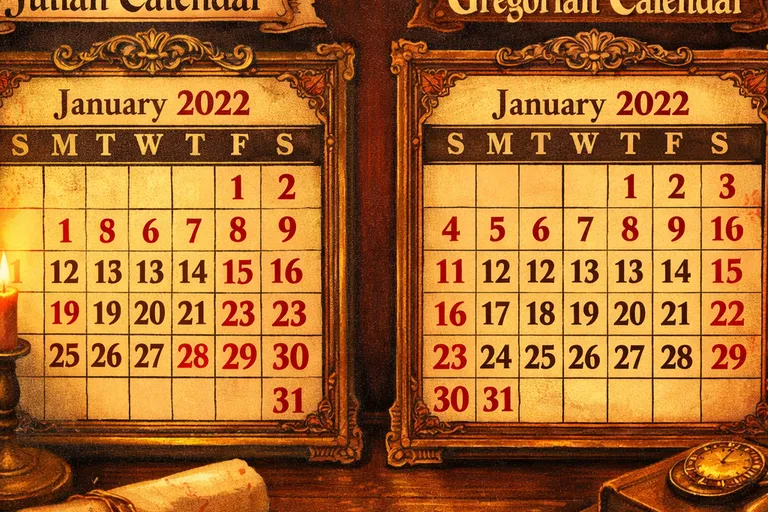
Not all Orthodox churches follow the Julian calendar, though. The Greek Orthodox Church, along with the Romanian, Bulgarian, and Antiochian churches, adopted the Revised Julian Calendar in 1923. This calendar aligns with the Gregorian calendar for fixed feasts, which means Greek Orthodox Christians celebrate Christmas on December 25. The Russian, Serbian, Georgian, and Jerusalem patriarchates remain on the old Julian calendar, placing their Christmas on January 7.
Russian Orthodox Christmas Traditions
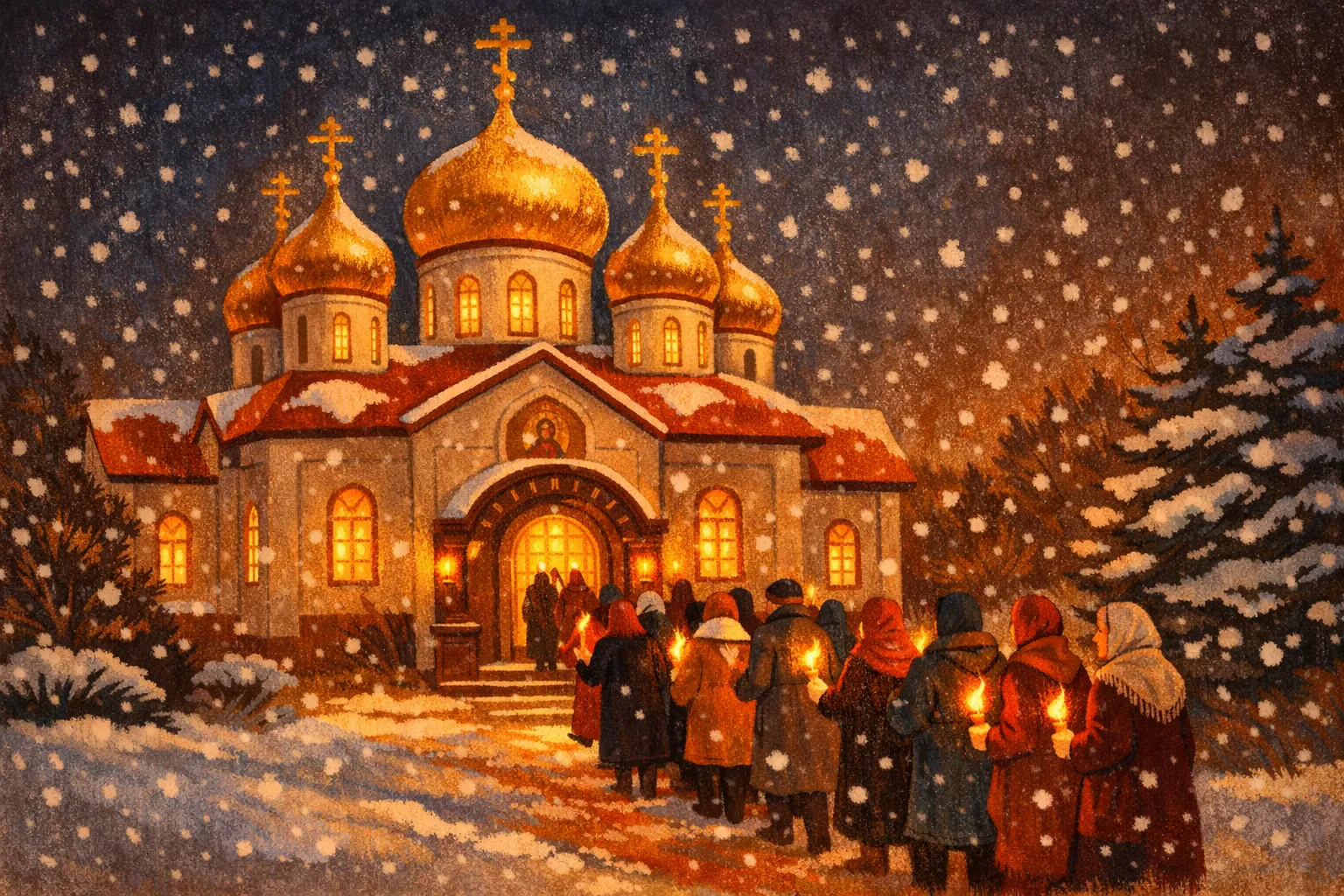
In Russia, Orthodox Christmas carries a weight that goes beyond religion. The Soviet government banned Christmas celebrations in 1929, folding gift-giving and tree-decorating into a secular New Year's holiday instead. The "New Year's tree" replaced the Christmas tree, and Ded Moroz (Grandfather Frost) took over from any religious figures. Christmas only returned as an official public holiday in 1991, after the Soviet Union collapsed.
That seventy-year gap reshaped how Russians relate to the holiday. For many families, New Year's Eve on December 31 remains the bigger celebration, with feasts, fireworks, and presents. Christmas on January 7 is the religious counterpart: church services, family gatherings, and a distinctly quieter mood.
The traditional Russian Orthodox Christmas Eve, called Sochelnik, centers on a strict fast that lasts until the first star appears in the evening sky. The first star symbolizes the Star of Bethlehem. Once it appears, families sit down to a meal of twelve dishes, each representing one of the apostles. These dishes are all meatless and dairy-free, since the Nativity Fast (a 40-day period of abstinence) only ends on Christmas Day itself.
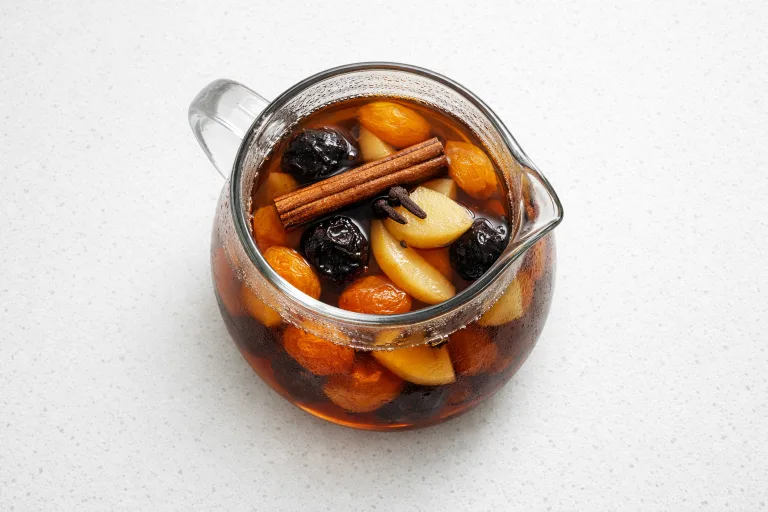
Common dishes on the Sochelnik table include kutya (a sweet porridge of wheat berries, honey, and poppy seeds), vinegret (a beet and potato salad), pickled mushrooms, and baked fish. Kutya holds particular significance. It is always the first dish served, and in some families, a spoonful is thrown at the ceiling. If it sticks, the coming year will bring a good harvest.
Greek Orthodox Christmas: December 25, Not January 7
This is where things get confusing for outsiders. Greek Orthodox Christmas is on December 25, the same day as Western Christmas. Greece adopted the Revised Julian Calendar in 1923, aligning its fixed feast dates with the Gregorian calendar. So while the Greek Orthodox Church is undeniably Orthodox, its Christmas falls on what most people consider "regular" Christmas.
Greek traditions on December 25 blend Orthodox liturgy with customs unique to the region. On Christmas Eve, children go door to door singing kalanda, traditional carols accompanied by triangles and small drums. The practice dates back centuries and earns the singers small gifts or coins. Churches hold midnight services, and families gather for a Christmas Day meal typically featuring roast pork or lamb.
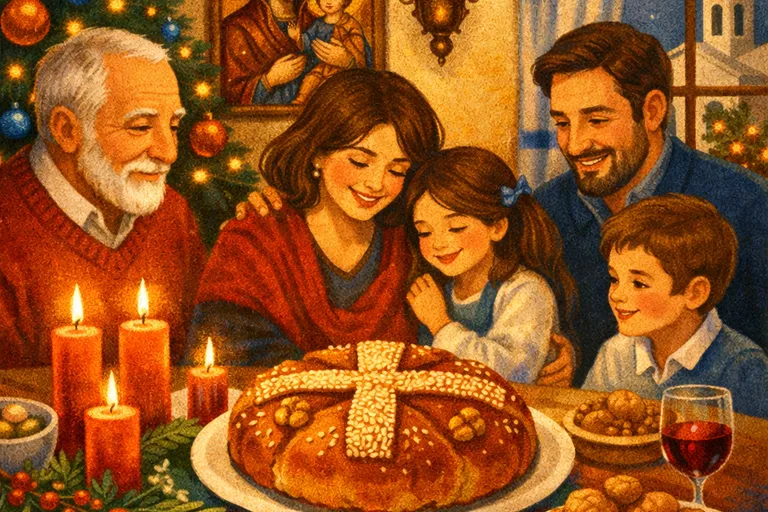
One distinctive Greek tradition involves the Christopsomo, or "Christ bread." This large, round loaf is decorated with a cross on top and sometimes with symbols representing the family's livelihood, such as grapes for vintners or sheep for shepherds. Each household bakes their own, and the bread holds a ceremonial role at the Christmas table.
Eastern Orthodox Christmas Traditions Around the World
Serbian Orthodox Christmas (Badnje Vece)
Serbian Christmas Eve, called Badnje Vece, features one of the most striking traditions in all of Christendom. Families bring an oak branch called a badnjak into the home and burn it in the fireplace (or, in cities, in front of the church). The badnjak represents the wood that warmed the infant Jesus in the manger, and its burning is meant to bring warmth, prosperity, and good fortune.
On Christmas morning, the first person to enter the house becomes the "polaznik," a kind of ritual first-footer whose arrival is thought to set the tone for the family's luck in the coming year. The Christmas meal centers on a roast pig turned on a spit, and the cesnica, a round bread with a coin hidden inside. Whoever finds the coin will have a year of good fortune.
Ethiopian Orthodox Christmas (Ganna)
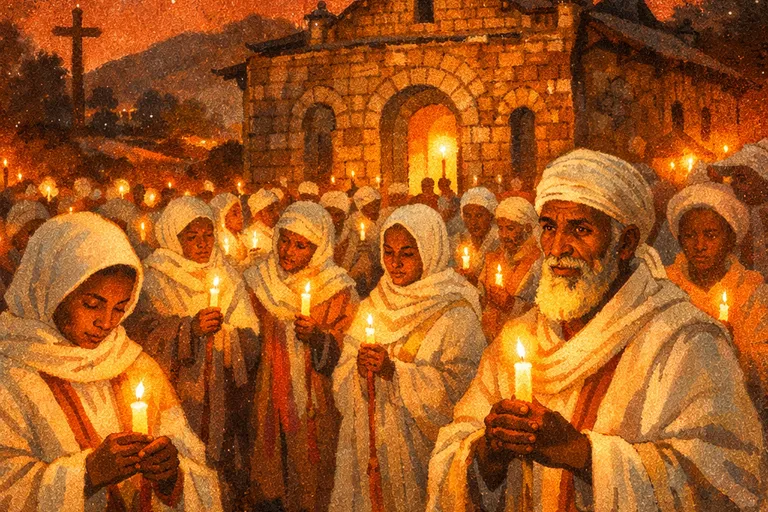
Ethiopia follows its own calendar, which places Christmas (called Ganna) on January 7. The Ethiopian Orthodox Tewahedo Church is one of the oldest Christian churches in the world, dating its origins to the fourth century. Ganna celebrations involve white-clad worshippers attending hours-long services that begin in the predawn darkness.
A traditional game also called ganna, similar to field hockey, is played on Christmas afternoon. According to Ethiopian tradition, the shepherds who heard the news of Christ's birth were so overjoyed that they began playing the game with their crooks. After the game, families share a feast featuring doro wat, a spiced chicken stew served on injera flatbread.
Coptic Orthodox Christmas in Egypt
Egypt's Coptic Christians, who make up roughly 10 percent of the country's population, celebrate Christmas on January 7 following the Coptic calendar. The Coptic Church mandates a 43-day fast called the Holy Nativity Fast, during which members abstain from all animal products. The fast ends at midnight on Christmas Eve with a church service that can last until the early morning hours.
After the service, families break their fast with a meal called fata, a dish of rice, bread, garlic, and meat in broth. Egypt declared January 7 a national holiday in 2003, a significant gesture of inclusion in a Muslim-majority country.
The Julian Calendar and "Old Christmas Day"
The term "Old Christmas Day" shows up in parts of Appalachia and the rural American South, where communities with Scots-Irish roots once observed Christmas on January 6 or 7, following older calendar reckoning. When Britain adopted the Gregorian calendar in 1752, not everyone moved with it. Some families in isolated mountain communities kept celebrating on the old date well into the twentieth century.
A similar story played out across the British Isles. In parts of Wales and Ireland, "Hen Galan" (Old New Year) on January 13 and "Little Christmas" or "Women's Christmas" on January 6 preserve memories of the pre-Gregorian calendar. These are not Orthodox Christian traditions, but they share the same root cause: a refusal, or simply a delay, in accepting Rome's calendar reform.
Orthodox Christmas Fasting and the Nativity Fast
Fasting is central to Orthodox Christmas in a way that has almost no parallel in Western Christianity. The Nativity Fast begins on November 15 (November 28 in the Julian calendar) and lasts 40 days, ending on Christmas Day. During this period, observant Orthodox Christians abstain from meat, dairy, eggs, and fish on most days. Wine and oil are permitted on weekends, and fish is allowed on certain feast days within the fast.
The fast is not just dietary. It includes increased prayer, charitable giving, and attendance at special church services. The purpose is preparation, arriving at the Nativity feast spiritually and physically ready. On Christmas Eve, the strictest day of the fast, many faithful eat nothing at all until the evening star appears.
This practice explains why Orthodox Christmas food traditions focus so heavily on the Christmas Eve meal. After forty days of abstinence, that first meal carries real meaning. The twelve meatless dishes of the Russian Sochelnik, the Serbian cesnica bread, the Ethiopian doro wat that breaks the fast: these are not arbitrary menu choices. They mark the end of a sustained period of discipline.
In 2023, the Orthodox Church of Ukraine officially moved its Christmas celebration from January 7 to December 25, a decision driven partly by the desire to distance itself from Russian religious influence following Russia's full-scale invasion. The move was historic but also practical. Ukrainian soldiers on the front lines had been celebrating on December 25 with Western allies, and the shift simply aligned the calendar with the reality on the ground. It was a reminder that even a date as seemingly fixed as Christmas can shift when the political and spiritual ground moves beneath it.
Frequently Asked Questions
When is Orthodox Christmas celebrated?
Most Orthodox churches that follow the Julian calendar celebrate Christmas on January 7 (Gregorian calendar), which corresponds to December 25 on the Julian calendar. However, Greek, Romanian, Bulgarian, and some other Orthodox churches adopted the Revised Julian Calendar and celebrate Christmas on December 25, the same date as Western Christians.
Why do Orthodox Christians celebrate Christmas on January 7?
Orthodox Christians who celebrate on January 7 still observe Christmas on December 25 according to their Julian calendar. The thirteen-day gap exists because the Julian calendar, introduced by Julius Caesar in 46 BC, gradually drifted out of sync with the solar year. When Pope Gregory XIII corrected this drift in 1582, most Orthodox churches did not adopt the new calendar.
What is the difference between Russian Orthodox Christmas and Greek Orthodox Christmas?
The main difference is the date. The Russian Orthodox Church follows the Julian calendar, placing Christmas on January 7 by the Gregorian reckoning. The Greek Orthodox Church adopted the Revised Julian Calendar in 1923 and celebrates Christmas on December 25. Both churches share the same theological understanding of the Nativity, but their traditions, foods, and customs differ culturally.
Do Orthodox Christians fast before Christmas?
Yes. The Nativity Fast is a 40-day period of abstinence that begins on November 15 (November 28 Julian) and ends on Christmas Day. During this time, Orthodox Christians traditionally avoid meat, dairy, and eggs, with fish permitted on certain days. The fast is considered a time of spiritual preparation for the celebration of Christ's birth.
What food is traditionally eaten on Orthodox Christmas Eve?
In Russia and Ukraine, the traditional Christmas Eve meal includes twelve meatless dishes, with kutya (a sweet wheat porridge with honey and poppy seeds) being the most important. Serbian families prepare cesnica bread with a hidden coin inside. Ethiopian Christians break their fast with doro wat, a spiced chicken stew served on injera. The specific foods vary by country and culture, but the common thread is that the meal marks the end of the Nativity Fast.
Is January 7 a public holiday?
January 7 is a public holiday in Russia, Serbia, Georgia, Egypt, Ethiopia, and several other countries with significant Orthodox Christian populations. In Russia, it forms part of the extended New Year's holiday period that runs from January 1 through January 8. Egypt declared it a national holiday in 2003.