
Christmas Prayers for Family, Dinner, and Friends
The oldest Christmas prayers weren't wishful holiday sentiments. They were liturgical texts rooted in centuries of theology, crafted for specific moments in the church calendar. Here's how those traditions shape the words we still speak at the table today.
Christmas prayers have been spoken in churches, homes, and around dinner tables for well over a thousand years. The earliest recorded Christmas liturgies date to fourth-century Rome, where prayers for the Feast of the Nativity appeared in sacramentaries used by priests during Mass. These weren't improvised words of gratitude. They were carefully composed texts, vetted by church authorities, designed to express specific theological truths about the Incarnation.
Contents
- 1. What Is a Traditional Catholic Christmas Prayer?
- 2. Christmas Prayers for Family Gatherings
- 3. Christmas Dinner Blessings and Grace Before Meals
- 4. Short Christmas Prayers for Any Occasion
- 5. Religious Christmas Blessings: Beyond the Prayer
- 6. Christmas Prayers for Friends Who Are Struggling
- 7. Frequently Asked Questions
That formal tradition still runs through Catholic and Orthodox Christmas worship today. But alongside it, a parallel tradition grew: the family prayer, spoken not by a priest but by a parent or grandparent, often from memory, often slightly different each year. These two streams of Christmas prayer, the liturgical and the domestic, have shaped how millions of people mark December 25.
What makes a Christmas prayer different from any other prayer? Timing, mostly. The content tends to circle the same themes: gratitude for the year, hope for those who are suffering, and some acknowledgment that the birth of Jesus sits at the center of the holiday. The best ones manage to say something genuine without sounding like a greeting card.
What Is a Traditional Catholic Christmas Prayer?
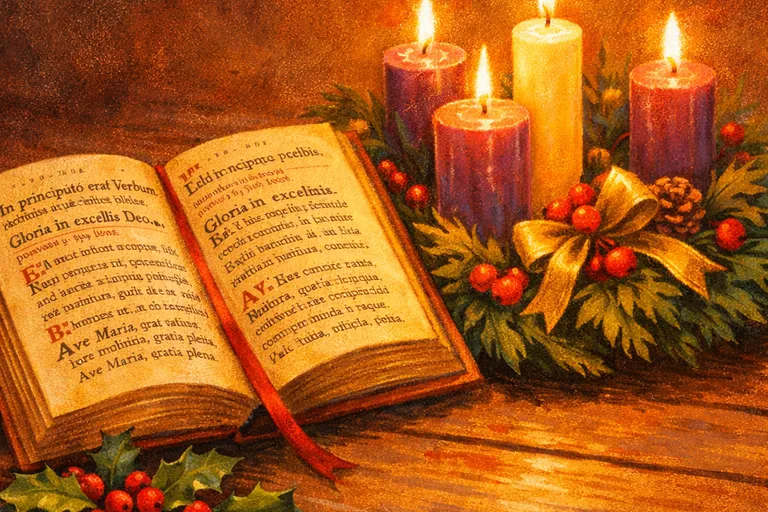
The Catholic tradition offers the most formally structured Christmas prayers in Christianity. The Collect for Christmas Day, read during Mass, has remained remarkably stable since the early medieval period. In its current English translation, it begins: "O God, who wonderfully created the dignity of human nature and still more wonderfully restored it, grant, we pray, that we may share in the divinity of Christ, who humbled himself to share in our humanity." That single sentence carries about 1,600 years of theological weight.
Beyond the Mass texts, Catholic families often turn to prayers from specific saints. St. Francis of Assisi's prayer tradition, emphasizing simplicity and wonder at the Nativity, influenced centuries of Catholic Christmas devotion. The Blessing of the Christmas Tree, found in the Book of Blessings, gives families a short liturgical form to use at home. It asks God to bless the household and let the tree's lights "remind us of the One who brings light to the world."
Polish Catholics have their own distinct layer. The Wigilia supper on Christmas Eve begins with the breaking of the oplatek wafer, accompanied by prayers and personal blessings exchanged between family members. Each person breaks a piece of another's wafer and offers a specific wish for the coming year. It's prayer made intimate and physical.
In Czech and Slovak households, the Christmas Eve dinner (Stedry vecer or Stedry den) also begins with prayer, though the specific words vary by family. The common thread across Central European Catholic practice is that the prayer isn't a generic grace. It's tied to the specific liturgical moment: the vigil of Christmas, the waiting that ends at midnight.
Christmas Prayers for Family Gatherings
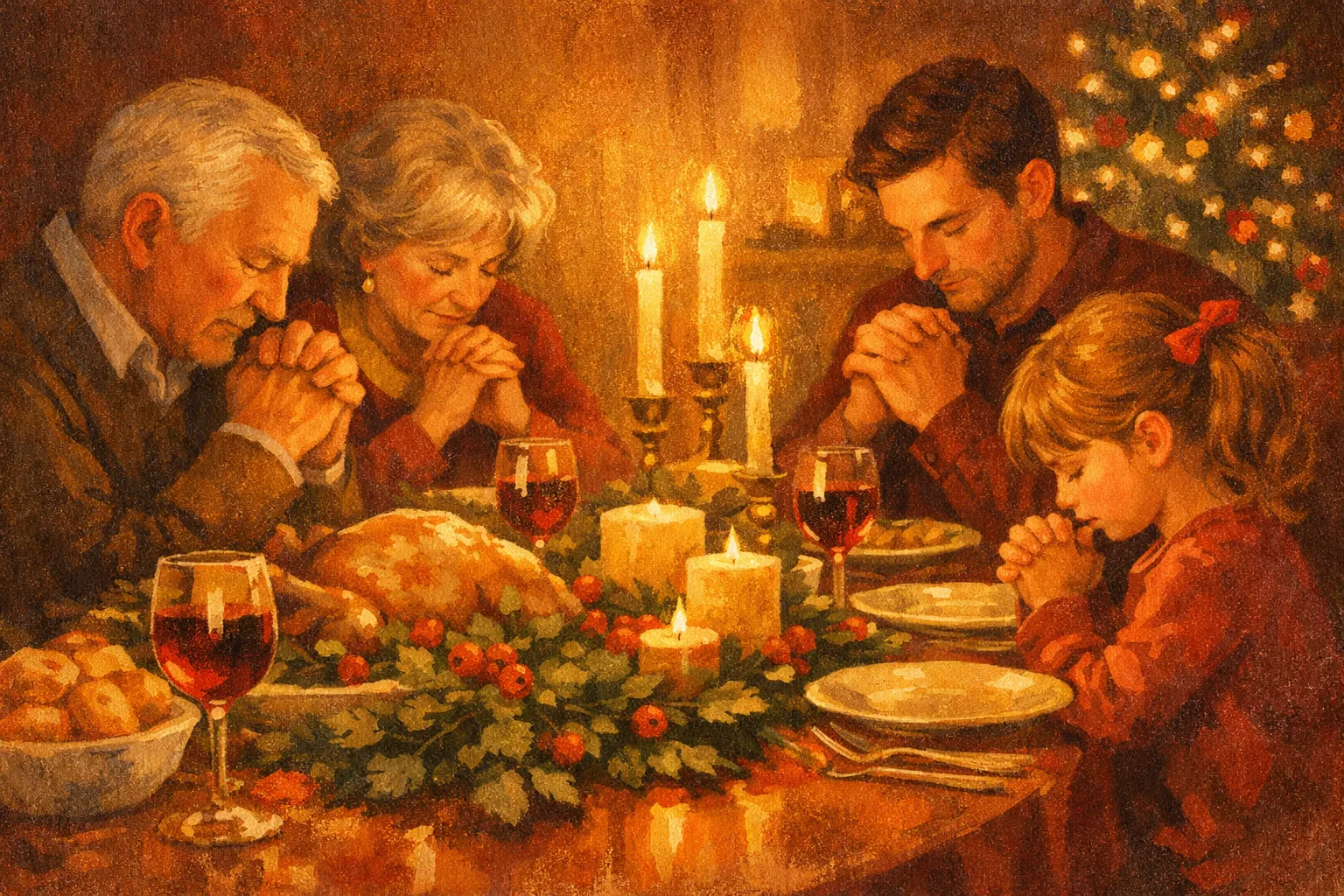
Family Christmas prayers serve a different purpose than church liturgy. They're meant to hold a room together for sixty seconds. That's harder than it sounds, especially when the room contains four generations, two feuding uncles, and several children who can smell the food.
The most effective family prayers tend to share a few qualities. They're short. They name something specific to be grateful for, not just "blessings" in the abstract but the actual people in the room, the year that passed, the ones who aren't there anymore. And they end cleanly, without trailing off into a sermon.
Here's a structure that works across denominations:
Lord, we thank you for bringing us together on this Christmas. We remember [names of those who have died or can't be present]. We're grateful for this food, for this family, and for the gift of your Son. Bless this home and everyone in it. Amen.
That's roughly 15 seconds to speak aloud. It does the job. The bracket for personal names is the most important part. A prayer that names Grandma Ruth who died in March, or Cousin David stationed overseas, does something a generic prayer can't. It makes the moment real.
For families with mixed beliefs, or members who don't practice any faith, the prayer leader faces a genuine challenge. One approach is to frame the prayer as a moment of shared gratitude rather than a specifically doctrinal act. "Let's take a moment to be thankful for being together" acknowledges the room without forcing anyone into a theological position they don't hold.
Christmas Dinner Blessings and Grace Before Meals
The dinner blessing is the most common Christmas prayer in practice. According to a 2014 Pew Research Center survey, about half of Americans say grace before meals regularly, and that number spikes at holidays. Christmas dinner is, for many families, the one meal of the year that begins with a spoken prayer even if no other meal does.
The traditional Christian grace is brief: "Bless us, O Lord, and these thy gifts, which we are about to receive from thy bounty, through Christ our Lord. Amen." Catholics will recognize this as the standard meal blessing, unchanged for centuries. It works at Christmas because it works any day, which is both its strength and its limitation. It doesn't mark the occasion as different.
A Christmas-specific dinner blessing might add a line acknowledging the Nativity:
Heavenly Father, on this day we celebrate the birth of your Son, Jesus Christ. We thank you for this meal, for the hands that prepared it, and for the love that brought us to this table. May the joy of Christmas fill our hearts and this home. Amen.
Some families rotate who says the blessing each year, giving children or teenagers a turn. This can go beautifully or hilariously wrong, and both outcomes tend to become family stories worth retelling. A seven-year-old thanking God for mashed potatoes and his new bike is, in its own way, a more honest prayer than most adults manage.
Short Christmas Prayers for Any Occasion
Not every moment calls for a full prayer. Sometimes you need four lines that fit a Christmas card, a text message to a friend going through a hard season, or a quiet word before opening presents on Christmas morning.
The Anglican tradition offers some of the best short-form prayers because the Book of Common Prayer was written by people who understood that brevity and beauty aren't opposites. Thomas Cranmer, who compiled the first Book of Common Prayer in 1549, had a gift for compression. His collects pack entire theological ideas into single sentences.
A useful short Christmas prayer:
God of all grace, thank you for the gift of this day and the people who share it with us. Help us carry the peace of Christmas into the year ahead. Amen.
That's 30 words. It covers gratitude, community, and forward-looking hope without becoming sentimental. It works for a card, a dinner, or a quiet moment alone.
For friends specifically, Christmas prayers take on a slightly different tone. They're less about communal worship and more about personal care. "I'm praying for you this Christmas" is one of the most common things Christians say to friends during the season, and it means more when followed by something specific: praying for your health, your family, your new job, your grief.
Religious Christmas Blessings: Beyond the Prayer
Blessings and prayers overlap but aren't identical. A prayer is directed to God. A blessing is directed at a person, a meal, a home, or an object, asking God's favor upon it. Christmas blessings include the priestly blessing at the end of midnight Mass, the blessing of the family creche, the chalking of the door on Epiphany, and the simple act of a parent making the sign of the cross on a child's forehead before bed on Christmas Eve.
In Ireland and parts of the United Kingdom, the tradition of placing a candle in the window on Christmas Eve is itself understood as a blessing. The light blesses the home and signals welcome to strangers, echoing the story of Mary and Joseph seeking shelter. In some Irish families, the youngest child lights the candle, and the mother says a prayer asking God's blessing on all who pass by.
The Orthodox tradition has an especially rich Christmas blessing practice. In many Greek and Russian Orthodox homes, a priest visits between Christmas and Epiphany to bless the house with holy water. The theophany blessing sanctifies the physical space, room by room. It's prayer as action, not just words.
Christmas Prayers for Friends Who Are Struggling
Christmas can be the hardest time of year for people dealing with grief, illness, loneliness, or financial pressure. The relentless cheerfulness of the season makes pain more visible, not less. Praying for friends in these situations requires more care than a generic "God bless you at Christmas."
The Psalms offer language for this. Psalm 34:18, "The Lord is close to the brokenhearted," has been quoted in Christmas prayers for centuries because it acknowledges suffering without trying to fix it. A prayer for a grieving friend might say: "Lord, be close to [name] this Christmas. Sit with them in the empty chair. Let them feel your presence where words fall short."
Dietrich Bonhoeffer wrote some of the most striking Christmas prayers from his prison cell in 1943, two years before his execution. His prayer for fellow prisoners asked God to bring light into darkness, and he meant it literally. He was writing by candlelight in a Nazi prison. That kind of specificity, prayer rooted in real circumstances rather than comfortable abstractions, is what gives Christmas prayers their power when they're needed most.
Frequently Asked Questions
What is a good short Christmas prayer to say before dinner?
A simple and widely used Christmas dinner prayer is: "Heavenly Father, thank you for this food, for the hands that prepared it, and for bringing us together on this holy day. Bless our meal and our time together. Amen." This takes about ten seconds to say and covers gratitude for both the meal and the gathering. You can personalize it by naming specific people or events from the year.
What is the traditional Catholic Christmas prayer?
The most important Catholic Christmas prayer is the Collect for Christmas Day, recited during Mass. It begins: "O God, who wonderfully created the dignity of human nature and still more wonderfully restored it..." Catholic families also commonly use the standard grace before meals ("Bless us, O Lord, and these thy gifts...") and may add prayers from the Book of Blessings for the Christmas tree or the family creche.
How do you pray for friends at Christmas?
The most meaningful Christmas prayers for friends are specific rather than generic. Instead of a vague "God bless my friends," name the person and their situation: their health, a loss they've experienced, a challenge they're facing. You can pray privately for them or send a message saying what you're praying for. Psalm 34:18 and other Scripture passages about God's closeness to those in pain are especially appropriate for friends going through difficult seasons.
What is the difference between a Christmas prayer and a Christmas blessing?
A prayer is addressed to God, asking for something or expressing gratitude. A blessing is directed at a person, place, or object, invoking God's favor upon it. At Christmas, common blessings include the priestly blessing at midnight Mass, blessing the family nativity scene, and parents blessing their children on Christmas Eve. In practice, many Christmas traditions combine both prayer and blessing in a single moment.
Can you say a Christmas prayer if you are not religious?
Many families with mixed or no religious beliefs adapt the Christmas prayer into a moment of shared gratitude. Instead of addressing God, the prayer leader might say, "Let's take a moment to appreciate being together and to think of those who can't be with us." This preserves the purpose of the tradition, pausing before a meal to acknowledge what matters, without requiring specific religious belief from everyone at the table.
What Christmas prayers come from the Bible?
Several Bible passages are commonly used as Christmas prayers. Luke 2:14, the angels' proclamation ("Glory to God in the highest, and on earth peace to those on whom his favor rests"), is one of the most frequently quoted. The Magnificat (Luke 1:46-55), Mary's prayer of praise, is central to Catholic and Anglican Christmas worship. The Benedictus (Luke 1:68-79) and Psalm 96 ("Sing to the Lord a new song") also appear regularly in Christmas liturgies.