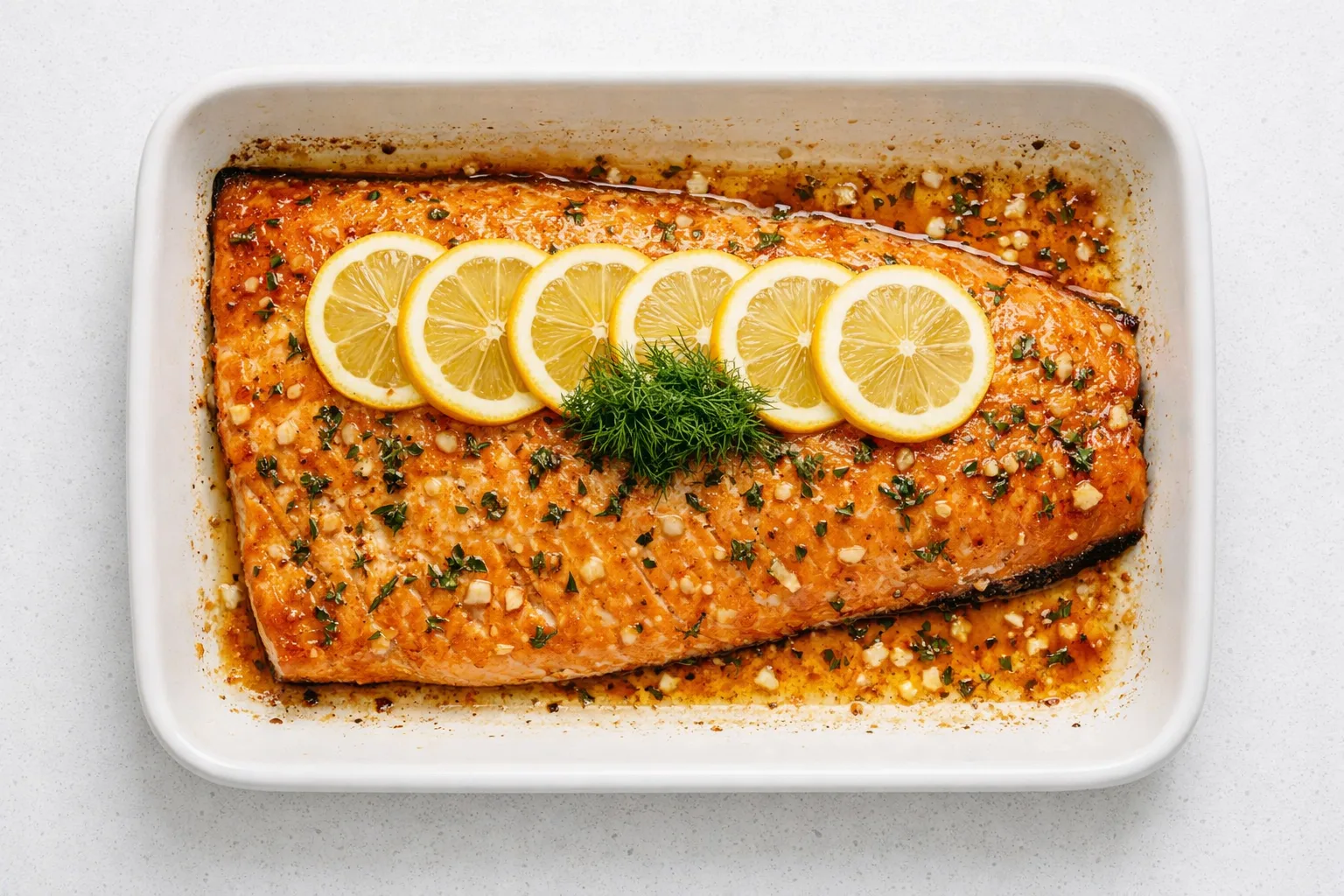
Christmas baked salmon is one of the most practical showpieces a home cook can put on a holiday table. A whole side of salmon, glazed with honey butter and roasted at high heat, looks spectacular, feeds six to eight people with ease, and goes from fridge to table in under 35 minutes. No brining, no trussing, no thermometer anxiety.
The honey butter glaze does two things: the honey caramelizes at the edges and gives the fish a lacquered finish, while the butter keeps it moist and carries the garlic and herb flavors into every bite. This is the kind of main course that lets you spend your energy on the sides rather than babysitting the oven.
For the best result, use a center-cut salmon fillet with skin on. The skin protects the bottom from the direct pan heat, so the flesh stays silky while the top gets color. Wild-caught Pacific salmon has firmer texture and a more pronounced flavor; farmed Atlantic salmon works well too and is typically easier to find as a full side.
Equipment
Instructions
Tap each step to track your progress
- 1
Preheat your oven to 425 F (220 C). Line a large rimmed baking sheet or a ceramic baking dish with parchment paper. The dish should be large enough for the salmon to lie flat without curling at the edges.
- 2
Pat the salmon completely dry with paper towels. Moisture on the surface will steam rather than roast, which prevents caramelization. Season both sides lightly with kosher salt and black pepper, then place skin-side down on the prepared dish.
- 3
Whisk together the melted butter, honey, minced garlic, lemon juice, thyme, and paprika in a small bowl until combined. The glaze should look glossy and smell fragrant.
- 4
Spoon and brush the honey butter glaze evenly over the entire flesh surface of the salmon, making sure to cover the edges. Reserve about one tablespoon of glaze to brush on partway through cooking.
- 5
Arrange the lemon slices in a single row down the center of the salmon, overlapping slightly.
- 6
Roast for 12 minutes, then brush the reserved glaze over the top. Return to the oven for 5 to 8 more minutes, until the thickest part of the salmon is just opaque and flakes easily when pressed with a fork. The glaze should look caramelized and the edges should be slightly darker.
- 7
Check for doneness at the thick end: the fish should be opaque all the way through with no translucent dark pink at the center. If the thinner tail end is cooking faster than the thick end, fold the tail under itself to protect it.
- 8
Remove from the oven and rest for 3 minutes. Scatter the fresh dill over the top and finish with a pinch of flaky sea salt. Serve directly from the baking dish.
Tips & Tricks
Bring the salmon to room temperature first
Take the salmon out of the refrigerator 20 minutes before it goes into the oven. A cold fillet straight from the fridge cooks unevenly: the outside overcooks before the center reaches temperature. Room temperature fish gives you much more control.
Dry the surface completely
Any moisture on the surface of the salmon will cause it to steam instead of roast. Pat it firmly with paper towels until the flesh feels slightly tacky to the touch. This is the single most important step for getting a caramelized glaze instead of a pale, steamed surface.
Don't baste too early
Apply the glaze once before roasting and reserve a small amount to brush on partway through. Applying all the glaze at the start means the garlic and honey can scorch before the fish is done. The second application in the last few minutes of cooking keeps the glaze bright and fresh.
Use a wide spatula for serving
Salmon flakes apart easily along its natural muscle seams. A wide fish spatula or a large flat serving spatula lets you lift substantial portions cleanly. Slide it between the skin and the flesh rather than trying to lift skin-on pieces, which tend to fall apart.
Check thickness, not time
Oven temperatures vary and salmon sides can range from 1 inch to 2 inches at the thickest point. Rather than trusting the clock entirely, press the thick end gently with your finger: properly cooked salmon should feel firm but with a slight give, and it should flake when pressed. An instant-read thermometer reads 125 to 130 F at the center for medium doneness.
Troubleshooting
The salmon is dry and chalky
The fish was overcooked. Salmon at 425 F goes from perfect to overcooked quickly. Start checking at 15 minutes total for a 2-pound fillet. The fish should still look slightly translucent at the very center when it comes out; residual heat finishes it during resting.
The glaze isn't caramelizing
Your oven may not be hot enough, or the glaze is too thin. Make sure the oven is fully preheated before the salmon goes in. If the top is looking pale after 15 minutes, switch to the broiler for 2 to 3 minutes with the rack in the upper third of the oven. Watch it closely under the broiler.
The skin is sticking to the pan
Parchment paper prevents sticking reliably. If you skipped it, slide a thin spatula between the skin and the pan before trying to lift the whole fillet. The skin may stay behind, which is fine: just slide the flesh portion onto the platter and discard the stuck skin.
The fish smells overly fishy
Fresh salmon should smell clean and mildly of the sea. A strong fishy smell before cooking indicates the fish is past its prime. For baked preparations, soaking the salmon in cold water with a squeeze of lemon for 10 minutes before drying can help, but starting with fresh fish is the real fix.
The thinner tail end is overcooked
Tuck the thin tail end under itself before roasting to create a double-thick section, which will cook at the same rate as the rest of the fillet. Alternatively, cut the tail end off entirely and add it to the pan 5 minutes later than the thick portion.
Variations
Maple Dijon Glaze
Replace the honey with pure maple syrup and add 1 tablespoon of Dijon mustard to the glaze. The mustard adds a slight tang and helps the glaze cling to the fish. This version is slightly more assertive in flavor and pairs especially well with roasted root vegetables.
Garlic Herb Butter (Dairy-Free)
Replace the butter with a good-quality olive oil and increase to 3 tablespoons. The result is a lighter glaze with less richness but still good caramelization from the honey. Use a mix of fresh thyme, rosemary, and parsley for a more herbal profile. This version is also dairy-free.
Spiced Christmas Salmon
Add 1/2 teaspoon of ground cinnamon and 1/4 teaspoon of ground coriander to the honey butter glaze. The warm spices give the salmon a subtle festive depth without making it sweet. This works particularly well if you are serving it alongside cranberry sauce or a citrus salad.
Individual Fillets
If a whole side is impractical, cut the salmon into 6-ounce portions before glazing and reduce the cook time to 10 to 12 minutes at the same temperature. Individual fillets are easier to plate formally for a sit-down Christmas dinner.
Serving & Gifting
Bring the baking dish straight to the table for a casual, generous presentation. Use a wide spatula to lift portions off the skin in large flakes. Christmas baked salmon pairs naturally with roasted potatoes, steamed asparagus, or a lemony green salad. A simple creme fraiche or Greek yogurt with dill alongside cuts through the richness of the glaze. For drinks, an unoaked Chardonnay or a dry Pinot Gris complements the honey butter flavors without competing.
Storage & Freezing
Leftover salmon keeps in an airtight container in the refrigerator for up to 3 days. Reheat gently in a 275 F oven covered with foil for 10 minutes, or serve cold on top of a salad or in a wrap. Baked salmon freezes adequately but the texture becomes softer after thawing; freeze in a single layer, tightly wrapped, for up to 1 month. The honey butter glaze does not survive freezing well, so if you are planning to freeze, hold back on the glaze and add it fresh when reheating.
Common Questions
How long to bake salmon at 425 F?
A 2 to 2 1/2 lb side of salmon at 425 F takes 17 to 20 minutes total. The general rule is 10 minutes per inch of thickness at the thickest point. Start checking early; overcooked salmon dries out quickly.
Can I make Christmas baked salmon ahead of time?
You can mix the honey butter glaze up to 2 days ahead and store it in the refrigerator. Bring it back to room temperature before using, since cold butter glaze won't spread evenly. The salmon itself is best roasted fresh on the day, since reheated salmon loses some of its texture.
Is this recipe gluten-free?
Yes. The honey butter glaze contains no gluten-containing ingredients. Always check your mustard or any condiments you serve alongside, as some brands add flour as a thickener.
What kind of salmon is best for this recipe?
A center-cut fillet from a whole side gives the most even thickness and best presentation. Wild-caught sockeye or king salmon has firmer flesh and a stronger flavor; farmed Atlantic salmon is milder and typically available as a full side. Both work well. Avoid pre-portioned thin fillets, as they overcook at high heat before the glaze has time to set.
Can I use frozen salmon?
Yes, but thaw it completely in the refrigerator overnight and dry it very well before roasting. Frozen salmon releases more water as it thaws, and any residual moisture will steam rather than roast. Do not try to cook salmon from frozen at this temperature.
What do I serve with Christmas baked salmon?
Roasted new potatoes, buttered asparagus, or a simple cucumber and dill salad all work well. For a more substantial Christmas dinner spread, add a grain like wild rice or farro alongside. A spoonful of creme fraiche with lemon zest and dill is the simplest and most complementary sauce.