Jesse Tree: Meaning, Symbols, and the Advent Tradition
A thousand years before Pinterest, medieval artists were already mapping the genealogy of Christ onto trees. The Jesse Tree tradition turns Advent into a daily walk through the Bible, one ornament at a time.
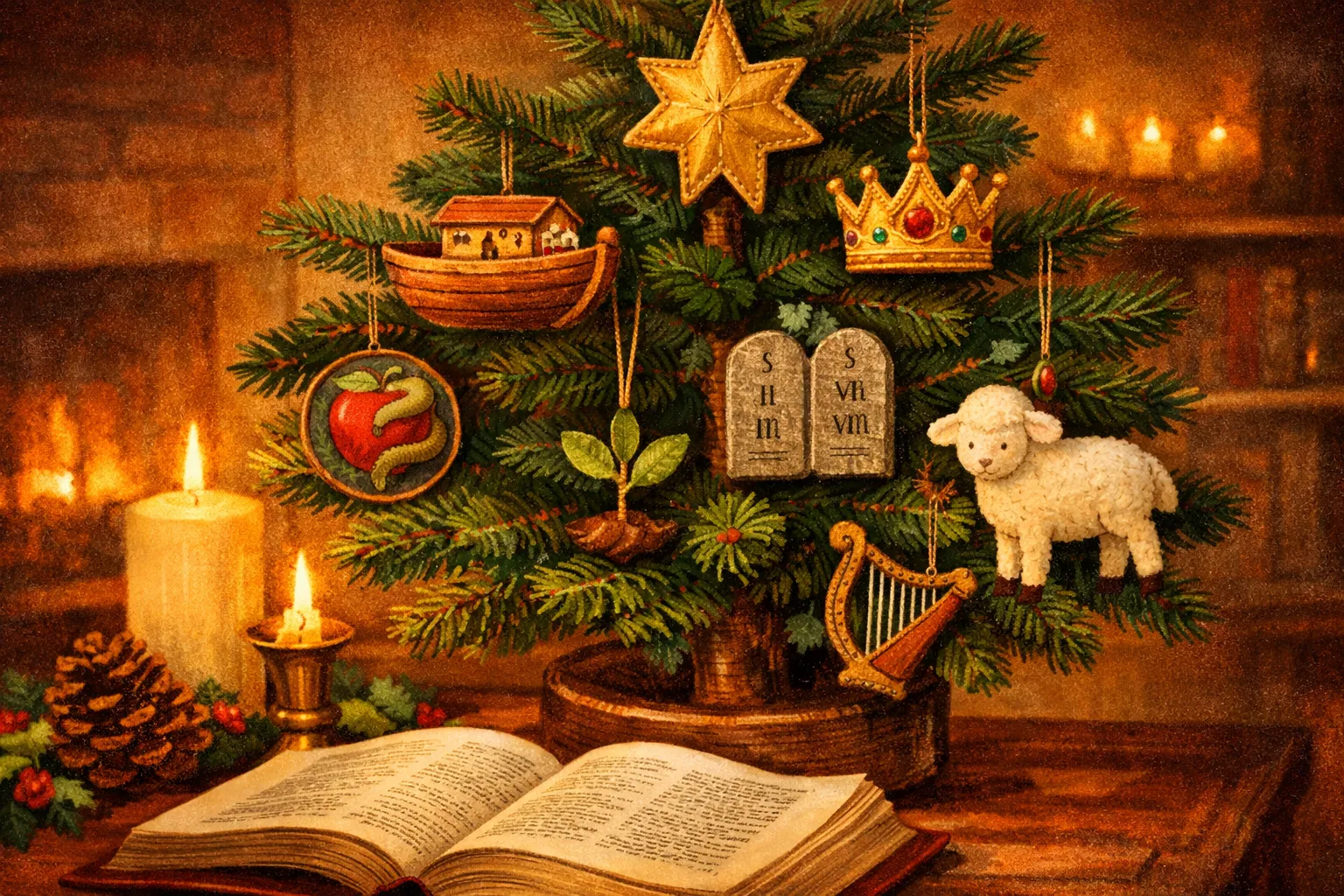
A Jesse Tree is a visual retelling of the Bible's story from Creation to Christ, displayed as a tree hung with ornaments during Advent. Each ornament represents a person, event, or prophecy from Scripture, and each day brings a new reading paired with its symbol. The name comes from Isaiah 11:1: "A shoot shall come out from the stump of Jesse, and a branch shall grow out of his roots." Jesse was the father of King David, and that royal line runs all the way forward to Jesus of Nazareth.
Contents
Unlike an Advent calendar filled with chocolate, the Jesse Tree asks something of you. It asks you to read, to discuss, to place a small handmade ark or crown or lamb onto a branch and to know why it matters. For families trying to anchor December in something older than retail cycles, the Jesse Tree has become one of the most compelling Advent traditions available.
What Is a Jesse Tree?
At its simplest, a Jesse Tree is a small tree or branch arrangement decorated with ornaments that tell the biblical story leading to the birth of Jesus. Starting on December 1st (or the first day of Advent, depending on the version), you hang one ornament each day. Each ornament corresponds to a Scripture passage and a figure or event from the Bible.
Day one typically begins with Creation. An ornament depicting the earth or a globe goes on the tree, and you read Genesis 1. Day two brings Adam and Eve, often represented by an apple or a garden. The sequence moves through Noah (an ark), Abraham (stars or a tent), Isaac (a ram), Jacob (a ladder), and onward through the prophets, kings, and ancestors of Jesus.
The final ornament, placed on Christmas Eve, is the Nativity itself. By that point, the tree holds a compressed visual history of salvation, each branch carrying a different chapter. The whole thing functions as a kind of advent countdown, but instead of counting down to presents, you're counting through a story.
The Origin of the Jesse Tree in Medieval Art
The Jesse Tree didn't start as a family craft project. It started as monumental art.
The earliest known depiction of the Tree of Jesse appears in an illuminated manuscript from Bohemia, dated to around 1086. But the image truly took hold in the great cathedrals of Europe. The Jesse Tree window at Chartres Cathedral in northern France, dating to approximately 1145, is among the oldest surviving examples in stained glass. It shows Jesse reclining at the base, a tree growing from his body, with the ancestors of Christ arranged along the trunk and Jesus seated at the crown.
These weren't decorative choices. In an era when most people couldn't read, stained glass windows taught theology. The Tree of Jesse communicated a specific claim: that Jesus was the fulfillment of Old Testament prophecy, descended from the royal house of David. The seven doves descending onto the figure of Christ in the Chartres window represent the seven gifts of the Holy Spirit from Isaiah 11:2. Fourteen prophets holding scrolls line the borders.
The motif spread rapidly. By the 12th and 13th centuries, Jesse Trees appeared in manuscripts, wood carvings, stone friezes, tapestries, floor tiles, and embroidery across Europe. The design at Chartres was influenced by an earlier window at the Abbey of Saint-Denis near Paris, commissioned by Abbot Suger around 1140. Saint-Denis is often credited as the birthplace of Gothic architecture, and the Jesse Tree was part of its visual vocabulary from the beginning.
Jesse Tree Symbols and Their Meanings
Each ornament on a Jesse Tree is a symbol tied to a specific biblical passage. The symbols aren't arbitrary. They're shorthand for stories that would take hours to read aloud. Here are the ones that matter most.
Creation through the Patriarchs
The Earth or Globe (Genesis 1): Represents the creation of the world. Some versions use a sun and moon, or a simple light-and-darkness design.
The Apple (Genesis 3): Symbolizes the Fall. The fruit isn't specified in Genesis, but the apple has served as its stand-in since at least the 4th century, possibly due to a Latin pun: "malum" means both "evil" and "apple."
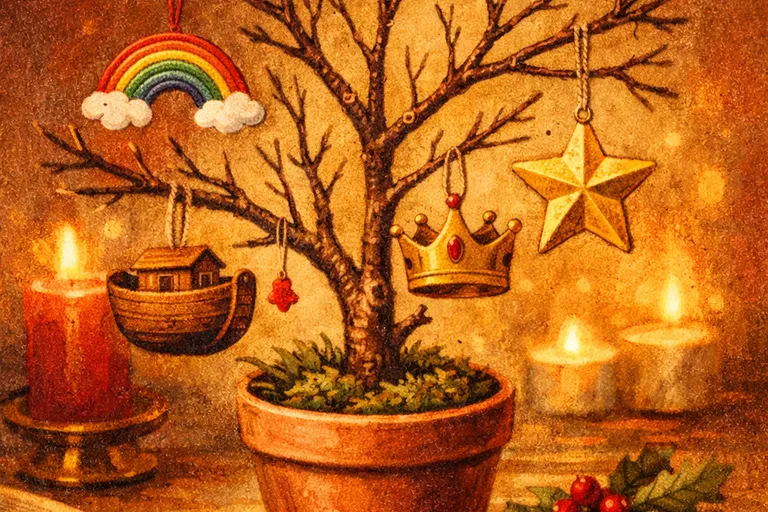
The Ark (Genesis 6-9): Noah's ark represents God's covenant after the flood. The rainbow sometimes accompanies it.
The Stars or Tent (Genesis 12): Abraham, called out of Ur with the promise that his descendants would outnumber the stars.
The Ram (Genesis 22): The sacrifice God provided when Abraham demonstrated his willingness to give up Isaac. This is one of the most theologically loaded symbols on the tree, foreshadowing substitutionary sacrifice.
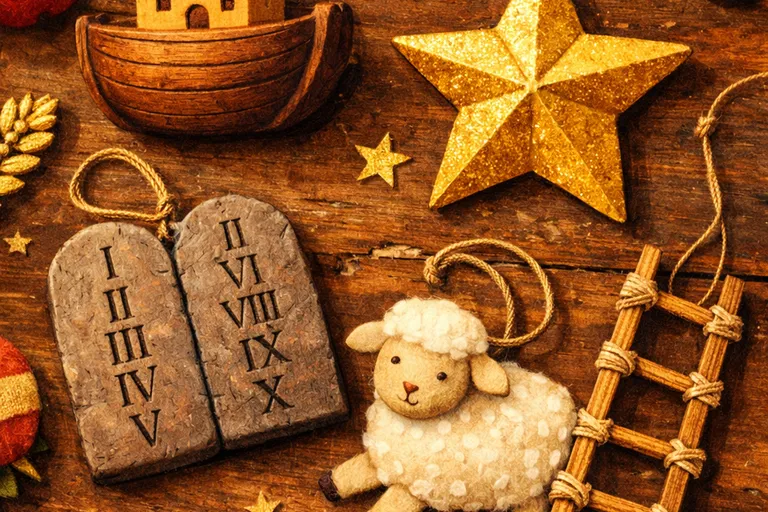
The Ladder (Genesis 28): Jacob's dream at Bethel, with angels ascending and descending.
Kings and Prophets
The Tablets of the Law (Exodus 20): Moses and the Ten Commandments.
The Crown (1 Samuel 16): David, the shepherd-king anointed by Samuel, Jesse's own son.
The Temple (1 Kings 6): Solomon, who built the first Temple in Jerusalem.
The Flower or Root (Isaiah 11:1-3): The prophecy of the shoot from Jesse's stump. This is the symbol that gives the entire tradition its name.
The Key (Isaiah 22:22): "The key of David," a symbol of authority. The Book of Revelation picks this image up again in chapter 3:7.
Advent Figures
The Shell (Matthew 3): John the Baptist, who baptized in the Jordan. The scallop shell has been a baptism symbol since the early Church.
The Lily (Luke 1:26-38): Mary, the mother of Jesus.
The Carpenter's Tools (Matthew 1:18-25): Joseph, Jesus' earthly father.
The Manger (Luke 2:1-20): The Nativity. The last ornament. The destination the whole tree has been pointing toward.
Jesse Tree Bible Verses for Each Day
Most Jesse Tree reading plans run from December 1st through December 24th or 25th, giving 24 or 25 daily readings. Some Catholic versions, following the liturgical calendar, extend to 28 readings to cover the longest possible Advent season (which begins on the Sunday nearest November 30th). The readings vary slightly between traditions, but a widely used Protestant sequence looks something like this:
- Creation: Genesis 1:1-31
- Adam and Eve: Genesis 2:7-24
- The Fall: Genesis 3:1-24
- Noah: Genesis 6:13-22
- Abraham: Genesis 12:1-7
- Isaac: Genesis 22:1-14
- Jacob: Genesis 28:10-22
- Joseph (Old Testament): Genesis 37:1-11
- Moses: Exodus 3:1-15
- The Ten Commandments: Exodus 20:1-17
- Joshua: Joshua 1:1-9
- Ruth: Ruth 1:16-17; 4:13-17
- Samuel: 1 Samuel 3:1-21
- David: 1 Samuel 16:1-13
- Solomon: 1 Kings 3:5-14
- Elijah: 1 Kings 18:17-39
- Isaiah: Isaiah 11:1-10
- Jeremiah: Jeremiah 23:5-6
- Daniel: Daniel 6:1-23
- Jonah: Jonah 1-3 (selections)
- Micah: Micah 5:2-5
- John the Baptist: Luke 1:57-80
- Mary: Luke 1:26-38
- Joseph: Matthew 1:18-25
- Jesus: Luke 2:1-20
Catholic versions often incorporate the "O Antiphons" for December 17th through 23rd. These are the ancient prayers that begin with "O Wisdom," "O Lord," "O Root of Jesse," and so on. Each antiphon becomes its own ornament and reading. The O Antiphons date to at least the 8th century and were already well established in Benedictine monasteries by the time Charlemagne was emperor.
How to Start a Jesse Tree Advent Tradition
You don't need much. A branch in a vase works. So does a small tabletop tree, a felt tree pinned to the wall, or even a poster-board outline. The tree is just the structure. The ornaments and readings are what carry the tradition.
For ornaments, you have three main paths. The first is printable: dozens of free printable Jesse Tree ornament sets exist online, designed to be cut out and hung with string. Sites like Catholic Icing and Faithward.org offer sets ready for download. The second path is handmade: felt, polymer clay, wood rounds, even Lego constructions. Crafting the ornaments yourself can become its own tradition, especially with children. The third option is purchased: Etsy sellers and Christian bookstores offer painted wood ornaments, embroidered sets, and laser-cut designs.
Pick a reading plan that fits your family's attention span. Young children won't sit through the full text of Genesis 22. Many plans offer condensed versions or storybook retellings for kids under seven. Ann Voskamp's "The Greatest Gift" and the "Advent Jesse Tree" devotional by Dean Lambert Smith are among the more popular published guides.
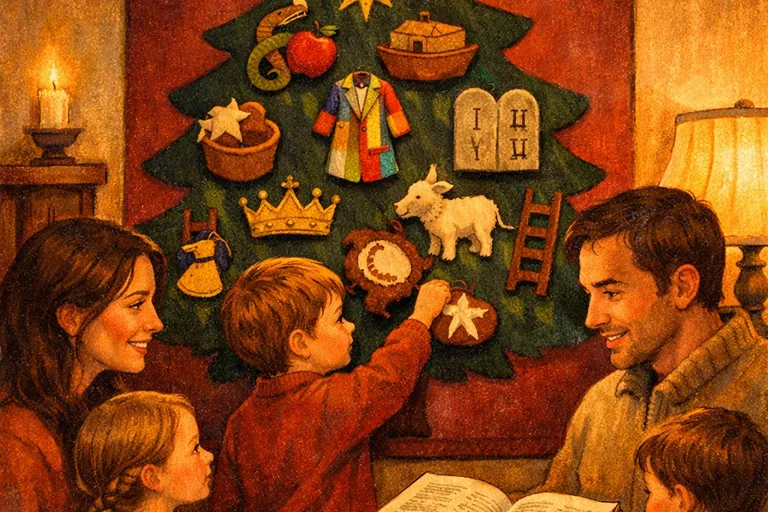
The ritual works best when it's consistent: same time each day, same spot in the house. Some families do it at dinner. Others fold it into bedtime. The ornament goes on, the passage gets read, someone asks a question. Twenty-five days later, the tree is full and the story is complete.
Why the Jesse Tree Still Resonates
The Jesse Tree doesn't compete with your regular Christmas tree. It occupies a different category entirely. Where a Christmas tree is decorative, a Jesse Tree is narrative. It exists to tell a specific story in a specific order.
That structure is part of its appeal. In a season overloaded with events, the Jesse Tree imposes a daily rhythm that's simple and repeatable. One ornament. One reading. One conversation. It takes ten minutes, and it builds on itself. By mid-December, children can retell the earlier stories from memory, pointing to the ornaments as prompts.
The tradition also bridges denominational lines in ways that many Advent practices don't. Catholics, Protestants, and Orthodox Christians all use Jesse Trees, though their reading plans and emphasis may differ. The underlying structure, tracing Christ's lineage through the Old Testament, is common ground.
Museum of the Bible in Washington, D.C., has featured the Jesse Tree as an example of how biblical narrative was communicated through visual art across centuries. The through-line from a 12th-century stained glass window at Chartres to a felt ornament on a branch in someone's living room is remarkably direct. The medium changed. The story didn't.
Frequently Asked Questions
What is a Jesse Tree in simple terms?
A Jesse Tree is a small tree or branch decorated with ornaments during Advent, where each ornament represents a Bible story leading to the birth of Jesus. Named after Jesse, the father of King David, it traces Christ's ancestry through daily Scripture readings and symbols from December 1st through Christmas Eve.
How many ornaments does a Jesse Tree have?
Most Jesse Tree sets include 25 ornaments, one for each day from December 1st through December 25th. Some Catholic versions use 28 ornaments to cover the longest possible Advent season. The exact number depends on the reading plan you follow, but 25 is the most common.
What is the biblical basis for the Jesse Tree?
The Jesse Tree is rooted in Isaiah 11:1, which prophesies that "a shoot shall come out from the stump of Jesse, and a branch shall grow out of his roots." Jesse was King David's father, and Jesus is identified in the New Testament as a descendant of David's royal line. The tree visually represents this genealogy.
What are the most common Jesse Tree symbols?
Common symbols include a globe for Creation, an apple for the Fall, an ark for Noah, stars for Abraham, a ram for Isaac, a ladder for Jacob, stone tablets for Moses, a crown for David, a flower or root for Isaiah's prophecy, a shell for John the Baptist, a lily for Mary, and a manger for the Nativity.
Is the Jesse Tree only a Catholic tradition?
No. While the Jesse Tree has deep roots in Catholic art and liturgy dating back to medieval cathedrals, it is used across Christian denominations today. Protestant churches, particularly Lutheran, Anglican, and Reformed traditions, have adopted and adapted the practice. The reading plans and ornament selections may vary, but the core concept crosses denominational boundaries.
How do you make a Jesse Tree at home?
You need a tree structure (a branch in a vase, a small tabletop tree, or a felt tree on a wall), 25 ornaments representing biblical figures and events, and a reading plan with daily Scripture passages. Ornaments can be printed from free online templates, handmade from felt or clay, or purchased. Many families start simple and add handmade ornaments each year.