
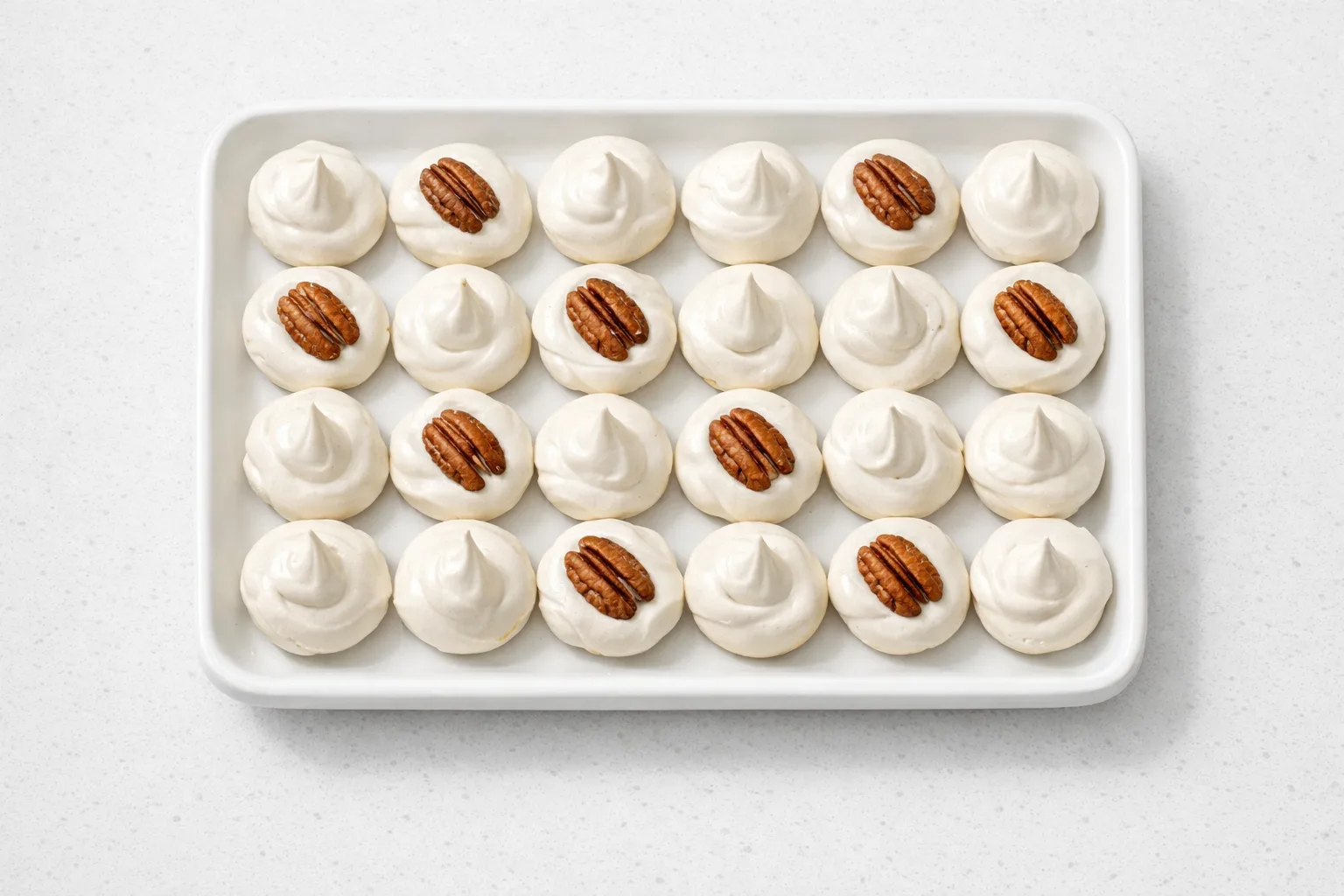
Christmas divinity candy is a confection that has appeared on Southern holiday tables for well over a century. It is made from a cooked sugar syrup beaten into stiff egg whites, a technique that produces candy with an impossibly light, cloud-like texture that still has enough body to hold a shape. When it works, divinity is one of the most striking sweets on a Christmas plate: snow-white, with a faint gloss, and a flavour that is purely sweet with vanilla and a trace of nuttiness from toasted pecans.
The recipe originated in American home kitchens in the early 1900s, and it spread through the South where it became as expected at Christmas as fruitcake or pecan pie. The name almost certainly refers to how good it tastes, not to any theological ambition. Unlike fudge, divinity gets its structure entirely from the meringue, which means the key variables are the sugar temperature and the condition of the egg whites, not the fat content of the dairy.
This recipe uses a firm ball stage for the first pour and a hard ball stage for the second, a two-stage cooking method that gives reliable, consistent results. The pecans are folded in at the end so they stay whole, and the drops are shaped by spoon while the candy is still warm enough to be pliable.
Equipment
Instructions
Tap each step to track your progress
- 1
Line two large baking sheets with parchment paper and set a heatproof silicone spatula, a candy thermometer, and two metal spoons beside the stove. Toast the pecans in a dry skillet over medium heat for 4 to 5 minutes, stirring often, until fragrant. Set aside to cool.
- 2
Combine the sugar, corn syrup, water, and salt in a heavy-bottomed 2-quart saucepan. Stir over medium heat until the sugar dissolves completely and the mixture comes to a boil, about 5 minutes. Once boiling, clip the candy thermometer to the side and stop stirring entirely.
- 3
While the syrup cooks, beat the egg whites in the bowl of a stand mixer fitted with the whisk attachment on medium-high speed until they hold stiff, glossy peaks. This takes about 3 to 4 minutes. Do not over-beat to dry peaks.
- 4
Watch the syrup closely. When it reaches 250 degrees F (121 degrees C, firm ball stage), remove about 1/4 cup of the syrup with a ladle and, with the mixer running on medium speed, pour it in a thin, steady stream down the side of the bowl into the egg whites. Avoid pouring directly onto the whisk. Continue cooking the remaining syrup.
- 5
Cook the remaining syrup until it reaches 265 degrees F (129 degrees C, hard ball stage). Increase the mixer to high speed and pour the remaining syrup in a thin stream into the egg white mixture, again down the side of the bowl.
- 6
Continue beating on high speed for 4 to 6 minutes. The mixture will be very hot and glossy at first, then it will gradually lose its shine and become thick and hold its shape when dropped from a spoon. The candy is ready when a spoonful dropped onto parchment holds a mound without spreading and the surface looks slightly matte rather than liquid-shiny.
- 7
Beat in the vanilla extract. Fold in the toasted pecans with the spatula if using.
- 8
Working quickly, drop heaped tablespoon mounds onto the prepared baking sheets using two spoons, swirling the top of each drop into a gentle peak. If you want a pecan half on top, press one in while the candy is still warm. The mixture will stiffen as it cools, so move efficiently. If it gets too stiff to drop, beat briefly with a few drops of hot water.
- 9
Let the divinity set at room temperature, uncovered, for at least 1 hour until completely firm and dry to the touch. Do not refrigerate during setting.
Tips & Tricks
Always make divinity on a dry day
Humidity is the single biggest enemy of divinity. On a day above 65% relative humidity, the candy may never set properly no matter what you do. Save this recipe for a clear, dry winter day.
Use a reliable candy thermometer and test it first
Bring a pot of water to a boil and check that your thermometer reads 212 degrees F (100 degrees C). If it reads off, adjust your target temperatures accordingly. A 5-degree error at this stage means the difference between candy that sets and candy that doesn't.
Beat the egg whites to stiff peaks before the syrup is ready
Have the egg whites beaten and waiting before the syrup hits temperature. If the whites are not ready when the syrup is, the syrup will continue cooking past the target temperature while you wait. Coordinate the timing so both are ready at the same moment.
Work fast when dropping the candy
Divinity sets as it cools and loses its workability within 5 to 10 minutes of leaving the mixer. Have everything laid out before you start beating so you can drop immediately when the texture is right. A second pair of hands helps.
The right texture to drop is specific
The candy is ready to drop when a spoonful holds a mound that does not flatten out within 30 seconds and the surface looks dull rather than shiny. If it is still flowing and glossy, beat for another 1 to 2 minutes.
Troubleshooting
My divinity won't set and stays sticky
The sugar syrup was not cooked to a high enough temperature, or the candy was not beaten long enough after adding the syrup. Humidity is also a major culprit: divinity is notoriously difficult to make on rainy or very humid days because it absorbs moisture from the air. Choose a dry day when possible and cook the syrup to the full 265 degrees F for the second pour.
The candy is grainy and sugary
The syrup was stirred after it came to a boil, or sugar crystals formed on the sides of the pan and fell back in. Use a pastry brush dipped in water to wash down any crystals from the side of the pan in the first few minutes of cooking, then leave it alone.
The mixture seized and became too stiff to drop
The candy cooled too much before dropping. Beat in hot water, a teaspoon at a time, while mixing on medium speed until it loosens to a droppable consistency. Work faster next time, or have a helper spoon while you beat.
My egg whites deflated when I added the syrup
The syrup was added too quickly or poured directly onto the whisk, which deflates the foam. Pour in the thinnest possible stream down the inner wall of the bowl. If the whites were not stiff before adding the syrup, start over; the structure depends entirely on properly beaten whites.
The divinity turned yellow
The sugar syrup cooked too long at too high a temperature and began to caramelize, or the pecans were too darkly toasted. Keep the syrup at exactly the temperatures specified and use a reliable thermometer.
Variations
Chocolate Swirl Divinity
Fold 2 tablespoons of unsweetened cocoa powder into half the batch just before dropping to create a marbled effect. Or drizzle melted dark chocolate over the set pieces for a visual contrast. The bitter edge of the chocolate balances the sweetness of the candy well.
Cherry Divinity
Swap pecans for 1/2 cup finely chopped maraschino cherries, well drained and patted dry. Press a whole cherry on top of each drop before it sets. The red-and-white colour combination makes these a particularly festive Christmas variation.
No-Nut Divinity (Nut-Free)
Simply omit the pecans entirely. The candy is equally good plain and sets with a cleaner, more uniform appearance. This version is also suitable for those with tree nut allergies.
Peppermint Divinity
Replace the vanilla extract with 1/2 tsp peppermint extract. Crush 2 candy canes and press the pieces onto the surface of each drop while still warm. The peppermint version has a sharp, clean flavour that cuts through the sweetness.
Serving & Gifting
Arrange divinity drops on a tiered dessert stand or a lined box for a stunning holiday spread. They pair naturally with strong black coffee, hot cocoa, or a cup of Christmas tea, as the sweetness of the candy benefits from something slightly bitter alongside. For cookie swaps or gift boxes, divinity travels well once fully set, though the pieces should not be stacked directly on top of each other.
Storage & Freezing
Once fully set, store divinity in an airtight container at room temperature with parchment or wax paper between layers. It keeps well for up to 2 weeks. Do not refrigerate, as cold air introduces moisture that makes the candy sticky. Do not freeze. Divinity does not freeze well and will weep and become sticky when brought back to room temperature.
Common Questions
Why does divinity need to be made on a dry day?
Sugar is hygroscopic, meaning it actively pulls moisture from the surrounding air. On humid days, the candy absorbs enough ambient moisture that it cannot set firm, and instead stays tacky or completely liquid. Dry winter air is part of why divinity became a Southern Christmas specialty rather than a year-round sweet.
Can I make divinity without a stand mixer?
Technically yes with a hand mixer, but it is genuinely difficult. You need to pour hot syrup with one hand while holding the hand mixer with the other, which requires careful setup. A stand mixer is strongly recommended and makes the job significantly safer.
How do I know when the divinity is ready to drop?
Drop a spoonful onto parchment. If it holds a mound for 30 seconds without spreading flat, it is ready. If the surface still looks wet and shiny, beat for 1 to 2 more minutes. If it has become so stiff that it won't drop cleanly from the spoon, add a teaspoon of hot water and beat briefly.
What is corn syrup doing in this recipe?
Corn syrup is an invert sugar that interferes with crystallization in the sugar syrup, keeping the candy smooth and preventing it from turning grainy. It is not a shortcut but a functional ingredient. You can find it in the baking aisle in most supermarkets. In Central European countries it may be labeled as glucose syrup, which is an equivalent substitute.
Can I use cream of tartar instead of corn syrup?
You can add 1/8 tsp cream of tartar to the syrup as a partial crystallization inhibitor, but it is not a direct substitute for corn syrup in this recipe. The texture will be slightly less stable, and the candy may be more prone to graining.
How long does divinity stay fresh?
Properly set divinity stored in an airtight container at room temperature stays fresh for up to 2 weeks. The flavour is best in the first 5 days. Do not refrigerate or freeze; both introduce moisture that ruins the texture.