
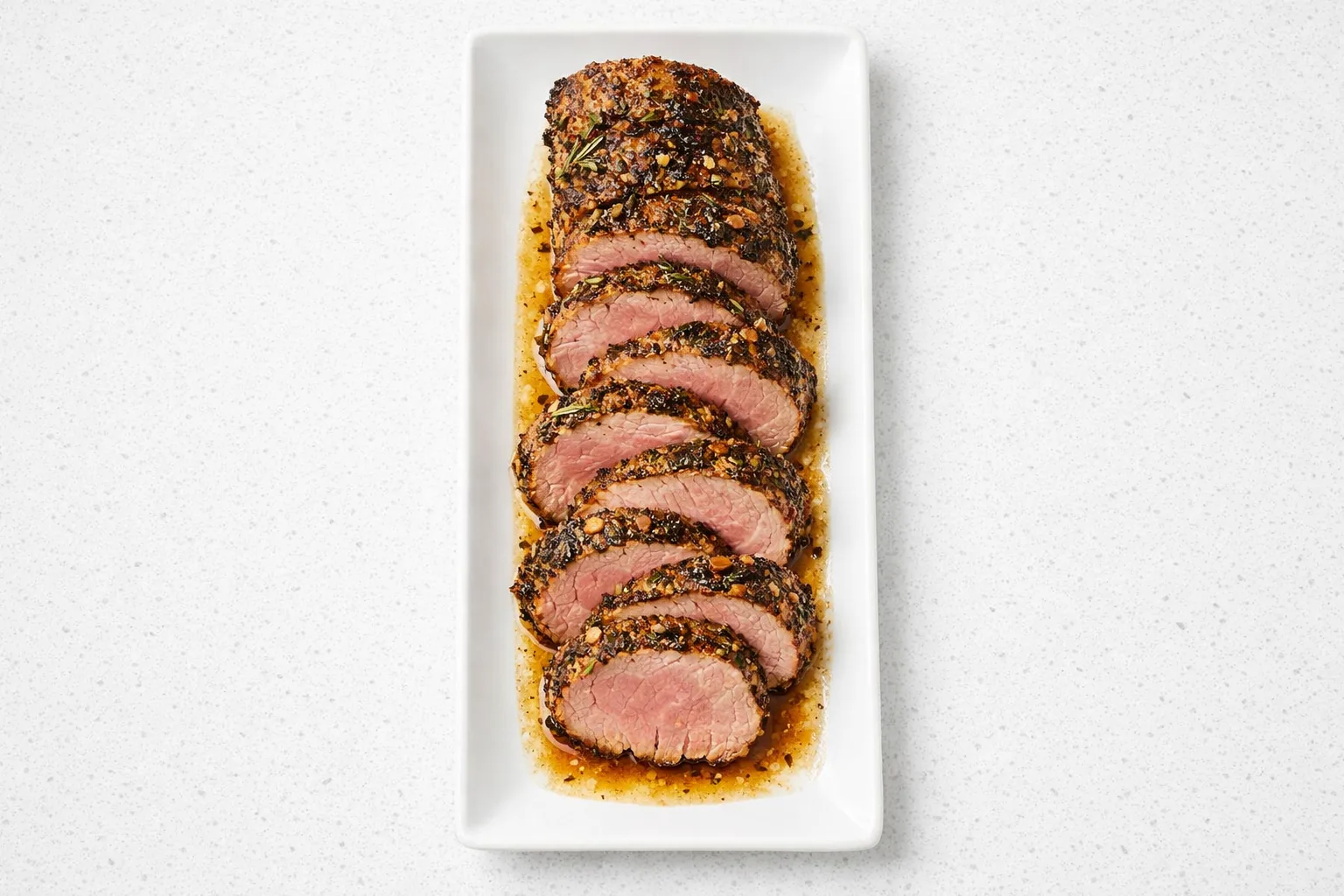
A Christmas pork tenderloin is one of the smartest choices for holiday entertaining: it feeds four comfortably, cooks in under 30 minutes, and consistently outperforms far more expensive cuts when handled correctly. Pork tenderloin is the leanest and most tender muscle on the animal, which means it needs a high-heat sear to build a crust, then a quick finish in the oven to protect that juiciness. Overcook it past 145 degrees F (63 degrees C) internal temperature and it dries out fast.
This version uses a simple paste of fresh rosemary, garlic, Dijon mustard, and olive oil pressed directly into the meat. The mustard acts as a binder for the herbs and adds a subtle tang that cuts through the richness of the pork. It is an easy Christmas pork tenderloin that requires no marinating time and no special equipment beyond a cast iron skillet or oven-safe pan.
Let the tenderloin rest for at least 5 minutes before slicing. Cut too soon and the juices run out onto the board instead of staying in the meat where they belong.
Equipment
Instructions
Tap each step to track your progress
- 1
Preheat your oven to 425 degrees F (220 degrees C). Pat the pork tenderloins completely dry with paper towels. Moisture on the surface prevents browning, so take your time here.
- 2
Mix the Dijon mustard, minced garlic, chopped rosemary, thyme, kosher salt, cracked pepper, and 1 tablespoon of olive oil together in a small bowl to form a paste.
- 3
Sprinkle the smoked paprika evenly over the tenderloins, then spread the herb paste all over the surface of both pieces, pressing it firmly into the meat so it adheres.
- 4
Heat the remaining 1 tablespoon of olive oil in a large oven-safe skillet (cast iron works best) over high heat until the oil is shimmering and just beginning to smoke.
- 5
Sear the tenderloins on one side for 2 minutes without moving them until a deep golden-brown crust forms. Turn and sear the other side for another 2 minutes. Use tongs to briefly sear the narrow ends for 30 seconds each.
- 6
Transfer the skillet directly to the preheated oven. Roast for 15 to 18 minutes, until an instant-read thermometer inserted into the thickest part reads 145 degrees F (63 degrees C). The meat will look slightly pink at center, which is correct and safe.
- 7
Transfer the tenderloins to a cutting board and tent loosely with foil. Rest for at least 5 minutes before slicing.
- 8
If making the pan sauce, return the skillet to medium heat (careful, the handle is hot). Pour in the wine or broth and scrape up any browned bits from the bottom. Simmer for 2 minutes until slightly reduced, then swirl in the butter and stir in the rosemary. Season with salt and pepper.
- 9
Slice the tenderloins into medallions about 3/4 inch thick. Arrange on a platter and drizzle with any resting juices and the pan sauce if using.
Tips & Tricks
Pull it at 145 F, not a degree more
Pork tenderloin is unforgiving above this temperature. An instant-read thermometer is not optional for this recipe. Start checking internal temperature at the 14-minute mark so you can catch it before it overshoots.
Remove the silver skin before cooking
The silver skin is the thin, shiny membrane running along one side of the tenderloin. If left on, it contracts during cooking and curls the meat into a bow shape, making it hard to sear evenly. Slide a thin knife under it and pull it off in one strip.
Sear first, then oven
Reversing this sequence (oven then sear) is sometimes called reverse sear, and it works well for thicker roasts. For tenderloin, which cooks so quickly, a traditional sear-then-oven approach builds better crust without risking overcooking.
Make the herb paste a day ahead
The paste can be mixed and stored in the refrigerator up to 24 hours in advance. Applying it the night before and letting the tenderloins rest uncovered in the fridge overnight also helps the surface dry out further, which produces an even better sear.
Rest on a warm plate
Transfer the rested meat to a slightly warmed serving platter rather than a cold plate. A cold surface pulls heat out of the meat faster than you expect, cooling your slices before they reach the table.
Troubleshooting
The herb crust fell off during searing
The meat was wet when it went into the pan. Pat the tenderloins completely dry before applying the paste, and press the paste on firmly with your hands. Also make sure the oil is fully hot before the meat touches the pan. A cool pan causes sticking and tearing.
The pork is dry and tough
It was overcooked. Pork tenderloin has almost no fat or connective tissue to protect it, so every degree past 145 F counts. Use an instant-read thermometer rather than guessing by time. If you hit 155 F or above, the texture will be noticeably drier. Rest the meat properly before slicing to redistribute juices.
No crust formed, the meat looks grey and steamed
The skillet was not hot enough, or the pan was overcrowded. Use a skillet large enough that both tenderloins fit without touching. Sear without moving them until the crust releases naturally from the pan surface. If you move the meat too soon, the crust tears.
The inside looks too pink and I am worried it is undercooked
Pink pork is safe at 145 degrees F (63 degrees C) internal temperature, per current USDA guidelines. This is not the well-done grey pork of older recipes. Use a thermometer to confirm, then trust it. The slight blush at center is correct for a properly cooked tenderloin.
The garlic burned and tastes bitter
This happens if the garlic-heavy paste goes into a very hot pan first. Sear the plain side of the meat first (or season the outside with just salt and paprika for the sear), then rotate to the herb-coated side briefly at the end before oven transfer. Alternatively, apply the paste after searing and just before the oven.
Variations
Garlic and Sage with Balsamic Glaze
Swap the rosemary and thyme for 1 tablespoon of finely chopped fresh sage. Add 1 tablespoon of balsamic vinegar to the herb paste. During the last 5 minutes of oven time, brush the tenderloins with a mixture of 2 tablespoons balsamic vinegar and 1 tablespoon honey for a sticky, lacquered crust.
Cranberry-Glazed Holiday Version
After searing, brush the tenderloins with 3 tablespoons of whole-berry cranberry sauce thinned with 1 tablespoon of orange juice before transferring to the oven. The natural sugars in the cranberry caramelize against the meat and make the presentation unmistakably festive.
Dairy-Free Version
The base recipe as written contains no dairy. Simply skip the butter in the optional pan sauce, or replace it with a tablespoon of good olive oil stirred in off the heat for a similar richness. Every other element remains exactly the same.
Spiced Moroccan-Style
Replace the Dijon and rosemary paste with a mixture of 2 teaspoons smoked paprika, 1 teaspoon ground cumin, 1/2 teaspoon ground coriander, 1/4 teaspoon cinnamon, and 2 tablespoons olive oil. Finish with a drizzle of pomegranate molasses and fresh cilantro. It brings a warm, aromatic quality that works beautifully for a non-traditional Christmas table.
Serving & Gifting
Slice into medallions and arrange on a long platter, slightly fanned, with pan sauce drizzled over. A roasted pork tenderloin for Christmas dinner pairs well with creamy mashed potatoes, roasted root vegetables, or a sharp apple and fennel slaw to cut the richness. For drinks, a medium-bodied white wine like a white Burgundy or an unoaked Chardonnay works well, as does a light red like Pinot Noir.
Storage & Freezing
Leftover sliced tenderloin keeps refrigerated in an airtight container for up to 3 days. Reheat gently in a low oven (300 degrees F / 150 degrees C) covered with foil, or slice thin and use cold in sandwiches. Whole unsliced tenderloins freeze well for up to 3 months, tightly wrapped. Thaw overnight in the refrigerator and reheat covered to avoid drying out.
Common Questions
How long do you cook pork tenderloin for Christmas dinner?
At 425 degrees F (220 degrees C), pork tenderloin takes roughly 15 to 18 minutes in the oven after a 4-minute stovetop sear, for a total active cooking time of about 20 to 22 minutes. The exact time depends on the thickness of your tenderloin and your oven. Always pull by internal temperature (145 F / 63 C), not by time alone.
Can I make this Christmas pork tenderloin ahead of time?
You can apply the herb paste the night before and refrigerate the tenderloins uncovered, which actually improves the sear. The cooking itself is fast enough that it is best done within an hour of serving. Leftover cooked tenderloin reheats reasonably well, but plan to cook it fresh for the best result.
Is pork tenderloin the same as pork loin for Christmas roast?
No. Pork tenderloin is a long, narrow, very lean muscle that weighs about 1 pound and cooks in under 30 minutes. Pork loin is a larger, wider roast that can weigh 3 to 5 pounds and takes 1 to 1.5 hours. They are different cuts and are not interchangeable in this recipe without adjusting temperature and timing significantly.
What internal temperature should Christmas pork tenderloin reach?
145 degrees F (63 degrees C) is the safe internal temperature for pork, per USDA guidelines. At this temperature, the meat will appear slightly pink at center, which is correct. Rest for 5 minutes after pulling from the oven before slicing.
Can I make this recipe gluten-free?
Yes. The base recipe is naturally gluten-free. Check your Dijon mustard label, as some brands contain wheat-based vinegar, but most standard Dijon mustards are gluten-free. The pan sauce made with wine or certified gluten-free chicken broth is also fully gluten-free.
What should I serve with pork tenderloin at Christmas?
Creamy mashed potatoes, roasted Brussels sprouts with bacon, glazed carrots, or roasted sweet potatoes are all natural matches. For something lighter, a crisp apple and celery salad provides good contrast. A drizzle of pan sauce or a simple cranberry compote on the side rounds out the plate.