
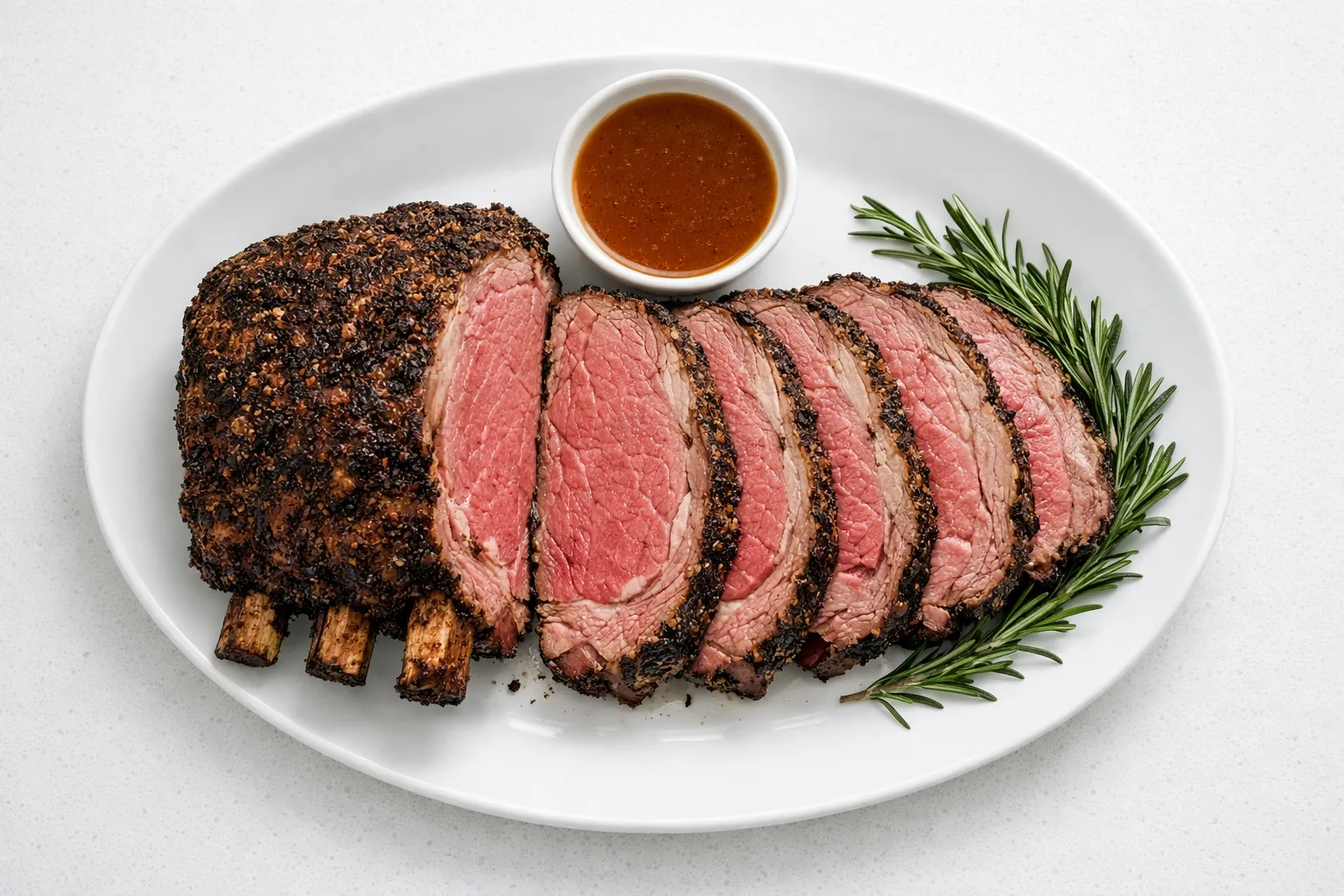
Christmas prime rib is the American holiday centerpiece that earns its status. A standing rib roast, meaning the ribs are left attached and act as a natural roasting rack, is one of the best cuts of beef you can buy: heavily marbled, deeply flavorful, and forgiving enough that a medium-rare interior is almost guaranteed if you follow two principles. Dry-brine it overnight and use a reverse sear.
The reverse sear method, roasting low and slow first, then blasting with high heat at the end, solves the classic prime rib problem of a wide grey band of overcooked meat under the crust. Done right, you get wall-to-wall pink from the bone to the fat cap, with a crust that crackles. Plan for around 15 minutes of cook time per pound at the low temperature, plus a 30-minute high-heat finish.
This recipe calls for a 3-bone roast, which feeds 8 people generously. A good rule: one rib serves two people. Order from a butcher and ask for USDA Choice or Prime grade, dry-aged if available, with the chine bone removed (it makes carving far easier) but the ribs left on.
Equipment
Instructions
Tap each step to track your progress
- 1
Two days before serving (or at minimum the night before), pat the roast completely dry with paper towels. Rub 2 tablespoons of kosher salt all over the surface, including the cut ends and between the ribs. Set the roast rib-side down on a wire rack set over a rimmed baking sheet and refrigerate uncovered for at least 18 hours and up to 48 hours. The salt will initially draw out moisture, then be reabsorbed, seasoning deep into the meat.
- 2
Remove the roast from the refrigerator 2 to 3 hours before you plan to start cooking. This is not optional for a roast this size. A cold center dramatically extends cook time and makes even cooking harder.
- 3
When ready to cook, preheat your oven to 250 degrees F (120 degrees C). Mix the black pepper, rosemary, thyme, garlic, and olive oil into a paste. Rub this herb paste all over the top and sides of the roast, coating the fat cap thoroughly. Do not salt again; the dry brine has already done that work.
- 4
Place the roast rib-side down in a heavy roasting pan. Insert a leave-in probe thermometer into the thickest part of the meat, away from any bones. Roast at 250 degrees F until the internal temperature reaches 115 degrees F (46 degrees C) for medium-rare, about 3 to 3.5 hours for a 7-8 pound roast. Check early; oven thermostats vary.
- 5
Once the roast hits 115 degrees F, remove it from the oven and tent loosely with foil. Increase oven temperature to 500 degrees F (260 degrees C) and let the oven fully preheat, at least 20-25 minutes. This rest period also lets the internal temperature coast up a few degrees.
- 6
Once the oven is screaming hot, remove the foil and return the roast to the oven. Roast at 500 degrees F for 15 to 20 minutes until the fat cap is deeply browned and the herb crust is dark and crackling. Watch it during this stage; the difference between a great crust and a burnt one is just a few minutes.
- 7
Remove the roast from the oven. The internal temperature will continue to rise by another 3 to 5 degrees during resting. For medium-rare, you are aiming for a final resting temperature of 125 to 130 degrees F (52 to 54 degrees C). Let the roast rest uncovered for at least 20 minutes before carving. Do not tent it during this rest; the crust will steam and soften.
- 8
While the roast rests, make the au jus. Pour off most of the fat from the roasting pan, leaving about 2 tablespoons of drippings. Place the pan over medium-high heat on the stovetop (use two burners if needed). Pour in the wine and scrape up all the browned bits from the bottom of the pan. Let the wine reduce by half, about 3 minutes. Add the beef stock and Worcestershire sauce, bring to a boil, and simmer for 5 minutes. Taste and season with salt and pepper. Strain through a fine-mesh sieve into a warm pitcher.
- 9
To carve: stand the roast upright on its ribs, cut along the rib bones to remove them in one piece, then slice the boneless roast to your desired thickness. A 3/4-inch slice is the sweet spot between showing off the interior and providing enough meat per portion. Serve immediately with au jus alongside.
Tips & Tricks
Dry-brining is non-negotiable
Salting the roast 24 to 48 hours ahead is the single most impactful step. It seasons the meat deeply (not just the surface), helps the exterior dry out for a better crust, and noticeably improves the texture. Do not skip this or try to do it the same day.
Use a leave-in probe thermometer, not an instant-read
For a 3-hour low-temperature roast, you want to monitor temperature passively without opening the oven repeatedly. Every time you open the oven door you lose 25 to 50 degrees and extend cook time. A probe thermometer with an external display lets you watch the number rise without touching the oven.
Rest the meat long enough
20 minutes is the minimum rest time for a roast this size; 30 minutes is better. The internal temperature will drop slightly during resting (despite what some expect), but the juices redistribute throughout the meat. Cut too early and those juices run straight out onto the board.
Buy from a butcher, not a supermarket case
Ask for USDA Choice or Prime grade, dry-aged if available, with the chine bone removed and the ribs left attached. A good butcher will also tie the roast if needed. The grade difference between Select and Choice or Prime is dramatic in a cut where the marbling is the entire point.
Ask your guests ahead of time about doneness preference
A whole roast comes off at one temperature. Medium-rare is the gold standard, but if someone needs well-done, cut a thin slice from the end nearest the outside of the roast early in carving; those slices will be more cooked. This avoids the awkward situation of holding everyone up while one slice goes back in the oven.
Troubleshooting
The roast is overcooked or has a thick grey band under the crust
You pulled the roast too late from the low-temperature phase. For a reverse sear, target 115 degrees F at the slow stage, not 125 or 130. The roast will coast up several degrees during the rest and another few during the high-heat finish. If you wait until 125 before searing, you will overshoot medium-rare.
The crust is not browning or crackling
Your oven is not hot enough, or the surface of the roast was wet before the high-heat stage. Make sure the oven is fully preheated to 500 degrees F before the sear. If your oven does not reach 500, use the broiler for the final 10 minutes instead, watching constantly. A properly dry-brined roast that went into the oven uncovered will have a dry, papery surface that crisps quickly.
The meat is done but the interior near the bones is still rare
The bones insulate the meat around them, so the meat closest to the bone often lags behind the center of the roast. This is normal. When carving, the slices farthest from the bone will be more cooked, slices nearer the bone will be rarer. Offer both to your guests.
My au jus is thin and not very flavorful
You need more fond (the browned bits on the pan). If your drippings are pale, it means the roast did not render enough or the pan was too deep and steamed rather than roasted. Next time, use a shallower pan. For a quick fix, add a teaspoon of beef bouillon concentrate to the au jus and reduce it an extra 5 minutes.
The roast looks done externally but the probe is reading low
Check that your probe thermometer is calibrated. Boiling water should read 212 degrees F (100 degrees C) at sea level. If it reads off by more than 2-3 degrees, adjust accordingly. Also verify the probe tip is in the thickest part of the meat and not touching bone.
Variations
Garlic Herb Butter Crust
Instead of an olive oil paste, make a compound butter with 4 tablespoons of softened unsalted butter, the herbs, garlic, 1 teaspoon of Dijon mustard, and the pepper. Apply it the same way as the paste. The butter drips into the pan and makes a richer, more unctuous au jus. The crust colors faster in the high-heat sear, so watch it closely.
Horseradish-Crusted Prime Rib
Add 2 tablespoons of prepared horseradish and 1 tablespoon of Dijon mustard to the herb paste. The heat mellows completely during roasting, leaving a subtle sharpness and a slightly crunchier crust. Serve with additional horseradish cream (sour cream, fresh horseradish, lemon juice) on the side.
Smaller Roast (2-Bone)
A 2-bone roast (roughly 4.5-5 lbs) works the same way but takes approximately 2 to 2.5 hours at 250 degrees F. Start checking the internal temperature at 1 hour 45 minutes. The high-heat finish time stays the same.
Yorkshire Pudding Accompaniment
The British tradition of serving roast beef with Yorkshire pudding translates perfectly here. Reserve 1/2 cup of the beef drippings from the pan after roasting (before making the au jus). Use them to make individual Yorkshire puddings: 1 cup flour, 3 eggs, 1 cup whole milk, a pinch of salt. Let the batter rest 30 minutes, heat the drippings in a muffin tin at 450 degrees F until smoking, pour in the batter, and bake 20-25 minutes without opening the oven.
Serving & Gifting
Carve at the table if you have a board large enough; it is good theater and lets guests choose their preferred slice thickness and doneness level. Serve with au jus in a warm pitcher alongside. Classic accompaniments include creamy horseradish sauce, roasted vegetables, and Yorkshire pudding. For a full Christmas dinner, mashed or roasted potatoes and a simple green vegetable round out the plate without competing with the beef.
Storage & Freezing
Leftover prime rib keeps refrigerated for up to 4 days, wrapped tightly in plastic wrap or in an airtight container. To reheat without overcooking, place slices in a baking dish with a splash of au jus or beef stock, cover tightly with foil, and warm in a 250 degree F oven for about 20 minutes until heated through. Prime rib also freezes well for up to 3 months; wrap individual slices in plastic wrap, then place in a zip-lock freezer bag. Thaw overnight in the refrigerator before reheating.
Common Questions
How long do I cook prime rib per pound?
At 250 degrees F (the low-temperature slow roasting phase), plan on approximately 15 minutes per pound. A 7-pound roast takes around 1 hour and 45 minutes, an 8-pound roast closer to 2 hours. Always use a thermometer rather than timing alone; pull the roast at 115 degrees F for medium-rare and let it coast up during resting and the high-heat sear.
What is the best internal temperature for prime rib?
For medium-rare, the target final resting temperature is 125 to 130 degrees F (52 to 54 degrees C). For medium, aim for 135 degrees F (57 degrees C). Pull the roast from the low-temperature oven 10 to 15 degrees below your target, as the temperature continues to rise during resting and the high-heat finish.
What is the difference between prime rib and standing rib roast?
They are the same cut. "Standing rib roast" is the butcher term for the bone-in beef rib section (ribs 6 through 12). "Prime rib" is the culinary name for the same roast, which traditionally refers to cooking it as a whole roast for serving. The word "prime" in the common name refers to the cut, not the USDA grade.
Can I cook prime rib without a bone?
Yes, a boneless rib roast works with this method, but cook time will be shorter since bones insulate the meat and slow cooking. Boneless roasts also tend to lose their shape slightly during cooking; tying them into a cylinder with kitchen twine before roasting helps. The flavor is marginally different since the bones contribute some flavor during roasting.
How far ahead can I prep prime rib?
The dry brine needs 18 to 48 hours, which you can plan around. The herb rub can be mixed 2 days ahead and refrigerated. The roast itself should be applied with the rub and started the same day you plan to serve it; the slow-roasting phase cannot be easily paused and resumed. The au jus can be made a day ahead and gently reheated.
Can I cook prime rib in a slow cooker or Instant Pot?
Not with this method. The dry heat of an oven is what creates the crust; pressure cooking and slow cookers work with wet heat and will give you braised, falling-apart beef rather than a roast. If you have no oven, the closest alternative is a grill set up for indirect heat at low temperature, with a sear over direct high heat at the end.