
 Mexico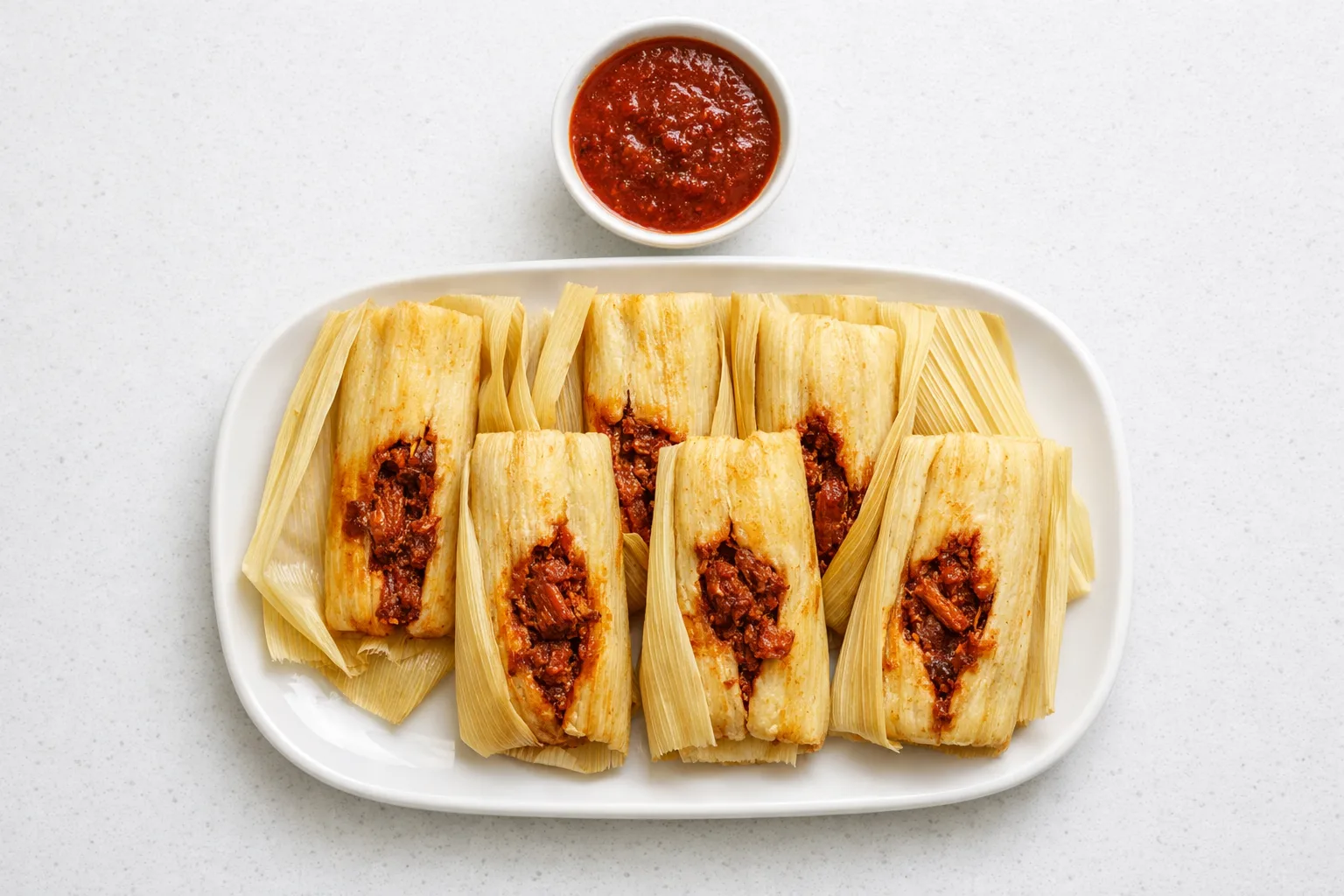
Christmas tamales are not a recipe you make alone on a Tuesday evening. In Mexico, tamaladas are the social event of the Nochebuena season: extended family gathered around a table, spreading masa, arguing about whether the filling is spiced correctly, assembling dozens of tamales at a speed that only comes from muscle memory. The tradition runs deep across Mexican households and is one of the most anticipated parts of the Christmas calendar.
The pork tamales recipe here uses shoulder braised low and slow in a sauce of rehydrated dried chiles, which gives you that rich, earthy depth that can't be faked with chili powder. The masa is mixed with the braising lard and broth so every bite of dough carries the flavor of the filling. Plan on spending the better part of a day, and recruit at least one other person for the assembly line.
This recipe makes 24 tamales, enough for a family gathering with leftovers. The entire process can be split across two days, which is how most Mexican families actually do it.
Equipment
Instructions
Tap each step to track your progress
- 1
Soak the dried corn husks in a large pot or bowl of hot water. Use a plate or heavy bowl to keep them submerged. Soak for at least 1 hour until pliable and soft. Drain and separate before using.
- 2
Place the pork shoulder chunks in a medium pot and cover with cold water by 2 inches. Add 1 halved onion, 4 unpeeled garlic cloves, 1 tsp salt, and 1 tsp black pepper. Bring to a boil over high heat, skimming any foam, then reduce to a low simmer. Cook uncovered for 1.5 to 2 hours until the pork is fork-tender and pulls apart easily. Reserve all the broth.
- 3
While the pork simmers, make the red chile sauce. Toast the guajillo, ancho, and pasilla chiles in a dry skillet over medium heat for 30 to 45 seconds per side, pressing them flat with a spatula, until fragrant and slightly darkened. Do not let them scorch or the sauce will be bitter. Transfer to a bowl, cover with boiling water, and soak for 20 minutes until softened.
- 4
Drain the rehydrated chiles and add to a blender with the remaining 2 garlic cloves (peeled), 1/2 tsp oregano, 1/4 tsp cumin, and 1/2 cup of the pork broth. Blend on high until completely smooth, at least 1 minute. Strain through a fine-mesh sieve, pressing with the back of a spoon to get all the sauce through.
- 5
Heat 1 tbsp lard in a skillet over medium-high heat. Pour the strained chile sauce directly into the hot fat. It will spatter, so stand back. Fry the sauce, stirring constantly, for 3 to 4 minutes until it darkens slightly and smells toasty rather than raw. Season with salt to taste.
- 6
Shred the cooked pork shoulder into rough, medium-sized pieces (not too fine). Add the shredded pork to the chile sauce in the skillet and stir to coat every piece. The filling should be moist but not soupy. Taste and adjust salt. Set aside to cool.
- 7
Make the masa. Measure 2.5 cups of warm pork broth (add water if you don't have enough). In a stand mixer fitted with the paddle attachment, beat the lard on medium-high speed for 3 to 4 minutes until light and fluffy. Add the masa harina, baking powder, and salt. Beat on low to combine. With the mixer running on low, slowly pour in the warm broth. Increase to medium and beat for 3 to 5 minutes until the masa is smooth, holds together, and a small ball dropped into a glass of cold water floats. If it sinks, beat for another 2 minutes. The masa should feel like soft playdough, slightly tacky but not sticky.
- 8
Set up your assembly station: a damp towel to work on, the softened corn husks in a pile, the masa, and the pork filling. Pick a corn husk that is at least 6 inches wide at the broad end. Hold it in your non-dominant hand with the smooth side facing up and the wide end toward you. Scoop about 1/4 cup of masa onto the center of the husk. Using a spoon or offset spatula, spread the masa into a rectangle roughly 4 by 5 inches, leaving a 2-inch border at the narrow top end and a 1-inch border on the sides.
- 9
Place 2 to 3 tablespoons of pork filling down the center of the masa. Fold one long edge of the corn husk over to encase the filling, then fold the other long side over that. Fold the narrow top end up and under the tamale. The bottom stays open. Set seam-side down. Repeat with remaining husks, masa, and filling.
- 10
Set up a large steamer pot with a steamer insert or a colander placed above 3 inches of water. Line the bottom of the steamer basket with leftover corn husks. Stand the assembled tamales upright, open-end up, in tight rows so they hold each other in place. If you have extra space, crumple husks to fill the gaps. Cover with a layer of corn husks over the top.
- 11
Bring the water to a boil over high heat, then reduce to a steady medium simmer. Cover the pot tightly with a lid. Steam for 75 to 90 minutes. Check the water level every 30 minutes and add more boiling water as needed. Tamales are done when the masa pulls cleanly away from the husk without sticking. If it sticks, recover and steam for another 15 minutes.
- 12
Remove from the steamer and let rest for 10 minutes before serving. The masa continues to firm up as it rests.
Tips & Tricks
Beat the lard properly
The float test on the masa only works if the lard is beaten until genuinely light and fluffy before adding the masa harina. Underbeaten lard produces dense, heavy tamales. Lard at room temperature beats to a pale, almost white fluff in 3 to 4 minutes in a stand mixer.
Split the work over two days
Braise the pork and make the chile sauce on day one; refrigerate the filling overnight. On day two, soak the husks, make the masa, and assemble. Chilled filling is much easier to work with and will not slide out of the masa during assembly.
Taste the masa before you assemble
The masa dough should taste noticeably salty and well-seasoned before it goes anywhere near a corn husk. It will lose some intensity during steaming, so season more aggressively than feels right. Flat-tasting masa cannot be fixed once the tamales are assembled.
Use a thermometer to check the water level without lifting the lid
Every time you lift the lid on the steamer, you lose steam and extend the cooking time. Instead, tilt the pot slightly to hear whether water is sloshing, or use a long-stemmed thermometer through the vent to confirm it has not boiled dry. Add boiling water only, never cold.
Stand tamales upright, not flat
Tamales steamed on their sides can come unwrapped and the filling can migrate to one end. Standing them open-end up in tight rows lets gravity keep the filling centered and the fold sealed.
Troubleshooting
The masa keeps sticking to the corn husk after steaming
The tamales were not steamed long enough, or the masa was too thin. Test one tamale after 75 minutes: unwrap it and try to peel the husk cleanly. If the masa tears or sticks, recover the pot and steam for another 15 to 20 minutes. Masa that floats in water during the mixing step is properly aerated; masa that sinks will likely stick.
My filling leaked out during steaming
The masa layer was spread too thin or the tamale was not folded tightly enough. The masa should be at least 1/4 inch thick across the entire surface with no thin spots near the edges. When folding, make sure the two long edges overlap generously and the filling is fully encased before folding the top down.
The masa tastes bland and gummy
Two likely causes: not enough salt in the masa, or the broth was too weak. Taste the masa dough before assembly and adjust salt aggressively. The masa should taste well-seasoned on its own because the corn absorbs flavor during steaming. Also check that you used pork broth with good body, not plain water.
The corn husks kept splitting when I tried to fold them
The husks were not soaked long enough or were dried out at the edges. Soak for a full hour minimum in very hot water. After soaking, select the most pliable husks for the outer layer and reserve cracked ones for lining the steamer or patching tears. Running a split husk briefly under warm tap water can sometimes restore flexibility.
The red chile sauce tastes bitter
The chiles were over-toasted. Dried chiles toast very fast, 30 to 45 seconds per side is usually enough. They should smell fragrant and a little smoky, not charred. If the sauce is already bitter, add a small amount of piloncillo (unrefined brown sugar) or regular sugar to balance it out, a teaspoon at a time.
Variations
Chicken and Green Chile Tamales
Replace the pork shoulder with 2 lbs bone-in chicken thighs, simmered in the same way. Swap the dried red chiles for 6 to 8 tomatillos (husked and halved), 3 poblano peppers (roasted and peeled), and a handful of fresh cilantro, blended into a salsa verde. Fry the salsa in lard the same way. The result is a lighter, brighter tamale that works beautifully alongside the red pork version at a holiday spread.
Bean and Cheese Tamales (Vegetarian)
For a meatless version, fill with seasoned refried black beans and a strip of Oaxacan string cheese or queso fresco. Use vegetable broth instead of pork broth for the masa and substitute vegetable shortening or refined coconut oil for the lard (the masa will be slightly less rich but still good). These are the tamales most often made for guests who do not eat meat.
Sweet Tamales (Tamales Dulces)
Use the same masa base but add 1/4 cup sugar, 1 tsp vanilla, and 1/2 tsp cinnamon. Tint the masa with a few drops of pink or red food coloring for the festive look typical of Mexican bakeries. Fill with sweetened raisins, shredded coconut, or a square of Mexican chocolate. Steam the same way. Sweet tamales are typically served at breakfast or as dessert during the holiday season.
Gluten-Free Note
Tamales made with masa harina are naturally gluten-free. Masa harina is nixtamalized corn flour with no wheat. Verify your baking powder is gluten-free certified (most are), and use a broth that has no wheat-based thickeners. No other substitutions required.
Serving & Gifting
Serve tamales still in their corn husks and let guests unwrap them at the table. A bowl of salsa roja, salsa verde, or crema alongside is all that is needed. At a Nochebuena table they typically appear next to rice, beans, and <em>ponche</em> (the traditional Mexican Christmas punch made with tejocotes and cane sugar). For a family spread, stack them in a deep pot lined with corn husks to keep warm for up to an hour after steaming.
Storage & Freezing
Cooled tamales keep in an airtight container or zip-lock bags in the refrigerator for up to 5 days. To reheat, re-steam in their husks for 15 minutes or microwave individually in their husks with a splash of water for 2 minutes. Tamales freeze exceptionally well: wrap each one individually in plastic wrap, then pack in freezer bags. They keep frozen for up to 4 months. Reheat directly from frozen by steaming for 25 to 30 minutes.
Common Questions
How long does it take to make tamales from scratch?
Making a full batch of 24 tamales takes approximately 4 to 5 hours if done in one day, or you can split it into two sessions. The pork shoulder braise takes 1.5 to 2 hours, making the masa and assembling takes about 1.5 hours, and steaming takes another 75 to 90 minutes. Most Mexican families split this across two days.
Can I make tamales without a stand mixer?
Yes. Beat the lard by hand with a wooden spoon for 5 to 8 minutes until lightened, or use a hand mixer. The float test still applies: the masa is ready when a small ball floats in cold water. It just takes more elbow grease.
What is masa harina and where do I find it?
Masa harina is dried and ground nixtamalized corn flour, the base for tamales and tortillas. It is not the same as cornmeal or corn flour. The most widely available brand is Maseca, sold in large bags at most Mexican grocery stores and in the international aisle of many supermarkets. Do not substitute cornmeal.
Can I freeze tamales before steaming them?
It is better to freeze tamales after steaming. Unsteamed tamales can be frozen, but the masa texture sometimes suffers during thawing and the hydration becomes uneven. Steamed tamales freeze perfectly and reheat in 25 to 30 minutes by re-steaming directly from frozen.
Why do Mexicans make tamales at Christmas specifically?
Tamales are labor-intensive enough that they became associated with special occasions. The communal assembly process, the <em>tamalada</em>, became a Christmas tradition across Mexico and among Mexican communities worldwide because Nochebuena is when extended family gathers. The tradition is also tied to Posadas celebrations throughout December.
Is lard necessary or can I use butter or oil?
Lard is strongly preferred for traditional texture and flavor. Rendered pork lard gives the masa a tender, slightly flaky quality that vegetable shortening can approximate but butter and liquid oils cannot. If you need to substitute, use solid vegetable shortening (not coconut oil or olive oil). The masa will be slightly denser but will still taste good.