
 Italy
Italy 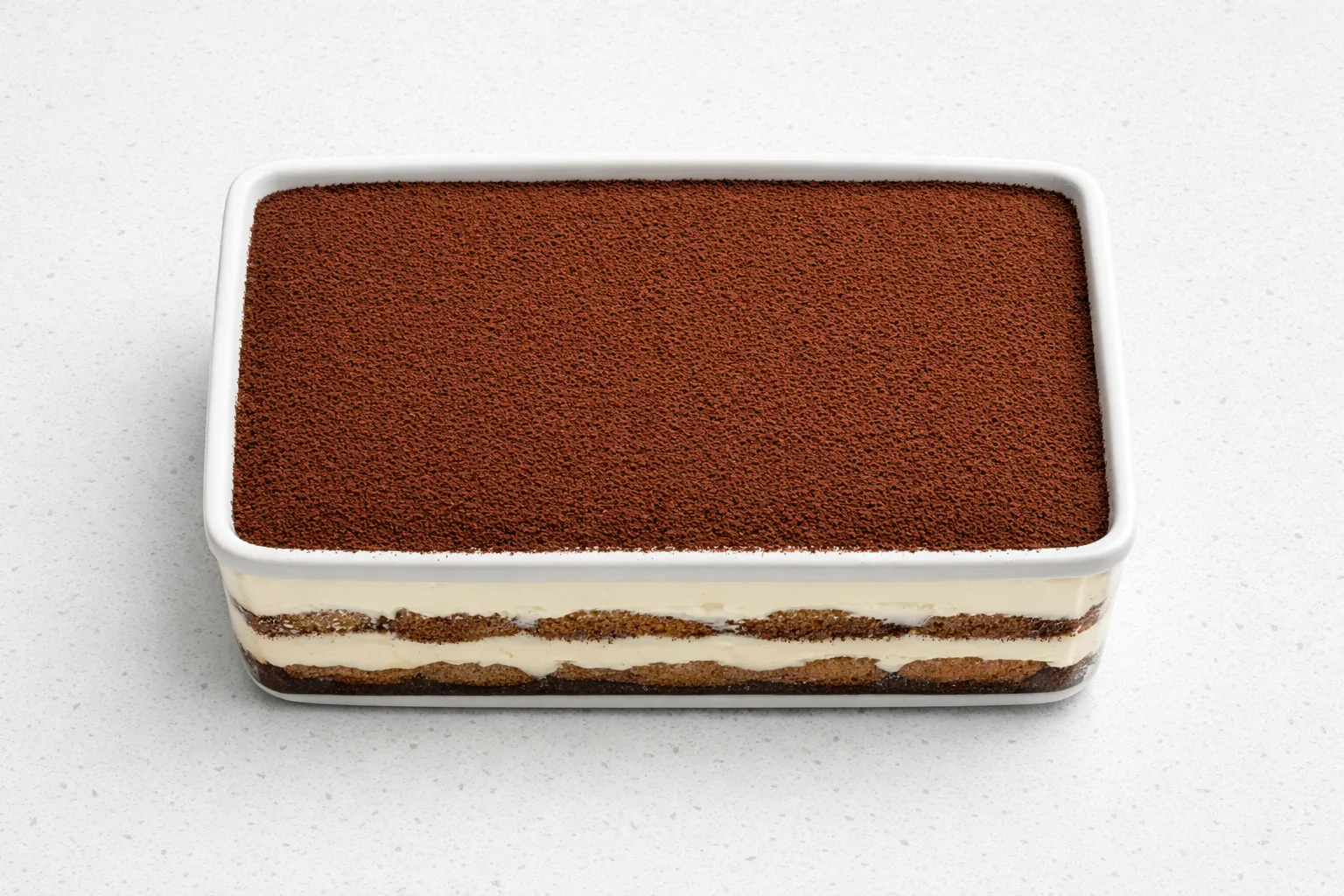
Christmas tiramisu, known in Italy as tiramisu di Natale, is the dessert that closes the Italian Christmas feast the way a full stop ends a sentence: cleanly and without question. The name means "lift me up," and after a long meal of antipasti, pasta, and roasted meats, a cold, coffee-soaked tiramisu does exactly that. It is one of Italy's most beloved Christmas desserts not because it requires skill, but because it requires care and good ingredients.
The dish originated in the Veneto region, with competing claims from Treviso restaurants dating to the 1960s and 1970s. At Christmas, some Italian families add a shot of Amaretto or swap Marsala for rum; others keep it strictly traditional. What stays constant is the ratio: strong espresso, savoiardi ladyfingers, high-fat mascarpone, egg yolks, and cocoa. This recipe uses Marsala wine in the mascarpone cream, which adds depth without the sweetness of Amaretto and keeps the flavour firmly in classic territory.
Make it the day before Christmas Eve dinner. A long rest in the refrigerator allows the layers to set firm and the flavours to integrate. It slices cleanly, serves a crowd, and requires zero oven time.
Equipment
Instructions
Tap each step to track your progress
- 1
Brew the espresso and stir in the sugar and 3 tablespoons Marsala while still hot. Pour into a wide, shallow bowl and let cool completely to room temperature. This is your soaking liquid.
- 2
Set up a double boiler: bring 2 inches of water to a gentle simmer in a medium saucepan. In a heatproof bowl that sits over but does not touch the water, whisk together the egg yolks, 3/4 cup sugar, and 3 tablespoons Marsala.
- 3
Whisk the egg yolk mixture continuously over the simmering water for 8-10 minutes until it thickens to a pale, ribbony consistency and reaches 160 F (70 C) on an instant-read thermometer. The whisk should leave a trail that holds for 3-4 seconds. Remove from heat and whisk for 1 more minute off the heat. Set aside to cool to room temperature, about 15 minutes.
- 4
While the zabaione cools, beat the cold heavy cream and vanilla extract in a stand mixer fitted with the whisk attachment on medium-high speed until it holds stiff peaks, about 3-4 minutes. Transfer to a clean bowl and refrigerate.
- 5
In the now-empty stand mixer bowl, beat the mascarpone on medium speed for 1 minute until smooth and lump-free. Add the cooled zabaione and beat on medium-low until just combined, about 30 seconds. Do not over-mix or the mascarpone can break.
- 6
Fold the whipped cream into the mascarpone-zabaione mixture using a large rubber spatula, working in two additions. Use a gentle folding motion; preserve as much volume as possible. The cream should be fully incorporated with no white streaks.
- 7
Working quickly, dip each ladyfinger into the cooled espresso soak. Hold it submerged for exactly 2 seconds per side, no longer. The ladyfinger should be saturated but still hold its shape. A soggy ladyfinger is the most common mistake in tiramisu.
- 8
Arrange a single layer of dipped ladyfingers in a 9x13 inch (23x33 cm) baking dish. Pack them close together; break some in half to fill gaps at the edges.
- 9
Spread half the mascarpone cream evenly over the ladyfinger layer. Use an offset spatula to smooth it flat from edge to edge.
- 10
Add a second layer of dipped ladyfingers, fitting them snugly in the same way.
- 11
Spread the remaining mascarpone cream over the top, smoothing it into a flat, even surface. This flat top is what gives the tiramisu its clean cocoa-dusted finish.
- 12
Cover tightly with plastic wrap and refrigerate for at least 6 hours, preferably overnight or up to 48 hours. Just before serving, dust the entire surface evenly with Dutch-process cocoa powder through a fine-mesh sieve.
Tips & Tricks
Use day-old ladyfingers if possible
Fresh savoiardi absorb the espresso too quickly and can become waterlogged. Biscuits that are a day or two old are slightly drier and more forgiving in the soak. If your ladyfingers are very fresh, spread them on a baking sheet and let them air-dry for 30 minutes before using.
Temperature matters for the mascarpone
Mascarpone straight from the refrigerator will clump and refuse to mix smoothly. Let it sit at room temperature for 20-30 minutes before you begin. Cold mascarpone is the leading cause of lumpy, broken tiramisu cream.
Cook the egg yolks properly
The zabaione step cooks the yolks to a food-safe temperature (160 F / 70 C) while building the base of the cream. Do not skip this step or replace it with raw yolks. Use an instant-read thermometer if you are unsure; guessing by consistency alone is less reliable.
Make it 24-48 hours ahead
Tiramisu is a genuinely better dessert after an overnight rest. The espresso migrates through the cream, the layers compress into a coherent texture, and everything firms up to a sliceable consistency. Making it the night before Christmas Eve dinner is the right call.
Sift the cocoa at the last moment
Cocoa powder sitting on the surface of the cream will absorb moisture from the mascarpone and become wet and uneven within an hour. Dust it on right before the dish goes to the table.
Troubleshooting
My tiramisu is too wet and won't slice cleanly
The ladyfingers were over-soaked. Next time, hold each one in the espresso for no more than 2 seconds per side. Also ensure the tiramisu has chilled for a full 6 hours minimum; slicing a tiramisu that has not set is always a disaster regardless of technique.
The mascarpone cream is grainy or broken
The mascarpone was too cold when mixed, or it was beaten too aggressively. Always bring mascarpone to room temperature first, and beat it only briefly before adding the zabaione. If it breaks, try folding in a tablespoon of warm heavy cream to bring it back together.
The zabaione didn't thicken
The water in the double boiler was likely boiling too hard. A gentle simmer, not a rolling boil, is what you need. The bowl must not touch the water. Keep whisking; it can take up to 10-12 minutes. You are looking for a pale, thick ribbon that falls slowly from the whisk.
My tiramisu tastes too bitter
Dutch-process cocoa is more intense than natural cocoa. Use a thin, even dusting rather than a thick layer. Alternatively, mix the cocoa powder with 1 teaspoon of powdered sugar before sieving to cut the bitterness slightly.
The cream layer collapsed after chilling
The whipped cream was not beaten to stiff peaks before folding, or the folding was too vigorous and deflated it. The cream must hold a firm peak that does not droop. Fold with a large spatula using a gentle, sweeping motion from the bottom of the bowl.
Variations
Booze-Free Version
Replace the Marsala in both the soak and the cream with 1 tablespoon of strong brewed espresso in the cream and skip the alcohol in the soak entirely. Add an extra teaspoon of vanilla extract to the mascarpone cream for depth. The result is noticeably lighter but still excellent, and suitable for children or anyone avoiding alcohol.
Chocolate Christmas Tiramisu
Add 2 oz (55g) of finely grated dark chocolate (70% cacao) between the layers alongside the mascarpone cream. Stir 2 tablespoons of Dutch-process cocoa powder directly into the espresso soak. The flavour becomes markedly more intense and pairs especially well with a glass of Vin Santo or sweet Madeira.
Amaretto Variation
Replace all Marsala with Disaronno Amaretto, both in the soak and the cream. Add 1 teaspoon of almond extract to the mascarpone mixture. This is the sweeter, more festive-tasting version popular in central Italy during the holidays. Scatter toasted flaked almonds over the cocoa dusting just before serving.
Dairy-Free Adaptation
Substitute the mascarpone with 16 oz of full-fat coconut cream (refrigerated overnight and drained of liquid) blended smooth. Use coconut cream in place of the whipping cream as well. The texture is slightly looser, so freeze the tiramisu for 30 minutes before serving to help it hold its shape when sliced.
Serving & Gifting
Dust with cocoa immediately before bringing the dish to the table; cocoa absorbs moisture in the refrigerator and loses its fine texture if applied too early. Serve cold, scooped with a large spoon or sliced into squares with a knife rinsed under hot water between cuts. Pair with a small glass of Vin Santo, Moscato d'Asti, or a double espresso. For a Christmas dinner centerpiece, transfer individual squares to dessert plates and add a light extra dusting of cocoa.
Storage & Freezing
Covered tightly in the baking dish, Christmas tiramisu keeps in the refrigerator for up to 3 days. The flavour is actually best on day 2, when the layers have fully melded. Do not freeze assembled tiramisu; the cream separates and the ladyfingers turn to mush on thawing. Leftover egg whites can be frozen separately for up to 2 months.
Common Questions
Can I make Christmas tiramisu without raw eggs?
Yes. This recipe already cooks the egg yolks to 160 F (70 C) via the double boiler method, making them food-safe. There are no raw whites in this recipe. If you need to avoid eggs entirely, the dairy-free variation using coconut cream also works egg-free.
How far in advance can I make holiday tiramisu?
Up to 48 hours in advance. Make it on the 23rd for Christmas Eve or the 24th for Christmas Day. Beyond 48 hours, the ladyfingers begin to break down and the texture becomes pasty rather than creamy.
Can I use store-bought espresso or instant coffee?
Strong brewed espresso gives the best flavour. If you don't have an espresso machine, use a Moka pot or brew double-strength French press coffee. Instant espresso powder dissolved in hot water (2 heaped teaspoons per 1.5 cups water) is an acceptable substitute. Avoid regular-strength drip coffee; it makes the ladyfingers taste watery.
Is there a substitute for Marsala wine in tiramisu?
Dry Marsala is traditional. You can substitute dry sherry, Madeira, or dark rum in equal quantities. For a booze-free version, simply omit it and add an extra teaspoon of vanilla extract to the cream. The flavour is different but still good.
What are savoiardi and where can I find them?
Savoiardi are Italian ladyfinger biscuits: light, dry, finger-shaped sponge biscuits sold in most grocery stores near Italian imports or in the biscuit aisle. They are also called "lady fingers" in English. Do not substitute with sponge cake or angel food cake; the absorbency is completely different.
How many people does this Christmas tiramisu serve?
A 9x13 inch dish cut into 10 generous squares serves 10 people. For a buffet or dinner party where guests are taking smaller portions alongside other desserts, it can stretch to 12-14 servings.