
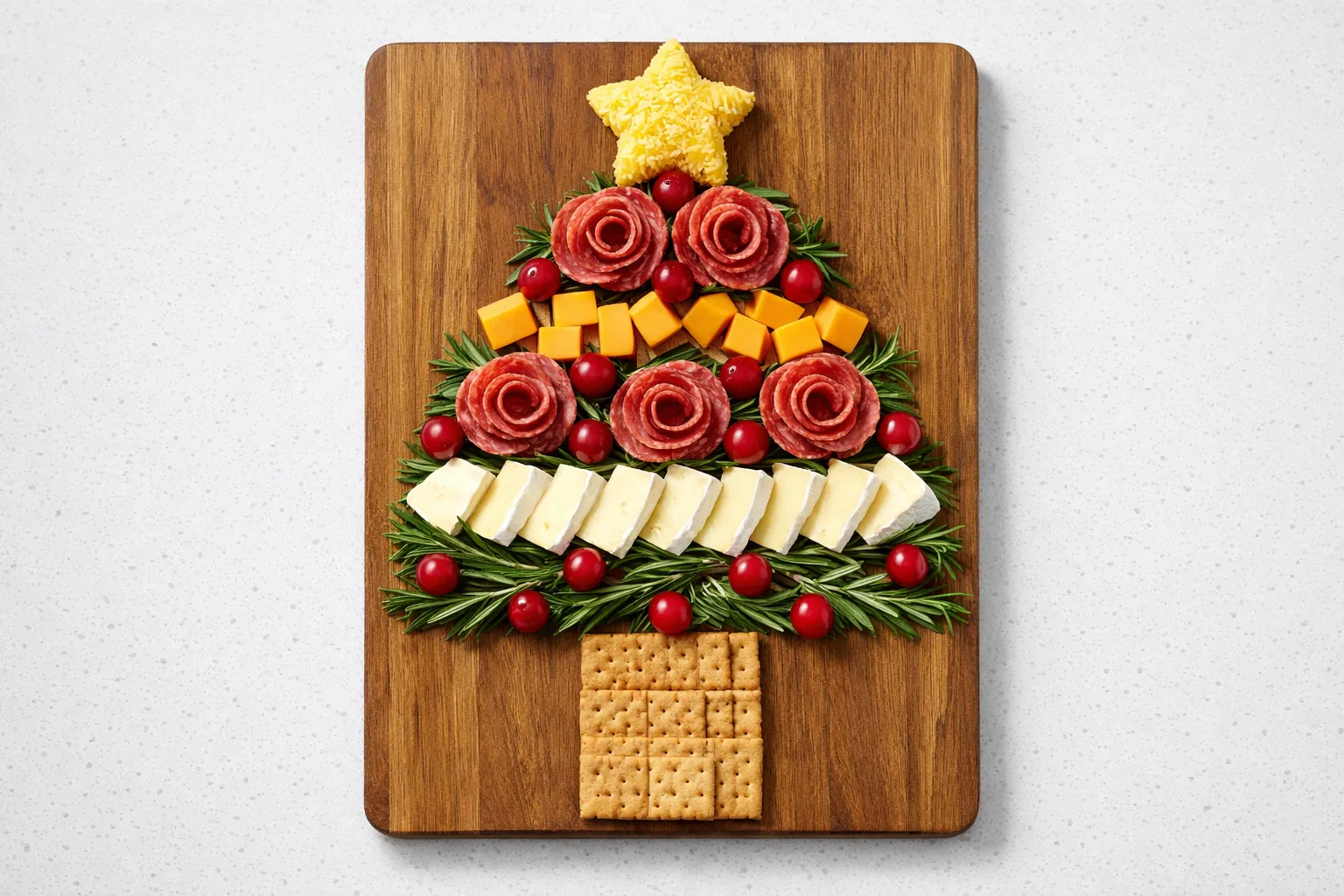
Christmas finger foods don't get more visually dramatic than a Christmas tree cheese board. The concept is simple: arrange cheeses, cured meats, crackers, and garnishes into a tree silhouette on a large board, and you have a centerpiece appetizer that doubles as a conversation starter. Unlike a standard charcuterie spread, the tree shape gives guests a clear place to start grazing and keeps the board looking intentional rather than improvised.
This version uses a three-cheese foundation, prosciutto and salami for the meat layer, and rosemary sprigs as the evergreen filler that actually smells like Christmas when you set it on the table. Cranberries and pistachios play the role of ornaments. The assembly takes about 30 minutes and no cooking, which makes it the ideal thing to build while other dishes are in the oven.
Equipment
Instructions
Tap each step to track your progress
- 1
Clear a large wooden board or slate serving board, at least 18 inches long. Sketch a mental triangle: wide base at the bottom, narrowing to a point at the top. The tree should take up about 80% of the board length.
- 2
Lay down the rosemary sprigs first as the green skeleton of the tree. Place them in overlapping rows from bottom to top, tips pointing outward toward the tree edges, creating a dense evergreen mat. This is the framework everything else sits on.
- 3
Build the trunk from 3-4 pretzel rods or breadsticks arranged vertically at the base of the triangle, below the rosemary line.
- 4
If making a cheese star for the top: roll softened cream cheese or goat cheese into a ball, then press it gently into a star shape using your hands or a small star cookie cutter as a mold. Press it firmly at the tip of the tree.
- 5
Place the cheese in sections working from bottom to top. Cluster the cheddar cubes in one area, fan the brie wedges in another, and tuck the manchego slices in a third zone. Keep each cheese together rather than scattering, so guests can identify them easily.
- 6
Fold the salami into roses: fold each slice in half, then fold again into a quarter-circle, then curl around your finger and press the bottom closed. Nestle these in gaps between cheese clusters.
- 7
Drape prosciutto in loose, airy ribbons between the salami roses. Fold pepperoni slices in half and tuck them into remaining gaps.
- 8
Scatter cranberries across the board as ornaments, pressing them slightly into the rosemary so they don't roll off. Add green olives in a few spots for color contrast.
- 9
Fill any remaining gaps with pistachios or almonds. Tuck crackers along the outer edges of the tree where guests can grab them without dismantling the design.
- 10
Set the honey and mustard ramekins at the base corners of the board. Serve immediately or loosely cover with plastic wrap and refrigerate for up to 2 hours before serving.
Tips & Tricks
Build the green skeleton first
Every experienced cheese board assembler starts with the garnishes, not the cheese. Lay your rosemary sprigs first to define the tree outline. Every other element fills that shape. If you place cheese first, the tree silhouette gets lost.
Temperature matters more than aesthetics
Cheese tastes best at room temperature, not cold. Pull the board from the fridge 20-30 minutes before serving. Brie in particular goes from chalky to properly creamy with that rest time.
Give each cheese its own zone
Cluster each cheese type together in a visible section rather than scattering pieces randomly. Guests want to know what they're reaching for, and distinct zones make the board look intentional rather than improvised.
Prep meat folds in advance
Salami roses and prosciutto ribbons can be folded and stored in a container in the fridge for up to 24 hours before assembly. Assembly day goes much faster when the fiddly work is already done.
Scale the board to your headcount
Plan roughly 2-3 oz of cheese and 1.5-2 oz of meat per person for an appetizer board. This board serves 10 as a starter; halve everything for a 5-person dinner party, or scale up for larger gatherings by using a bigger board and proportionally more of each ingredient.
Troubleshooting
The board looks messy and the tree shape is hard to read
You built from the edges in rather than the center out, or the rosemary is too sparse. Start fresh: lay all the rosemary first to define the silhouette clearly, then stack cheese and meat on top of it. The green mat is what makes the tree shape readable.
The cheese is sweating or looks greasy
The cheeses came to room temperature too far in advance or the room is warm. Pull the board from the fridge no more than 30 minutes before serving. Aged cheddar in particular releases oils when it sits too long. Pat cubes dry with a paper towel before arranging.
The cranberries keep rolling off the board
Press them slightly into the rosemary gaps rather than resting them on flat cheese or wood surfaces. Alternatively, swap fresh cranberries for dried cranberries, which stay where you put them.
The board dries out before guests arrive
Cover loosely with plastic wrap or a damp towel and refrigerate. Remove 20 minutes before serving. Don't use foil directly on soft cheeses, it transfers a metallic taste.
My salami roses fall apart
The slices are too thick or the fold isn't tight enough. Use thin-sliced salami (deli-cut at about 1/16 inch). Fold firmly and press the base hard before placing. If they keep unrolling, spear each rose with a toothpick from the side.
Variations
All-Vegetarian Christmas Cheese Board
Skip the cured meats entirely and double the cheese variety. Add roasted red peppers, artichoke hearts, sun-dried tomatoes, and cornichons to fill the board. Stuffed mini peppers and caprese skewers (mozzarella, cherry tomato, basil on a toothpick) work well as meaty anchors without the meat.
Vegan Adaptation
Use cashew-based cream cheese and aged vegan cheddar (Violife and Miyoko's both slice and cube well). Replace meat with marinated mushrooms, roasted chickpeas, and sun-dried tomatoes. The rosemary, cranberries, nuts, and crackers stay the same. Honey swaps to agave or maple syrup.
Spicy Charcuterie Tree
Swap Genoa salami for spicy capicola or 'nduja (spreadable spicy salami). Add pickled jalapenos and pepper jack cheese. Include hot honey in place of regular honey. The heat contrast against the creamy brie is the point.
Mini Individual Boards
Build the same tree concept on small cheese boards or slate tiles for individual guests, about 6 inches each. Prep takes longer but each guest gets their own untouched board, which works well for seated dinner parties.
Serving & Gifting
Set the board on the table before guests arrive so the tree silhouette makes an impact as a centerpiece. Pair with a dry sparkling wine or prosecco, which cuts through the richness of aged cheeses, or mulled wine for a warmer holiday feel. Provide a dedicated cheese knife for each cheese type to avoid flavor blending. Replenish crackers from the edges as guests graze inward toward the tree.
Storage & Freezing
Assembled cheese boards don't store well once served, as guests disturb the arrangement and the cheeses dry out. Individual components keep separately: wrapped cheeses last 3-5 days in the fridge, cured meats last up to a week. If you need to prep ahead, arrange the rosemary base and cheese on the board up to 4 hours before serving, cover tightly, and add the crackers, cranberries, and nuts just before guests arrive so crackers don't absorb moisture.
Common Questions
How far in advance can I make a Christmas cheese board?
You can arrange the base (rosemary, cheese, meats) up to 4 hours ahead and refrigerate it covered. Add crackers, nuts, and fresh cranberries within 30 minutes of serving so they stay crisp and don't absorb moisture from the board.
What cheeses work best for a Christmas charcuterie board?
Aim for variety in texture and intensity: one aged hard cheese (cheddar, manchego, or gruyere), one soft and creamy (brie or camembert), and one with a distinct character (goat cheese, blue cheese, or smoked gouda). Three cheeses is the practical minimum for a full tree-sized board.
How many people does a Christmas tree cheese board serve?
This recipe serves 10 as an appetizer. For a party of 20, double all quantities and use a board at least 24 inches long. For 5-6 people, halve the quantities and use a 12-inch board.
Can I make a Christmas cheese board without meat?
Yes. A vegetarian cheese board works just as well and is often more inclusive for mixed groups. Replace cured meats with roasted vegetables, marinated olives, stuffed peppers, and extra cheese variety. The tree silhouette holds its shape with or without charcuterie.
What crackers should I use for a Christmas charcuterie board?
Use at least two types: something neutral and sturdy (water crackers or plain flatbreads) that won't compete with the cheese flavor, and something with texture or seasoning (seeded crackers, rosemary crisps) for variety. Avoid crackers with strong flavors like everything bagel seasoning, they overpower delicate cheeses.
Is a Christmas tree cheese board good for a kids' party?
Yes, with modifications. Swap the cured meats for mild ham or turkey slices, skip the mustard and replace with a mild hummus, and add mild cheeses like mild cheddar or string cheese. Keep the cranberries and nuts on the side for younger children.