
Christingle: Meaning, History and the Orange Tradition
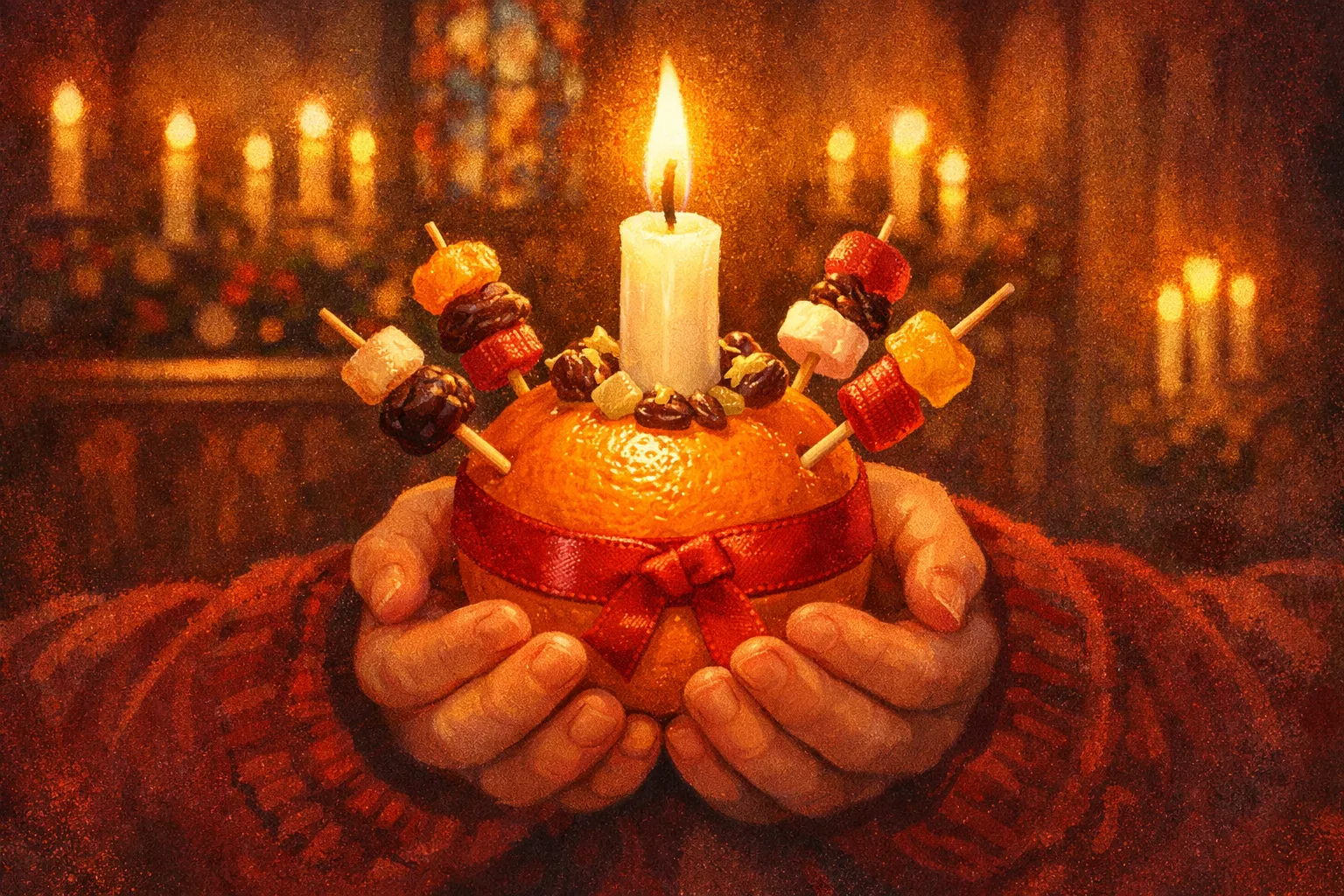
A candle jammed into an orange, wrapped in red ribbon, and skewered with sweets on sticks. It looks odd. It sounds odder. But the Christingle carries nearly three centuries of meaning, and roughly a million people still gather around one every December.
A Christingle is a small symbolic object made from an orange, a candle, red ribbon, and four cocktail sticks loaded with dried fruit or sweets. It represents Christ as the light of the world, and each component carries its own meaning rooted in Christian symbolism. The tradition dates back to a Moravian Church children's service in Germany in 1747 and arrived in the Church of England in 1968, where it became one of the most attended services of the Christmas season.
Contents
Around one million people in the United Kingdom attend a Christingle service each year, according to The Children's Society. That makes it one of the few church events that consistently fills pews with families who might not set foot in a church the other 51 weeks. The reason is simple: hand a child a lit candle stuck in an orange, and you have their complete attention.
What Is a Christingle and What Does It Mean?
The word "Christingle" likely comes from the German dialect word Christkindl, meaning "Christ-child" or "Christmas gift." Some scholars suggest it derives from the old Saxon word "ingle," meaning fire, which would make it "Christ-light." Others connect it to the German "engel" (angel). The etymology is genuinely uncertain, but all three possibilities point to the same place: Christ.
The Christingle itself is built from five components, each carrying specific symbolism:
- The orange represents the world. Its round shape stands for God's creation.
- The candle, pushed into the top of the orange, symbolizes Jesus Christ as the Light of the World.
- The red ribbon or red tape wrapped around the middle represents the blood of Christ.
- Four cocktail sticks are pushed into the orange, pointing in four directions to represent north, south, east, and west, as well as the four seasons.
- Dried fruit, nuts, or sweets threaded onto the sticks represent God's gifts to the world: the fruits of the earth and the goodness of creation.
It is, in other words, an entire theology lesson compressed into something you can hold in one hand. That compression is precisely what makes it effective for children's services. You don't explain abstract doctrine; you build something, light it, and let the object do the teaching.
The Moravian Origin of the Christingle
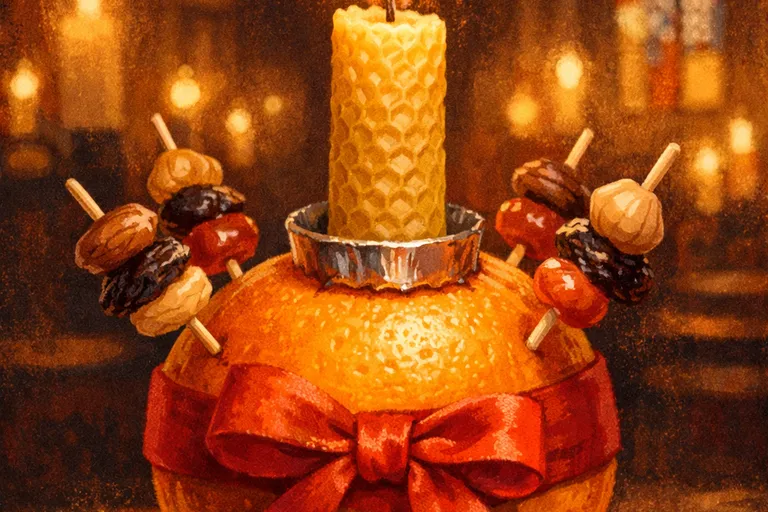
The Christingle was born on 20 December 1747, in the Moravian congregation at Marienborn, Germany. Bishop Johannes de Watteville conducted a children's service during which the children sang hymns and Watteville read verses they had written to celebrate the birth of Jesus. At the close of the service, each child received a small lighted beeswax candle tied with a red ribbon.
Watteville ended the service with a prayer that the Marienborn diary preserved: "Lord Jesus, kindle a flame in these children's hearts, that theirs like Thine become." The diary also records what happened next: the children "went full of joy with their lighted candles to their rooms and so went glad and happy to bed."
That original version was simpler than what we know today. No orange. No cocktail sticks. Just a candle wrapped in red ribbon. The Moravian Church, one of the oldest Protestant denominations in the world, carried this custom wherever its missionaries traveled: to Labrador, Pennsylvania, Tibet, Suriname, the Caribbean, and South Africa. In each place, the tradition was adapted with local materials and customs.
The orange appeared later, likely in the British Moravian congregations. The exact date of this adaptation is not recorded, but by the mid-20th century, the modern form with its five components was well established within Moravian communities in Britain.
How the Christingle Came to the Church of England
The person who brought the Christingle out of its Moravian niche and into the mainstream of English church life was John Pensom, a layman working with the Church of England Children's Society in Lincoln.
On 7 December 1968, Pensom organized the first Christingle service outside the Moravian tradition at Lincoln Cathedral. He expected about 300 people to attend. Close to 1,500 showed up, with around 1,200 of them children from parishes across the diocese. Each child received a Christingle made by volunteers from the Lincoln Committee of the Church of England Children's Society.
The response stunned everyone involved. The following year, the Society held seven Christingle services. The year after that, roughly double. By the mid-1970s, the tradition had spread to parishes across England, Wales, and beyond. When Pensom died in 2005 at the age of 78, his obituary in the Church Times noted he was affectionately known as "Mr Christingle."

The Christingle Service Today
Christingle services are held in churches and schools across the United Kingdom each year during Advent, typically in late November or December. The format varies between congregations, but most services include hymns, a short talk explaining the Christingle's symbolism, and a moment where the lights are dimmed and every candle is lit simultaneously.
That moment, when a church full of children holds up their glowing oranges in the dark, is the reason the tradition endures. It is genuinely striking. Even the most fidgety six-year-old tends to go quiet when handed a real flame.
The Children's Society reports that over 5,000 Christingle services take place annually across the UK, raising more than 1.2 million pounds each year for its work with vulnerable young people. The charity provides collection candles that double as donation tools, and many churches incorporate the fundraising element directly into the service.
Christingle services are not exclusive to the Church of England. Methodist, Baptist, United Reformed, and Roman Catholic churches all hold them, as do many schools. The Moravian Church in Britain continues to hold its own Christingle services, maintaining the tradition it originated nearly three centuries ago.
How to Make a Traditional Christingle
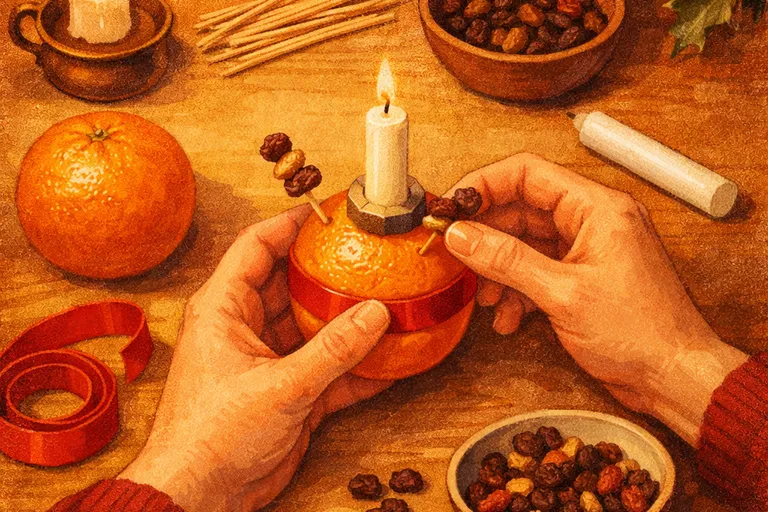
Making a Christingle takes about five minutes and requires no special skill. You need an orange, a candle (a small taper or birthday candle works), red ribbon or red tape, four cocktail sticks, and dried fruit, raisins, or small sweets.
- Wrap the red ribbon around the middle of the orange and secure it with a small pin or tape.
- Push the four cocktail sticks into the orange at equal intervals around the middle, just above the ribbon. They should point outward in four directions.
- Thread dried fruit, raisins, marshmallows, or sweets onto each cocktail stick.
- Use a knife or skewer to make a small hole in the top of the orange, then push the candle firmly into it. A small square of foil around the base of the candle catches dripping wax and helps stabilize it.
The entire assembly should be stable enough to hold upright but not so loaded with sweets that the cocktail sticks droop. Churches preparing hundreds at once typically set up production lines, with volunteers on ribbon duty, stick duty, and candle duty. It is efficient and surprisingly satisfying work.
Why the Christingle Still Works
The genius of the Christingle is that it is participatory. Children don't sit and listen to an explanation of Christian theology. They build a physical object, hold fire, eat sweets. Every sense is engaged. The orange smells like Christmas. The candle is warm. The dried fruit is edible.
This is also why it translates so well across denominations and even across cultures. You don't need to understand English church history to grasp what a lit candle in a dark room means. The Moravians understood this in 1747 when they handed lighted candles to children in Marienborn. John Pensom understood it in 1968 when he filled Lincoln Cathedral with families.
The Children's Society has raised tens of millions of pounds through Christingle services since 1968. But the tradition's survival doesn't rest on fundraising alone. It rests on the fact that an orange with a candle in it, held by a child in a dark church, remains one of the most visually and emotionally direct ways to communicate a two-thousand-year-old story.
In many parish churches, the Christingle service draws more people than Christmas Day itself. The Marienborn diary's note about children going "glad and happy to bed" after that first service in 1747 still describes the scene in thousands of churches each December.
Frequently Asked Questions
What is a Christingle?
A Christingle is a symbolic object made from an orange (representing the world), a lit candle (representing Jesus as the Light of the World), a red ribbon (representing the blood of Christ), and four cocktail sticks with dried fruit or sweets (representing God's creation and the four seasons). It is used in church services during Advent and Christmas, primarily in the United Kingdom.
Where did the Christingle originate?
The Christingle originated on 20 December 1747 in the Moravian Church congregation at Marienborn, Germany. Bishop Johannes de Watteville gave children lighted beeswax candles tied with red ribbon during a children's service. The modern form with the orange was developed later by British Moravian congregations.
Why is an orange used in a Christingle?
The orange represents the world because of its round shape. It was not part of the original 1747 Christingle, which was simply a candle with a red ribbon. The orange was added later, likely by British Moravian churches, as a practical way to hold the candle upright and to add a layer of symbolism representing God's creation.
When did the Church of England start holding Christingle services?
The first Church of England Christingle service was held on 7 December 1968 at Lincoln Cathedral, organized by John Pensom of the Children's Society. It was expected to draw 300 people but nearly 1,500 attended. The tradition spread rapidly through English parishes in the following years.
How many people attend Christingle services each year?
According to The Children's Society, approximately one million people attend Christingle services in the United Kingdom each year. Over 5,000 services are held annually across churches of various denominations and schools, raising more than 1.2 million pounds for the charity's work with vulnerable children and young people.
Can you hold a Christingle service outside the Church of England?
Yes. Christingle services are held by many Christian denominations including Methodist, Baptist, United Reformed, and Roman Catholic churches, as well as in schools. The Moravian Church, which originated the tradition, continues to hold its own services. There is no restriction on which churches or organizations can hold a Christingle celebration.