
 Lebanon
  Egypt
Egypt 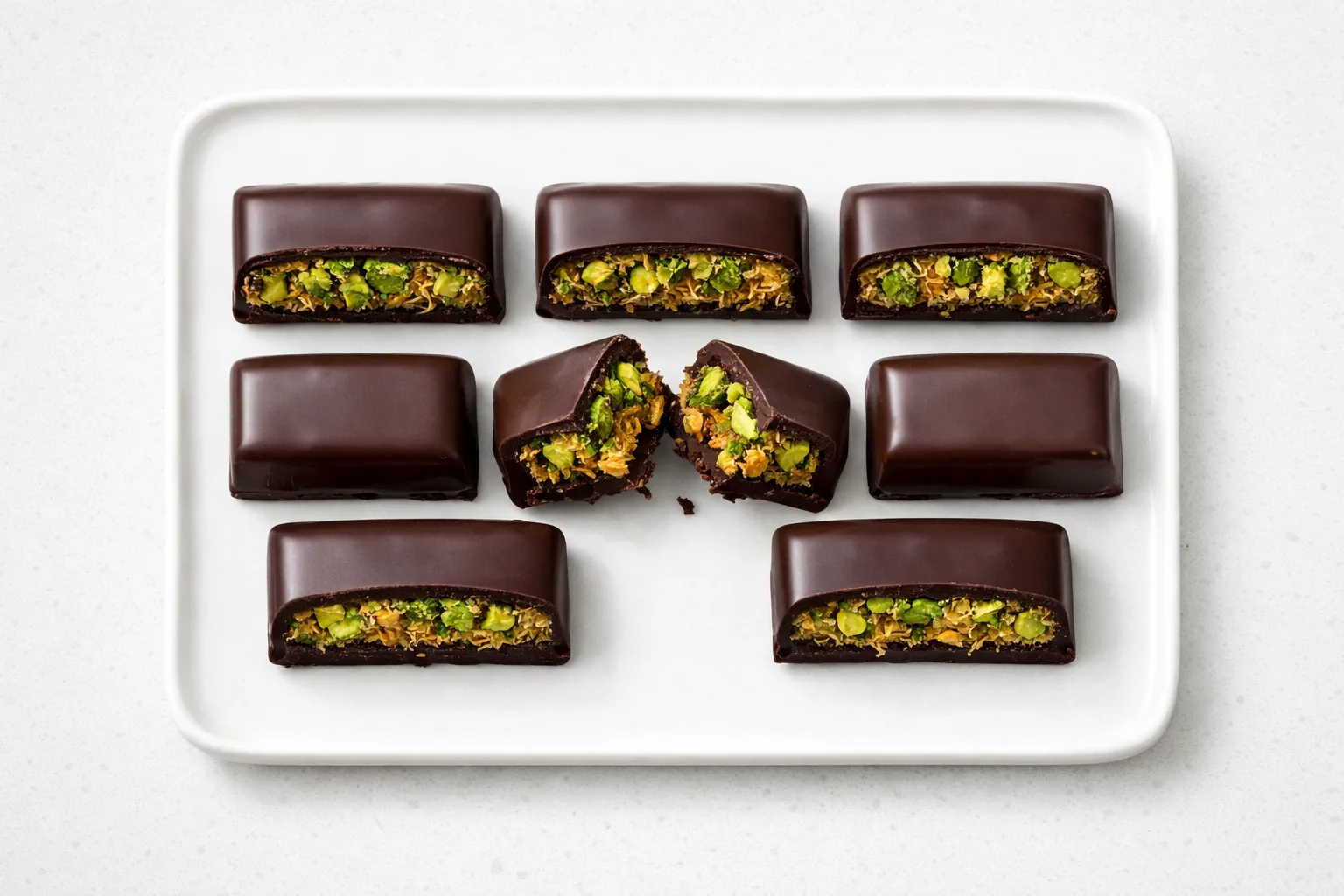
The Dubai chocolate bar took over the internet in 2024 when Fix Dessert Chocolatier in Dubai created a dark chocolate shell packed with pistachio cream and toasted kataifi (shredded wheat pastry from Arabic and Middle Eastern baking). The result is a textural contrast that genuinely earns the hype: snappy chocolate, creamy pistachio, and chewy-crunchy threads of pastry. It has since become a sought-after Christmas gift, a party showpiece, and one of the most-searched chocolate recipes of the year.
Kataifi is the key ingredient. When pan-toasted in butter until golden and nutty, the fine pastry strands develop a flavor somewhere between toasted sesame and toasted brioche. Combined with pistachio cream (pistachio paste thinned with tahini) and tempered dark chocolate, the filling becomes richer and more complex than anything a pistachio truffle delivers. This recipe makes eight full bars using a standard silicone bar mold, with a proper tempered shell so the chocolate snaps clean.
Note on pistachio paste: use a pure paste with no added sugar or oil if you can find it. The filling is rich enough without extra sweetness, and pure paste gives you the most vivid green color and authentic pistachio flavor.
Equipment
Instructions
Tap each step to track your progress
- 1
Prepare the mold: make sure your 8-cavity silicone chocolate bar mold is completely dry. Any moisture will cause the chocolate to seize. Set it on a flat baking sheet and place in the freezer for 10 minutes to chill.
- 2
Toast the kataifi: roughly pull apart the shredded pastry into shorter strands, about 3-4 cm long. Melt the butter in a wide skillet over medium heat. Add the kataifi and cook, stirring constantly, for 6-8 minutes until evenly golden and smelling nutty and toasted. It should look like fine browned vermicelli. Transfer to a plate and let cool completely before mixing with the filling. (If you mix it warm, it softens and loses its crunch.)
- 3
Temper the chocolate: set aside one-third of the chopped chocolate. Melt the remaining two-thirds in a heatproof bowl over a pot of barely simmering water (the bowl must not touch the water), stirring occasionally, until it reaches 50-55C (122-131F). Remove from heat and stir in the reserved unmelted chocolate a handful at a time, letting each addition melt fully before adding more. Continue stirring until the temperature drops to 31-32C (88-90F) for dark chocolate. The chocolate should feel barely warm on your wrist and leave no smear when swiped on parchment. If you skip tempering, the shells will be soft and bloomed.
- 4
Coat the molds: pour about 2 tbsp of tempered chocolate into each cavity. Tilt and rotate the mold so chocolate coats the sides and bottom evenly. Tap the mold firmly on the counter to remove air bubbles, then invert it over the bowl of chocolate and let the excess drip back for 30 seconds. Scrape the top of the mold clean with an offset spatula. Place upright on the baking sheet and refrigerate for 10 minutes until the shells are fully set and matte.
- 5
Make the filling: whisk together the pistachio paste, tahini, powdered sugar, salt, and rose water (if using) until smooth and uniform. The mixture should be thick but spreadable, roughly the texture of peanut butter at room temperature. If it is too stiff, add a few drops of neutral oil. Fold in the cooled toasted kataifi and stir to combine fully.
- 6
Fill the bars: remove the mold from the refrigerator. Spoon or pipe the filling into each chocolate shell, leaving a 3mm gap at the top so the chocolate back can seal fully. Press the filling down gently to eliminate air pockets.
- 7
Seal the bars: pour a thin layer of tempered chocolate over each filled cavity, covering the filling completely. Scrape the surface flush with an offset spatula so the back of each bar is flat. Tap the mold once on the counter to settle.
- 8
Set and unmold: refrigerate the filled mold for at least 30 minutes until the chocolate is fully set and the bars have contracted slightly from the sides. Flex the mold gently and push each bar out from the back. The bars should release cleanly with a glossy shell. Store at cool room temperature (below 20C / 68F) or refrigerate.
Tips & Tricks
Use couverture chocolate, not chips
Couverture has a higher cocoa butter percentage and is formulated for molding. Chocolate chips contain stabilizers that prevent proper tempering and give a dull, waxy shell. Look for couverture at baking supply shops or online.
Toast the kataifi past the point that looks safe
The biggest mistake is under-toasting. Pale kataifi has a raw, floury flavor that does not improve in the filling. Push it to a deep even gold, stirring constantly. The entire pan should smell like toasted bread before you stop.
Work in a cool room
Chocolate tempering and molding require a room temperature of 18-20C (65-68F). In a warm kitchen, the chocolate sets too slowly, blooms, and the bars release poorly. If your kitchen runs hot, chill the mold between steps.
Chill the mold before the first pour
A cold mold accelerates shell setting, which makes the first chocolate layer thinner and more even. A room-temperature mold gives the chocolate too long to flow and produces uneven shells that may crack when filled.
Make the filling a day ahead
The pistachio-kataifi filling can be made up to 24 hours in advance and stored covered at room temperature. This saves time on the day of assembly and lets the flavors meld.
Troubleshooting
My chocolate shell is soft and streaky, not glossy
The chocolate was not properly tempered. Streaky or soft chocolate means it set in the wrong crystal form. Re-melt the chocolate and re-temper, making sure to hit 31-32C before pouring. Room temperature must also be below 20C; a warm kitchen prevents proper setting.
The bars won't release from the mold
Either the shells are too thin or the chocolate has not contracted fully. Return the mold to the refrigerator for another 20 minutes. If they still stick, the shells may have been poured too thin in step 4 or the mold was not fully dry before coating.
The kataifi filling turned soggy
The toasted kataifi was mixed into the filling while still warm, causing it to steam and soften. Always let it cool fully to room temperature before combining with the pistachio paste. Once the bars are assembled and sealed, the filling stays crunchy for several days.
My filling is too stiff to pipe
The pistachio paste was too thick, or the ratio of tahini was too low. Stir in neutral oil one teaspoon at a time until the filling is soft enough to pipe without cracking the chocolate shell. Do not add water; any moisture in the filling will cause problems.
The chocolate seized when I melted it
Water got into the bowl or tools, or the bowl was touching the simmering water directly. Any steam or moisture contaminates chocolate immediately. Re-start with fresh chocolate, ensure every surface is bone dry, and keep the bowl above (not in) the hot water.
Variations
Milk Chocolate Shell
Replace the dark chocolate with 400g of milk chocolate couverture. Temper to 30C (86F) instead of 32C. The sweeter shell makes the pistachio filling taste more dessert-like and less bitter. Use the full rose water amount to cut through the extra sweetness.
White Chocolate and Mango Dubai Bars
Use white chocolate for the shells (temper to 27-28C / 81-82F) and replace the pistachio paste with unsweetened mango puree reduced to a thick paste, folded into toasted coconut flakes instead of kataifi. The result is a lighter, tropical interpretation.
Dairy-Free Adaptation
Use dairy-free dark chocolate (most good-quality 70%+ bars are naturally dairy-free) and replace the butter for toasting the kataifi with refined coconut oil. Check your pistachio paste and tahini labels for cross-contamination. The bars will be fully dairy-free and still snap and taste correct.
Cardamom and Saffron Filling
Add 1/2 tsp ground cardamom and a pinch of saffron (dissolved in 1 tsp warm water) to the filling mixture. This pulls the flavor decisively toward Gulf sweets and tastes particularly good with a 65% Venezuelan dark chocolate shell.
Serving & Gifting
Serve the bars at cool room temperature for the best texture; straight from the refrigerator the chocolate is too hard and the filling too firm to appreciate the contrast. For a Christmas gift, wrap each bar individually in gold foil or parchment, then in a branded tissue-paper box. They make an impressive edible gift for people who are tired of receiving generic chocolate boxes. Pair with cardamom coffee, mint tea, or a small glass of dessert wine.
Storage & Freezing
Store finished bars in an airtight container at cool room temperature (below 20C / 68F) for up to 5 days. In warmer conditions, refrigerate and bring to room temperature 20 minutes before eating. The bars freeze well for up to 2 months; wrap individually in cling film, place in a zip-lock bag, and thaw overnight in the refrigerator to prevent condensation. Do not store near strongly scented foods as chocolate absorbs odors.
Common Questions
What is Dubai chocolate made of?
Dubai chocolate bars consist of a dark (or milk) chocolate shell filled with pistachio cream, tahini, and toasted kataifi shredded pastry. The combination was popularized by Fix Dessert Chocolatier in Dubai and went viral in 2024. The filling is what sets it apart: the crunchy toasted pastry threads folded into pistachio paste create a texture unlike a standard chocolate truffle.
Where can I buy kataifi pastry?
Kataifi (also spelled kadayif) is available in Middle Eastern, Greek, and Turkish grocery stores, usually in the frozen pastry section. In many countries it can also be ordered online. If unavailable, very finely shredded phyllo dough is a partial substitute, but the texture will be less fine.
Can I make Dubai chocolate without tempering?
You can melt chocolate without tempering and it will still taste the same, but the shells will be soft, dull, and will melt on your fingers. For bars that snap cleanly and look professional, tempering is necessary. A digital thermometer makes it straightforward; the process takes about 15 minutes.
Is Dubai chocolate a Christmas gift?
Yes, it has become popular as a Christmas gift precisely because it looks expensive, travels well when individually wrapped, and tastes unusual enough to feel special. Eight bars made from this recipe fill a standard gift box and cost a fraction of the imported version.
Can I use store-bought pistachio cream instead of pistachio paste?
Store-bought pistachio cream (such as Sicilian pistachio spread) works and is easier to source. It is typically sweeter and may contain added oils or sugar, so omit the powdered sugar from the filling and taste before adding. The color will be slightly paler than pure paste.
How long do homemade Dubai chocolate bars last?
Properly tempered bars stored in an airtight container at cool room temperature last 5 days. Refrigerated, they keep for up to 2 weeks. Frozen and well-wrapped, up to 2 months. The kataifi filling stays crunchy throughout; it does not soften noticeably over the shelf life.