

Why Do We Give Gifts at Christmas?
The tradition of exchanging Christmas presents stretches back over two thousand years, rooted in ancient Roman festivals, biblical narratives, and a fourth-century bishop with a habit of throwing gold through windows.
We give Christmas gifts because a handful of ancient traditions, religious stories, and commercial inventions collided over two millennia and produced something no one originally planned. The practice has roots in Roman midwinter festivals, the Gospel of Matthew's account of the Magi, and a fourth-century Greek bishop who allegedly saved three young women from destitution by tossing bags of gold through their father's window. None of these people were shopping at a department store.
Contents
- 1. What Is the Biblical Origin of Gift Giving at Christmas?
- 2. Did the Romans Exchange Gifts Before Christmas Existed?
- 3. How Did St. Nicholas Become the Patron Saint of Gift Giving?
- 4. When Did Christmas Gift Giving Become Commercial?
- 5. How Was Gift Wrapping Invented?
- 6. How Much Do People Spend on Christmas Gifts Today?
- 7. Frequently Asked Questions
Yet by the time the twentieth century arrived, that is exactly what Christmas gift giving had become: a retail event. The path from gold, frankincense, and myrrh to a $994 billion holiday shopping season (the National Retail Federation's figure for 2024) is stranger and more accidental than most people realize.
What Is the Biblical Origin of Gift Giving at Christmas?
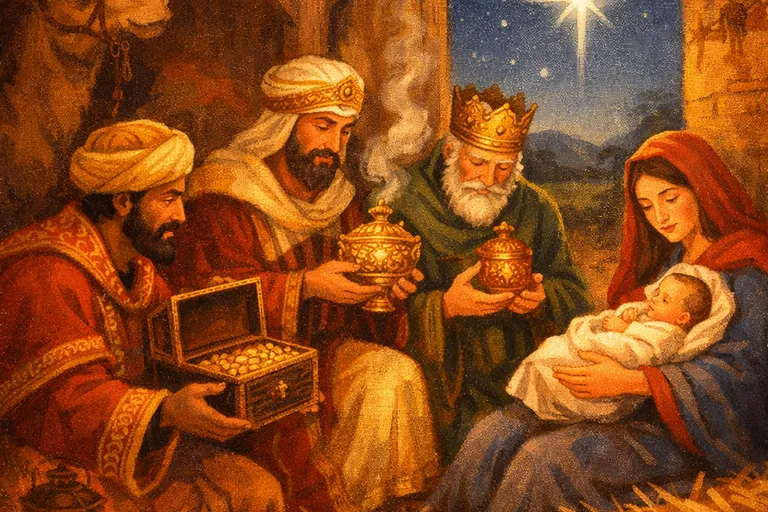
The oldest justification for Christmas gifts comes from the Gospel of Matthew, chapter 2. The Magi, sometimes called the Three Wise Men or Three Kings, traveled to Bethlehem and presented the infant Jesus with gold, frankincense, and myrrh. These were not random choices. Gold acknowledged kingship. Frankincense, burned as incense in temples across the ancient Near East, symbolized divinity and priestly authority. Myrrh, used in embalming and anointing, pointed toward suffering and death.
The Syrian King Seleucus I Nicator made a similar offering of gold, frankincense, and myrrh to the temple of Apollo at Didyma around 288 BC, suggesting the combination was already a recognized tribute to the divine long before the Christian era. The Magi's gifts gave early Christians a theological reason to associate generosity with the birth of Jesus, and the feast of Epiphany on January 6 eventually became the primary gift-giving day in many European countries.
In Spain, Mexico, and much of Latin America, children still receive presents on January 6, the Dia de los Reyes Magos. The idea that gifts belong on December 25 is actually a later development, one that required a different character entirely.
Did the Romans Exchange Gifts Before Christmas Existed?
They did, and enthusiastically. Saturnalia, the Roman festival honoring the god Saturn, ran from December 17 through December 23 by the first century BC. Romans feasted, gambled in public (normally illegal), and upended social hierarchies. Masters served their slaves at dinner. People wore informal clothes instead of togas. The mood was deliberately chaotic.
The final day, called the Sigillaria, was dedicated to gift exchange. The name comes from sigilla, small figurines made of wax, terracotta, or wood that were the standard present. These were intentionally inexpensive. Giving lavish gifts would have reasserted the social distinctions the festival was meant to suspend. Romans also exchanged candles, gag gifts, and small tokens of good luck called strenae.
When Emperor Constantine converted to Christianity in 312 AD and the church eventually established December 25 as the date of Christ's birth, Saturnalia's customs did not simply vanish. Many historians argue that early Christian leaders absorbed elements of the festival, including its gift-giving tradition, into Christmas celebrations. The transition was gradual and politically useful: it gave former pagans familiar rituals within a Christian framework.
How Did St. Nicholas Become the Patron Saint of Gift Giving?
Nicholas of Myra was a Greek Christian bishop born around 270 AD in Patara, in what is now Turkey. He inherited considerable wealth and, according to church tradition, gave it all away. The most famous story involves a father too poor to provide dowries for his three daughters, which in the ancient world meant they faced slavery or worse.
Nicholas visited the house on three separate nights and threw a purse of gold coins through the window each time. One version of the legend says the gold landed in shoes drying by the fire, which is why children in the Netherlands, Germany, and other European countries still leave shoes or stockings out on the eve of St. Nicholas Day, December 6.
Dutch settlers brought Sinterklaas to New Amsterdam in the seventeenth century. English-speaking Americans eventually transformed him into Santa Claus, merging the bishop's reputation for generosity with Nordic folklore about a figure who rewarded good children and punished naughty ones. But the core idea survived intact: someone gives gifts to those in need, secretly, expecting nothing in return.
When Did Christmas Gift Giving Become Commercial?
The short answer: the 1800s. At the start of the nineteenth century, Christmas was barely celebrated in much of England and North America. It was a minor religious observance, not a cultural season. Several forces converged to change that.
Charles Dickens published A Christmas Carol in 1843, and the first print run of 6,000 copies sold out by Christmas Eve. The novella reframed Christmas as a time of generosity and family warmth, with Ebenezer Scrooge's transformation serving as a moral argument for open-handedness. According to the Smithsonian, the book "marvelously captured the holiday's Victorian spirit and inspired new traditions for centuries to come."
Queen Victoria and Prince Albert helped popularize the family-centered Christmas celebration, including the decorated tree and the exchange of gifts. The Industrial Revolution made this commercially viable. Factories could now mass-produce toys, ornaments, and novelty items at prices the growing middle class could afford. Gift giving shifted from handmade or homegrown tokens to purchased goods, and it shifted fast.
How Department Stores Shaped Modern Gift Giving
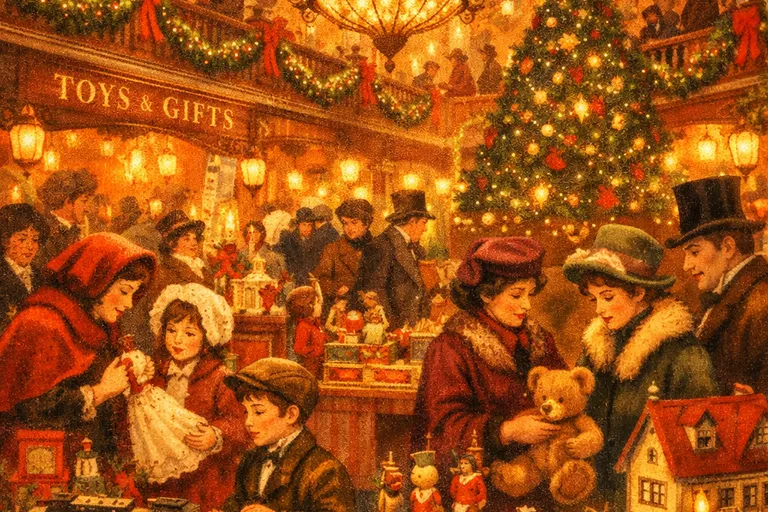
American department stores did not just sell Christmas gifts. They invented the entire culture around Christmas shopping. R. H. Macy debuted the nation's first Christmas window displays at his 14th Street store in New York in 1874. By the 1880s, animated window scenes drew crowds to stores before they ever stepped inside. Macy's claims Santa Claus was greeting children in-store as early as 1862, though the first well-documented department store Santa appeared in 1890 at James Edgar's store in Brockton, Massachusetts.
John Wanamaker in Philadelphia pushed retail innovation even further. His store, founded in 1861, introduced fixed price tags (he believed that if everyone was equal before God, they should be equal before price), electrical illumination in 1878, and eventually a Christmas light show in the store's six-story Grand Court. Wanamaker turned holiday shopping into spectacle, and competitors followed.
By the early twentieth century, Christmas shopping was a major driver of the American economy. The season that once centered on church services and family meals had become inseparable from retail.
How Was Gift Wrapping Invented?
Before 1917, most people wrapped Christmas presents in plain brown paper, newspaper, or simple tissue paper in red, green, or white. Charles Dickens mentions brown-paper parcels in A Christmas Carol. Victorian-era upper classes used decorated paper with floral motifs, but it was expensive and uncommon.
The modern gift wrapping industry started by accident. During the 1917 Christmas rush, the Hall Brothers store in Kansas City ran out of tissue paper entirely. Rollie Hall, brother of Hallmark founder J.C. Hall, ran to their manufacturing plant and grabbed stacks of decorative French envelope liners. They were thick, colorful, and covered in geometric and floral patterns unlike anything American shoppers had seen on a gift.
Rollie stacked the envelope liners next to the cash register at 10 cents a sheet. They sold out. The next year, same result. By 1919, the Hall brothers were designing and printing their own decorative gift wrap. It was the first product Hallmark manufactured besides greeting cards. A century later, Americans use roughly 4.6 million pounds of wrapping paper every holiday season.
How Much Do People Spend on Christmas Gifts Today?
The numbers are staggering. According to the National Retail Federation, holiday retail sales in the United States hit a record $994.1 billion in 2024, up 4% from the previous year. The average American shopper budgeted $902 for gifts and seasonal items. Online sales alone reached $296.7 billion.
The spending is not evenly distributed. Gallup polling found that about 37% of Americans planned to spend $1,000 or more on holiday gifts in 2024, while 31% budgeted under $500. People aged 45 to 54 spend the most, averaging roughly $1,162 annually.
Globally, the picture is just as large. The NRF expects U.S. holiday sales to surpass $1 trillion for the first time in 2025. Per capita, Canadians lead global Christmas spending at around $2,100, followed by Lebanon at $2,058 and Germany at $1,453.

The distance between a Roman Sigillaria figurine and a $994 billion shopping season is about 2,000 years. But the impulse behind both is recognizable: the midwinter urge to give someone something, even if it is a small wax figure bought from a market stall outside the Temple of Saturn.
Frequently Asked Questions
Why do we give gifts at Christmas?
Christmas gift giving combines several historical traditions: the biblical Magi presenting gold, frankincense, and myrrh to the infant Jesus; Roman Saturnalia gift exchanges during the winter solstice; and the legend of St. Nicholas, a fourth-century bishop known for secretly giving money to those in need. These traditions merged over centuries into the modern custom of exchanging presents on December 25.
When did Christmas gift giving start?
Gift exchanges during the winter season date back to ancient Rome's Saturnalia festival, which predates Christmas by centuries. The Christian tradition of Christmas gifts is rooted in the Magi's visit to Jesus, described in the Gospel of Matthew. The practice of widespread gift giving on December 25 became common in the nineteenth century, driven by Victorian-era cultural shifts and the rise of department stores.
Who invented gift wrapping?
Modern decorative gift wrapping was invented by accident in 1917 at the Hall Brothers store in Kansas City, the company that became Hallmark. When the store ran out of tissue paper during the Christmas rush, Rollie Hall sold colorful French envelope liners as wrapping instead. They proved so popular that Hallmark began manufacturing its own gift wrap by 1919.
How much do Americans spend on Christmas gifts?
In 2024, total U.S. holiday retail sales reached a record $994.1 billion according to the National Retail Federation. The average American shopper spent approximately $902 on gifts and seasonal items. The NRF projects holiday sales will surpass $1 trillion for the first time in 2025.
What is the connection between St. Nicholas and Christmas gifts?
St. Nicholas was a fourth-century Greek bishop from Myra (modern-day Turkey) famous for secretly giving gold to help those in need. Dutch settlers brought the Sinterklaas tradition to America, where it evolved into Santa Claus. His feast day on December 6 is still a gift-giving occasion in many European countries, while in America his role merged with Christmas Day celebrations.