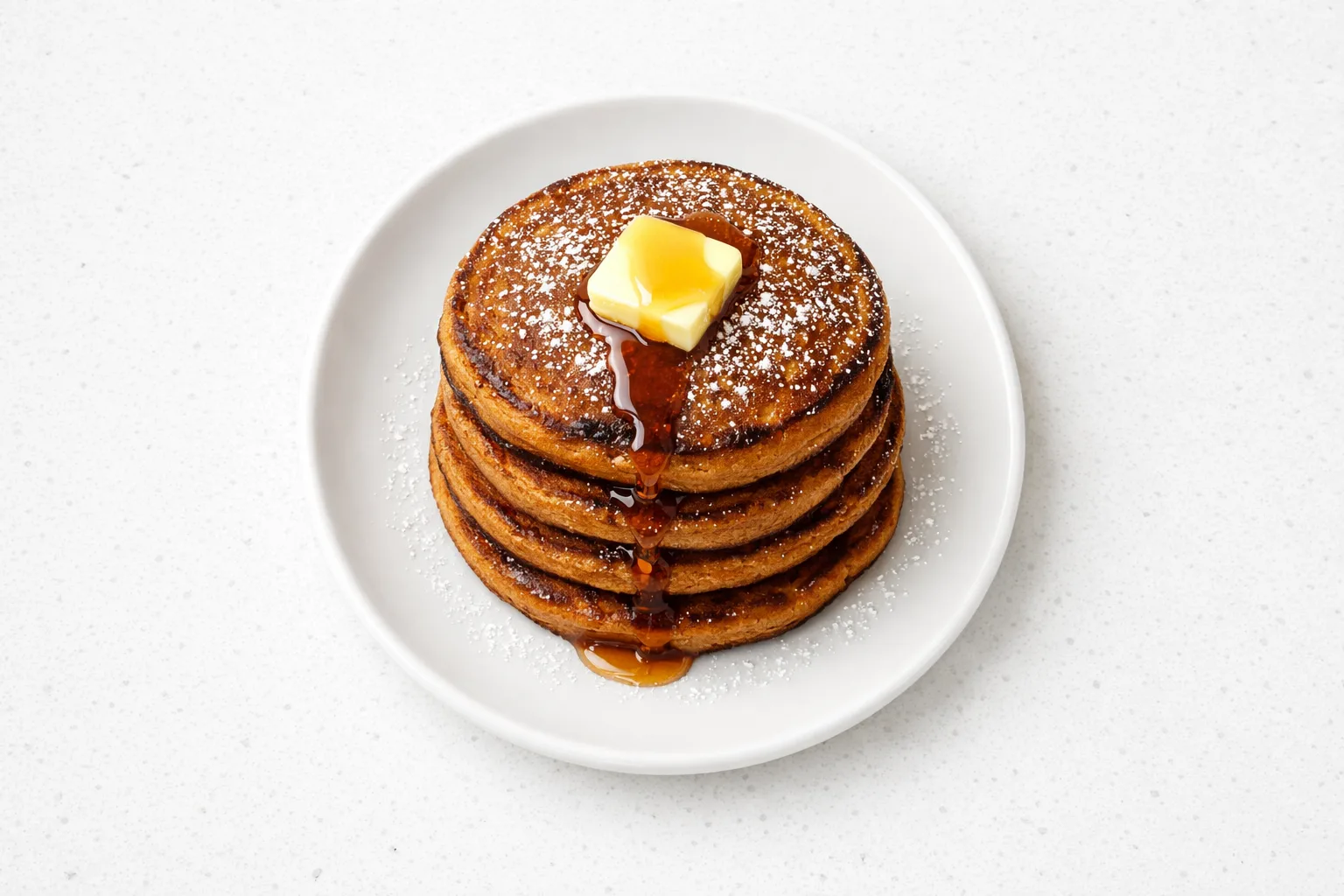
Gingerbread pancakes bring all the warming spice of a classic Christmas gingerbread cookie into a fast, no-chill breakfast stack. The combination of ground ginger, cinnamon, cloves, and molasses gives these pancakes a deep, slightly smoky sweetness that plain buttermilk pancakes simply cannot match. They have been a fixture of American Christmas morning tables for decades, a natural evolution of holiday baking flavors into the easiest possible format.
What separates a great gingerbread pancake from a mediocre one is molasses. Use unsulfured dark molasses (sometimes called "full" or "robust" molasses in Central Europe, where it may be harder to find than in the US), not blackstrap, which is too bitter. A small addition of black pepper, barely enough to notice, amplifies the ginger and gives the pancakes a warmth that lingers. This recipe is scaled for a family of four with leftovers easy to reheat.
Equipment
Instructions
Tap each step to track your progress
- 1
Whisk together the flour, baking powder, baking soda, salt, ginger, cinnamon, cloves, nutmeg, black pepper, and dark brown sugar in a large mixing bowl until evenly combined. Make a well in the center.
- 2
In a separate bowl, whisk the eggs until lightly beaten, then add the buttermilk, molasses, melted butter, and vanilla extract. Whisk until smooth. The mixture will be a deep caramel-brown.
- 3
Pour the wet ingredients into the well in the dry ingredients. Stir with a spatula or wooden spoon until just combined. Stop when the flour is no longer visible; a few lumps are fine and desirable. Do not overmix or the pancakes will be tough and flat.
- 4
Let the batter rest for 5 minutes while you heat the pan. This allows the baking powder to start working and the flour to hydrate fully.
- 5
Heat a large non-stick skillet or griddle over medium heat. Brush lightly with neutral oil or a small knob of butter. The pan is ready when a drop of water flicked onto the surface skitters and evaporates within 2 seconds.
- 6
Pour approximately 1/4 cup of batter per pancake onto the pan. Do not press down. Cook until bubbles form across the surface and the edges look matte and set, about 2 to 3 minutes. The underside should be deep golden-brown.
- 7
Flip each pancake once and cook for a further 1 to 2 minutes until the second side is evenly browned and the center is cooked through. Press gently with a spatula; it should spring back without leaving a dent.
- 8
Transfer to a wire rack set over a baking sheet and keep warm in a 200 F (93 C) oven while you cook the remaining batches. Wipe the pan between batches if there are any dark spots from the molasses.
- 9
Serve immediately in stacks with butter and maple syrup.
Tips & Tricks
Rest the batter
Five minutes of resting makes a real difference. The baking powder activates partially during the rest, and the flour hydrates fully, giving you thicker, puffier pancakes without any extra effort.
Keep molasses warm
Cold molasses pours slowly and can sink to the bottom of the batter unevenly. Measure it into the bowl before you melt the butter, then pour the warm butter over it. The butter loosens it and the two combine easily.
Do not press down on the pancakes
It is tempting to flatten a domed pancake with the spatula, but pressing forces out the air bubbles that make them fluffy. Leave them alone after flipping.
Test with a quarter-batch first
If you are cooking these for the first time, cook one pancake before committing to the rest. It lets you calibrate your pan temperature, check the thickness of the batter, and confirm the flip timing without risking the whole batch.
Make the batter the night before (with a tweak)
If you want to serve these on Christmas morning without standing in the kitchen mixing, combine all the dry ingredients in one bowl and all the wet ingredients in another, cover both and refrigerate overnight. Mix them together in the morning and cook immediately.
Troubleshooting
My pancakes are spreading flat instead of puffing up
The pan was not hot enough or the batter was overmixed. A cold pan causes the batter to spread before the exterior can set. Test the heat before cooking the first batch, and stop stirring the batter the moment the flour disappears.
The centers are gummy or raw inside
The heat is too high. The outside is cooking too fast and burning before the inside has time to cook through. Lower the heat to medium-low and extend the cooking time by 30 to 60 seconds per side.
My pancakes taste bitter
You may have used blackstrap molasses, which has a very strong bitter flavor. Use unsulfured dark or robust molasses instead. Blackstrap is a nutritional supplement, not a baking ingredient.
The batter is too thick and won't pour
This can happen if the flour was scooped rather than spooned into the measuring cup, packing it in. Stir in 2 tablespoons of buttermilk at a time until the batter pours like thick cream. Resting the batter for 5 minutes also helps it loosen slightly.
Pancakes are sticking to the pan
The pan needs more fat between batches. Even non-stick pans need a light re-oiling after every second or third batch, especially with molasses in the batter, which can burn and stick.
Variations
Dairy-Free Gingerbread Pancakes
Replace the buttermilk with oat milk or almond milk mixed with 1 tbsp apple cider vinegar (let it sit for 5 minutes to curdle). Use a neutral oil such as refined coconut oil or avocado oil in place of the melted butter. The pancakes will be slightly less rich but just as spiced.
Gluten-Free Version
Substitute a 1:1 gluten-free all-purpose flour blend (one that contains xanthan gum) for the regular flour. The batter may be slightly thicker; add 2 to 3 extra tablespoons of buttermilk if it seems too stiff. Cook on slightly lower heat, as gluten-free pancakes take a little longer to cook through.
Gingerbread Flapjacks with Spiced Apple Compote
Make a quick compote by simmering 2 peeled, diced apples with 2 tbsp brown sugar, 1/2 tsp cinnamon, and a splash of water for 8 minutes until soft. Serve over the pancakes in place of maple syrup for a more filling, fruit-forward plate that still reads as fully Christmas.
Extra-Fluffy Separation Method
Separate the eggs and whip the whites to soft peaks before folding them into the finished batter at the end. The pancakes will be noticeably taller and lighter, closer to a souffle pancake texture, at the cost of an extra bowl and a few more minutes of work.
Serving & Gifting
Serve stacked three to four high per plate with a cold knob of salted butter on top (it melts into the layers as you eat) and good maple syrup warmed in a small pitcher. A dusting of powdered sugar and a few thin slices of candied ginger on top makes the plate look polished without extra effort. For a Christmas morning spread, these pair well with crispy streaky bacon, a clementine or two, and a pot of good coffee.
Storage & Freezing
Leftover pancakes keep in an airtight container in the refrigerator for up to 3 days. Reheat in a toaster or in a dry non-stick pan over medium heat for 1 to 2 minutes per side; the microwave works but softens the exterior. Pancakes freeze well stacked between sheets of parchment paper in a zip-lock bag for up to 2 months. Reheat from frozen in a toaster at medium heat for 2 cycles, or in a 350 F (175 C) oven for 8 minutes. Do not refrigerate raw batter for more than 24 hours; the baking powder loses its lift.
Common Questions
Can I make gingerbread pancakes without molasses?
Molasses is the ingredient that gives gingerbread pancakes their characteristic depth and color. You can substitute dark treacle (common in the UK and Ireland) 1:1. In a pinch, use 2 tablespoons of dark brown sugar dissolved in 1 tablespoon of warm water, but the flavor will be noticeably lighter and less complex.
Can I use regular milk instead of buttermilk?
Yes. Add 1 tablespoon of white vinegar or fresh lemon juice to 1 cup of whole milk and let it sit for 5 minutes until it curdles slightly. This mimics the acidity of buttermilk, which is important for reacting with the baking soda and giving the pancakes lift and a slight tang.
How do I keep gingerbread pancakes warm for a crowd?
Place cooked pancakes on a wire rack set over a baking sheet in a 200 F (93 C) oven. Stacking them directly on a plate traps steam and makes them soggy on the bottom. The rack keeps air circulating and holds them for up to 30 minutes.
Are gingerbread pancakes the same as gingerbread flapjacks?
In American English, pancakes and flapjacks are the same thing (thin, round, cooked on a griddle). In British English, a flapjack is a dense oat-based baked bar, not a pancake at all. This recipe uses the American definition: a spiced, pourable batter cooked on a griddle.
Can I make gingerbread pancakes vegan?
Yes. Replace the eggs with flax eggs (1 tbsp ground flaxseed + 3 tbsp water per egg, rested 5 minutes). Use oat milk with apple cider vinegar in place of buttermilk, and melted refined coconut oil or vegan butter in place of dairy butter. The texture will be slightly denser but the spice flavor comes through just as well.
How long does the gingerbread pancake batter keep?
Mixed batter keeps refrigerated for up to 24 hours, but the baking powder will lose some of its lift by the next day, resulting in flatter pancakes. For best results, cook within 30 minutes of mixing. If making ahead, keep the wet and dry ingredients separate and combine them in the morning.