
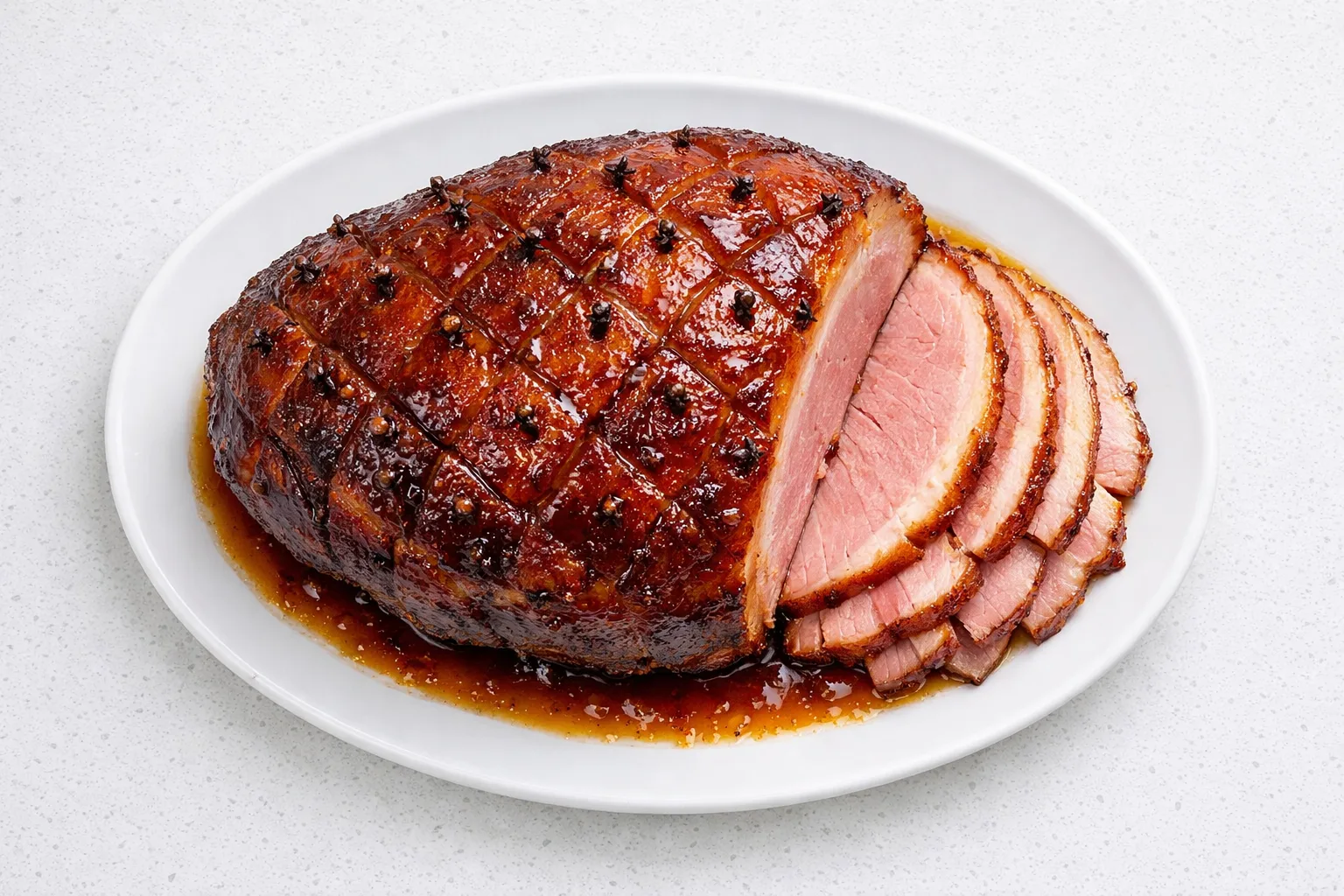
Christmas ham is the anchor of the American holiday table, and for good reason. A bone-in, spiral-cut ham does most of the work for you. It arrives pre-cooked and pre-sliced, which means your job is simple: build a glaze worth talking about and get the oven to do the rest. This is not a recipe that rewards complexity. It rewards patience and a good thermometer.
The glaze here is a three-ingredient base of honey, dark brown sugar, and Dijon mustard, spiked with a little apple cider vinegar and warm spices. The combination caramelizes into a sticky, burnished shell that cracks slightly when you slice into it. It is the version of glazed ham that tastes the way holiday ham is supposed to taste: sweet, savory, a little sharp, and deeply bronzed.
The technique matters more than the ingredient list. Baking low and slow, then finishing with repeated glaze layers under higher heat, builds color and flavor without drying out the meat. Expect a ham that holds well for a crowd and reheats beautifully for days of leftovers.
Equipment
Instructions
Tap each step to track your progress
- 1
Remove the ham from the refrigerator 1 to 2 hours before baking to take the chill off. A cold ham straight from the fridge will cook unevenly. Preheat the oven to 300F (150C).
- 2
Line a large roasting pan with heavy-duty aluminum foil for easy cleanup. Place the ham cut-side down on a wire rack set inside the pan. Score the surface in a diamond crosshatch pattern, cutting about 1/4 inch deep, and press a whole clove into the center of each diamond.
- 3
Add 1 cup of water to the bottom of the roasting pan. Cover the entire ham tightly with aluminum foil, sealing the edges around the pan. Bake at 300F for about 2 hours, roughly 15 minutes per pound, until the internal temperature reaches 120F.
- 4
While the ham bakes, make the glaze. Combine the honey, dark brown sugar, Dijon mustard, apple cider vinegar, cinnamon, ground cloves, nutmeg, and cayenne in a small saucepan over medium heat. Stir until the sugar dissolves completely and the mixture is smooth, about 3 minutes. Remove from heat and set aside.
- 5
When the ham reaches 120F internally, remove it from the oven. Increase the oven temperature to 400F. Remove the foil and discard it.
- 6
Brush a generous layer of glaze over the entire surface of the ham, getting it into the score marks and between the spiral slices. Use about one-third of the glaze for this first coat.
- 7
Return the uncovered ham to the oven for 15 minutes. Remove and brush with another third of the glaze. Repeat once more: 15 minutes in the oven, then the final layer of glaze.
- 8
Bake for a final 10 to 15 minutes until the glaze is bubbling and deeply caramelized. The surface should look lacquered and mahogany-brown. The internal temperature should read 140F.
- 9
Transfer the ham to a cutting board or serving platter. Let it rest for 15 to 20 minutes before serving. The glaze will set as it cools, becoming sticky and slightly firm. Spoon any pan drippings over the sliced ham for extra flavor.
Tips & Tricks
Use an instant-read thermometer, not guesswork
Ham is already cooked when you buy it, so you are reheating, not cooking from raw. The target is 140F internal temperature. Overshooting to 160F or beyond is how hams go dry. A thermometer removes all doubt.
Let the ham come to room temperature
Pulling the ham from the fridge and putting it straight into the oven creates uneven heating. The outside overcooks while the center stays cold. One to two hours on the counter solves this entirely.
Apply the glaze in thin, repeated coats
One thick coat of glaze does not caramelize well. It pools, burns in spots, and stays sticky-raw in others. Three thin coats, each baked for 15 minutes, build up a lacquered shell with real depth of color and flavor.
Save the bone for soup
A ham bone with bits of meat clinging to it is the base for an outstanding split pea soup, bean soup, or stock. Wrap the bone tightly and freeze it within two days of serving. It keeps for up to 3 months.
Make the glaze up to 3 days ahead
The glaze stores well in a sealed jar in the refrigerator. Warm it gently on the stovetop or in the microwave before brushing. Making it ahead means one less thing to manage on Christmas morning.
Troubleshooting
My ham is dry
The most common cause is overbaking uncovered. The low-and-slow phase under foil is what keeps the meat moist. If you skip the foil or go straight to high heat, the outer layers dry out before the center warms through. Always cover tightly for the first two hours.
The glaze burned instead of caramelizing
Your oven ran too hot during the glazing phase, or the glaze layer was too thick in spots. Brown sugar burns quickly above 425F. Keep the oven at 400F and apply thin, even coats. If you see blackened patches, scrape them gently and brush on a fresh layer.
The glaze is too thin and runs right off
The glaze needs to reduce slightly in the saucepan until it coats the back of a spoon. If it still slides off the ham, let the ham cool for 5 minutes before brushing. A slightly cooler surface helps the glaze grip and set.
The ham tastes too salty
Spiral-cut hams are cured and already quite salty. Soaking a very salty ham in cold water for 4 to 8 hours before baking pulls out excess salt. Change the water once or twice during soaking. The sweet glaze also helps balance the salt when applied generously.
Variations
Maple-Bourbon Glaze
Replace the honey with pure maple syrup and add 2 tablespoons of bourbon to the saucepan. Let the bourbon cook off for about 1 minute before removing from heat. The result is deeper, more complex, with a slight smokiness that pairs especially well with a double-smoked ham.
Pineapple-Brown Sugar Glaze
Add 1/2 cup crushed pineapple (drained) to the glaze mixture and replace the apple cider vinegar with the pineapple juice. This is the retro mid-century approach, sweeter and more tropical. You can also stud the ham with pineapple rings secured with toothpicks for the full vintage effect.
Spicy Mustard Glaze
Increase the Dijon to 1/4 cup, swap the honey for equal parts stone-ground mustard and brown sugar, and add 1 tablespoon of hot sauce or 1/2 teaspoon of red pepper flakes. This version leans savory and pairs well with a strong cheese board or pickled vegetables on the side.
Dairy-Free and Gluten-Free (Default)
This recipe is naturally dairy-free and gluten-free as written. Check that your ham is not injected with a gluten-containing solution by reading the label. Most major brands are gluten-free, but some specialty or artisan hams use wheat-based seasonings.
Serving & Gifting
Carve the ham along the spiral slices for easy portioning and arrange on a warm platter. Spoon the pan drippings into a small bowl for passing at the table. This ham pairs well with scalloped potatoes, roasted green beans, dinner rolls, and a sharp Dijon or whole-grain mustard on the side. For a crowd of 16, one 8-to-10-pound ham is exactly right, with enough leftovers for sandwiches the next day.
Storage & Freezing
Leftover ham keeps in the refrigerator for up to 5 days, wrapped tightly in foil or stored in airtight containers. The glazed surface actually helps seal in moisture. For freezing, slice or dice the ham and pack into freezer bags, pressing out excess air. Frozen ham holds for 2 to 3 months. Thaw overnight in the refrigerator and reheat gently in a 300F oven, covered with foil and a splash of water to prevent drying.
Common Questions
How long does it take to cook a Christmas ham?
Plan for about 15 minutes per pound at 300F for the covered baking phase, plus 45 minutes to 1 hour for the glazing rounds at higher heat. An 8-to-10-pound ham takes roughly 3 to 3.5 hours total. Always use an internal thermometer and target 140F rather than relying on time alone.
Can I use a boneless ham instead of bone-in?
Yes, but bone-in hams have better flavor and stay moister during long baking. A boneless ham will cook faster, so reduce the initial baking time by about 20%. The spiral-cut variety is ideal because it makes serving effortless.
How do I keep my Christmas ham from drying out?
Three things prevent a dry ham: starting with the ham at room temperature, covering tightly with foil during the low-heat phase, and adding water to the bottom of the roasting pan. The steam inside the foil tent bastes the meat continuously. Only remove the foil for the final glazing stage.
Is glazed ham gluten-free?
This glaze recipe is naturally gluten-free. However, some commercially cured hams contain wheat-based additives or seasonings in the injection solution. Check the packaging label for wheat, barley, or malt ingredients before purchasing.
Can I make Christmas ham the day before?
Yes. Bake and glaze the ham as directed, then refrigerate it whole. On Christmas Day, slice it cold for a buffet, or reheat covered at 300F for about 45 minutes with a splash of water in the pan. The flavor actually improves overnight as the glaze sets and the spices meld.
What is the best glaze for Christmas ham?
A combination of honey, dark brown sugar, and Dijon mustard is the most reliable base. The honey provides stickiness and shine, the brown sugar caramelizes into a crackling shell, and the mustard adds sharpness that balances the sweetness. Apple cider vinegar and warm spices round it out.