 Greece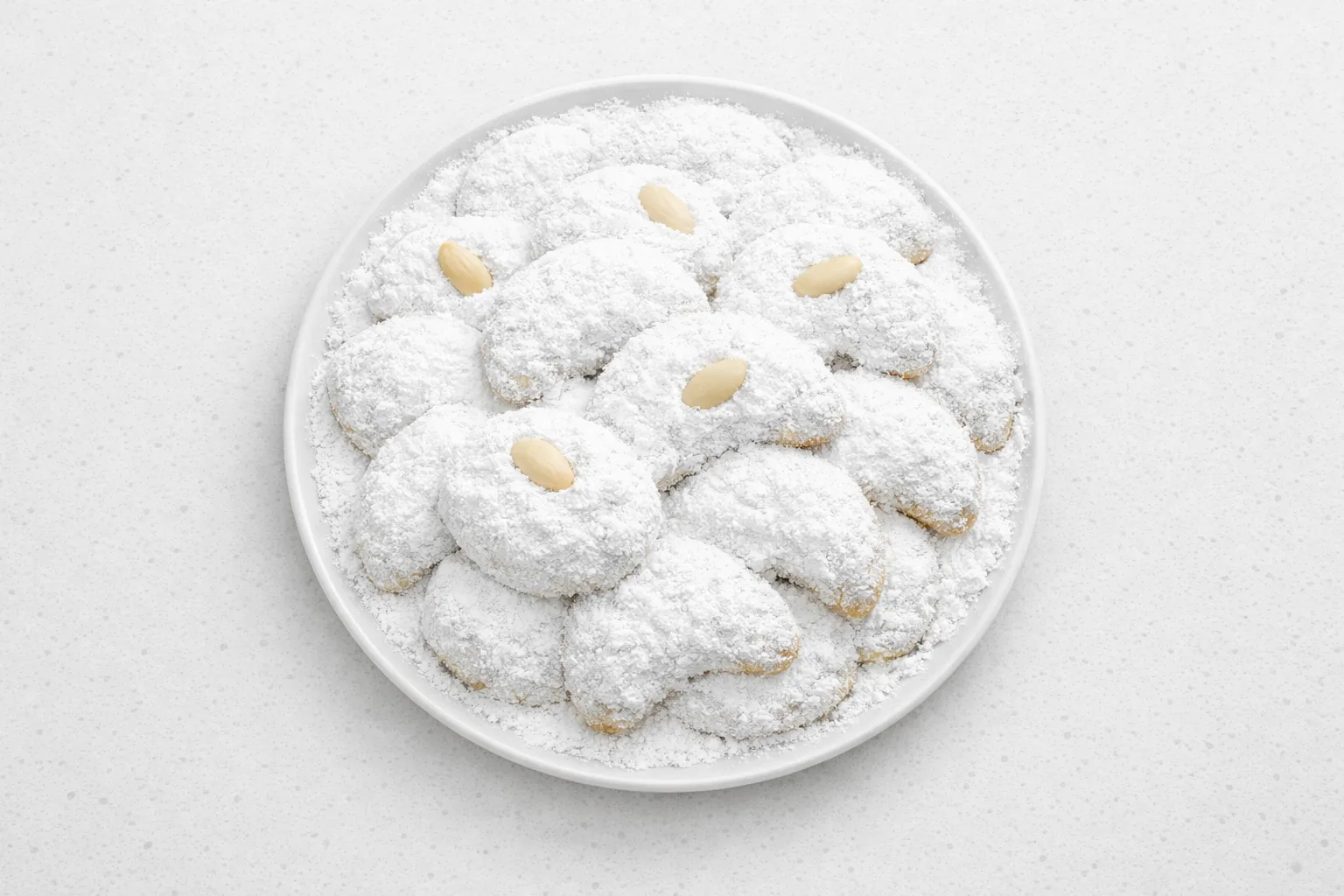
Kourabiedes are Greece's essential Christmas cookie, a short, crumbly butter cookie packed with toasted almonds and completely buried under a blizzard of powdered sugar. Every Greek household makes them in December, often by the kilo. They appear on every holiday table alongside melomakarona, the honey-soaked walnut cookies that are kourabiedes' counterpart in the Greek Christmas cookie canon. Where melomakarona are warm and sticky, kourabiedes are cool, dry, and delicate, dissolving on the tongue before the almond flavor hits.
The secret to kourabiedes that hold together without being dense is clarified butter, called staka in some regions, though most modern recipes use unsalted butter beaten long enough to incorporate air. The dough needs no egg and almost no leavening, which is what gives these cookies their characteristic sandy, melt-in-the-mouth texture. Skipping the resting step or under-toasting the almonds are the two most common mistakes that produce flat, greasy results. This recipe addresses both.
Equipment
Instructions
Tap each step to track your progress
- 1
Toast the almonds in a dry skillet over medium heat for 5-7 minutes, stirring frequently, until they are golden and smell nutty. Tip onto a cutting board, let cool completely, then chop roughly. Set aside.
- 2
In a stand mixer fitted with the paddle attachment, beat the butter on high speed for at least 8 minutes until it is very pale, almost white, and significantly increased in volume. Stop and scrape down the sides twice during this time. This extended creaming is not optional; it is what makes kourabiedes light.
- 3
Add the sifted powdered sugar and beat for another 2 minutes. Add the egg yolks, vanilla, and brandy or ouzo if using, and beat until fully incorporated.
- 4
Reduce the mixer to low. Add the sifted flour, baking powder, and salt in three additions, mixing just until no dry streaks remain. Fold in the chopped toasted almonds with a spatula. The dough should be soft but not sticky.
- 5
Let the dough rest at room temperature for 20 minutes. This relaxes the gluten and makes shaping easier.
- 6
Preheat the oven to 350 F (175 C). Line two baking sheets with parchment paper.
- 7
Scoop tablespoon-sized portions of dough and roll into smooth balls or shape into crescents by rolling a log and curving the ends. Place 1 inch apart on the prepared sheets. Kourabiedes do not spread much.
- 8
Bake for 18-20 minutes until the cookies are just barely golden on the bottom; the tops should remain very pale. Do not wait for visible browning on top or they will be dry.
- 9
While the cookies are still warm (about 5 minutes out of the oven), sift a generous layer of powdered sugar onto a clean baking sheet or tray. Arrange the warm cookies on top of the sugar layer, then sift another thick layer over the tops and sides. The warmth helps the sugar adhere.
- 10
Once fully cooled, sift a final coat of powdered sugar over the cookies until they look like they were caught in a snowstorm. If using rose water, sprinkle a few drops over the final sugar layer.
Tips & Tricks
Beat the butter longer than feels necessary
The creaming step is the foundation of the entire cookie. If the butter has not gone nearly white and doubled in volume, the cookies will be dense rather than crumbly. Set a timer for 8 minutes and do not stop early.
Toast the almonds fresh
Pre-toasted or packaged roasted almonds lack the aroma of almonds you toast yourself. Raw almonds toasted in a dry skillet for 5-7 minutes have a depth of flavor the packaged version can't match. Cool them completely before chopping or they will make the dough greasy.
Rest the dough
The 20-minute rest after mixing is not optional. It hydrates the flour fully and lets the butter firm up slightly, making the dough much easier to shape. Skip it and the dough will be too soft to roll into clean shapes.
Coat in stages while warm
The first layer of powdered sugar goes on when the cookies are still warm, about 5 minutes from the oven. Add a second, generous coat once fully cool. Two coats give that signature thick, matte white finish that defines the cookie.
Make ahead for better flavor
Like most shortbread-style cookies, kourabiedes improve over 24-48 hours as the butter flavor settles and the texture becomes even more crumbly. Bake them a day or two before serving if you can.
Troubleshooting
My kourabiedes are greasy and heavy
The butter was not beaten long enough. Eight minutes minimum on high speed is not excessive; it is the point. If the butter has not tripled in volume and turned nearly white, keep going. Room-temperature butter, not cold and not melted, is also essential.
The cookies crumble apart when I move them after baking
They are too hot. Leave them on the baking sheet for 5 minutes before handling. The short-bread style dough is fragile when warm but firms up significantly as it cools. Use a thin offset spatula to move them gently.
The powdered sugar slides off after the cookies cool
The first coat of sugar must go on while the cookies are still warm so it bonds. If the cookies cooled before you could coat them, lightly mist them with water from a spray bottle, then re-coat with sugar.
My dough is sticky and hard to shape
Either the butter was too warm or the flour was not measured accurately. Refrigerate the dough for 20-30 minutes. Do not add extra flour; it will make the cookies dense and tough.
The cookies are too pale and taste raw
Kourabiedes bake at a lower temperature than most cookies and should remain very pale on top. Check the bottoms: if they are golden and the cookies feel firm when pressed lightly, they are done. The sugar coating makes the tops look raw even when fully baked.
Variations
Cardamom and Pistachio
Replace the blanched almonds with unsalted shelled pistachios, roughly chopped. Add 1/2 tsp ground cardamom to the flour mixture. The flavor is more aromatic and the cookies have a subtle green fleck inside. Reduce toasting time for pistachios to 3-4 minutes as they burn faster than almonds.
Walnut Kourabiedes
Swap the almonds for lightly toasted walnuts, chopped to a medium crumb. Walnuts are more assertive in flavor and give the cookies a slightly darker interior. Some Greek home bakers add a pinch of cinnamon to the dough when using walnuts.
Dairy-Free Adaptation
Replace the butter with a high-quality vegan butter that has at least 80% fat content (brands like Violife or Earth Balance work well). The extended beating step still applies. Texture will be slightly less crumbly but the flavor is close. Add an extra 2 tbsp of the powdered sugar to compensate for less richness.
Unfilled (Plain Kourabiedes)
Omit the almonds entirely for a simpler, smoother cookie. This version relies entirely on the butter flavor, so using the best butter you can find matters more here. Shape into perfect balls for a cleaner presentation.
Serving & Gifting
Pile kourabiedes generously on a large platter, stacked high so the powdered sugar coats everything in a visible drift of white. They are traditionally served with Greek coffee or mountain tea. For holiday gatherings, pair them alongside melomakarona so guests can compare both classic Greek Christmas cookies. For gifting, pack in a tin or box with a sheet of parchment between layers so the sugar coating stays intact during transport.
Storage & Freezing
Kourabiedes keep extremely well in an airtight tin at room temperature for up to 3 weeks, which is part of why Greeks make them by the hundred in early December. The powdered sugar coating actually helps preserve the texture. Do not refrigerate them; the moisture from the fridge makes the sugar damp and sticky. The unbaked dough freezes well for up to 2 months, tightly wrapped in plastic. Thaw overnight in the refrigerator before shaping and baking.
Common Questions
What are kourabiedes?
Kourabiedes are traditional Greek Christmas butter cookies made with almonds and coated in a thick layer of powdered sugar. They are crumbly, very short in texture, and have a delicate vanilla and almond flavor. Along with melomakarona, they are the defining Christmas cookie of Greek households.
Can I make kourabiedes without almonds?
Yes. The cookies work well without nuts and have a clean butter flavor on their own. Some families also use walnuts or pistachios instead of almonds. If omitting nuts entirely, the dough may be slightly stickier, so chill for 15 minutes before shaping.
What does brandy or ouzo do in kourabiedes?
The brandy or ouzo adds a subtle aromatic note and also acts as a tenderizer. Alcohol interferes with gluten development, helping keep the cookies short and crumbly. You can substitute with an equal amount of orange juice if you want an alcohol-free version.
How long do kourabiedes last?
Stored in an airtight tin at room temperature, kourabiedes last 2-3 weeks easily. This is one reason they are made weeks before Christmas in Greece. Do not refrigerate them as the moisture damages the sugar coating.
Can I freeze kourabiedes?
Yes, both the dough and the finished cookies freeze well. Freeze unbaked dough for up to 2 months. Finished cookies can be frozen before the final sugar coating; thaw at room temperature and re-coat with fresh powdered sugar once thawed.
What is the difference between kourabiedes and shortbread?
Both are butter cookies with a crumbly texture, but kourabiedes use a higher ratio of butter, include toasted nuts, and are buried in powdered sugar rather than left plain. The extended butter creaming in kourabiedes gives a lighter, more aerated crumb than most shortbread recipes.