Overnight cinnamon rolls are the solution to every Christmas morning problem: you want something spectacular on the table, but nobody wants to be up at 5am measuring flour. The method is simple — you build the rolls the night before, refrigerate them through their second rise, and on Christmas morning you pull them straight from the fridge into a warm oven. The slow cold fermentation actually improves the dough, giving you a deeper, slightly tangy flavor that same-day rolls can't match.
The technique comes from American home baking tradition, where make-ahead rolls have been a holiday staple for generations. Using an enriched yeast dough — eggs, butter, and milk all working together — produces rolls that stay soft for days rather than staling by afternoon. The cream cheese frosting goes on hot, straight out of the oven, so it melts into every gap and swirl. These are the best cinnamon rolls you will make, and the fact that Christmas morning requires zero stress is the entire point.
Equipment
Instructions
Tap each step to track your progress
- 1
Proof the yeast: whisk the yeast into the warmed milk with 1 tsp of the measured granulated sugar. Let stand for 5-10 minutes until foamy. If the mixture doesn't foam, your yeast is dead or your milk was too hot — start again.
- 2
In a stand mixer fitted with the dough hook, combine the remaining sugar, softened butter, eggs, and salt. Add the yeast mixture and mix on low to combine. Add the flour 1 cup at a time with the mixer running, then increase to medium speed and knead for 6-8 minutes until the dough is smooth and slightly tacky — it should pull cleanly from the bowl sides but still feel soft. If it sticks heavily, add flour 1 tbsp at a time.
- 3
Transfer the dough to a lightly oiled bowl, turn to coat, and cover tightly with plastic wrap. Let rise at room temperature for 1 to 1.5 hours until doubled. A cold kitchen will slow this; a warm spot near the oven speeds it up.
- 4
Mix the filling: stir together the very soft butter, dark brown sugar, cinnamon, nutmeg, and salt in a small bowl until it forms a thick, spreadable paste. It should not be melted — if your butter is too warm, chill it briefly.
- 5
Punch down the risen dough and turn it onto a lightly floured surface. Roll into a rectangle approximately 16x12 inches. The dough should be roughly 1/4 inch thick. Spread the cinnamon filling evenly to within 1/2 inch of all edges using an offset spatula or the back of a spoon.
- 6
Starting from the long edge closest to you, roll the dough tightly into a log. Pinch the seam firmly to seal. Using unflavored dental floss or a sharp serrated knife, cut the log into 12 equal rounds, each about 1.5 inches thick. Dental floss gives a cleaner cut without compressing the dough.
- 7
Arrange the rolls cut-side up in a lightly buttered 9x13 inch baking pan, spaced slightly apart. Cover tightly with plastic wrap and refrigerate for 8 to 16 hours. This is the overnight rest. The rolls will puff slowly in the cold.
- 8
On Christmas morning, remove the pan from the refrigerator and let the rolls sit at room temperature for 45-60 minutes while the oven preheats to 375°F (190°C). The rolls should look noticeably puffier than when they went in. They will not double in size in the fridge — some of that rise happens in the oven.
- 9
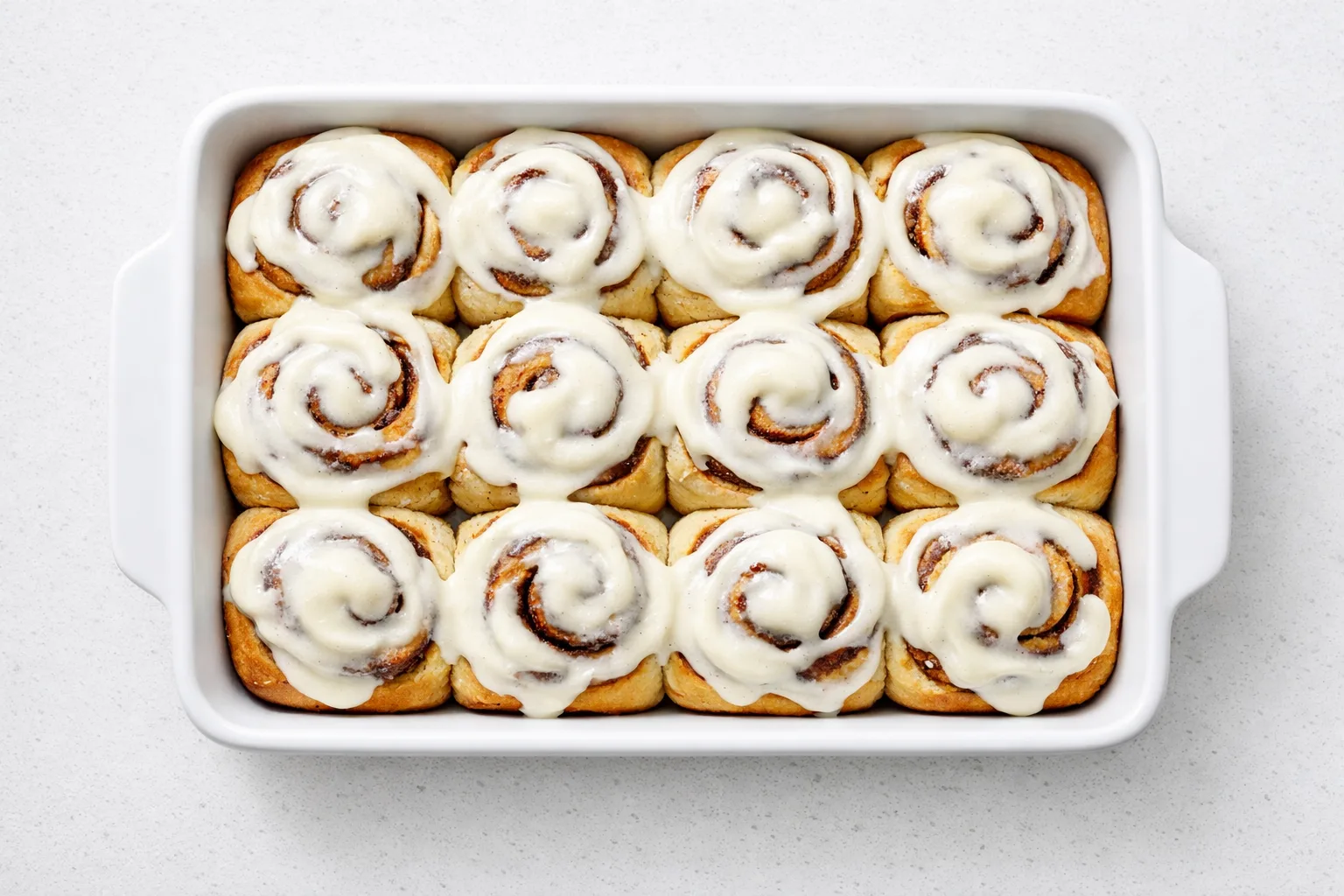
Bake for 24-28 minutes until the tops are deep golden brown and the centers of the middle rolls are cooked through. If the tops are browning too fast, tent loosely with foil after 18 minutes. An instant-read thermometer inserted into the center should read 190°F (88°C).
- 10
While the rolls bake, make the frosting: beat the cream cheese and butter together with a hand mixer or in the stand mixer until completely smooth, about 2 minutes. Add the powdered sugar, milk, vanilla, and salt, and beat on medium-high for 1 minute until fluffy and spreadable.
- 11
Spread the frosting over the rolls immediately while they are still hot from the oven. The heat will melt the frosting into the swirls and crevices. Serve directly from the pan within 15 minutes for the best texture — they are at their peak while still warm.
Tips & Tricks
Don't skip the room-temperature rest on Christmas morning
Baking cold dough straight from the refrigerator results in uneven cooking: the outer rolls overbrown before the center rolls are done. The 45-60 minute rest allows the dough to come toward room temperature and resume active yeast activity, giving you more even rise and color in the oven.
Use dental floss to cut the rolls
A sharp serrated knife works but compresses the dough at the cut point. Slide a 12-inch piece of unflavored dental floss under the log at the cut mark, cross the ends over the top, and pull in opposite directions. This cuts cleanly and keeps each roll round rather than squashed.
Proof the yeast properly before committing to the recipe
Active dry yeast can fail if it is old or if the milk is too hot (above 115°F/46°C kills it). The foaming step at the beginning is your quality check. This matters more with overnight recipes because you won't discover a failed rise until Christmas morning, which is not the time to discover it.
The filling butter must be spreadable, not melted
Melted butter soaks into the dough and the filling slides out during rolling. The butter should be soft enough to spread easily with a spatula but still hold some body. If you're working in a warm kitchen, make the filling and chill it for 10 minutes before using.
Pull them 2 minutes early
Cinnamon rolls continue cooking from residual heat after leaving the oven. Pull them when the tops are deep golden and the thermometer reads 188-190°F (87-88°C). Waiting until they look "fully done" in the oven means dry, tight rolls 10 minutes later.
Troubleshooting
My rolls didn't rise much overnight in the fridge
Cold slows but does not stop yeast. If your refrigerator runs very cold (below 35°F/2°C), the rise will be minimal overnight and most of the puff will happen during the 45-60 minute room-temperature rest and in the oven. Let the rolls sit out a full 60 minutes before baking if your kitchen is cool on Christmas morning.
The filling leaked out all over the pan
Your butter was too soft or melted when you spread it, which causes the filling to run rather than stay in the swirl. The butter should be very soft but not liquid — it should spread without tearing the dough. If filling pools in the pan, the rolls will still taste fine but may stick. Next time, chill the filling briefly if it looks too runny.
My rolls are doughy in the center after baking
The center rolls in a 9x13 pan take longer than the edge rolls. If the tops are brown but the centers are still raw, tent with foil and bake an additional 5-7 minutes. Use an instant-read thermometer — you need 190°F (88°C) in the geometric center of the pan. Underbaked rolls also happen when the rolls went into the oven too cold; always allow the full room-temperature rest.
The dough is too sticky to roll out
The dough should be slightly tacky, but if it tears and sticks heavily to the surface, it needs a little more flour. Dust the surface and the top of the dough lightly, then let it rest 5 minutes covered with a kitchen towel — the gluten will relax and make it easier to roll. Avoid adding too much flour at this stage or the rolls will be dense.
The frosting is too stiff to spread
Add milk or cream 1 teaspoon at a time and beat again. The cream cheese needs to be fully room temperature — cold cream cheese will always result in a lumpy, stiff frosting that won't spread cleanly.
Variations
Dairy-Free Adaptation
Replace the whole milk in the dough with oat milk or full-fat coconut milk warmed to 110°F. Use vegan butter (stick-style, not spread) for both the dough and filling. For the frosting, use dairy-free cream cheese and vegan butter with the same ratios. The dough texture will be very similar; the frosting will be slightly less tangy. Most readers in Central Europe can find good vegan cream cheese at Lidl or specialty stores.
Orange Cardamom Rolls
Add the zest of 2 large oranges and 1 tsp ground cardamom to the filling in place of the nutmeg. Reduce the cinnamon to 2 tbsp. For the frosting, add 2 tbsp fresh orange juice in place of the milk. This variation has a bright, floral quality that suits Christmas well.
Brown Butter Pecan Rolls
Brown the 1/2 cup of filling butter in a saucepan until it smells nutty and has golden-brown solids, then cool completely until solid. Use this in the filling. Add 3/4 cup roughly chopped toasted pecans scattered over the cinnamon filling before rolling. The brown butter adds a toasted, caramel depth.
Maple Cream Cheese Frosting
Replace the powdered sugar with 3/4 cup pure maple syrup and reduce the milk to 0 (the syrup thins the frosting sufficiently). Beat with the cream cheese and butter until smooth. The frosting will be glossy and less stiff, and will soak into the rolls more aggressively. Only use real maple syrup here; artificial maple flavor becomes cloying.
Serving & Gifting
Serve the rolls directly from the baking pan, still warm, within 15 minutes of adding the frosting for the best experience. Pair with strong black coffee, a pot of tea, or a glass of cold orange juice. For a Christmas morning spread, these pair well with a simple fruit platter and scrambled eggs. The rolls are self-contained enough to be the centerpiece of the meal on their own.
Storage & Freezing
Leftover rolls keep in the pan covered tightly with plastic wrap or foil at room temperature for up to 2 days, or refrigerated for up to 4 days. Reheat individual rolls in the microwave for 20-25 seconds — they return almost entirely to their fresh texture. The unbaked, assembled rolls can be frozen before the overnight refrigerator rest: wrap the pan tightly in two layers of plastic wrap and freeze for up to 4 weeks. Thaw overnight in the refrigerator, then follow the normal Christmas morning bake schedule.
Common Questions
Can I make cinnamon rolls the night before and bake them in the morning?
Yes, this is exactly what this recipe is designed for. You assemble and cut the rolls, place them in the buttered pan, cover with plastic wrap, and refrigerate for 8 to 16 hours. On Christmas morning, let them sit at room temperature for 45-60 minutes before baking at 375°F for 24-28 minutes.
How long can overnight cinnamon rolls stay in the fridge before baking?
Up to 16 hours is safe and reliable. Beyond that, the yeast can become overproofed and the dough may develop an overly sour smell. Assembling the rolls before bed (around 10-11pm) and baking mid-morning the next day is the ideal window.
Can I use instant yeast instead of active dry yeast?
Yes. Use the same quantity. You can skip the proofing step — add instant yeast directly to the flour with the other dry ingredients and the rise time will be similar or slightly faster. The overnight cold rise works the same with both types.
Why are my overnight cinnamon rolls not fluffy?
The most common cause is flour. Too much flour produces dense, bread-like rolls instead of soft, pillowy ones. Measure flour by spooning it into the cup and leveling off, or use a kitchen scale (1 cup all-purpose flour = 125g). The second cause is overworking the dough after the initial knead, which tightens the gluten structure. Once the dough is shaped, handle it as gently as possible.
How do I store leftover cinnamon rolls?
Cover the pan tightly with plastic wrap or foil and store at room temperature for up to 2 days, or refrigerate for up to 4 days. Microwave individual rolls for 20-25 seconds to restore softness. They do not freeze well once baked and frosted — the texture degrades.
Can I make the cream cheese frosting ahead of time?
Yes. Make the frosting the night before and store it in an airtight container in the refrigerator. On Christmas morning, let it sit at room temperature for 20 minutes and stir well before spreading. You may need to add a teaspoon of milk to loosen it if it has stiffened significantly in the cold.