
 Russia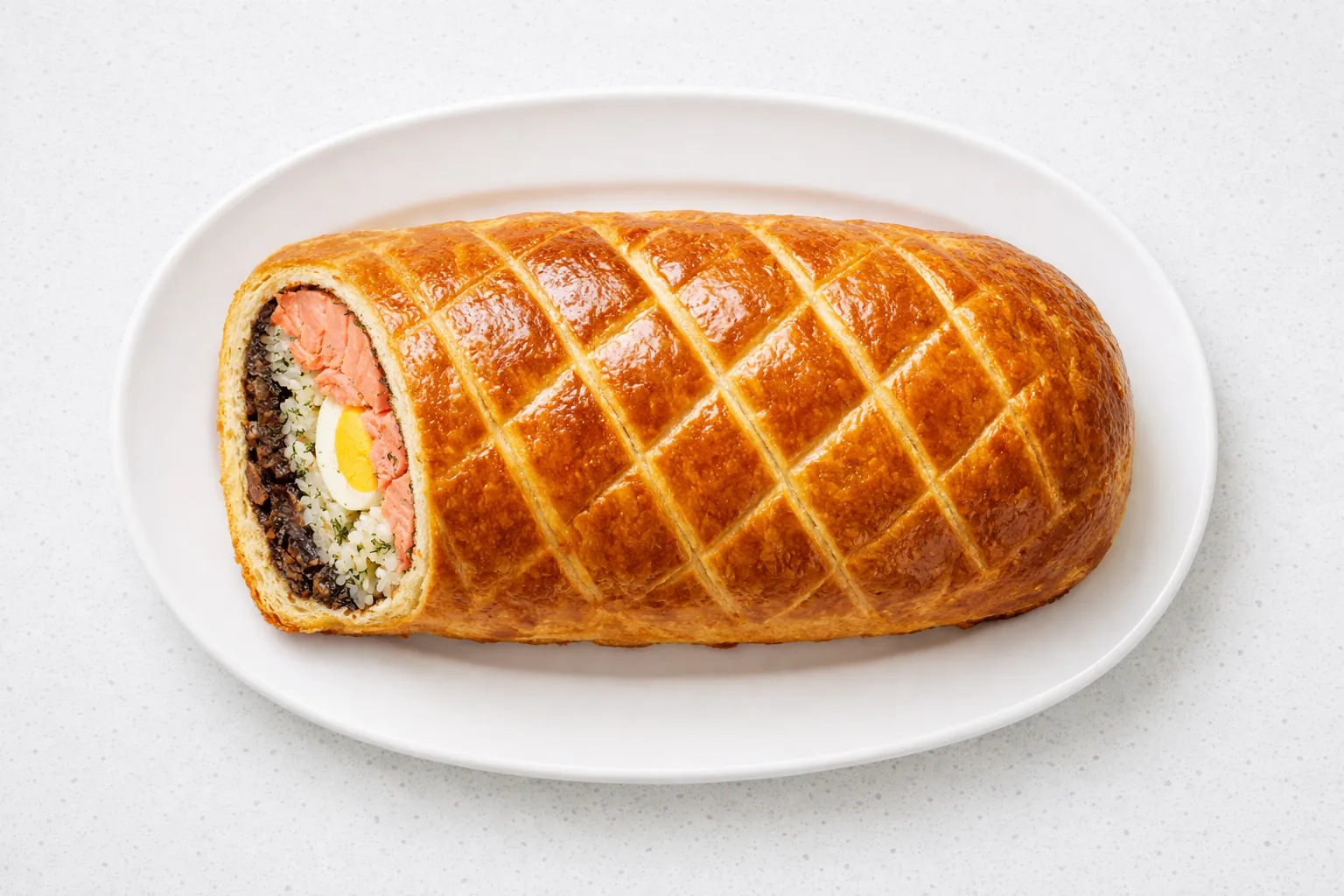
Salmon coulibiac, known in Russian as kulebyaka, is one of the great centrepiece dishes of the Russian feast table. A whole fillet of salmon is layered with mushroom duxelles, herbed rice, and hard-boiled eggs, then encased in an enriched brioche dough and baked until the crust turns deep gold and audibly crisp. It is elaborate by design: this was never a weeknight dish. It was the dish that announced a celebration.
The name causes some confusion because French-trained chefs brought it west under the name "coulibiac" in the 19th century, and it eventually fused with ideas from beef Wellington. The Russian original has always been a salmon en croute affair, built in distinct vertical layers rather than a rolled log. Those layers are the point: when you slice it at the table, each cross-section shows salmon pink against mushroom brown against pale rice. Getting those layers clean requires patience and cold dough.
This version uses a buttery brioche rather than shortcrust or puff pastry. Brioche holds structure, absorbs none of the salmon juices into sogginess, and has enough fat in the dough to stay tender even when cold. The mushroom duxelles acts as a moisture barrier. The result is a salmon Wellington that actually works.
Equipment
Instructions
Tap each step to track your progress
- 1
Make the brioche dough first since it needs to rise twice. Combine the warm milk, yeast, and sugar in the bowl of a stand mixer. Let sit for 5 minutes until foamy. Add the flour and salt, then add 3 eggs one at a time with the mixer on low using the dough hook. Once incorporated, increase to medium speed and mix for 6 minutes until the dough is smooth and pulls away from the bowl sides.
- 2
With the mixer on medium-low, add the softened butter a few cubes at a time, waiting until each addition is fully incorporated before adding the next. This takes about 8-10 minutes total. The dough should be smooth, slightly tacky, and glossy. Transfer to a lightly oiled bowl, cover with plastic wrap, and refrigerate overnight or for at least 6 hours. Cold dough is essential for easy handling.
- 3
Make the herbed rice: bring the stock to a boil in a small saucepan, add the rice and salt, reduce to a low simmer, cover, and cook for 15-17 minutes until the stock is absorbed and the rice is tender. Remove from heat. Stir in the butter, dill, parsley, chives, and lemon zest. Spread on a sheet pan to cool completely. The rice must be fully cold before assembly or it will steam the dough from inside.
- 4
Make the mushroom duxelles: pulse the mushrooms in a food processor until very finely chopped, working in batches. They should resemble coarse wet sand. Melt the butter in a large skillet over medium-high heat. Add the shallots and cook for 2 minutes until softened, then add the garlic and cook for 30 seconds more. Add the mushrooms, salt, and pepper. Cook, stirring frequently, for 12-15 minutes until all the liquid has evaporated and the mixture is dry and dark. Add the wine and thyme, cook another 3-4 minutes until the wine is fully absorbed. Spread on a sheet pan and cool completely. Wet duxelles will make the pastry soggy.
- 5
Season the salmon fillet evenly on both sides with salt and pepper. Pat dry with paper towels. Brush the top surface with Dijon mustard and scatter the dill over it. Set aside at room temperature while you prepare to assemble.
- 6
Remove the chilled brioche dough from the refrigerator. On a lightly floured surface, roll it into a rectangle approximately 14 x 18 inches (35 x 46cm) and no thinner than 1/4 inch. The dough should be cold and firm. If it springs back or warms up, return it to the refrigerator for 15 minutes before continuing.
- 7
Transfer the dough rectangle to a large parchment-lined baking sheet. Spread half the herbed rice lengthwise down the center third of the dough, leaving a 2-inch border at both short ends. Leave the rice layer slightly narrower than the salmon. Layer all the mushroom duxelles evenly over the rice. Place the salmon fillet mustard-side down on top of the duxelles. Arrange the hard-boiled egg slices in a single overlapping layer on top of the salmon. Spread the remaining herbed rice over the egg layer, pressing gently to pack the layers together.
- 8
Fold one long side of the dough up and over the filling, then bring the other side over to overlap it by at least 1 inch. Press to seal the seam along the top. Fold and crimp the short ends tightly like wrapping a package, pressing firmly to seal. Flip the entire parcel over so the seam is on the bottom. The coulibiac should now be a smooth, firm oval package. Use your hands to shape it gently.
- 9
Beat the remaining egg with cold water to make the egg wash. Brush the entire surface generously with egg wash. Use a sharp knife to score a diagonal crosshatch pattern across the top, cutting only 1/8 inch deep into the dough, not through it. Cut 3-4 small steam vents along the top. Refrigerate the assembled coulibiac for at least 30 minutes while the oven heats. This firms up the dough so it holds shape during baking.
- 10
Preheat the oven to 400F (200C). Bake the coulibiac for 35-40 minutes until the crust is deeply golden brown all over. An instant-read thermometer inserted into the center through one of the steam vents should read at least 130F (54C) for medium salmon or 145F (63C) for fully cooked. The crust should sound hollow when tapped on the bottom. Rest for 10-15 minutes before slicing with a serrated knife.
Tips & Tricks
Build dry, build cold
Every component that goes inside the pastry needs to be completely cool and as dry as possible. Warm or wet fillings turn the bottom crust into a paste. Make the duxelles, rice, and eggs the day before, refrigerate everything separately overnight, and assemble with cold hands.
Blind-season the salmon
The Dijon mustard brushed on the salmon before assembly does two things: it seasons the fish directly, and it acts as a glue to hold the dill in place during the layered assembly. Do not skip it. It is subtle in the final result but the layers taste noticeably more cohesive with it.
Score and vent properly
The scored crosshatch is not decoration. It helps the crust bake evenly and prevents blowouts along the seams where steam pressure builds. Cut the vents at least 1/2 inch wide so they stay open during baking rather than sealing over from oven spring.
Use an instant-read thermometer
Do not guess the doneness of salmon baked inside a pastry. The crust browning tells you nothing about what is happening to the fish inside. Insert the thermometer through one of the steam vents. Pull at 130F (54C) for salmon that is still translucent at the center, or 140F (60C) for fully opaque.
Make the brioche dough two days ahead
The dough improves with a longer cold ferment. Made two days ahead and kept refrigerated, the brioche develops more flavor from slow fermentation and is noticeably easier to handle because the butter firms up thoroughly throughout. The slower rise makes the final crumb tighter and better suited to slicing cleanly at the table.
Troubleshooting
The pastry is soggy at the bottom
Both the duxelles and the rice were not dry enough before assembly. Wet components release steam inside the sealed pastry and have nowhere to go. Next time, cook the duxelles until it looks bone-dry and spread both components on sheet pans for at least 30 minutes before using. Also ensure the baking tray itself is fully preheated before the coulibiac goes in.
The dough tore during assembly
The brioche warmed up too much during rolling and became too soft to handle. Brioche has a high butter content and softens fast in a warm kitchen. Work in sections, returning the dough to the refrigerator for 15-minute rests whenever it starts to feel tacky or hard to control. Cold dough rolls cleanly; warm dough tears.
The layers collapsed when I sliced it
The coulibiac needs the 10-15 minute rest after baking to allow the filling to set up. Sliced immediately from the oven, the layers are too loose to hold. The rest also allows the internal temperature to equalize and the pastry to firm up so your knife makes clean cuts. Use a sharp serrated knife and slice with a gentle sawing motion rather than pressing down.
The crust is pale and doesn't brown evenly
The egg wash was applied too thinly or missed patches. Apply a second coat of egg wash after the first dries slightly, paying attention to all surfaces including the ends. Make sure your oven is fully preheated. If the bottom is still pale after 35 minutes, carefully slide the parchment directly onto the oven rack for the final 5 minutes of baking.
The salmon is overcooked and dry
The fillet was too thin at the tapered end, or the oven temperature was too high. Fold the thin tail end of the fillet under itself to create a more even thickness before layering. Pull the coulibiac at 130F (54C) internal if you prefer salmon with some pink; the resting time will carry it a few more degrees.
Variations
Mushroom and Spinach Vegetarian Version
Replace the salmon with a 1.5-inch-thick layer of seasoned ricotta blended with sauteed spinach (squeeze very dry), roasted red peppers, and black olives. Use vegetable stock for the rice. Skip the mustard and egg layer and instead add a layer of roasted cherry tomatoes. Bake until the crust reaches 190F (88C) internally.
Puff Pastry Version (Shorter Prep)
Substitute two sheets of thawed all-butter frozen puff pastry for the brioche dough. Roll each sheet to about 14 x 10 inches. Assemble the filling on one sheet, top with the second sheet, and seal the edges by pressing with a fork. Puff pastry will be flakier and lighter but more prone to sogginess at the base. Keep all filling layers very dry and consider adding a thin layer of cream cheese directly under the salmon to act as a moisture barrier.
Smoked Salmon and Cream Cheese Version
For a richer, no-cook filling, replace the fresh salmon with 1 lb (450g) of good-quality smoked salmon. Mix the cream cheese (8oz) with fresh dill and horseradish to taste and spread it where the duxelles layer goes. Skip baking to an internal temp check since the salmon is already cured. Bake only until the crust is golden, about 30-35 minutes.
Dairy-Free Adaptation
Replace the butter in the brioche with refined coconut oil and use oat milk in place of dairy milk. The texture will be slightly less tender and the dough slightly stickier to handle; keep everything well-chilled and flour your hands generously. Use olive oil for the duxelles instead of butter. The result is still impressive though the crust will lack some of the richness.
Serving & Gifting
Bring the whole coulibiac to the table on a board or platter before slicing. It makes a dramatic entrance. Slice with a serrated knife into portions about 1.5 inches thick and serve with soured cream or creme fraiche, a sharp dill and caper sauce, or classic Russian-style horseradish cream. A simple salad of cucumber, dill, and white wine vinegar cuts through the richness and is the traditional accompaniment. For a Christmas dinner centerpiece, plan on one thick slice per person with sides.
Storage & Freezing
Leftover coulibiac keeps refrigerated, wrapped tightly in foil, for up to 2 days. Reheat individual slices in a 325F (160C) oven for 12-15 minutes, covered loosely with foil to prevent the crust from drying. The coulibiac does not freeze well once assembled and baked as the pastry becomes soggy on thawing. You can, however, freeze the fully assembled but unbaked coulibiac for up to 3 weeks; transfer directly from freezer to oven and add 15-20 minutes to the bake time, checking internal temperature.
Common Questions
What is the difference between salmon coulibiac and salmon Wellington?
They are closely related but come from different traditions. Salmon coulibiac (kulebyaka) is Russian in origin and traditionally built in distinct horizontal layers including rice and eggs inside an enriched dough. Salmon Wellington was adapted by French-trained chefs and typically follows the Wellington structure: salmon wrapped in mushroom duxelles inside puff pastry, without the rice or egg layers. The coulibiac is more complex, more filling, and older.
Can I make salmon coulibiac ahead of time?
Yes. You can assemble the entire coulibiac up to 24 hours in advance, keep it covered and refrigerated unbaked, and bake it straight from the refrigerator on the day. Add 5-8 minutes to the bake time if baking from cold. This is how most home cooks manage the timing for a Christmas dinner main course.
What type of salmon is best for coulibiac?
Use a center-cut fillet from wild-caught salmon (sockeye or king/Chinook) for the best flavor and color. Center-cut fillets have even thickness, which means even cooking throughout. Avoid tail pieces or thin edge cuts, which will overcook before the pastry is done. Farmed salmon works but has a softer texture and paler color in the finished layers.
How do I know when the coulibiac is cooked through?
An instant-read thermometer is the only reliable method. Insert it through one of the steam vents until it reaches the center of the salmon layer. 130F (54C) for medium (slightly translucent center), 145F (63C) for fully cooked through. The deep golden color of the crust alone does not indicate the salmon's doneness.
Can I use puff pastry instead of brioche dough?
You can, and the result will be flakier and lighter. However, puff pastry is more prone to sogginess at the base because it relies on steam between layers for its rise rather than a yeasted structure. If using puff pastry, keep all filling components exceptionally dry, consider pre-baking the base sheet for 10 minutes before assembly, and bake at a slightly higher temperature (425F / 220C) for a shorter time.
Is salmon coulibiac traditionally a Christmas dish in Russia?
Kulebyaka has been a celebratory dish in Russian cuisine since at least the 19th century and appears on Easter, Christmas, and New Year tables. Fish versions were especially associated with Orthodox fasting periods when meat was prohibited, making a salmon kulebyaka the natural feast-day choice for a Christmas Eve or Christmas dinner centrepiece in Russian Orthodox households.