 Spain
Spain 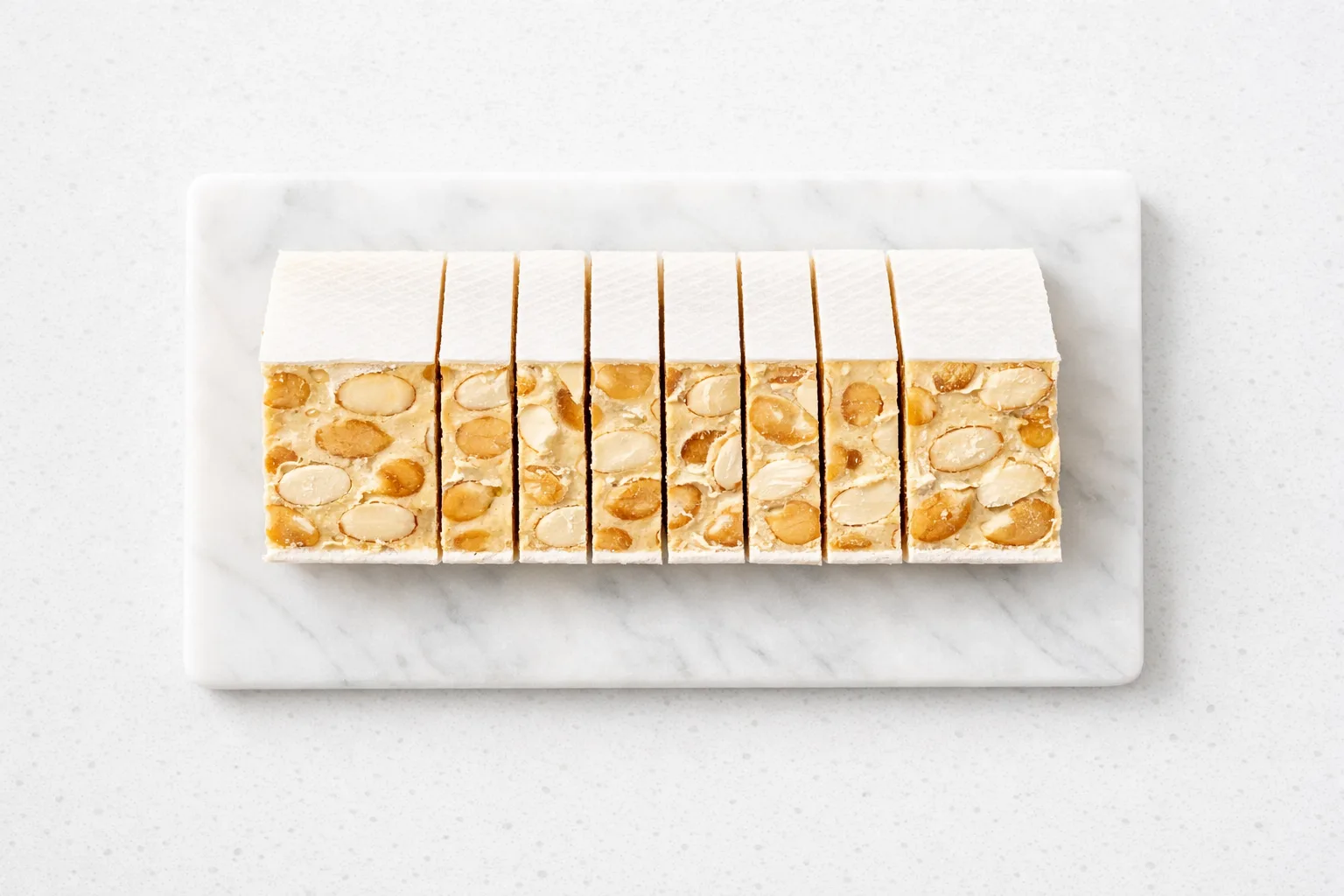
Turron is Spain's most important Christmas confection, eaten across the country from Christmas Eve through Three Kings' Day on January 6. It comes in two canonical forms: Turron de Alicante, the hard variety with whole roasted almonds suspended in a crystalline honey-sugar matrix, and Turron de Jijona, a soft, fudgy paste where the almonds are ground into the honey until the texture becomes almost spreadable. Both styles are protected by Spanish geographical indication status and have been made in the towns of Alicante and Jijona since at least the 16th century.
The ingredients are almost absurdly simple: almonds, honey, sugar, and egg whites. The craft is entirely in the cooking. The key variable is final temperature: take the sugar-honey syrup to 145C (293F) for crunchy Alicante, stop at 120C (248F) for soft Jijona. This recipe covers both, with clear instructions for where the paths diverge.
Use the best honey you can buy. Spanish blossom honey is traditional, but any mild, floral honey works. Avoid strongly flavored honeys like buckwheat, which will overpower everything else. The almonds should be raw Marcona almonds if you can find them; they have a rounder, more buttery flavor than standard California almonds and are the variety actually used in Jijona.
Equipment
Instructions
Tap each step to track your progress
- 1
Toast the almonds on a dry baking sheet in a 325F (160C) oven for 10 to 12 minutes, stirring once halfway, until they are fragrant and light golden. Pull them out and keep them warm. Cold almonds will cause the syrup to seize when combined.
- 2
Line an 8x4 inch loaf pan with one sheet of rice paper on the bottom. Set a second sheet nearby to place on top. If making both styles, prepare two pans.
- 3
In a medium heavy-bottomed saucepan, combine the honey, sugar, and salt. Stir briefly to combine, then attach a candy thermometer to the side of the pan. Cook over medium heat without stirring until the mixture reaches 120C (248F) for Jijona style or 145C (293F) for Alicante style. This takes 15 to 25 minutes depending on your target temperature; watch the thermometer carefully in the last few degrees.
- 4
While the syrup cooks, whip the egg whites in a clean stand mixer bowl with the whisk attachment on medium-high speed until stiff peaks form. The whites should hold a firm, glossy peak when you lift the whisk.
- 5
When the syrup hits your target temperature, immediately remove it from the heat. With the mixer running on low speed, pour the hot syrup in a slow, steady stream down the side of the bowl into the whipped whites, avoiding the whisk. Once all the syrup is in, increase the speed to medium and whisk for 2 minutes until the mixture is thick and slightly cooled.
- 6
Add the warm toasted almonds and fold them in quickly using a heat-proof spatula. Work fast; the mixture will stiffen as it cools. For Jijona style, skip this step and instead transfer the mixture to a food processor; see Variations section.
- 7
Scrape the turron mixture into the prepared pan, pressing it down firmly and evenly with the spatula or dampened hands. Lay the second sheet of rice paper over the top and press firmly so it adheres.
- 8
Let the turron cool completely at room temperature, at least 2 hours, before unmolding. For Alicante style, place a heavy cutting board or another loaf pan on top as a weight to compress the nougat while it sets; this gives cleaner, denser slices.
- 9
Unmold the turron, peel away any overhanging rice paper from the sides, and slice with a sharp heavy knife into 1/2-inch pieces. The rice paper on top and bottom stays on; it is edible and traditional.
Tips & Tricks
Temperature accuracy is everything
The difference between 120C and 145C determines whether you get Jijona or Alicante. Use a digital probe thermometer rather than a glass candy thermometer if possible. Clip it to the pan so the probe is in the syrup but not touching the bottom.
Warm almonds, fast hands
Cold almonds cool the nougat too fast and make it seize before you can spread it. Pull the almonds from the oven just before your syrup hits temperature and have your pan lined and ready before you start. Speed matters from the moment the almonds go in.
Make the Alicante style first
If making both styles in one session, make Alicante first. It requires the higher temperature so you can simply stop cooking earlier on the second batch for Jijona. This way you only dirty one saucepan and one mixer bowl.
Rest overnight for clean slices
Alicante turron slices most cleanly after an overnight rest under weight. If you cut it after just 2 hours it may crumble at the edges. A heavy book on top of the pan overnight produces noticeably cleaner, glossier cuts.
Use real rice paper, not plastic-backed sheets
Rice paper (wafer paper) for candy-making is edible and dissolves on the tongue. It is not the same as Asian spring roll wrappers. Look for it in specialty baking shops or online; the brand Oblea is commonly used in Spain and widely available.
Troubleshooting
My turron is grainy or sugary instead of smooth
The sugar crystallized, almost certainly because the syrup was stirred after it came to a boil or because sugar crystals from the sides of the pan fell in. Use a wet pastry brush to wash down the sides of the pan once the syrup starts boiling, and do not stir once the boil begins.
The nougat won't set and stays too soft
The syrup did not reach a high enough temperature. A 5-degree drop from your target makes a significant difference in the final texture. Invest in an accurate digital candy thermometer; analog thermometers can read several degrees off. If your Alicante nougat is soft after 4 hours, it likely peaked at 135C instead of 145C.
The mixture seized up immediately and won't spread into the pan
This happens when the nougat is overworked at too low a temperature or when the almonds were cold when added. Work quickly and keep the almonds warm. If it seizes mid-transfer, dampen your hands with cold water and press it into the mold by force; it will compress acceptably.
The rice paper bubbles or separates from the nougat
The nougat was too hot when the top paper was applied, or the paper got wet. Apply the top paper only after the mixture has been pressed into the pan and rested for 5 minutes off direct heat. Press firmly and evenly.
My Jijona turron is too crumbly, not fudgy
The almond paste needs more oil. Add another teaspoon of almond oil and re-process. Jijona's texture comes from the natural fat released by the ground almonds; if yours feels dry, the almonds may have needed longer in the processor to break down fully.
Variations
Turron de Jijona (Soft Style)
After step 6, instead of adding whole almonds to the nougat, first grind the toasted almonds in a food processor until they reach a coarse paste. Fold this almond paste into the nougat mixture along with 1 tablespoon of almond oil or neutral oil to help achieve the characteristic fudgy texture. The soft version does not need to be pressed under weight; it will firm up on its own to a paste-like consistency that can be sliced but not snapped.
Chocolate Turron
Melt 3.5 oz (100g) of good dark chocolate (70% cacao) and fold it into the nougat mixture along with the almonds in step 6. The chocolate will seize slightly against the hot nougat but stir firmly until evenly combined. The result is a denser, darker turron with a bittersweet edge that balances the honey sweetness.
Pistachio and Rose Water Turron
Replace half the almonds with shelled raw pistachios and add 1 teaspoon of rose water to the syrup in step 3. The color will be pale green-flecked and the flavor slightly floral. This variation is closer to Middle Eastern nougat traditions that influenced Spanish confectionery via Moorish culture.
Nut-Free Adaptation
Replace all almonds with toasted pumpkin seeds (pepitas) for a nut-free version. The flavor is earthier and less sweet. Keep the target temperature the same; the seeds behave like almonds in the hot nougat. Note: rice paper and all other ingredients are naturally nut-free. Add `nut-free:dietary` consideration for allergy sufferers.
Serving & Gifting
Turron is traditionally served on a wooden board in its block form and sliced at the table, letting guests break off or cut pieces themselves. Pair it with a small glass of Spanish cava, sweet sherry, or a strong espresso to cut through the sweetness. It also works well as part of a Christmas dessert spread alongside dried figs, dates, and polvorones. For gifting, wrap individual bars tightly in parchment, then foil, and tie with twine; a homemade turron bar is a genuinely impressive edible gift.
Storage & Freezing
Turron keeps extremely well wrapped tightly in parchment and stored in an airtight container at room temperature for up to 4 weeks, which is part of why it became a Christmas gift tradition. Refrigeration is not necessary and can introduce moisture that softens the Alicante style. Do not freeze turron; the nougat weeps when thawed and the texture changes permanently. If you live in a very humid climate, add a small food-safe silica packet to the storage container.
Common Questions
What is turron made of?
Traditional Spanish turron contains just four ingredients: almonds, honey, sugar, and egg whites. The ratio and cooking temperature determine the final texture; no other ingredients are needed for the classic versions.
What is the difference between Turron de Alicante and Turron de Jijona?
Turron de Alicante is the hard variety, made by cooking the syrup to a higher temperature (145C/293F) and folding in whole almonds. Turron de Jijona is the soft variety, made at a lower temperature (120C/248F) with the almonds ground into a paste rather than left whole. Both use the same base recipe.
Can I make turron without a candy thermometer?
Not reliably. Both styles require precise temperatures that cannot be judged accurately by eye or by the cold water test. A candy thermometer is the single most important piece of equipment for this recipe, and the difference of even 5 degrees significantly changes the result.
What type of almonds should I use for turron?
Marcona almonds are the traditional choice; they are rounder, fattier, and more buttery than California almonds and produce a more authentic flavor. If you cannot find them, blanched whole California almonds work, but the turron will have a slightly firmer, drier texture.
How long does homemade turron last?
Wrapped properly in parchment and stored in an airtight container at room temperature, homemade turron keeps for 3 to 4 weeks. This makes it an excellent make-ahead recipe for Christmas; you can prepare it in late November and it will still be fresh for the holiday season.
Is turron gluten-free?
Yes, traditional turron contains no gluten. The wafer paper used as a liner is typically made from potato starch or rice starch and is also gluten-free, but check the packaging to confirm if you are baking for someone with celiac disease.