
Christmas Wreath History, Meaning and Symbolism
The wreath on your front door has a 2,500-year backstory involving Olympic athletes, Lutheran orphans, and a woman named Louise Fisher who changed how America decorates for Christmas.
The Christmas wreath is one of the oldest decorations still in common use. Its circular form connects to traditions stretching back more than two millennia, from the athletic fields of ancient Greece to the church doors of 16th-century Germany. Today, roughly 35 million wreaths sell in the United States alone each holiday season. But the wreath's meaning has shifted dramatically across those centuries, absorbing layers of pagan, Christian, and purely decorative significance along the way.
Contents
- 1. Ancient Greek and Roman Wreath Traditions
- 2. What Does a Christmas Wreath Symbolize?
- 3. The Advent Wreath and Its Lutheran Origins
- 4. Why Do We Hang Wreaths on Doors at Christmas?
- 5. How Colonial Williamsburg Shaped the American Wreath
- 6. Traditional Wreath Materials and What They Mean
- 7. How to Make a Simple Christmas Wreath
- 8. Frequently Asked Questions
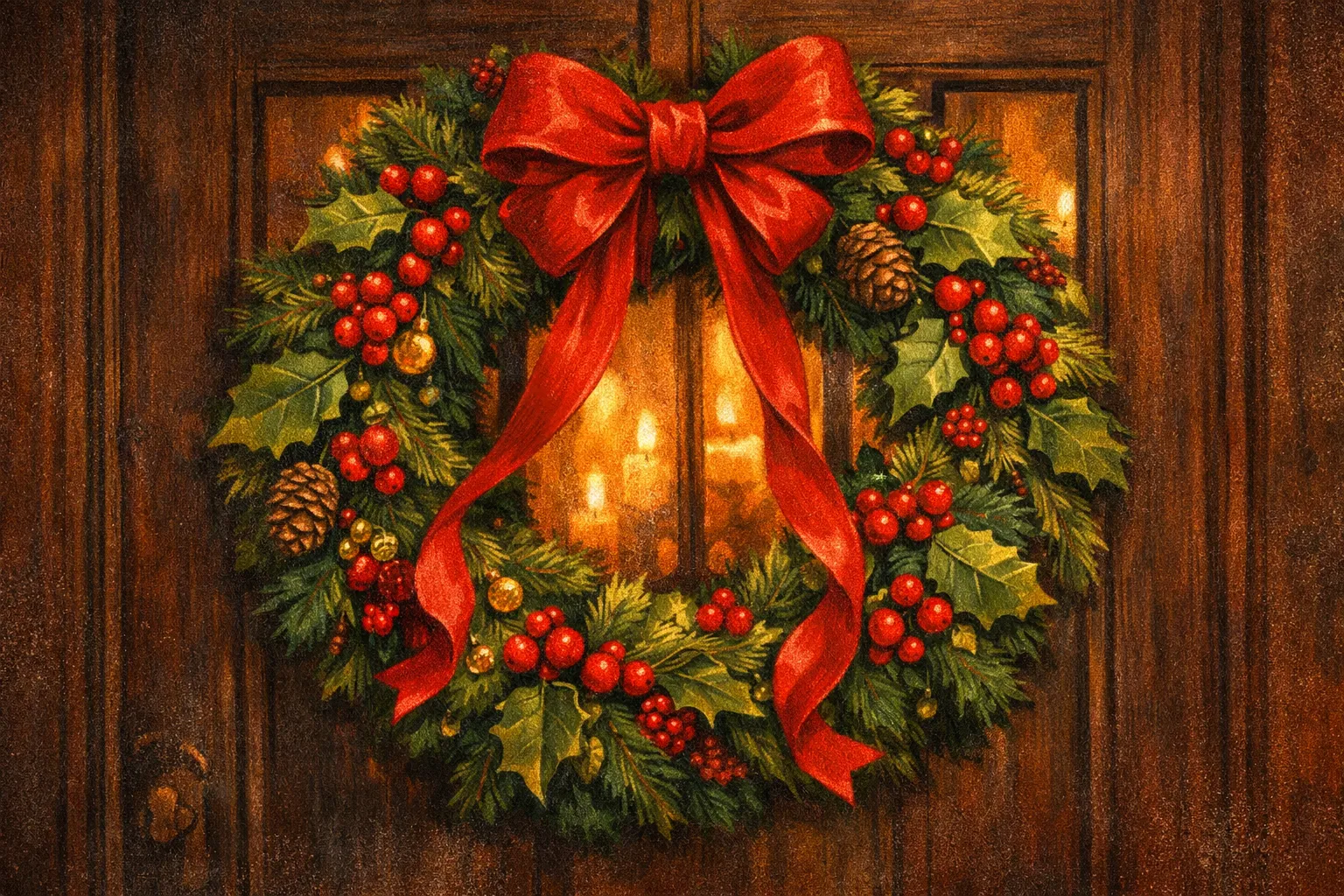
At its simplest, a Christmas wreath is a circle of evergreen branches hung on a door or placed on a table with candles. The circle, having no beginning and no end, represents eternity. The evergreens represent persistent life in the dead of winter. Those two symbols combined give the wreath its staying power across cultures and centuries.
Ancient Greek and Roman Wreath Traditions
Long before anyone hung a wreath on a door in December, the ancient Greeks were placing them on the heads of athletes. At the four Panhellenic Games, victors received plant crowns rather than medals. Olympic champions at Olympia wore olive wreaths cut from a sacred tree near the temple of Zeus. At the Pythian Games in Delphi, held in honor of Apollo, winners received laurel wreaths. At the Nemean Games, wild celery. At the Isthmian Games, pine.
The laurel wreath carried particular cultural weight. Greek mythology tied it to the story of Daphne, a nymph who was transformed into a laurel tree to escape Apollo's pursuit. Apollo then declared the laurel sacred and fashioned the first wreath from its branches. The symbol stuck. Poets, musicians, and military leaders all adopted the laurel as a mark of achievement.
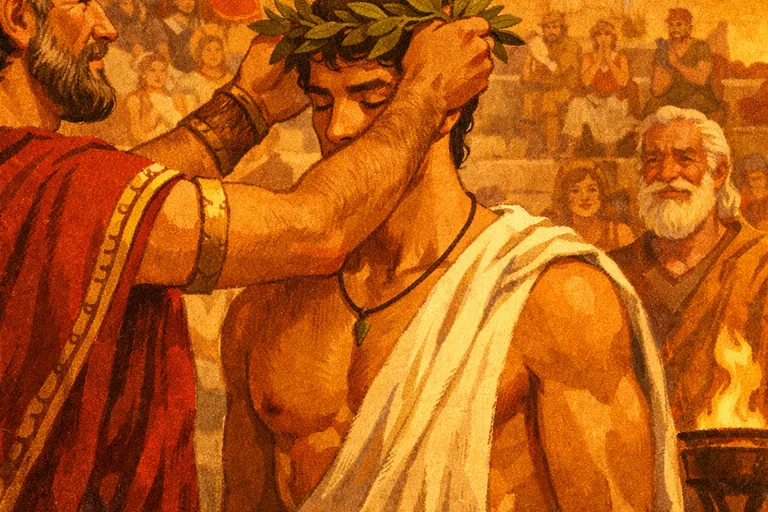
Rome took the idea and ran with it. Generals celebrating a triumph wore laurel wreaths through the streets. Emperors adopted the wreath as a symbol of authority. The Romans also introduced wreaths into their winter celebrations. During Saturnalia, the late-December festival honoring Saturn, Romans exchanged evergreen wreaths as tokens of good luck and renewal. Evergreens held obvious appeal during the darkest weeks of the year, since they were the only plants that refused to die.
This is the critical link. When Christianity spread across the Roman Empire, many existing customs were absorbed rather than discarded. The Saturnalia wreath, already associated with winter celebration, became available for new meaning.
What Does a Christmas Wreath Symbolize?
Christians mapped their theology onto the wreath's existing form. The circle, already a symbol of cycles and renewal in pagan practice, became a symbol of God's eternal nature and the promise of everlasting life. The evergreen branches, once symbols of natural endurance, came to represent the immortality of the soul.
Specific materials acquired their own Christian readings. Holly, with its sharp leaves, was interpreted as a reference to the crown of thorns. Its red berries represented the blood of Christ. Ivy, which clings and climbs, symbolized faithfulness. Pine and fir, green through the harshest cold, stood for hope and resurrection.
The red ribbon or bow that appears on most modern wreaths carries a double meaning. In Christian symbolism, red represents Christ's sacrifice. In the broader folk tradition, it simply signals warmth and welcome. A wreath without a ribbon can look unfinished, which says more about aesthetic convention than theology.
The Advent Wreath and Its Lutheran Origins
The Advent wreath is a distinct tradition from the door wreath, though the two are often confused. It sits on a table or hangs from a ceiling, holds candles, and serves a liturgical purpose tied to the four weeks before Christmas.
Its inventor is known by name. In 1839, Johann Hinrich Wichern, a Protestant theologian in Hamburg, Germany, built the first Advent wreath for the children at the Rauhen Haus, an institution he had founded in 1833 to house neglected and orphaned children. The kids kept asking how many days remained until Christmas. Wichern's solution was practical: he mounted candles on an old cartwheel. The original design held 24 candles, one for each day of Advent. Four large white candles marked the Sundays. Twenty smaller red candles filled in the weekdays between.
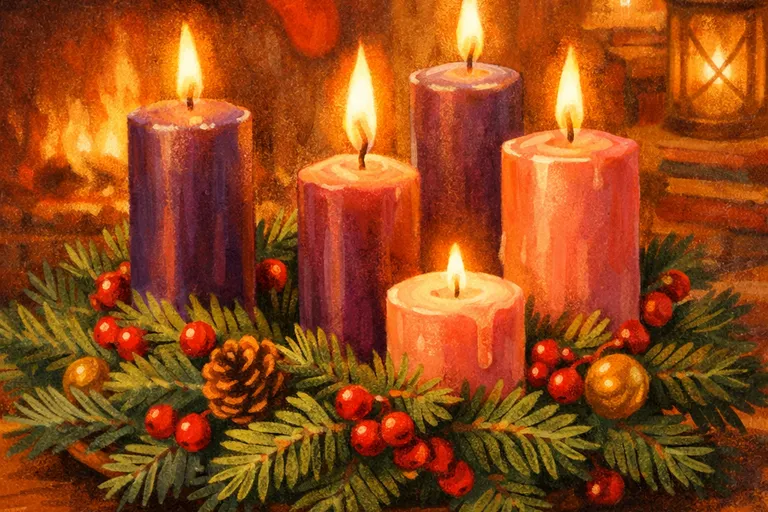
That original cartwheel wreath was far too large for a normal living room. Over the following decades, the design was simplified to four candles on a ring of evergreen branches. This is the version that spread across German Protestant households. Roman Catholics in Germany adopted it in the 1920s. By the 1930s, the Advent wreath had crossed the Atlantic to North America.
The four candles now carry standardized symbolic meaning in most Christian traditions: hope, peace, joy, and love. Their colors vary by denomination. Many Catholic and some Protestant churches use three purple (or blue) candles and one rose candle, with rose lit on the third Sunday of Advent, known as Gaudete Sunday. Other traditions use all white or all red candles. Some add a fifth white candle in the center, lit on Christmas Day itself.
Why Do We Hang Wreaths on Doors at Christmas?
The door wreath has different roots from the Advent wreath. Hanging greenery on or above a door is an ancient practice linked to hospitality. In medieval Europe, a bundle of evergreen on a door signaled that travelers were welcome inside. It served as a kind of pre-literate "open" sign.
By the 18th and 19th centuries, door wreaths in Britain and northern Europe had become associated with Christmas specifically. Families decorated their entrances with holly, ivy, and whatever local evergreens grew nearby. The wreath was a public declaration: this household is celebrating.
In 19th-century America, the tradition took on additional social meaning. Hanging a wreath became a way to signal welcome to carolers and neighbors during the holiday season. The grander the wreath, the more prosperous the household appeared. This competitive aspect has never entirely disappeared. Anyone who has driven through a wealthy suburb in December knows the wreath can still function as a status marker.
How Colonial Williamsburg Shaped the American Wreath
The wreaths most Americans picture at Christmas owe a surprisingly specific debt to one woman and one place. In 1936, Colonial Williamsburg in Virginia began decorating its historic buildings for Christmas. The initial effort was modest: a few plain wreaths and some running cedar. Louise Fisher, appointed to oversee the decorations, traveled to the Library of Congress to research period-appropriate designs.
What Fisher found and created was not, strictly speaking, historically accurate. She drew inspiration from the della Robbia style, named after the 15th-century Italian sculptor Luca della Robbia, known for ceramic garlands of fruits and flowers. She also looked to Grinling Gibbons, the English woodcarver who created elaborate fruit-and-foliage carvings for cathedrals and royal palaces until his death in 1720.
By 1939, Fisher's fruit-studded wreaths were attracting national attention. The timing was perfect. After World War II, America's expanding middle class went looking for aspirational holiday traditions. Colonial Williamsburg provided them. Decorating magazines spread the "Williamsburg look" across the country. Thousands of tourists photographed the wreaths each year and went home to replicate them.
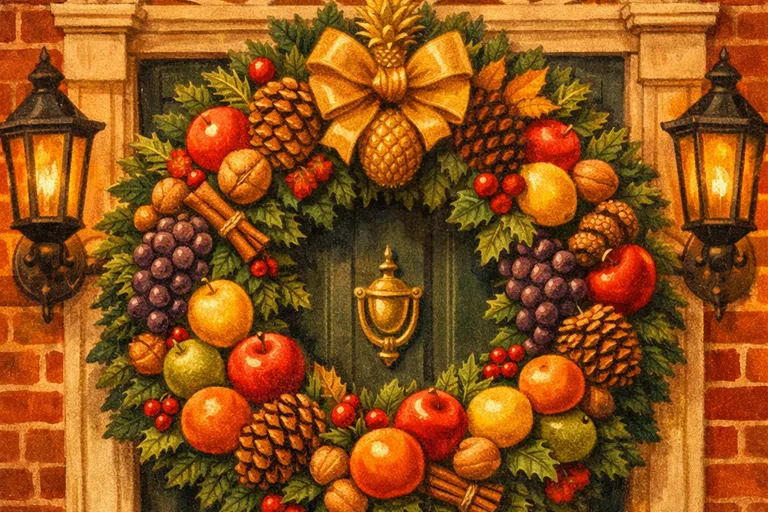
The irony is that actual colonial Americans did not decorate this way. The elaborate fruit-and-greenery wreaths are a 20th-century invention dressed in 18th-century clothing. Colonial Williamsburg's own historians have acknowledged this. But the style proved so popular that historical accuracy became beside the point. The "colonial" wreath is now a genuine American tradition, just not the one it claims to be.
Traditional Wreath Materials and What They Mean
A traditional Christmas wreath is built on a frame of wire, grapevine, or straw, then covered with evergreen branches. The choice of greenery matters both practically and symbolically.
- Pine and fir form the base of most wreaths. They're widely available, hold their needles reasonably well indoors, and carry a strong seasonal scent. Symbolically, they represent endurance and eternal life.
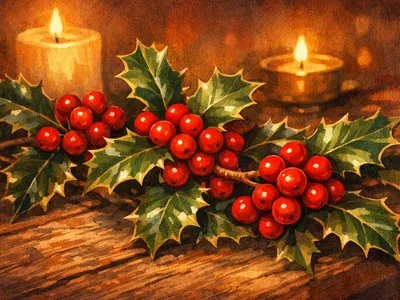
- Holly is the most symbolically loaded wreath material. Its spiny leaves and red berries connect to Christ's passion in Christian tradition. In pre-Christian Celtic and Roman culture, holly was believed to ward off evil spirits.
- Ivy represents fidelity and attachment. It was traditionally paired with holly in English Christmas carols and decorations.
- Red ribbon serves as both a visual anchor and a symbol of sacrifice or welcome, depending on the tradition.
- Pinecones symbolize renewal and the promise of spring growth.
- Dried fruits and berries added color in eras before artificial decorations existed, and nod to the della Robbia tradition Colonial Williamsburg popularized.
Modern wreaths often add cinnamon sticks, dried orange slices, bells, or battery-powered lights. The base materials remain remarkably consistent with what people used three centuries ago. Maine's balsam fir industry ships millions of wreaths each November, and hand-tied wreaths from fresh-cut branches remain the gold standard for anyone willing to spend more than the price of a plastic alternative.
How to Make a Simple Christmas Wreath
Making a wreath at home requires surprisingly few materials: a wire wreath frame (available at any craft store), floral wire, pruning shears, and fresh evergreen branches. Cut the branches into pieces roughly 15 to 20 centimeters long. Working in one direction around the frame, wire small bundles of branches to the frame, overlapping each bundle to hide the stems of the previous one. Continue until the entire frame is covered.
Once the green base is complete, add decorations. Wire or hot-glue pinecones, berries, and ribbon. A bow at the top or bottom provides a focal point. The whole process takes about an hour for a beginner and produces a wreath that will last three to four weeks outdoors in cool weather.
The craft dimension of wreath-making has seen a revival in recent years. Wreath-making workshops have become a popular pre-Christmas social activity across Europe and North America, particularly in the UK, Germany, and Scandinavia. For many people, building the wreath has become as much a part of the seasonal ritual as hanging one.
Frequently Asked Questions
What does a Christmas wreath symbolize?
A Christmas wreath symbolizes eternity and everlasting life through its circular shape, which has no beginning or end. The evergreen branches represent hope and enduring life through winter. In Christian tradition, specific materials carry additional meaning: holly represents the crown of thorns, red berries symbolize Christ's blood, and red ribbon signifies sacrifice and welcome.
Why do we hang wreaths on doors at Christmas?
The tradition of hanging wreaths on doors dates back to medieval Europe, where greenery on a doorway signaled hospitality and welcome to travelers. By the 18th and 19th centuries, the practice became specifically associated with Christmas. In America, Colonial Williamsburg popularized elaborate door wreaths starting in the 1930s, and the custom spread nationwide through decorating magazines and tourism.
Who invented the Advent wreath?
Johann Hinrich Wichern, a Protestant theologian in Hamburg, Germany, created the first Advent wreath in 1839. He built it from an old cartwheel with 24 candles to help orphaned children at his Rauhen Haus institution count the days until Christmas. The original design was later simplified to four candles representing the four Sundays of Advent.
What is the difference between an Advent wreath and a Christmas wreath?
An Advent wreath is a table or ceiling decoration with four candles, used during the four weeks before Christmas to mark the liturgical season of Advent. A Christmas wreath is typically a door decoration made of evergreen branches, ribbon, and ornaments. The Advent wreath serves a religious and calendrical function, while the door wreath is primarily decorative and a symbol of welcome.
How long does a fresh Christmas wreath last?
A fresh Christmas wreath made from balsam fir, pine, or cedar typically lasts three to four weeks outdoors in cool weather. In dry indoor conditions, it may dry out faster. Misting the wreath with water every few days and keeping it away from direct heat sources can extend its life. Wreaths made from boxwood or magnolia leaves tend to last longer than needle-based varieties.
What were ancient Greek and Roman wreaths made of?
Ancient Greek wreaths were made from specific plants depending on the occasion. Olympic victors received olive wreaths, Pythian Games winners received laurel, Nemean Games champions wore wild celery, and Isthmian Games victors received pine. Romans adopted the laurel wreath as a symbol of military triumph and imperial authority, and exchanged evergreen wreaths during their winter festival of Saturnalia.