
Colors of Christmas and What They Mean
Red and green weren't always the default. The Christmas color palette took centuries to settle, shaped by ancient Roman festivals, medieval church customs, Victorian advertising, and one very influential soft drink company.
The colors of Christmas feel inevitable. Red and green dominate store displays, wrapping paper, and sweaters worn with varying degrees of irony. Gold glitters on tree toppers. White blankets everything from frosted windowpanes to ceramic village sets. But none of this was predetermined. The Christmas color palette we treat as ancient tradition is really a patchwork of religious symbolism, botanical accident, Victorian taste, and corporate marketing that only locked into place about 150 years ago.
Contents
The core Christmas colors are red, green, gold, and white, with silver and blue as strong secondary players. Each carries specific symbolism rooted in both Christian theology and pre-Christian winter customs. Red represents the blood of Christ and the warmth of fire. Green signals eternal life through evergreen plants that refuse to die in winter. Gold recalls the gifts of the Magi. White stands for purity and snow.
But meanings shift over time. Understanding why these particular hues stuck requires looking at what people actually did during winter celebrations, long before anyone sold a Christmas-themed anything.
Why Are Red and Green Christmas Colors?
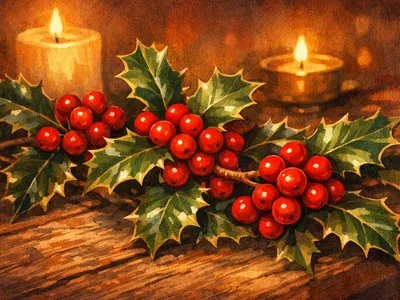
The pairing of red and green at Christmas has roots older than the holiday itself. Ancient Romans decorated with evergreen branches during Saturnalia, their late-December festival of feasting and gift exchange. Holly, with its sharp green leaves and bright red berries, was especially prized. Romans believed holly warded off evil spirits and brought good fortune, and they exchanged holly wreaths as gifts.
Early Christians adopted these same plants but reassigned their meanings. Holly's thorny leaves became a reference to Christ's crown of thorns, its red berries a symbol of his blood. The green represented resurrection and eternal life. Medieval churches across Europe decorated with holly and ivy during the Christmas season, cementing the red-green combination in religious practice centuries before it became a commercial palette.
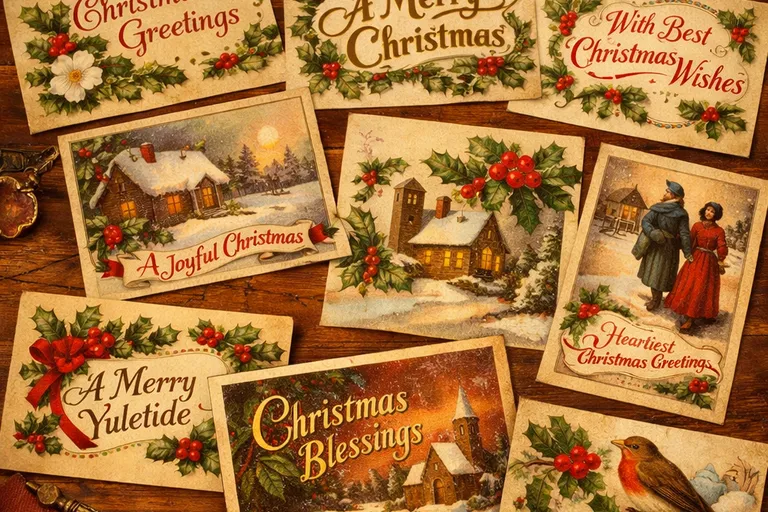
But the real lock-in happened in the Victorian era. Chromolithography, the first commercial color printing process, made mass-produced Christmas cards possible starting in the 1860s. Printers found that red and green reproduced well together and created strong visual contrast. Louis Prang, a German-born printer working in Boston, produced the first widely distributed American Christmas cards in 1875, heavily featuring red and green. By the 1880s, these cards had trained an entire generation's eye.
Then came Coca-Cola. The company didn't invent Santa's red suit, as is sometimes claimed. But their 1931 advertising campaign, illustrated by Haddon Sundblom, did standardize a particular version of Santa in a vivid Coca-Cola red. Those ads ran for over three decades and appeared in magazines read by millions. The warm red of Santa's coat, set against green Christmas trees, reinforced the color pairing more powerfully than any church tradition ever had.
Why Is Red a Christmas Color?
Red's association with Christmas runs along three separate tracks. The religious symbolism came first: red as the color of Christ's sacrifice, the liturgical color worn by clergy during certain feast days, and the red of holly berries that decorated churches. St. Nicholas, the historical bishop who inspired Santa Claus, would have worn red bishop's robes in the 4th century.
The second track is purely practical. Red is the color of fire. In northern European and Scandinavian countries, December means short days and long, freezing nights. Candles, hearth fires, and red-painted wooden ornaments brought visual warmth to dark homes. Swedish and Norwegian Christmas traditions are particularly saturated with red, from painted wooden horses (Dalecarlian horses date to the 17th century) to the red linens that cover holiday tables.
The third track is commercial. After Prang's Christmas cards and Sundblom's Coca-Cola Santa, 20th-century advertising locked red into its dominant position. Red is the color of urgency and warmth. It photographs well. It pops on shelves. Marketers didn't choose red because it was traditional. They helped make it traditional because it sold.
Why Is Green a Christmas Color?
Green's role is the most straightforward of any Christmas color, and also the oldest. It predates Christianity entirely. In the dead of winter, when deciduous trees stand bare and landscapes turn brown and grey, evergreen plants are the only visible proof that life continues. Pine, fir, spruce, holly, ivy, and mistletoe all keep their leaves through the darkest months.
Pagan cultures across northern Europe brought evergreen branches indoors during the winter solstice as a reminder that spring would return. The practice was so widespread that the early Christian church couldn't suppress it, so they absorbed it instead. Evergreens became symbols of God's everlasting life and Christ's promise of resurrection.
The modern Christmas tree, a decorated evergreen brought indoors, traces its documented origins to 16th-century Strasbourg (now in France, then part of the Holy Roman Empire). German immigrants brought the tradition to America in the 1700s, but it didn't become mainstream until 1848, when the Illustrated London News published a drawing of Queen Victoria and Prince Albert gathered around a decorated tree. The image went viral by Victorian standards. Within a decade, the Christmas tree was a fixture in British and American homes, and green was permanently locked in as a foundational Christmas color.
Gold Christmas Color Meaning
Gold's place in the Christmas palette connects directly to the Nativity story. The Gospel of Matthew describes the Magi bringing three gifts to the infant Jesus: gold, frankincense, and myrrh. Gold, the most visually striking of the three, became the color most associated with that story.
But gold also carries broader symbolic weight. It represents light in darkness, the star that guided the Magi to Bethlehem, and divine radiance. In Christian art stretching back to late antiquity, gold backgrounds (especially in Byzantine icons and medieval altarpieces) signified the heavenly realm. The gold halos painted around saints and angels used actual gold leaf, a material choice that carried theological meaning.

In practical terms, gold works beautifully as an accent color. It catches light. It suggests luxury without being cold. Gold ornaments on a green tree create a contrast that feels both regal and cozy. It's the reason gold ribbon, gold tinsel, and gold-painted nutcrackers remain perennial bestsellers.
What Are the 12 Christmas Colors?
The concept of "12 Christmas colors" doesn't come from any single historical source, but the number keeps surfacing in modern design guides and holiday decor references. The most commonly cited list includes:
- Red: Christ's blood, warmth, Santa's suit
- Green: Evergreen life, hope, renewal
- Gold: Gift of the Magi, divine light, the Star of Bethlehem
- White: Purity, snow, peace
- Silver: Moonlight on snow, stars, elegance
- Blue: The Virgin Mary, night sky, winter cold
- Purple: Advent, royalty, repentance
- Burgundy/Maroon: Richness, tradition, mulled wine
- Pink: The third Advent candle (Gaudete Sunday), joy
- Brown: Earth, the stable at Bethlehem, gingerbread
- Orange: Citrus fruit (a traditional Christmas gift), cloves, warmth
- Ivory/Cream: Candlelight, vintage nostalgia, aged parchment
Some lists swap in copper or bronze for orange, or include tartan plaid as a pattern rather than a single color. The point isn't that exactly twelve colors exist by some official decree. It's that Christmas has accumulated a remarkably deep palette over time, far beyond the red-and-green shorthand.
Christmas Colors History: How the Palette Evolved
Before the 19th century, there was no standardized Christmas color scheme. Medieval Christmas was dominated by whatever nature and the church provided: green boughs, red berries, white candles, gold chalices. The colors varied by region. Scandinavian countries leaned into red and white. Germanic traditions favored green, white, and gold. Italian celebrations used rich purples and reds associated with religious vestments.
The Victorian era (1837-1901) was the great standardizer. Queen Victoria and Prince Albert didn't just popularize the Christmas tree. They popularized a specific aesthetic: green trees decorated with candles (white and gold), glass ornaments imported from the German town of Lauscha (where hand-blown glass baubles were first produced around 1847), and tartan ribbons. The Victorian Christmas card industry, which exploded after Henry Cole commissioned the first commercial card in 1843, established red, green, and gold as the "correct" holiday palette.
The 20th century layered on silver and blue. Silver tinsel, originally made from actual silver and later aluminum, became a tree staple in the early 1900s. Blue gained ground through associations with winter, frost, and the Virgin Mary. The 1957 Elvis Presley song "Blue Christmas" cemented blue as emotionally compatible with the holiday, even if its mood ran counter to the usual cheer.
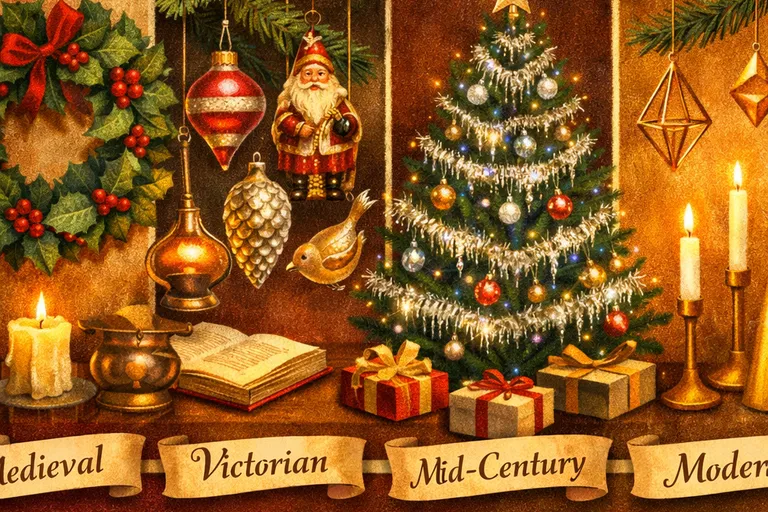
Recent decades have fractured the palette further. Rose gold arrived in the 2010s and refuses to leave. Scandinavian minimalism brought muted whites, greys, and natural wood tones into holiday decor. Teal and turquoise have become popular alternatives to traditional blue. The classic red-and-green palette still dominates, but it now competes with dozens of "curated" alternatives promoted by retailers and interior designers each November.
The Symbolism That Sticks
Color symbolism at Christmas works because it layers multiple meanings onto single hues. Red is simultaneously fire, blood, berries, and a Coca-Cola ad. Green is an evergreen branch, the Garden of Eden, and a department store display. This density is what gives Christmas colors their emotional weight. They don't mean one thing. They mean everything at once.
Church liturgical colors still follow their own logic. The Advent season uses purple (or sometimes blue, in some Protestant traditions) to signify preparation and penitence. The third Sunday of Advent, Gaudete Sunday, introduces pink to signal that the waiting is almost over. Christmas Day itself shifts to white and gold, the colors of celebration and divinity. These liturgical choices predate any commercial Christmas palette by centuries.
The commercial palette, meanwhile, continues to evolve. Pantone has declared a "Color of the Year" since 2000, and retailers increasingly build holiday collections around trending tones. In 2023, Pantone's Viva Magenta showed up in Christmas decor lines within months. The traditional palette absorbs new colors the way a Christmas tree absorbs new ornaments: the old ones stay, and the new ones find whatever branch is open.
In 1858, the first commercial Christmas tree lot opened in New York City. The trees were sold bare. No standard ornament colors existed. No red-and-green wrapping paper. No gold star toppers. Every color association we now consider timeless has been invented, borrowed, or repurposed within the last 150 years. The palette feels eternal because it's been repeated so many times that it's burned into visual memory, which is how all traditions work, when you think about it.
Frequently Asked Questions
Why are red and green the traditional Christmas colors?
Red and green became Christmas colors through a combination of ancient botanical associations (holly's red berries and green leaves), Christian symbolism (red for Christ's blood, green for eternal life), and Victorian-era commercial reinforcement through Christmas cards and advertising. The pairing was cemented by mass-produced cards in the 1870s and Coca-Cola's iconic Santa campaigns starting in 1931.
What does gold symbolize at Christmas?
Gold represents the gift brought to the infant Jesus by the Magi, as described in the Gospel of Matthew. It also symbolizes divine light, the Star of Bethlehem, and heavenly glory. In Christian art, gold has been used for centuries to depict the sacred realm, making it a natural fit for Christmas decorations connected to the Nativity story.
What are the 12 colors of Christmas?
The commonly cited 12 Christmas colors are red, green, gold, white, silver, blue, purple, burgundy, pink, brown, orange, and ivory. There's no single official list, but these 12 appear most frequently in holiday design references. Each carries its own symbolism, from red's association with warmth and sacrifice to purple's connection to the Advent season.
Why is blue considered a Christmas color?
Blue is associated with the Virgin Mary, whose robes are traditionally depicted in blue in Christian art. It also represents the winter night sky, frost, and the cold beauty of the season. In some Protestant churches, blue replaces purple as the liturgical color for Advent. The color gained further holiday recognition through the 1957 Elvis Presley recording of "Blue Christmas."
Did Coca-Cola invent the red Christmas color scheme?
No. Red was already firmly established as a Christmas color through centuries of religious symbolism, holly berries, and Victorian Christmas cards. However, Coca-Cola's advertising campaigns from 1931 onward, featuring Haddon Sundblom's paintings of Santa in a bright red suit, did more than any other single source to standardize the specific shade of red we associate with Christmas today.
How have Christmas colors changed over time?
Before the Victorian era, there was no standardized Christmas color palette. Medieval celebrations used whatever nature provided: green boughs, red berries, white candles. The Victorians locked in red, green, and gold through Christmas cards and tree decorating trends. The 20th century added silver tinsel and blue. Recent decades have introduced rose gold, teal, muted Scandinavian neutrals, and annually trending accent colors.