
Poinsettia History, Meaning, and Care
Before an American diplomat renamed it, the poinsettia was a sacred Aztec plant called cuetlaxochitl. Its path to every Christmas mantle involves colonialism, corporate monopoly, and one very persistent myth about toxicity.
Every December, roughly 70 million poinsettias sell across the United States in a six-week window, generating about $250 million at the wholesale level. No other potted plant comes close to that kind of seasonal dominance. But the story of how a subtropical Mexican shrub became the definitive Christmas houseplant involves a diplomat with questionable motives, a German immigrant family's grafting secret, and a 16th-century Mexican folk tale about a girl too poor to bring a gift to church.
Contents
- 1. How Joel Roberts Poinsett Brought the Plant to America
- 2. Why Are Poinsettias Associated with Christmas?
- 3. The Ecke Family Monopoly on Poinsettia Production
- 4. National Poinsettia Day and the Plant's Cultural Footprint
- 5. Are Poinsettias Poisonous? The Myth Debunked
- 6. Poinsettia Care Tips for the Christmas Season
- 7. Modern Poinsettia Varieties Beyond Classic Red
- 8. Frequently Asked Questions
The poinsettia, known scientifically as Euphorbia pulcherrima, is native to Mexico and Central America. Long before it had anything to do with Christmas, the Aztecs cultivated it under its Nahuatl name: cuetlaxochitl (roughly pronounced kwet-la-sho-she), meaning "mortal flower that perishes and withers like all that is pure." They prized the plant for practical reasons, extracting red and purple dyes from its bracts for textiles and cosmetics, and using its milky white sap as a folk remedy for fevers and skin infections.
How Joel Roberts Poinsett Brought the Plant to America
In 1825, Joel Roberts Poinsett became the first United States Minister to Mexico. A South Carolina politician, amateur botanist, and deeply controversial figure, Poinsett spent his time in Mexico interfering in local politics so aggressively that the Mexican government eventually asked for his recall. But he also spent time collecting plants.
In 1828, while traveling through Taxco in the state of Guerrero, Poinsett encountered the red-bracted shrub the Spanish-speaking locals called flor de nochebuena, the "flower of Christmas Eve." He clipped specimens and shipped them back to his greenhouse in South Carolina.
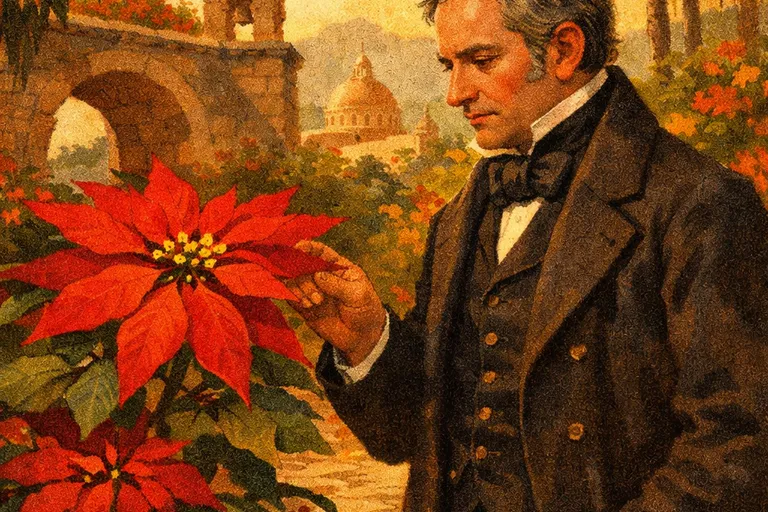
Poinsett sent samples to Robert Buist, a prominent Philadelphia nurseryman, who exhibited the plant at a Pennsylvania Horticultural Society show in 1829. Botanists initially named it Euphorbia pulcherrima ("most beautiful euphorbia"), but William Hickling Prescott, the historian best known for his work on the Spanish conquest, suggested naming it after Poinsett. The common name stuck.
The irony is worth noting. Poinsett's legacy in Mexico is largely negative. He meddled in Mexican affairs, pushed expansionist U.S. interests, and later, back in the States, played a role in the forced removal of the Cherokee along the Trail of Tears as Secretary of War under Martin Van Buren. That his name is now permanently attached to Mexico's most beloved flower is a fact that hasn't gone unnoticed by Mexican historians and activists who prefer the original name, cuetlaxochitl.
Why Are Poinsettias Associated with Christmas?
The plant's connection to Christmas predates Poinsett. In Mexico, poinsettias naturally bloom during the short days of winter, coinciding with the Christmas season. The Aztecs considered the plant significant because it flowered around the winter solstice, the birthday of Huitzilopochtli, their god of sun and war.
After the Spanish colonization and conversion of Mexico to Catholicism, Franciscan monks in the 17th century began incorporating the red plants into Nativity processions. The star shape of the bract arrangement suggested the Star of Bethlehem, and the red color evoked the blood of Christ. The Vatican itself adopted the poinsettia for Christmas displays in the 19th century, and Catholic churches worldwide followed.
The Legend of Pepita
The most popular origin story is a Mexican folk tale about a girl named Pepita (sometimes called Maria) who was too poor to bring a gift for the baby Jesus at the Christmas Eve church service. An angel, or in some versions her cousin Pedro, told her that any gift given with love would be enough. Pepita gathered a handful of roadside weeds and placed them at the church Nativity scene. The weeds miraculously bloomed into brilliant red flowers. From that night on, the plants were called Flores de Noche Buena, Flowers of the Holy Night.
Whether you consider this a touching parable or a piece of missionary folklore designed to syncretize indigenous botanical knowledge with Catholic tradition is a matter of perspective. Either way, it cemented the plant's Christmas identity across Latin America centuries before it reached U.S. living rooms.
The Ecke Family Monopoly on Poinsettia Production
The poinsettia might have remained a niche botanical curiosity if not for one German immigrant family. Albert Ecke emigrated from Germany to Los Angeles in 1900, started a dairy and orchard, and became fascinated by the wild poinsettias growing in the area. By 1909, the poinsettias were selling so well from his roadside stand that he abandoned everything else to focus on them.
His son Paul moved the operation to Encinitas, California, about 25 miles north of San Diego. But it was Paul's grandson, Paul Ecke Jr., who turned the family business into something close to a monopoly. The Eckes discovered a grafting technique that combined two poinsettia varieties to produce a compact, bushy plant with dense bract coverage. Wild poinsettias are leggy, sparse things. The Ecke method produced the lush, full plants that consumers wanted.
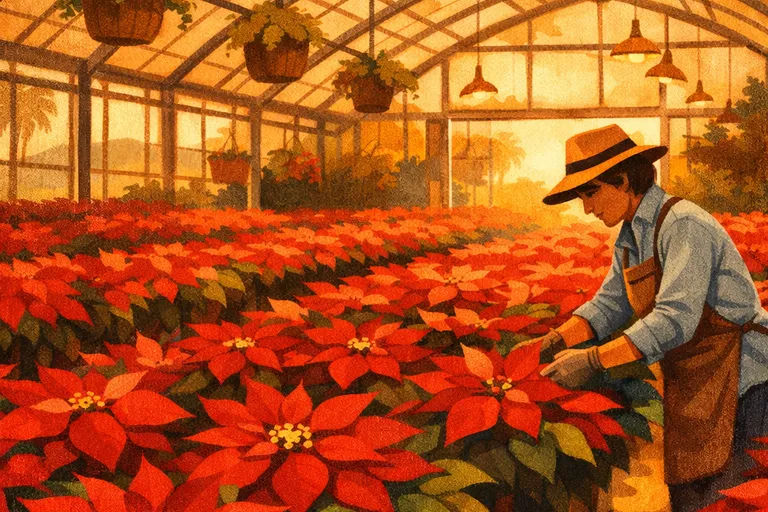
Paul Ecke Jr. was also a marketing genius. He sent free poinsettias to television shows, magazines, and women's publications. Every November and December, poinsettias appeared on The Tonight Show and in the pages of Ladies' Home Journal. The association between poinsettias and Christmas became inescapable, and the Eckes controlled the supply. At their peak, they held a 90 percent share of the U.S. wholesale poinsettia market, with more than 150 plant patents and annual sales exceeding 25 million cuttings to other growers on a royalty basis.
The monopoly crumbled thanks to a single academic paper. In 1988, a university researcher named John Dole published an article revealing the Ecke family's grafting technique, which had been a closely guarded trade secret. Growers around the world could now produce the same compact plants. The Ecke family's market share eroded steadily, and in 2012 they sold the business to the Dutch conglomerate Dümmen Orange.
National Poinsettia Day and the Plant's Cultural Footprint
In 2002, the United States Congress designated December 12 as National Poinsettia Day. The date marks the anniversary of Joel Roberts Poinsett's death in 1851. It also coincides, perhaps more fittingly, with Dia de la Virgen de Guadalupe, one of Mexico's most important religious celebrations.
The numbers tell the scale of the poinsettia's cultural footprint. According to the USDA, U.S. producers sold nearly 47 million potted poinsettias in 2019, roughly four times the number of live Christmas trees sold that year. Poinsettias account for over one-fifth of all potted flowering plants sold annually in the United States, despite a retail selling season of just six to eight weeks. California leads production, followed by North Carolina, Florida, and Virginia.
Are Poinsettias Poisonous? The Myth Debunked
This is the single most persistent misconception about the plant. The short answer: no, poinsettias are not poisonous to humans or pets in any meaningful sense.
The myth traces to a 1919 incident in which a two-year-old child in Hawaii died, and the cause was incorrectly attributed to eating a poinsettia leaf. The story spread through medical folklore for decades, eventually becoming an unquestioned "fact" that parents repeated every December.
Science has thoroughly debunked it. The most cited study comes from researchers at Children's Hospital of Pittsburgh and Carnegie Mellon University, who analyzed 22,793 poinsettia exposure cases reported to the American Association of Poison Control Centers. The result: essentially zero toxicity of any significance. Most exposures produced no symptoms at all. A small number caused mild nausea or vomiting, nothing more.
The POISINDEX database, the primary reference used by poison control centers in the United States, calculated that a 50-pound child would need to eat between 500 and 600 poinsettia leaves to exceed the experimental doses that showed no toxic effect. That is not a realistic scenario. The plant's milky sap can irritate skin in sensitive individuals, similar to other plants in the Euphorbia family, but this is a far cry from being poisonous.
The Ohio State University's research program has tested the poinsettia more extensively than almost any other consumer plant and confirmed it to be non-toxic. The Society of American Florists has been working to correct the myth since the 1970s. Still, it persists, likely because it sounds plausible and people prefer caution over fact-checking when children and pets are involved.
Poinsettia Care Tips for the Christmas Season
Poinsettias are tropical plants pretending to be hardy, and they punish neglect quickly. Here is what actually matters for keeping them alive through the holidays and beyond.
Light
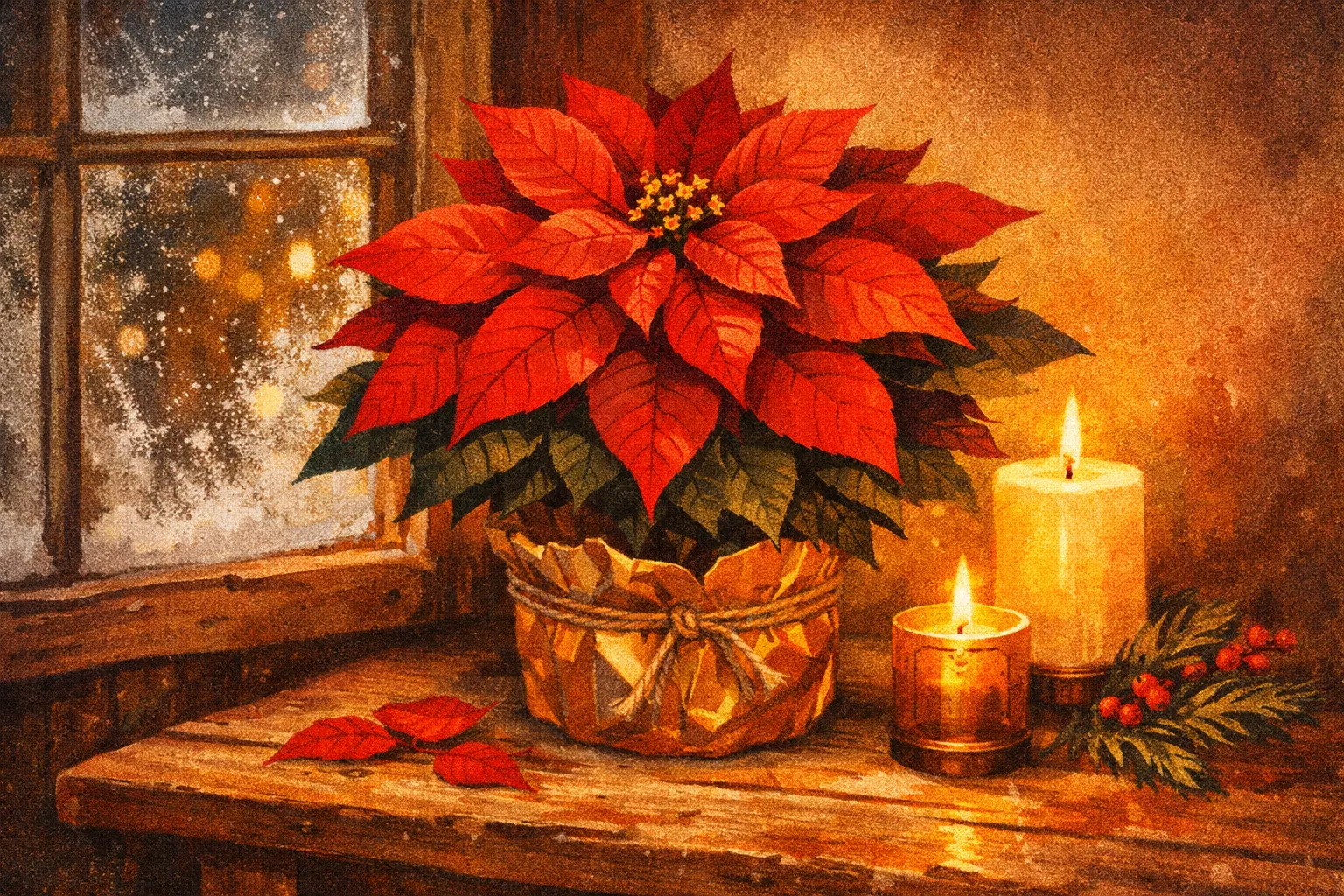
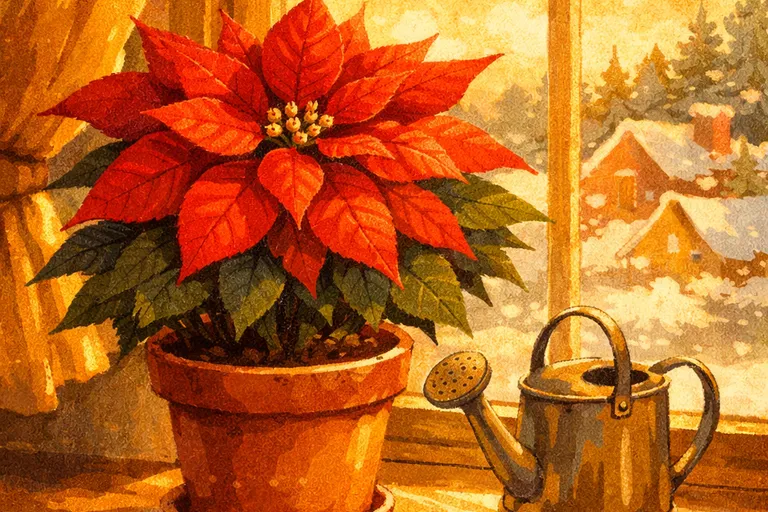
Place your poinsettia near a south-, east-, or west-facing window where it gets at least six hours of bright, indirect sunlight daily. Direct midday sun in summer can scorch the bracts, but during December and January, all available light is welcome. The colorful bracts are actually modified leaves, not flowers. The real flowers are the small yellow clusters at the center of the bract rosette.
Temperature
Keep the plant in a room between 65 and 70 degrees Fahrenheit during the day, slightly cooler at night. Poinsettias hate temperature swings more than almost anything else. A cold draft from an open door, a blast from a heating vent, or proximity to a fireplace can cause leaves to drop within 24 to 48 hours. Temperatures below 50 degrees Fahrenheit cause permanent damage. Freezing temperatures kill the plant outright.
Watering
Water when the top inch of soil feels dry. The most reliable method is to place the pot in a sink, water thoroughly, and let it drain completely before returning it to its saucer or decorative pot. Never let the pot sit in standing water. Overwatering causes root rot faster than underwatering causes wilt. If your poinsettia came wrapped in decorative foil, either poke drainage holes in the foil or remove it entirely.
Modern Poinsettia Varieties Beyond Classic Red
The classic red poinsettia still dominates sales, but modern breeding has produced dozens of varieties that would have been unrecognizable a generation ago. Breeders like Dümmen Orange (the company that absorbed the Ecke operation) and Selecta One release new cultivars annually.
Current varieties include whites like Polar Bear and Princettia Pure White, pinks ranging from soft blush to hot magenta, and novelties like Ice Punch (red with white centers) and Candy Cane (red bracts speckled with creamy white). The Freya Series, introduced recently, comes in marble, pink, red, and white. Princettia Sparkling Rouge and Princettia Sparkling Rose feature splashy variegated patterns, a first for euphorbia hybrids.
There are also varieties bred for durability rather than novelty. Modern cultivars last significantly longer than their predecessors, with some maintaining their color for two to three months under proper care. The plants sold today are far removed from the tall, fragile specimens Joel Poinsett shipped from Mexico in 1828. They are shorter, fuller, more colorful, and considerably harder to kill. In 2019, the Ecke Ranch facility in Encinitas that once controlled the global supply was demolished to make way for housing. The poinsettia business, like the plant itself, had long since outgrown its origins.
Frequently Asked Questions
Why are poinsettias associated with Christmas?
Poinsettias bloom naturally during the short days of winter in their native Mexico, which coincides with the Christmas season. Franciscan monks in 17th-century Mexico began using them in Nativity processions, and a Mexican folk legend about a girl named Pepita whose roadside weeds miraculously bloomed into red flowers on Christmas Eve reinforced the connection. The Vatican adopted the plant for Christmas decorations in the 19th century, spreading the tradition worldwide.
Are poinsettias poisonous to humans or pets?
No. A study of 22,793 poinsettia exposure cases by Children's Hospital of Pittsburgh and Carnegie Mellon University found essentially zero significant toxicity. The POISINDEX database estimates a 50-pound child would need to eat 500 to 600 leaves to exceed doses that showed no toxic effects. The myth originated from a misattributed child death in 1919 and has been debunked by researchers at Ohio State University and other institutions.
When is National Poinsettia Day?
National Poinsettia Day falls on December 12. The U.S. Congress designated the date in 2002 to honor Joel Roberts Poinsett, who introduced the plant to the United States and died on December 12, 1851. The date also coincides with Mexico's Dia de la Virgen de Guadalupe.
How do you keep a poinsettia alive indoors?
Place it near a bright window with at least six hours of indirect sunlight. Maintain room temperatures between 65 and 70 degrees Fahrenheit and avoid cold drafts or heat vents. Water when the top inch of soil feels dry, draining completely afterward. Never let the pot sit in standing water, and remove decorative foil that traps moisture.
What is the original name of the poinsettia?
The Aztecs called the plant cuetlaxochitl (kwet-la-sho-she) in Nahuatl, meaning "mortal flower that perishes and withers like all that is pure." In Spanish-speaking Mexico, it is still known as flor de nochebuena, or "flower of Christmas Eve." The English name comes from Joel Roberts Poinsett, the U.S. diplomat who brought specimens to America in 1828.
Who were the Ecke family and why did they matter to poinsettias?
The Ecke family of Encinitas, California, controlled up to 90 percent of the U.S. wholesale poinsettia market for decades using a proprietary grafting technique that produced compact, bushy plants. Paul Ecke Jr. aggressively marketed poinsettias through television appearances and magazine placements, cementing the plant's association with Christmas. Their monopoly ended after a researcher published their grafting method in 1988, and the family sold the business to Dutch conglomerate Dümmen Orange in 2012.