
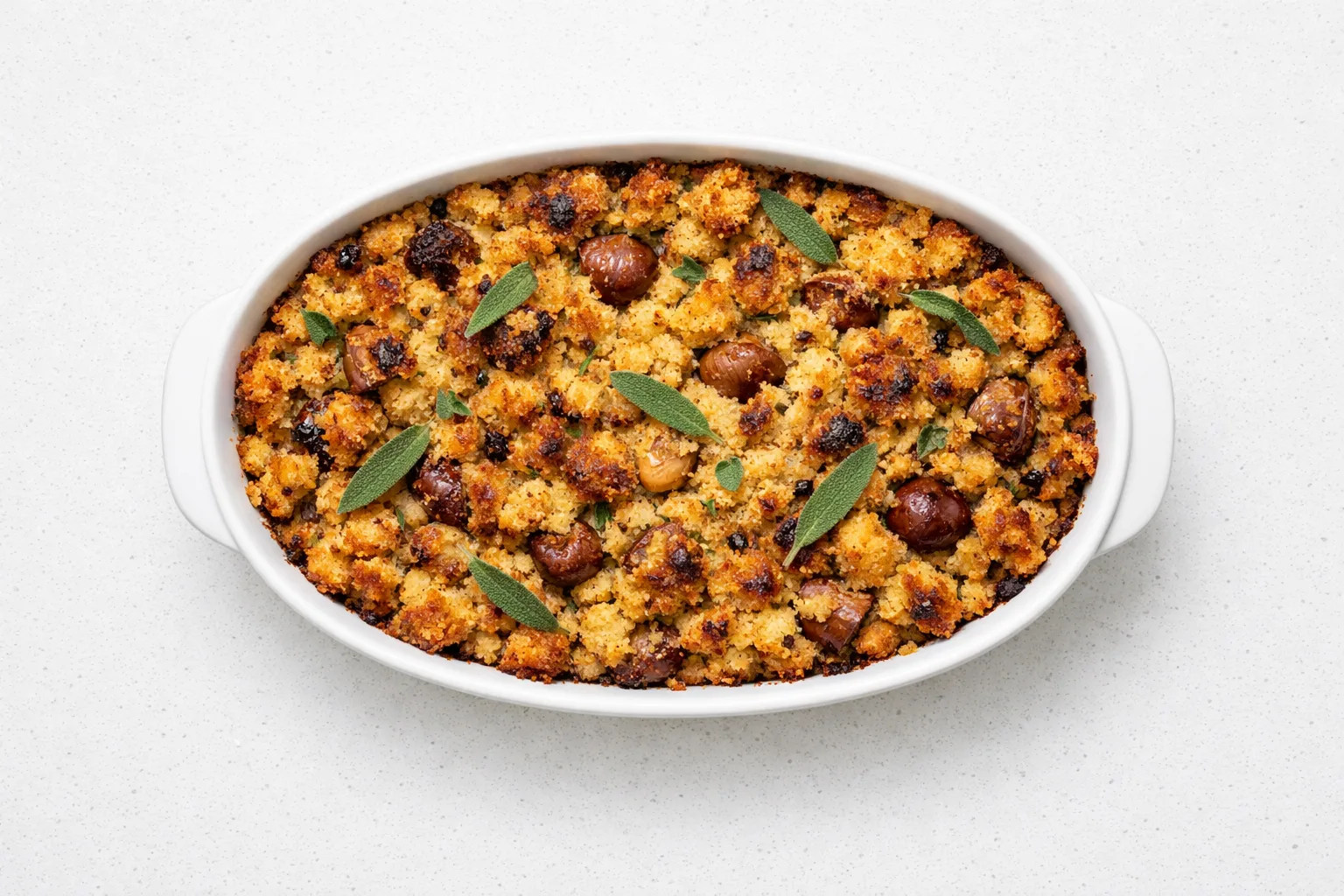
Chestnut cornbread dressing is a Southern Christmas institution with real staying power. Where Northern stuffing leans on white bread and poultry seasoning, the Southern dressing tradition calls for crumbled skillet cornbread as its base, baked separately in a casserole dish rather than stuffed inside a bird. Add roasted chestnuts and you get a side that earns its spot on the table: the chestnuts bring a subtly sweet, earthy richness that cuts through the cornbread's savory depth in a way that dried herbs alone never could.
Chestnuts have been tied to Christmas in America and Europe for centuries, immortalized in the carol and eaten roasted on street corners from New York to Rome. In Southern cooking they pair naturally with the cornbread dressing tradition that goes back to colonial kitchens. This version uses whole roasted chestnuts (fresh or vacuum-packed), plenty of butter-softened aromatics, and a good pour of chicken stock to keep the center custardy while the top goes properly golden and cragged.
Equipment
Instructions
Tap each step to track your progress
- 1
Make the cornbread a day ahead if possible. Preheat oven to 425 F (220 C). Grease a 10-inch cast-iron skillet and place it in the oven for 5 minutes while you mix the batter.
- 2
Whisk together the cornmeal, flour, sugar, baking powder, baking soda, and salt in a large bowl. In a separate bowl, whisk the eggs, buttermilk, and melted butter. Pour the wet ingredients into the dry and stir just until combined; small lumps are fine.
- 3
Pour the batter into the hot skillet and bake for 20 to 22 minutes until the top is golden and a toothpick inserted in the center comes out clean. Cool completely on a wire rack, then crumble into rough 1/2-inch pieces. Spread on a baking sheet and leave uncovered overnight to dry out, or dry in a 275 F (135 C) oven for 30 minutes.
- 4
When ready to assemble the dressing, preheat oven to 375 F (190 C). Butter a 9x13 inch baking dish.
- 5
Melt 4 tbsp butter in a large skillet over medium heat. Add the onion and celery and cook, stirring occasionally, for 8 to 10 minutes until softened and just beginning to color at the edges. Add the garlic, sage, thyme, and black pepper and cook for another 2 minutes until fragrant.
- 6
Remove the skillet from heat. Add the crumbled cornbread and the chopped chestnuts to the skillet and toss gently to combine with the aromatics.
- 7
In a bowl, whisk together the warm stock, beaten eggs, and 1 tsp salt. Pour three-quarters of the stock mixture over the cornbread mixture and fold with a flexible spatula until the bread is evenly moistened. The mixture should hold together when pressed but not feel wet or soupy. Add more stock as needed, a splash at a time.
- 8
Transfer the mixture to the prepared baking dish and spread into an even layer. Dot the top with the small pieces of butter.
- 9
Cover tightly with foil and bake for 30 minutes. Remove the foil and bake for an additional 20 to 25 minutes until the top is deeply golden and cragged, with crisp edges and a custardy set center. The dressing is done when a knife inserted in the center comes out clean and the top sounds hollow when tapped.
- 10
Rest uncovered for 10 minutes before serving.
Tips & Tricks
Stale cornbread is non-negotiable
Fresh cornbread has too much moisture and will make the dressing dense and gluey. Crumble and dry it at least overnight, or give it 30 minutes in a low oven. Properly dried cornbread absorbs the stock evenly without becoming waterlogged.
Use real chestnuts, not chestnut puree
Chestnut puree blends into the dressing invisibly. Whole roasted chestnuts, roughly chopped, give you distinct pieces with textural contrast. Vacuum-packed whole chestnuts (found at most grocery stores in autumn and winter) are a reliable shortcut that saves 40 minutes of roasting and peeling.
Add stock in stages
Every batch of cornbread absorbs liquid differently depending on how long it dried and how much fat it contains. Pour in three-quarters of the stock first, mix, and check the texture before adding more. The mixture should feel like very moist crumbled bread, not a batter.
Let the top really brown
The contrast between the cragged, crisp top and the custardy interior is what makes cornbread dressing worth eating. Do not pull it early because the top looks done; the edges and surface should be genuinely dark gold, almost tan, before you take it out.
Make-ahead strategy
The cornbread can be baked and dried up to 3 days ahead. The aromatics can be cooked and cooled 2 days ahead. Combine everything and assemble the dish the morning of Christmas; cover and refrigerate until ready to bake.
Troubleshooting
The dressing is soggy in the center
The cornbread was not dry enough before assembling, or too much stock was added. Dry-out time is not optional; fresh cornbread holds too much moisture. If the assembled dressing looks wet before it goes in the oven, bake it uncovered from the start and add 10 minutes to the total baking time.
The top burns before the center sets
Your oven likely runs hot, or the dish is too close to the top element. Move the rack to the lower third of the oven and cover with foil for the first 35 minutes instead of 30. Check for doneness with a knife inserted in the dead center.
The dressing tastes flat
The stock was under-seasoned or the cornbread itself had too little salt. Taste the stock mixture before pouring it in and season aggressively: dressing needs more salt than you think because the cornbread soaks it up. A splash of dry sherry or white wine added to the aromatics also lifts the flavor significantly.
The chestnuts are gummy
Vacuum-packed chestnuts vary in quality. If yours are soft and sticky rather than firm, pat them dry with paper towel before chopping and toss them with a little of the melted butter. If using fresh chestnuts, make sure they are fully cooked through before adding.
The cornbread crumbles too fine
Over-mixing the cornbread batter causes a tight, cake-like crumb that falls to dust when crumbled. Stir the batter only until the dry ingredients disappear; a lumpy batter makes a more open, crumbly texture that holds up better in the dressing.
Variations
Make It with Turkey Drippings
Replace 2 tbsp of the butter in the aromatics step with an equal amount of turkey or chicken drippings. Add 2 tbsp of the drippings to the stock mixture as well. The dressing takes on a deeper roasted poultry flavor that makes it taste like it was cooked inside the bird.
Dairy-Free Adaptation
Replace all butter with a good-quality dairy-free butter (such as Earth Balance). Substitute the buttermilk in the cornbread with unsweetened oat milk plus 1 tbsp apple cider vinegar, left to curdle for 5 minutes. The texture is nearly identical. Use vegetable stock instead of chicken stock to make the whole dish dairy-free.
Mushroom and Chestnut Dressing
Saute 8 oz of cremini or shiitake mushrooms, finely sliced, alongside the onion and celery. The mushrooms add umami depth and a slightly meaty texture. Use vegetable stock for a fully vegetarian version.
Spiced Southern Version
Add 1/2 tsp smoked paprika and a pinch of cayenne to the aromatic mixture. Replace the thyme with 1/2 tsp poultry seasoning. This version has more backbone and works especially well alongside a bold glazed ham.
Serving & Gifting
Serve directly from the baking dish, scooped in generous portions alongside roast turkey, glazed ham, or a bone-in prime rib. A ladle of good pan gravy over the top is traditional. Chestnut cornbread dressing also holds well in a low oven (275 F / 135 C), covered, for up to 45 minutes before serving, making it ideal for a large Christmas dinner where timing every dish is a juggle.
Storage & Freezing
Leftover dressing keeps refrigerated in an airtight container for up to 4 days. Reheat individual portions in a 350 F (175 C) oven, covered with foil, for 15 minutes, or microwave with a damp paper towel over the top to prevent the surface from drying out. The dressing freezes well for up to 2 months; thaw overnight in the refrigerator before reheating. Assembled but unbaked dressing can be refrigerated for up to 24 hours before baking; add 10 minutes to the covered baking time if going straight from cold.
Common Questions
Can I make chestnut cornbread dressing ahead of time?
Yes. Assemble the dressing up to 24 hours in advance, cover tightly with plastic wrap, and refrigerate. Bring it out 30 minutes before baking so it takes the chill off, then bake as directed, adding about 10 minutes to the covered portion of the baking time.
What is the difference between stuffing and dressing?
Stuffing is cooked inside the cavity of a bird; dressing is baked separately in a casserole dish. Southern cornbread dressing is almost always baked as a casserole, which gives you a crisper top and makes it easier to cook to a safe internal temperature.
Can I use canned chestnuts?
Vacuum-packed whole roasted chestnuts work well and are widely available from October through January. Canned chestnuts in water tend to be mushier and more watery; drain and pat them dry before using. Avoid chestnut puree or sweetened chestnut spread, which change the flavor profile entirely.
How do I keep cornbread dressing from being dry?
The stock-to-cornbread ratio is the key variable. Start with 2 cups of warm stock, mix thoroughly, then assess the texture. If the mixture seems stiff or dry, add the remaining stock in small amounts. The pre-baking mixture should feel wetter than you think is right; it dries considerably in the oven.
Is chestnut cornbread dressing gluten-free?
Not as written, because the cornbread base includes all-purpose flour. To make it gluten-free, replace the flour in the cornbread with an equal amount of certified gluten-free cornmeal or a gluten-free all-purpose blend. Check your stock label as well; many commercial stocks contain wheat-based thickeners.
What stock should I use for the best flavor?
Homemade turkey or chicken stock gives the best depth. If using store-bought, choose a low-sodium variety so you can control the salt level. Warm the stock before adding it; cold stock slows absorption into the dried cornbread and can make the texture uneven.