
 United Kingdom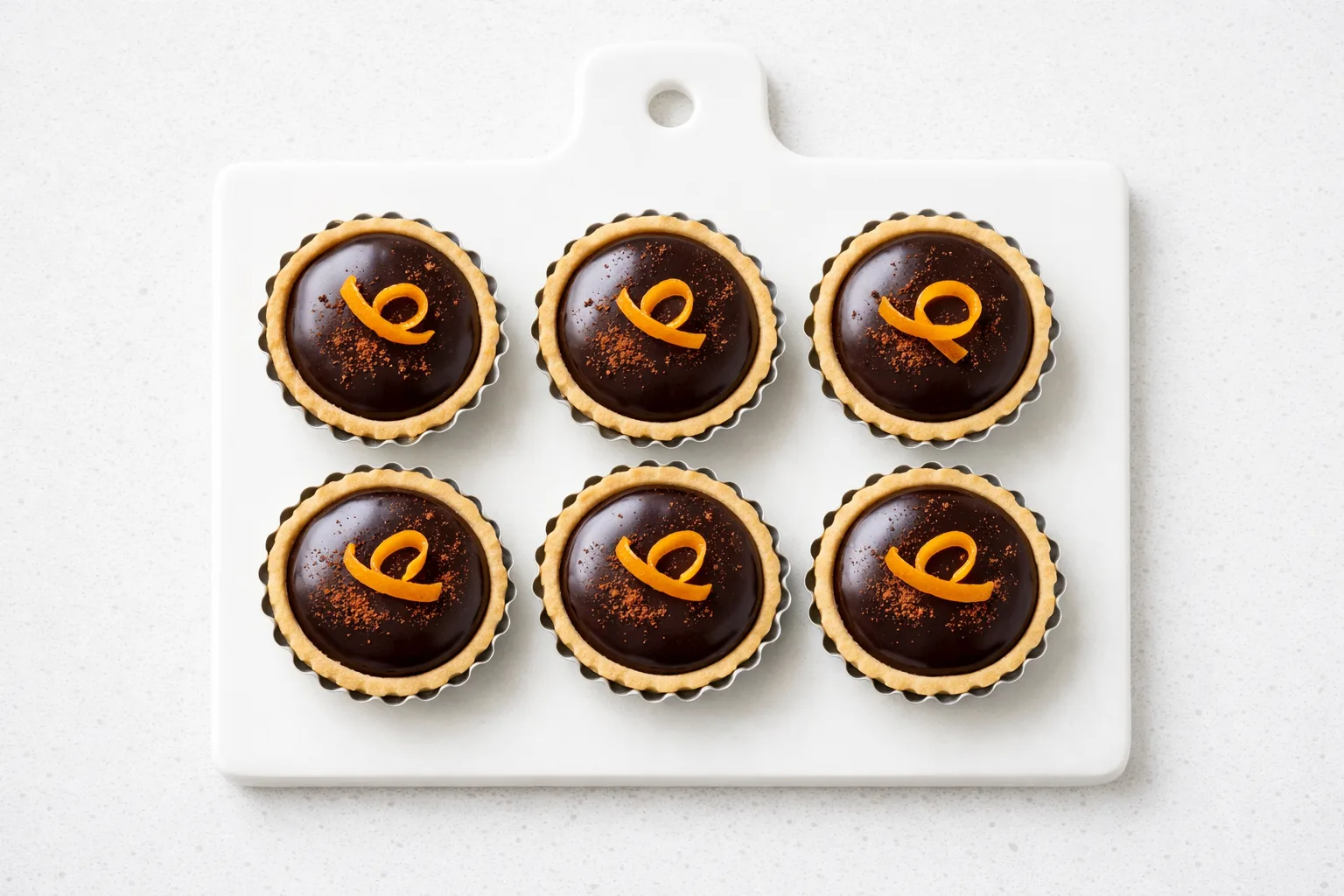
Chocolate orange tarts are one of those Christmas desserts that look far more demanding than they are. The combination of dark chocolate and orange has been a British Christmas staple since Terry's launched their Chocolate Orange in 1932, but these miniature tartlets take that familiar pairing somewhere more refined. Buttery shortcrust shells, a ganache that sets to a silky but sliceable consistency, and a hit of real orange zest in both the pastry and the filling.
The key to a ganache that behaves is the cream-to-chocolate ratio and the temperature of both components when they meet. Too hot and the fat splits; too cold and you get lumps. Get it right and the filling pours smooth, sets firm enough to unmould cleanly, and cuts without cracking. These are exactly what you want for a Christmas dessert spread or as individual gifts packed into boxes.
Equipment
Instructions
Tap each step to track your progress
- 1
Make the pastry. Combine the flour, powdered sugar, salt, and orange zest in a large bowl. Add the cold butter cubes and rub in with your fingertips until the mixture resembles coarse breadcrumbs with a few pea-sized butter pieces still visible. Make a well in the centre, add the egg yolk and ice water, and mix with a fork until the dough just comes together. Do not overwork it. Press into a flat disc, wrap tightly in cling film, and refrigerate for at least 30 minutes.
- 2
While the dough chills, make the candied orange garnish. Slice the orange into thin rounds (about 3mm), then cut each round into quarters. Combine the sugar and water in a small saucepan over medium heat, stirring until the sugar dissolves. Add the orange pieces and simmer gently for 15 to 20 minutes until translucent and the syrup is thick. Transfer to a wire rack set over parchment to drain and dry for at least 30 minutes.
- 3
Preheat the oven to 375 F (190 C). On a lightly floured surface, roll the chilled dough to about 3mm thickness. Cut rounds slightly larger than your tartlet tins (about 4 inches / 10cm for standard 3-inch tins) and press gently into the tins, pushing into the fluted edges without stretching the dough. Trim any excess flush with the tin rim. Prick the base of each shell several times with a fork.
- 4
Line each pastry shell with a small square of parchment, fill with baking beans or dry rice, and blind bake for 12 minutes. Remove the paper and beans, then return to the oven for a further 5 to 8 minutes until the bases are dry and lightly golden. The shells should feel firm and have a very pale biscuit colour. Allow to cool completely in the tins before filling.
- 5
Make the ganache. Place the finely chopped chocolate in a heatproof bowl. Heat the heavy cream in a small saucepan over medium heat until you see the first bubble break the surface, just below a full boil. Pour the hot cream over the chocolate and let it sit undisturbed for 2 minutes.
- 6
Starting in the centre of the bowl, stir the cream and chocolate together with a rubber spatula in small concentric circles, gradually widening the movement outward. The ganache should come together into a smooth, glossy emulsion. If it looks grainy or split, see the Troubleshooting section below. Add the butter cubes, orange zest, golden syrup, and orange liqueur if using, and stir until fully incorporated and glossy.
- 7
Let the ganache cool at room temperature for 8 to 10 minutes, stirring occasionally, until it thickens slightly but is still pourable. It should coat the back of a spoon and hold a ribbon for a few seconds. Pour or spoon into the cooled pastry shells, filling to just below the rim.
- 8
Tap the filled tins lightly on the counter to level the surface and release any air bubbles. Allow to set at room temperature for 1 hour, then refrigerate for at least 2 hours until fully firm. The ganache is ready when it holds its shape cleanly when the tins are tilted.
- 9
To unmould, run a small offset spatula or thin knife around the edge of each tartlet, then carefully push up from the base if using removable-bottom tins. Place on a serving board or plate. Dust lightly with cocoa powder through a fine sieve, then top each with one or two pieces of candied orange peel.
Tips & Tricks
Use the best chocolate you can buy
Ganache has nowhere to hide. At 70% cocoa solids, the chocolate is the dominant flavour. Valrhona Guanaja, Lindt Excellence 70%, or Callebaut 70-30-38NV all produce a clean, bitter-edged ganache that holds the orange without either component drowning the other. Avoid compound chocolate or baking chips, which contain stabilisers that prevent the ganache from setting smoothly.
Keep everything cold until baking day
The pastry dough can be made up to 2 days ahead and kept wrapped in the fridge. The blind-baked shells can sit at room temperature in an airtight tin for a day. The ganache should be made and poured on the day you plan to set the tarts, and the candied orange can be made a day ahead and stored uncovered at room temperature to dry out further.
Chop the chocolate very fine
The finer the chocolate pieces, the faster and more evenly they melt when the hot cream hits them. Rough chunks create hot spots that can seize the ganache. Use a sharp heavy knife and chop in two directions to get pieces no larger than a small pea.
Do not let the cream fully boil
A rolling boil drives off water and concentrates the cream, altering the fat-to-water ratio and making a split ganache more likely. Watch for the first few bubbles at the surface and remove from the heat immediately. The residual heat is enough to melt 70% chocolate completely.
Troubleshooting
My ganache looks grainy or split
The cream was too hot, or the chocolate was too cold. To rescue a split ganache, warm the mixture briefly over a bain-marie (a bowl set over a pot of barely simmering water), stirring constantly, until it comes back together. Alternatively, add a tablespoon of warm milk or cream and stir vigorously from the centre outward until it emulsifies again.
The pastry shells shrank in the tins
The dough was either over-worked (developing too much gluten) or it was not chilled long enough before baking. Next time, handle the dough as little as possible and chill for the full 30 minutes. When lining the tins, lift and drape rather than stretching the dough over the tin.
The ganache did not set firm enough to unmould
It needs more time in the fridge, or your kitchen is very warm. Give the tarts a full 3 to 4 hours of refrigeration. If they are still too soft to handle cleanly, pop them in the freezer for 20 minutes before unmoulding; the ganache will firm up quickly. Serve within 20 minutes of removing from the freezer.
The ganache surface cracked after setting
This usually happens if the ganache was too cold when poured, or if the tartlets were moved from fridge to a warm room too quickly. Make sure the ganache is poured while still fluid and at room temperature. If serving from cold, allow 15 minutes at room temperature before plating to minimize temperature shock.
My pastry tore when I tried to unmould the tarts
The shells were not baked long enough and are too fragile, or the ganache was still warm and heavy when you attempted to unmould. Always wait until the ganache is fully set before removing from the tins, and use a thin offset spatula to loosen the edges gently rather than forcing the base up.
Variations
Milk Chocolate Orange Tarts
Replace the 70% dark chocolate with good-quality milk chocolate (40 to 45% cocoa solids). Reduce the cream to 1/2 cup since milk chocolate has a higher fat content and sets firmer. The result is sweeter and softer, better suited to those who find dark chocolate too intense at Christmas.
Vegan Adaptation
Use coconut cream (full-fat, chilled) in place of heavy cream, and substitute the butter in both the pastry and ganache with vegan block butter such as Violife or Earth Balance sticks. Replace the egg yolk with 1 tablespoon of ice water plus 1 teaspoon of apple cider vinegar. The pastry will be slightly more crumbly but holds together well once chilled and baked. Skip the orange liqueur or use a vegan-certified brand.
Spiced Chocolate Orange
Add 1/2 teaspoon ground cinnamon and a pinch of cayenne pepper to the ganache along with the orange zest. The heat blooms in about 5 seconds after tasting and lingers just long enough to feel intentional. This variation suits adults and pairs especially well with a glass of mulled wine.
Gluten-Free Pastry
Replace the all-purpose flour with a 1:1 gluten-free baking blend and add 1/2 teaspoon xanthan gum if the blend does not already contain it. The dough will be more fragile and may crack when pressed into the tins; patch any gaps with extra dough rather than re-rolling. Blind bake for an extra 2 to 3 minutes to ensure the base dries out fully.
Serving & Gifting
These tarts are best served at room temperature, taken out of the fridge 15 to 20 minutes before plating so the ganache softens slightly and the flavour opens up. They hold together beautifully on a board or cake stand for a Christmas dessert table and need no accompaniment beyond a small spoon. For a more composed plate, serve each tart with a tablespoon of lightly whipped cream and an extra curl of orange zest. For gifting, nestle each tart in a small paper case and pack into a rigid box lined with tissue paper; they travel well for up to 24 hours at room temperature in cool weather.
Storage & Freezing
Store finished tarts in an airtight container in the fridge for up to 5 days. Bring to room temperature for 15 minutes before serving. Unfilled pastry shells can be stored in an airtight tin at room temperature for up to 3 days or frozen for up to 2 months; thaw completely and warm in a low oven for 5 minutes before filling. Filled tarts can be frozen individually before the garnish is added; wrap each in cling film and freeze for up to 6 weeks. Thaw overnight in the fridge and add the cocoa dust and candied orange just before serving.
Common Questions
Can I make chocolate orange tarts ahead of Christmas?
Yes. The pastry shells can be blind baked up to 2 days in advance. Filled tarts keep in the fridge for up to 5 days, making them ideal for preparing on December 22nd or 23rd ready for Christmas Day. Add the garnish on the day of serving.
What chocolate percentage is best for these tarts?
70% cocoa solids gives the best balance for a chocolate orange tart. Lower percentages (under 60%) result in a ganache that is too sweet and does not firm as cleanly. Higher percentages (above 80%) can make the ganache grainy and very firm; if using 85%, reduce the cream slightly and add an extra tablespoon of golden syrup to maintain suppleness.
Can I make one large tart instead of mini tartlets?
Yes. Use a 9-inch (23cm) fluted tart tin with a removable bottom. Blind bake the shell at the same temperature for 15 minutes with weights, then 10 minutes without. Use the full ganache quantity. Set time will be longer, at least 3 to 4 hours in the fridge. Slice with a hot knife wiped clean between cuts.
How do I stop the pastry from going soggy?
Make sure the shells are fully blind baked until dry and golden on the base before filling. A pale or underbaked shell will absorb moisture from the ganache within hours. You can also brush the inside of the warm shells with a thin coat of melted dark chocolate and allow it to set before pouring in the ganache; this creates a barrier and also adds flavour.
Is there a shortcut for the pastry?
Good-quality ready-rolled shortcrust pastry works and cuts the prep time significantly. Look for an all-butter version for the best flavour. Add orange zest to the ganache only in this case, since the shop-bought pastry will not have it. The result is slightly less tender than homemade but perfectly acceptable.
Can I use fresh orange juice in the ganache instead of zest?
Zest is better for this recipe. Juice adds water, which can destabilise the ganache emulsion and affect how firmly it sets. If you want a more intense orange flavour, increase to the zest of 2 oranges or add a few drops of high-quality orange extract (not orange flavouring, which tastes artificial).