
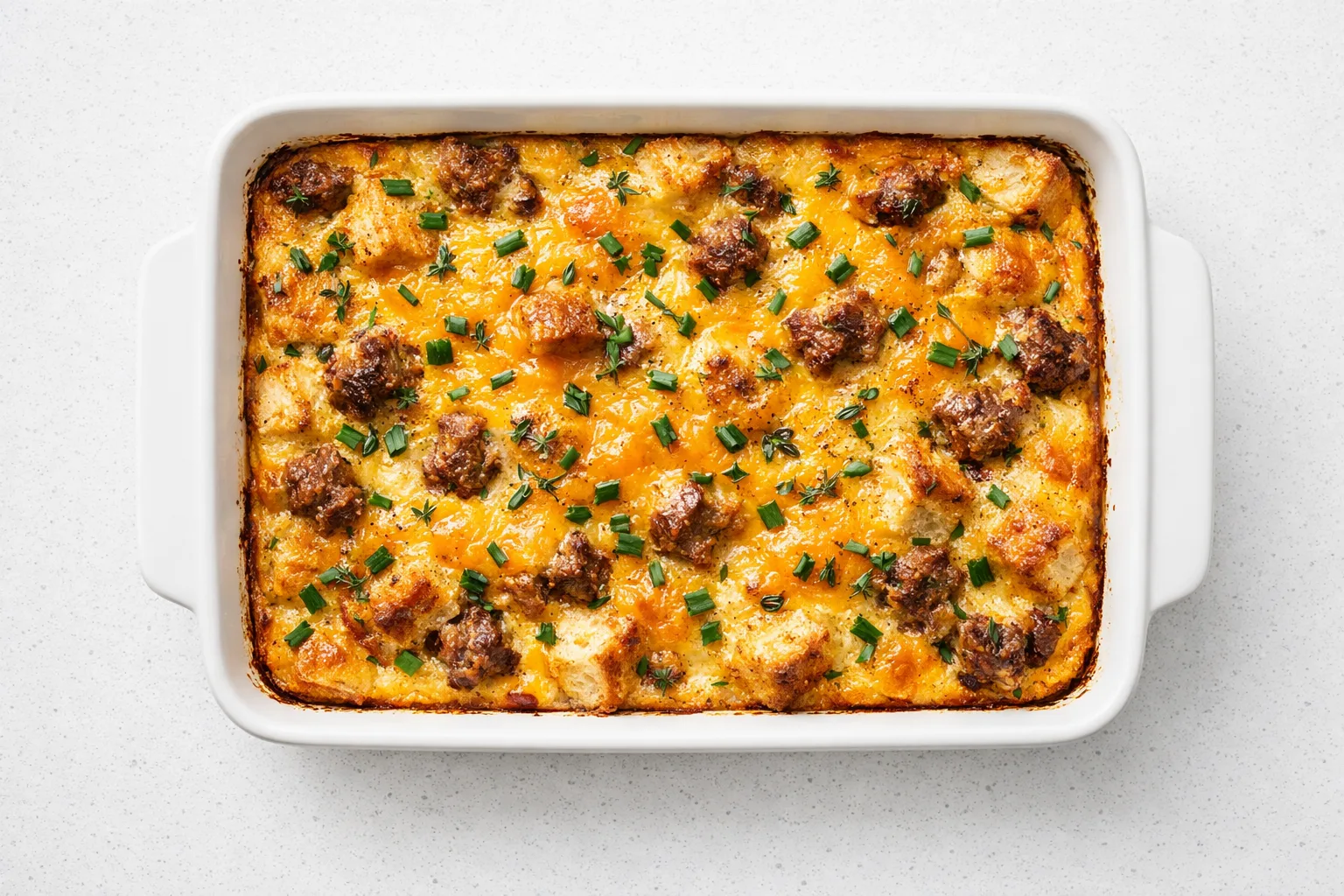
A Christmas breakfast casserole is the smartest move you can make for December 25th. The concept is simple: cubed bread soaks overnight in a seasoned egg custard with browned sausage and sharp cheddar, then bakes into a savory, puffed casserole while you open gifts. This is the dish that has anchored American Christmas morning tables for decades, and for good reason. It feeds a crowd, requires no last-minute scrambling, and tastes like you spent the morning cooking when you actually spent it in pajamas.
This version uses a higher ratio of eggs to bread than most recipes, giving you a custardy, almost souffle-like interior rather than a heavy bread pudding. Italian pork sausage provides depth, extra-sharp cheddar adds bite, and a generous handful of fresh thyme and chives keeps everything bright. The overnight rest is not optional. It gives the bread time to absorb the custard fully, which is the difference between a great egg casserole for Christmas brunch and a dry, bready disappointment.
Equipment
Instructions
Tap each step to track your progress
- 1
Brown the sausage in a large skillet over medium-high heat, breaking it into small, irregular pieces with a wooden spoon or spatula. Cook for 6 to 8 minutes until no pink remains and the edges are crispy in spots. Transfer to a paper towel-lined plate and set aside.
- 2
Reduce heat to medium. Add the butter to the same skillet with the rendered sausage fat. Add the diced onion and cook for 4 to 5 minutes, stirring occasionally, until softened and translucent. Add the garlic and cook for 30 seconds until fragrant. Remove from heat and let cool for 5 minutes.
- 3
Whisk together the eggs, milk, heavy cream, Dijon mustard, salt, black pepper, and cayenne in a large bowl until completely smooth. No streaks of egg white should remain.
- 4
Grease a 9x13 inch baking dish with butter. Spread half the bread cubes in an even layer. Top with half the cooked sausage, half the onion-garlic mixture, and half the shredded cheddar. Scatter half the chives and thyme over the top. Repeat with the remaining bread, sausage, onion mixture, cheddar, and herbs.
- 5
Pour the egg custard slowly and evenly over the layered casserole. Use a spatula to press the bread cubes down gently so they are submerged in the liquid. You will need to press a few times as the bread absorbs.
- 6
Cover tightly with plastic wrap and refrigerate for at least 8 hours or overnight. This rest is essential for the bread to fully absorb the custard.
- 7
Remove the casserole from the refrigerator 30 minutes before baking. Preheat the oven to 350 degrees F (175 degrees C).
- 8
Remove the plastic wrap. Scatter the topping cheddar and chives over the surface. Cover with aluminum foil and bake for 30 minutes.
- 9
Remove the foil and continue baking for 18 to 22 minutes until the top is golden brown with bubbling cheese, the center is puffed and set, and a knife inserted in the middle comes out clean with no liquid egg.
- 10
Let the casserole rest on a wire rack for 10 minutes before cutting. This rest firms up the custard and makes clean slicing possible. Cut into 12 squares and serve warm.
Tips & Tricks
Use day-old bread, not fresh
Stale bread absorbs the custard without dissolving. Sourdough, ciabatta, and crusty country loaves all work well. If your bread is fresh, cut it into cubes and spread them on a sheet pan in a 300 degree F oven for 8 to 10 minutes. Let them cool completely before assembling.
Brown the sausage hard
Do not just cook the sausage through. Let it sit in the skillet undisturbed for a minute or two at a time to develop crispy, browned edges. This Maillard reaction gives the casserole depth and savory complexity that pale, steamed sausage never will.
Press the bread down after pouring
After adding the custard, use a spatula to firmly press the bread cubes into the liquid. Walk away for 5 minutes, then press again. Repeat one more time before covering and refrigerating. Every cube should be at least partially submerged. Dry bread on top bakes into hard croutons instead of custardy casserole.
Assemble the night before without fail
The overnight rest is what separates a good breakfast casserole from a great one. Eight hours minimum. The bread needs that time to fully absorb the seasoned custard, and the flavors meld significantly during the rest. Assembling and baking the same morning produces noticeably inferior results.
Let it rest before cutting
Ten minutes of rest after baking is essential. The eggs continue to set as they cool slightly, and cutting too early gives you a wet, sloppy slice. Patience here means clean, beautiful portions that hold their shape on the plate.
Troubleshooting
The center is still jiggly after baking
The casserole was either too cold when it went into the oven or the oven was not fully preheated. The 30-minute counter rest is critical. If the center is still wobbly, cover with foil to prevent over-browning on top, then bake for an additional 10 to 15 minutes. The center should be set like a firm custard, not liquid.
The top is browning too fast
Your oven runs hot, or the dish is positioned too high. Move it to the lower-middle rack and cover loosely with foil. The covered baking phase in the first 30 minutes is specifically designed to prevent this, so make sure your foil seal is tight.
The casserole tastes bland
Underseasoning the custard is the most common mistake. The egg mixture needs to be seasoned aggressively because it is distributing flavor across 8 cups of bread and a pound of filling. Taste the raw custard before pouring. It should taste slightly salty and well-seasoned. Dijon mustard is doing heavy lifting here; do not skip it.
The bread is soggy and mushy
The bread was too fresh or too soft. A good casserole needs sturdy bread with some structure. Day-old sourdough, ciabatta, or a rustic country loaf work best. Soft sandwich bread breaks down completely in the custard. If your bread is fresh, cube it and dry it out on a sheet pan in a 300 degree F oven for 10 minutes before assembling.
Variations
Vegetarian Version
Skip the sausage entirely. Saute 8 oz sliced cremini mushrooms and 2 cups baby spinach in butter until the mushrooms are golden and the spinach is wilted. Season with a pinch of nutmeg. Layer into the casserole in place of the sausage. Add an extra 1/2 cup of cheese to compensate for the lost fat.
Ham and Swiss
Replace the Italian sausage with 2 cups diced smoked ham (no cooking required). Swap the cheddar for Gruyere or Swiss cheese. Add 1 teaspoon of whole grain mustard to the egg mixture. This gives a milder, nuttier flavor that pairs well with a fruit salad on the side.
Gluten-Free Adaptation
Use a sturdy gluten-free bread, cut into cubes and toasted at 300 degrees F for 10 minutes to firm up before assembling. Gluten-free bread is often softer and wetter, so toasting prevents it from dissolving into mush in the custard. Reduce the milk by 1/4 cup.
Spicy Southwest
Replace the Italian sausage with chorizo. Swap the cheddar for pepper jack cheese. Add 1 diced roasted poblano pepper and 1/4 cup chopped cilantro. Serve with sour cream and salsa on the side. This version has real heat, so taste the chorizo before deciding on the cayenne.
Serving & Gifting
Cut into generous squares and serve straight from the baking dish. A Christmas morning casserole like this needs bright, acidic partners: a simple green salad with vinaigrette, sliced fresh fruit, or roasted cherry tomatoes all work well. On the drink side, fresh-squeezed orange juice, mimosas, or strong coffee are the right call. For a larger Christmas brunch spread, pair it with a batch of cinnamon rolls, a fruit platter, and a carafe of juice.
Storage & Freezing
Cover the baking dish tightly with foil or plastic wrap and refrigerate for up to 3 days. Reheat individual portions in the microwave for 60 to 90 seconds, or reheat the whole dish covered with foil at 325 degrees F for 20 to 25 minutes. You can freeze baked casserole portions wrapped tightly in foil and placed in freezer bags for up to 2 months. Thaw overnight in the refrigerator before reheating. The unbaked, assembled casserole also freezes well; thaw it completely in the refrigerator for 24 hours before baking as directed.
Common Questions
Can I assemble this casserole two days ahead?
One night (8 to 12 hours) is ideal. You can push it to 24 hours without issues. Beyond that, the bread starts to break down too much and the texture becomes overly soft. If you need to prep further ahead, freeze the unbaked casserole and thaw it in the refrigerator for 24 hours before baking.
What is the best bread for a breakfast casserole?
Sturdy, crusty bread with an open crumb. Sourdough is the top choice because its tang complements the rich custard. Ciabatta and French bread also work well. Avoid soft sandwich bread, brioche, or challah. They absorb too much liquid and turn to mush.
Can I use turkey sausage instead of pork?
Yes. Turkey sausage works but adds less fat, so the casserole will be slightly less rich. Consider adding an extra tablespoon of butter to the onion step, or mixing in 2 tablespoons of olive oil to the custard to compensate. Italian-seasoned turkey sausage is the best swap.
How do I know when the casserole is done?
Insert a knife or thin skewer into the center. It should come out clean with no liquid egg. The top should be golden brown, the edges will be slightly pulled away from the dish, and the center should be puffed and firm. A slight jiggle is fine, but it should not look watery. The internal temperature should read 165 degrees F on an instant-read thermometer.
Can I make this without heavy cream?
You can substitute with additional whole milk, but the custard will be less rich and the texture lighter. Half-and-half is a better middle ground. Do not use skim or low-fat milk; the casserole needs fat for a creamy, cohesive texture. The cream is what gives this casserole its custardy, almost souffle-like interior.
Is this casserole good for feeding a crowd?
A 9x13 dish serves 12 generously. For larger gatherings, make two casseroles rather than trying to scale up into a single larger pan. Uneven custard distribution in an oversized dish leads to dry edges and an undercooked center. Two standard casseroles bake more evenly and are easier to handle.