
An egg casserole for Christmas brunch solves the problem that every host faces on December 25th: how to feed a table full of people a hot, impressive meal without spending the morning hunched over a stove. This is not a bread-heavy strata or a quiche with pastry to fuss over. It is an egg-forward casserole, closer to a thick frittata than a bread pudding, built on a simple ratio of eggs to dairy that bakes into a rich, spoonable custard. The technique has been standard at American holiday brunches for generations, and it works because the custard only improves after sitting overnight in the refrigerator.
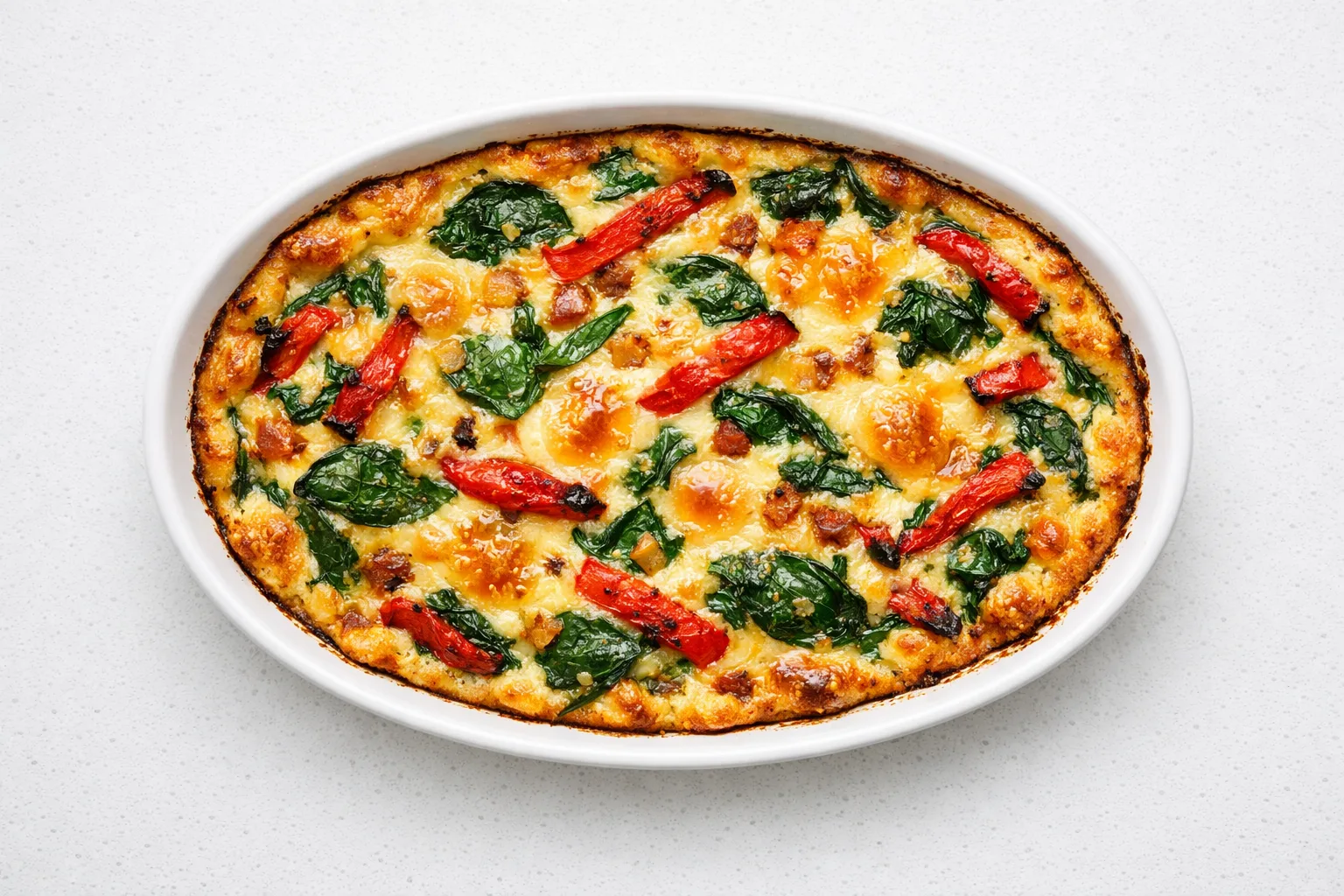
This version keeps the bread out entirely, letting eggs, Gruyere, roasted red peppers, and fresh spinach do the work. The result is lighter than most holiday brunch casseroles but more satisfying, with a clean savory flavor that pairs well with fruit, toast, or pastries on the side. You assemble everything on Christmas Eve, cover the dish, and slide it into the oven the next morning. Fifty-five minutes later, you have a golden, puffed Christmas morning egg bake for twelve.
Equipment
Instructions
Tap each step to track your progress
- 1
Melt the butter in a large skillet over medium heat. Add the sliced shallots and cook for 5 to 6 minutes, stirring occasionally, until softened and lightly golden at the edges. Add the garlic and cook for 30 seconds until fragrant. Add the spinach in two batches, tossing with tongs until wilted, about 2 minutes total. Transfer to a colander set over a bowl and let cool for 10 minutes. Press firmly with the back of a spoon to squeeze out excess liquid. Wet spinach will make the casserole watery.
- 2
Whisk together the eggs, milk, heavy cream, salt, pepper, and nutmeg in a large bowl until completely smooth with no streaks of egg white visible. The custard should be pale yellow and uniform.
- 3
Grease a 9x13 inch baking dish with butter. Spread the cooled spinach-shallot mixture evenly across the bottom. Scatter the roasted red pepper strips over the spinach. Sprinkle 2 cups of the Gruyere evenly over the vegetables, then scatter the remaining 1/2 cup of Gruyere and the chives on top.
- 4
Pour the egg custard slowly over the layered vegetables and cheese. Use a fork to gently nudge the ingredients so the custard settles into all the gaps. The liquid should come close to the top of the vegetables but not overflow.
- 5
Cover the dish tightly with plastic wrap and refrigerate for at least 6 hours or overnight. The overnight rest allows the custard to fully integrate with the vegetables and cheese, and the eggs develop a more complex flavor.
- 6
Remove the casserole from the refrigerator 30 minutes before baking to take the chill off. Preheat the oven to 350 degrees F (175 degrees C).
- 7
Remove the plastic wrap. Scatter the topping Gruyere and chives over the surface. Cover the dish with aluminum foil and bake for 30 minutes.
- 8
Remove the foil and bake for an additional 22 to 25 minutes until the top is golden brown with bubbling cheese, the center is puffed and set with a slight jiggle (but no visible liquid), and a knife inserted in the center comes out clean. The internal temperature should read 170 degrees F on an instant-read thermometer.
- 9
Sprinkle flaky sea salt over the top. Let the casserole rest on a wire rack for 10 to 12 minutes before slicing. The custard firms as it cools and will hold its shape when cut. Slice into 12 portions and serve warm.
Tips & Tricks
Press the spinach dry
This is the single most important step for a clean-textured casserole. Cooked spinach holds a surprising amount of water. After wilting, transfer it to a colander and press hard with the back of a spoon. You should get at least 2 to 3 tablespoons of liquid out. Skip this and you get a watery bottom.
Use real Gruyere, not a substitute
Gruyere melts into smooth, stretchy pools and adds a nutty, slightly sweet depth that sharper cheeses cannot match. Pre-shredded bagged cheese contains anti-caking starch that prevents smooth melting. Buy a block and shred it yourself for the best results.
Assemble the night before
The overnight rest is what transforms this from a decent egg bake into a great one. Six hours minimum, twelve is ideal. The eggs absorb flavor from the vegetables and cheese during this time, and the custard bakes more evenly when it has been uniformly cold rather than having warm and cool spots from fresh assembly.
Bring to room temperature before baking
A cold ceramic dish in a hot oven bakes unevenly and can even crack. Thirty minutes on the counter before baking ensures the center and edges cook at roughly the same rate, so you do not end up with overdone edges and a raw middle.
Do not skip the resting period
Ten minutes of rest after baking lets the eggs finish setting with carryover heat. Cutting into the casserole immediately releases steam and liquid, giving you a sloppy slice. Wait, and you get clean, firm portions that hold their shape on the plate.
Troubleshooting
The center is still liquid after baking
The casserole was too cold when it went into the oven, or the oven did not fully preheat. The 30-minute counter rest before baking matters. If the center jiggles like liquid rather than like set custard, cover with foil to protect the top and bake for another 10 to 15 minutes. Check with a thermometer: 170 degrees F at the center means it is done.
The top is browning too quickly
Your oven runs hot or the dish is on a rack that is too high. Move it to the lower third of the oven and tent loosely with foil. The initial 30 minutes of covered baking should prevent this, but every oven is different.
The casserole is watery when sliced
Excess moisture from the spinach is the most likely cause. Pressing the cooked spinach firmly in a colander is not optional. Squeeze it until barely any liquid comes out. A second cause is underbaking: if the custard has not fully set, it will release liquid when cut. Let it rest the full 10 minutes before slicing.
The eggs taste rubbery
Overbaking or baking at too high a temperature. At 350 degrees F, the eggs set gently into a creamy custard. At 400 degrees F or above, the proteins tighten too much and the texture turns dense and bouncy. Pull the casserole as soon as a knife comes out clean. The residual heat finishes the job during the resting period.
The cheese sank to the bottom
This happens when the cheese is added before the custard has been poured. Layer the cheese over the vegetables first, then pour the custard on top. The cheese suspended between the vegetables and the custard stays distributed. If you dump cheese into liquid, gravity wins.
Variations
Meat Lover's Version
Add 8 oz of cooked, crumbled breakfast sausage or 1 cup of diced cooked ham to the vegetable layer. Brown the sausage in the skillet before cooking the shallots, using the rendered fat in place of butter. This adds about 80 calories per serving and makes the casserole richer and more filling.
Vegan Adaptation
Replace the eggs with a mixture of 2 blocks (28 oz total) of firm silken tofu blended smooth with 1/4 cup nutritional yeast, 2 tablespoons cornstarch, and 1 teaspoon kala namak (black salt, for an eggy flavor). Use oat milk and coconut cream in place of dairy. Swap the Gruyere for a melting vegan cheese. The texture will be softer and denser, but it sets well and slices cleanly after resting.
Mediterranean Style
Replace the spinach with sun-dried tomatoes (1/2 cup, oil-packed, drained and chopped) and add 1/2 cup pitted Kalamata olives, halved. Swap the Gruyere for crumbled feta cheese. Add 1 teaspoon dried oregano to the custard. Finish with a drizzle of good olive oil after baking. This version has a sharper, brighter flavor profile.
Gluten-Free Confirmation
This recipe is naturally gluten-free as written, with no bread, flour, or thickeners. Just verify that your roasted red peppers (if jarred) contain no added wheat-based ingredients, which is rare but worth checking on the label.
Serving & Gifting
Slice into generous squares and serve straight from the baking dish with a spatula. This overnight egg casserole pairs well with crisp green salad, roasted fruit, or a simple platter of sliced avocado and cherry tomatoes. For drinks, fresh-squeezed orange juice, mimosas, or hot coffee are natural partners. If you are building a full Christmas brunch spread, this casserole covers the savory anchor, so round it out with pastries, a fruit bowl, and something sweet like cinnamon rolls or scones.
Storage & Freezing
Cover the baking dish with foil or transfer individual portions to airtight containers and refrigerate for up to 3 days. Reheat slices in the microwave for 60 to 90 seconds, or reheat the full dish covered with foil at 325 degrees F for 20 minutes until warmed through. Baked casserole portions freeze well for up to 2 months when wrapped tightly in foil and sealed in freezer bags. Thaw overnight in the refrigerator before reheating. The unbaked assembled casserole can also be frozen; thaw it completely in the refrigerator for 24 hours, then bake as directed.
Common Questions
Can I make this egg casserole two days ahead?
You can assemble it up to 24 hours in advance without any loss of quality. Beyond 24 hours, the vegetables start releasing more moisture into the custard, which can affect the texture. If you need more lead time, freeze the unbaked casserole and thaw it in the refrigerator for 24 hours before baking.
What can I use instead of Gruyere?
Fontina, Jarlsberg, or aged Swiss are the closest substitutes and melt similarly. Sharp cheddar works but changes the flavor profile significantly, making the casserole tangier and less nutty. Avoid mozzarella: it melts well but contributes almost no flavor to the custard.
Is this egg casserole gluten-free?
Yes. This recipe contains no bread, flour, or other gluten-containing ingredients. Check the label on jarred roasted red peppers to confirm no wheat-based additives, though this is uncommon. It is one of the advantages of an egg-forward casserole over a bread-based strata.
How many eggs do I need for a Christmas brunch casserole?
This recipe uses 14 large eggs for 12 servings in a 9x13 inch dish. That is a higher egg ratio than bread-based casseroles, which is what gives this version its custardy, souffle-like texture. Do not reduce the egg count; fewer eggs will leave you with a thin, flat casserole.
Can I add meat to this recipe?
Absolutely. Cooked crumbled breakfast sausage, diced ham, or chopped cooked bacon all work well. Add about 1 cup of cooked meat to the vegetable layer before pouring the custard. Brown any raw meat fully before adding it to the casserole, and drain excess fat.
How do I reheat leftover egg casserole?
Microwave individual portions for 60 to 90 seconds, or reheat the whole dish at 325 degrees F covered with foil for 20 minutes. Add a tablespoon of water to the dish before reheating in the oven to prevent the top from drying out. Avoid reheating at high temperatures, which will make the eggs rubbery.