
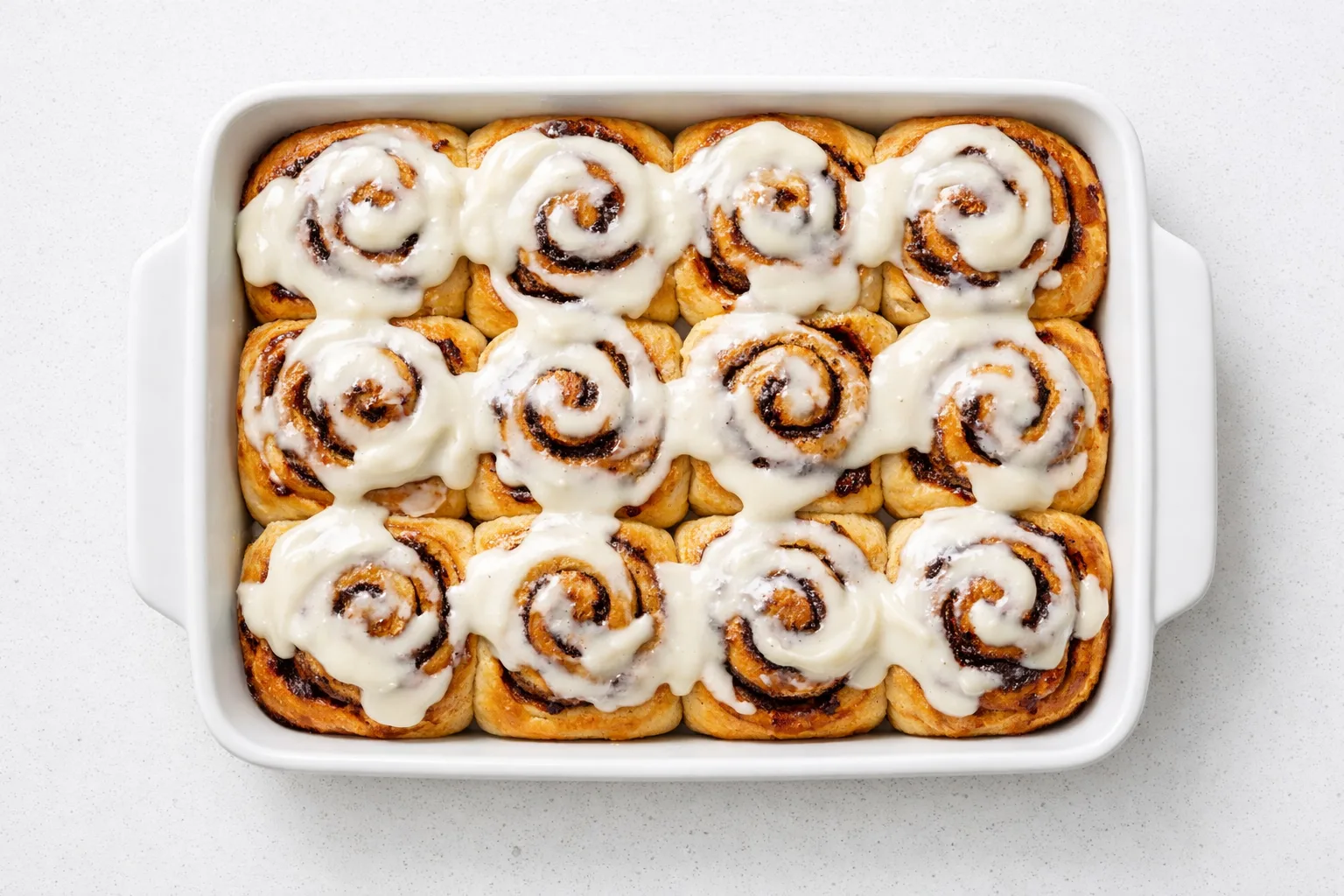
Christmas cinnamon rolls are the American answer to the problem every household faces on December 25th: how to feed a crowd something warm and extraordinary while half the house is still in pajamas. The overnight method solves everything. You build the dough, fill and shape the rolls, then refrigerate them while you sleep. By the time the first gift is unwrapped, the kitchen smells like browned butter, cinnamon, and caramelized sugar.
This recipe uses an enriched yeasted dough with enough butter and egg to stay tender for hours after baking, not the lean, tough rolls that go stale by noon. The filling is a thick layer of dark brown sugar and cinnamon, and the frosting is a proper tangy cream cheese version, not a thin glaze. These are the kind of homemade cinnamon rolls people quietly eat two of.
Equipment
Instructions
Tap each step to track your progress
- 1
Stir the warm milk, yeast, and a pinch of the granulated sugar together in the bowl of a stand mixer. Let it sit for 5 to 8 minutes until the surface is foamy and smells yeasty. If nothing happens after 10 minutes, the yeast is dead and you need a fresh packet.
- 2
Add the remaining granulated sugar, melted butter, egg, and vanilla to the yeast mixture. Fit the mixer with the dough hook and mix on low until combined, about 30 seconds. Add the flour and salt, then mix on low speed for 1 minute until a shaggy dough forms.
- 3
Increase to medium-low speed and knead for 6 to 7 minutes. The dough is ready when it pulls cleanly from the sides of the bowl and feels smooth, slightly tacky, but not sticky. If it clings to the bowl after 7 minutes, add flour one tablespoon at a time.
- 4
Shape the dough into a ball, place it in a lightly oiled bowl, and cover tightly with plastic wrap. Let it rise in a warm spot for 60 to 90 minutes until doubled in size. A turned-off oven with the light on works well.
- 5
Mix the soft butter, dark brown sugar, cinnamon, and salt for the filling in a small bowl until it forms a thick paste. Set aside.
- 6
Punch down the dough and turn it out onto a lightly floured surface. Roll it into a rectangle roughly 16 by 12 inches, with the long side facing you. The dough should be about 1/4 inch thick and even across the surface.
- 7
Spread the cinnamon filling evenly over the dough, leaving a 1/2-inch border along the far long edge. Use an offset spatula or the back of a spoon to get an even layer. Starting from the long edge closest to you, roll the dough into a tight log. Pinch the seam closed.
- 8
Using a sharp knife or unflavored dental floss, cut the log into 12 equal pieces. Place them cut-side up in a greased 9x13 inch baking pan, spacing them evenly in a 3-by-4 grid. They should have about 1/2 inch of space between them.
- 9
Cover the pan tightly with plastic wrap. For overnight (make-ahead) rolls, refrigerate for 8 to 16 hours. For same-day rolls, let them rise at room temperature for 30 to 40 minutes until puffy and the rolls are nearly touching.
- 10
If baking from the fridge, remove the pan and let it sit at room temperature for 45 to 60 minutes while you preheat the oven to 375F. The rolls should look puffy and press together when they are ready.
- 11
Bake at 375F for 25 to 28 minutes until the tops are golden brown and the internal temperature reads 190F on an instant-read thermometer. The center rolls will be the last to set. If the tops brown too quickly, tent loosely with foil for the final 5 minutes.
- 12
While the rolls bake, beat the cream cheese, butter, powdered sugar, vanilla, and salt together until smooth and fluffy, about 2 minutes with a hand mixer. Spread the frosting generously over the hot rolls as soon as they come out of the oven, so it melts into every crevice.
Tips & Tricks
Measure flour properly
Spoon flour into your measuring cup and level with a knife. Scooping directly from the bag can add up to 30% more flour, which makes the dough stiff and the rolls dense. If you have a kitchen scale, 3 1/2 cups is roughly 440 grams.
Use dental floss for clean cuts
Slide a piece of unflavored dental floss under the log, cross the ends over the top, and pull to slice cleanly through. A knife compresses the soft dough and squishes the filling out; floss gives you perfect rounds every time.
Do not rush the counter warm-up
When the rolls come out of the fridge on Christmas morning, they need a full 45 to 60 minutes at room temperature before baking. Cold rolls baked too soon will be dense in the center and underdone. Be patient; preheat the oven while you wait.
Frost the rolls while hot
Spreading the cream cheese frosting over rolls straight out of the oven lets it melt down between the spirals, creating pockets of creamy sweetness throughout. If you wait until they cool, the frosting sits on top instead of soaking in.
Troubleshooting
My dough did not rise
The yeast was either dead or the milk was too hot. Yeast dies above 120F. Always check that the milk feels warm but comfortable on the inside of your wrist. If the yeast does not foam within 10 minutes, discard and start with a new packet.
The rolls are doughy in the center
They needed more time in the oven, or the pan was too crowded. An instant-read thermometer is the most reliable check: pull at 190F. If the tops are already dark but the center reads under 185F, tent with foil and continue baking for 5 to 8 more minutes.
The filling leaked out during baking
The dough log was not rolled tightly enough, or the seam was not sealed. When rolling, keep consistent tension and press the final edge firmly into the log. Also make sure the filling butter was soft, not melted, as liquid butter seeps out during proofing.
My rolls are tough and dense
Overkneading or too much flour are the usual culprto. Measure flour by spooning it into the cup and leveling, not by scooping directly from the bag (which packs it). The dough should feel slightly tacky after kneading, not dry and stiff.
Variations
Brown Butter Frosting
Skip the cream cheese and make a brown butter glaze instead. Brown 4 tablespoons of butter in a saucepan until it smells nutty and turns amber, then whisk in 1 1/2 cups powdered sugar and 2 to 3 tablespoons of milk until pourable. The nutty, caramelized flavor pairs well with the cinnamon filling if you prefer something less tangy.
Apple Cinnamon Rolls
Fold 1 cup of finely diced, peeled Granny Smith apple into the cinnamon filling before spreading. Toss the apple pieces with 1 tablespoon of flour first so they do not make the filling watery. The apple softens during baking and adds a tart, fruity layer.
Dairy-Free Adaptation
Replace the milk with oat milk, the butter with vegan butter (such as Miyoko's) in both the dough and filling, and swap the cream cheese frosting for a glaze of 1 1/2 cups powdered sugar, 2 tablespoons oat milk, and 1 teaspoon vanilla. The texture will be slightly less rich but still soft and tender.
Serving & Gifting
Serve the rolls warm, straight from the pan, with extra frosting on the side for those who want more. They pair well with strong coffee, fresh-squeezed orange juice, or a glass of cold milk. For a Christmas brunch spread, set the baking pan on a wooden board alongside a fruit platter and scrambled eggs.
Storage & Freezing
Frosted rolls keep at room temperature, covered, for up to 2 days, though they are best within the first few hours. Refrigerate leftovers and reheat individual rolls in the microwave for 20 to 30 seconds until warm. Unfrosted rolls freeze well for up to 2 months in a zip-top bag; thaw overnight in the fridge, warm in a 300F oven for 10 minutes, then frost. Do not freeze frosted rolls, as the cream cheese frosting turns grainy when thawed.
Common Questions
Can I make cinnamon rolls the night before Christmas?
Yes, that is exactly what this recipe is designed for. Prepare the rolls through step 8, cover the pan tightly with plastic wrap, and refrigerate for 8 to 16 hours. On Christmas morning, pull them out, let them warm up for 45 to 60 minutes, and bake.
How do I know when cinnamon rolls are fully baked?
The most reliable method is an instant-read thermometer inserted into a center roll. You want an internal temperature of 190F. Visually, the tops should be golden brown and the rolls should feel firm when gently pressed, not doughy.
Can I use instant yeast instead of active dry?
Yes. Use the same amount but skip the proofing step. Add the instant yeast directly to the flour mixture, then add the warm milk and wet ingredients. Instant yeast does not need to be activated in liquid first, so you save about 10 minutes.
How long do homemade cinnamon rolls stay fresh?
Frosted rolls are best within a few hours of baking but will stay soft for up to 2 days at room temperature if covered tightly. Unfrosted rolls freeze for up to 2 months. Reheat before serving for the best texture.
Can I halve this recipe for a smaller batch?
Yes. Halve all ingredients and use an 8x8 inch or 9-inch round pan instead. You will get 6 rolls. Reduce the baking time by about 3 to 5 minutes since the smaller pan has less thermal mass. Check at 20 minutes.
Why are my cinnamon rolls dry?
Usually too much flour or overbaking. Measure flour by the spoon-and-level method (or weigh it), and pull the rolls from the oven as soon as they hit 190F internally. They firm up as they cool, so pulling them when they still look slightly underdone in the center is correct.