
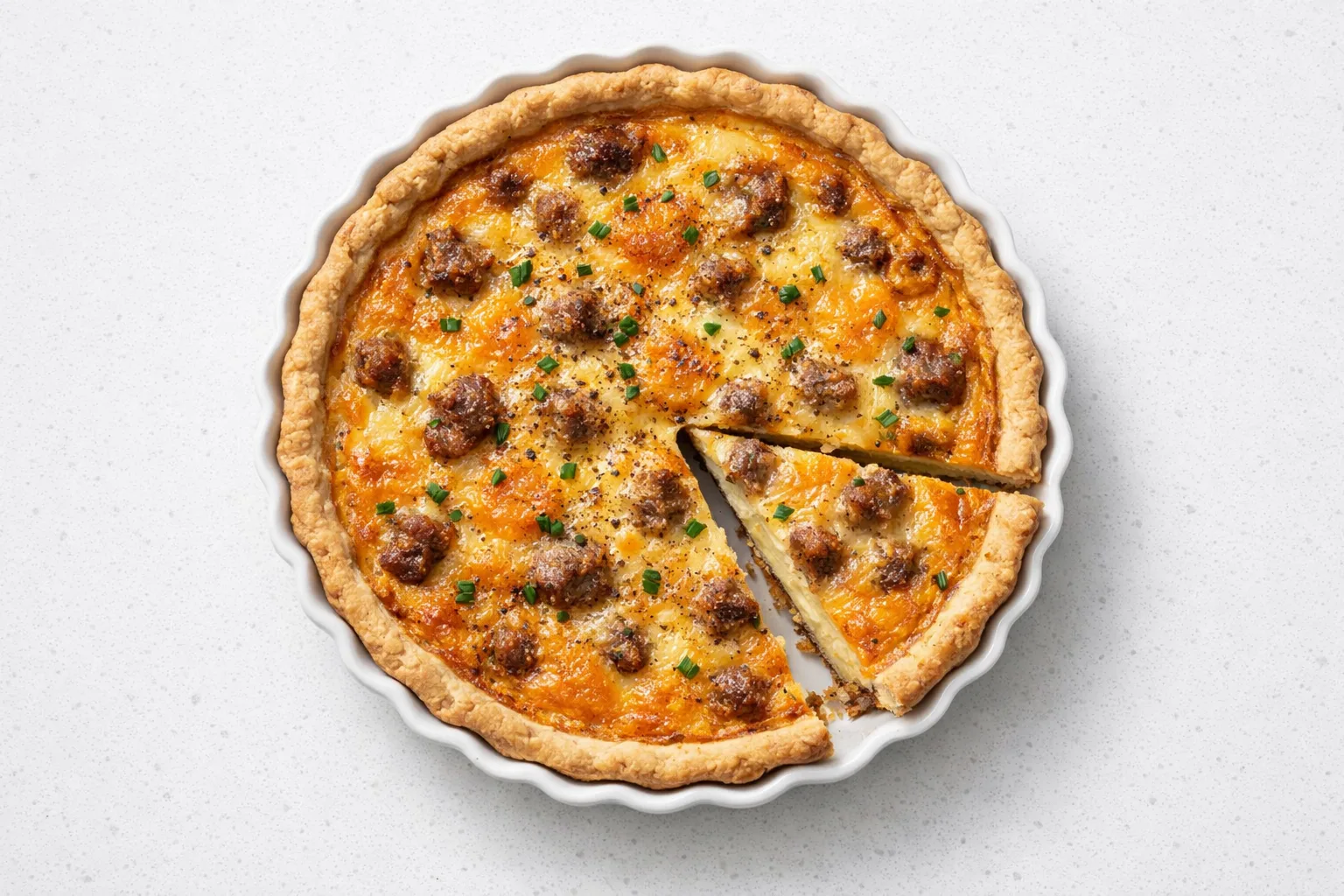
A christmas quiche is the rare brunch dish that earns its place at the table without asking anything of you on the morning it matters most. The concept is straightforward: a buttery shortcrust shell filled with savory pork sausage, sharp cheddar, and a cream-heavy egg custard. Assemble it the night before, refrigerate it unbaked, and slide it into the oven while the household is still in pajamas unwrapping gifts. An hour later, you have a centerpiece that feeds eight without drama.
This recipe is rooted firmly in the American Christmas brunch tradition, where the challenge is cooking something impressive while simultaneously hosting chaos. The quiche solves that problem with make-ahead prep and a filling substantial enough to carry people through a long morning. The key to a clean, custardy slice is the cream-to-egg ratio and a properly blind-baked crust that doesn't go soggy under a wet filling.
The sausage is browned hard before it goes in, which drives off excess fat and builds the kind of fond that flavors the whole filling. Sharp cheddar rather than mild adds enough bite to balance the richness of the custard. The result is a holiday quiche that tastes like it took more effort than it did.
Equipment
Instructions
Tap each step to track your progress
- 1
Make the crust: Pulse the flour and salt together in a food processor. Add the cold butter cubes and pulse 8 to 10 times until the mixture resembles coarse crumbs with pea-sized butter pieces visible. Add ice water one tablespoon at a time, pulsing after each addition, until the dough just begins to clump together when pinched. Do not let it form a ball in the processor. Turn it out onto a lightly floured surface, press it into a flat disc, wrap in plastic film, and refrigerate for at least 1 hour.
- 2
Preheat your oven to 375 F (190 C). On a lightly floured surface, roll the chilled dough into a circle about 12 inches in diameter, 1/8 inch thick. Fit it into a 9-inch tart pan with a removable base (or a 9-inch deep-dish pie dish), pressing it gently into the edges without stretching. Trim any overhang to 1/2 inch and fold it back in to reinforce the sides. Refrigerate for 20 minutes.
- 3
Blind-bake the crust: Line the chilled crust with parchment paper and fill with pie weights or dried beans. Bake for 20 minutes until the edges are set and pale golden. Remove the weights and parchment, prick the bottom several times with a fork, and bake for another 8 to 10 minutes until the base looks dry and very faintly golden. Remove from the oven and set aside. Reduce oven temperature to 325 F (165 C).
- 4
Brown the sausage: While the crust bakes, crumble the pork sausage into a large skillet over medium-high heat. Cook, breaking it up with a wooden spoon, for 6 to 8 minutes until well browned with some crisp bits. Remove the sausage with a slotted spoon and set aside, leaving about 1 tablespoon of fat in the pan.
- 5
In the same skillet, cook the diced onion over medium heat until softened and translucent, about 5 minutes. Season lightly with salt. Remove from heat and let cool for 5 minutes.
- 6
Whisk together the eggs, heavy cream, milk, salt, pepper, mustard powder, and cayenne in a large bowl or large-lipped measuring pitcher until fully combined and smooth. Do not whisk vigorously enough to create foam. Stir in the chives.
- 7
Assemble the quiche: Spread the cooked sausage and onion evenly across the bottom of the blind-baked crust. Scatter the grated cheddar over the top in an even layer. Pour the egg custard slowly over the filling, stopping about 1/4 inch below the top of the crust rim to avoid overflow.
- 8
(Make-ahead step): If preparing the night before, cover the assembled unbaked quiche tightly with plastic wrap and refrigerate overnight. Remove from the refrigerator 30 minutes before baking to take the chill off.
- 9
Bake at 325 F (165 C) for 35 to 40 minutes until the custard is just set at the center. It should still have a very slight jiggle when you shake the pan gently, the way a nearly-set gelatin moves. The edges will be fully firm and the surface will be lightly puffed. Do not overbake or the custard will be rubbery.
- 10
Let the quiche rest on a wire rack for at least 15 minutes before slicing. This allows the custard to finish setting and the slices will cut cleanly. Garnish with fresh chives and serve warm or at room temperature.
Tips & Tricks
Blind-bake until it looks done
The most common mistake with quiche is an under-baked crust. The base should look dry and very pale gold, not raw and doughy, before the filling goes in. A soggy-bottomed quiche can't be fixed after baking, so take the extra 5 minutes with the crust.
Use cold butter and work fast
For a flaky, tender crust, the butter must stay cold until it hits the oven. If your hands run warm, use a food processor for mixing. If the dough starts feeling greasy or sticky while rolling, slide it onto a baking sheet and refrigerate for 10 minutes before continuing.
Make the custard in a pitcher, not a bowl
Pouring a wet custard from a mixing bowl into a filled pastry shell without spilling is difficult. Whisk the custard in a large-lipped measuring pitcher (at least 4-cup capacity) and pour directly from the spout. This is a minor change that makes assembly much cleaner.
Rest before you slice
Fifteen minutes of resting makes a genuine difference in slice quality. The custard firms up considerably as it cools from oven temperature. Cutting too early turns clean slices into crumbly wedges.
Make-ahead is the real advantage
The unbaked assembled quiche refrigerates overnight without any quality loss. Prepare everything on Christmas Eve, cover the pan tightly, and on Christmas morning simply move it from the fridge to a preheated oven. The cold-to-oven timing adds about 5 minutes to the bake, so check for that slight jiggle starting at 40 minutes rather than 35.
Troubleshooting
The custard is watery and won't set
The cream-to-egg ratio is off, or the quiche was underbaked. This recipe uses a high cream ratio intentionally for richness, but it needs full 325 F heat and adequate time. If your oven runs cool, add 5 minutes of bake time. A thermometer is more reliable than timing alone: the internal temperature of a set quiche should read around 170 F (77 C).
The crust is soggy at the bottom
The crust was not blind-baked long enough, or the filling was added before the crust cooled slightly. The bottom of the blind-baked shell should look dry and faintly matte before the filling goes in. A wet-looking bottom after the weights come off means it needs more time. If you're using a glass pie dish rather than a metal tart pan, add 5 to 10 minutes to the blind-bake since glass conducts heat more slowly.
The filling puffed up and cracked on top
This happens when the oven temperature is too high or the quiche was overbaked. A cracked top is cosmetic rather than catastrophic, but it signals the custard is drier than ideal inside. Keep the oven at 325 F and check for the slight jiggle at 35 minutes. Overbaked quiche can't be saved, but covering it with chives hides surface cracks effectively.
The slices fall apart when cut
The quiche wasn't rested long enough after baking. The custard continues to set as it cools. Wait at least 15 minutes before the first cut. For cleaner slices, use a thin sharp knife dipped in hot water between cuts.
The sausage is greasy and the filling feels heavy
Insufficiently browned sausage releases its fat into the custard during baking, making the whole filling oily. Brown the sausage hard, in a single layer if possible, until genuinely crisp in places, then drain it on paper towels before adding it to the crust.
Variations
Vegetarian Christmas Quiche
Skip the sausage entirely and replace it with 8 oz of cremini mushrooms, sliced and sauteed in butter until their moisture evaporates and they turn golden. Add 1/2 cup of roasted red pepper strips (from a jar, drained) alongside the mushrooms. The quiche is just as satisfying and makes the crust-to-filling ratio feel generous. Add `vegetarian:dietary` to your considerations.
Gruyere and Ham
Swap the sharp cheddar for an equal weight of aged Gruyere and replace the pork sausage with 6 oz of cooked ham, diced into 1/2-inch cubes. This is closer to a classic Quiche Lorraine and pairs better with a simple green salad on the side. The Gruyere melts more smoothly than cheddar and gives a nuttier finish.
Gluten-Free Crust Option
Replace the all-purpose flour with a 1:1 gluten-free flour blend (Bob's Red Mill or similar, with xanthan gum included). The dough will be stickier and more fragile. Roll it between two sheets of parchment paper and refrigerate the rolled-out round for 10 minutes before transferring to the pan. The baked crust will be slightly more crumbly but holds together for slicing.
Spinach and Feta
Reduce the sausage to 6 oz and add 2 cups of fresh baby spinach, wilted in the skillet after the onion and roughly chopped. Replace half the cheddar with crumbled feta (about 1/2 cup each). The feta adds a sharp brininess that cuts through the cream custard well.
Serving & Gifting
Serve the quiche warm or at room temperature, cut into wedges at the table. It pairs well with a simple green salad dressed with a sharp vinaigrette, fresh orange slices, or roasted cherry tomatoes on the side for color. For a full Christmas brunch spread, add a fruit platter and a pot of strong coffee. The quiche holds at room temperature for up to 2 hours, which makes it easy to set out before the first guests arrive.
Storage & Freezing
Refrigerate leftover quiche, covered loosely with foil or in an airtight container, for up to 4 days. To reheat individual slices, place on a baking sheet in a 325 F oven for 12 to 15 minutes until warmed through. The microwave reheats faster but softens the crust. The assembled, unbaked quiche keeps in the refrigerator overnight, which is the make-ahead window this recipe is designed around. Baked quiche can be frozen for up to 1 month, wrapped tightly in plastic film then foil, but the crust texture suffers slightly after freezing; thaw overnight in the refrigerator and reheat in the oven.
Common Questions
Can I make this quiche the night before?
Yes, this is the recommended approach. Assemble the fully unbaked quiche (crust blind-baked, filling poured in) up to 18 hours ahead, cover tightly with plastic wrap, and refrigerate. Take it out 30 minutes before baking to remove the chill. Bake as directed, adding about 5 minutes to the time since the filling starts cold.
What kind of sausage is best for breakfast quiche?
Bulk pork breakfast sausage (sold as a loose roll or patty, not in links) works best because it crumbles evenly. Sage-seasoned or plain both work. If you can only find link sausages, remove the casings before cooking. Italian sausage (sweet or mild) is a good substitute if breakfast sausage isn't available.
How do I know when the quiche is done baking?
The quiche is done when the edges are fully set and the center has only a very slight jiggle when the pan is shaken gently. Think just-set gelatin, not liquid. The surface should look lightly puffed and dry, not wet or shiny. If you have an instant-read thermometer, aim for around 170 F (77 C) at the center.
Can I use store-bought pie crust?
Yes. A refrigerated roll-out pie crust (like Pillsbury) works as a shortcut. Fit it into your pan, refrigerate for 20 minutes, and blind-bake as directed before filling. The texture will be slightly less flaky than homemade but the result is still very good. Frozen deep-dish pie shells also work; thaw completely before blind-baking.
How many people does one quiche serve?
One 9-inch quiche serves 6 to 8 people as part of a brunch spread with other dishes. For a quiche-only breakfast with large appetites, plan on 6 servings. The recipe scales up easily: bake two quiches for a crowd rather than trying to scale one into a larger pan.
Can I use milk instead of heavy cream?
You can replace the heavy cream with whole milk, but the custard will be noticeably less rich and set slightly firmer. For a lighter result, use half heavy cream and half whole milk. Do not use low-fat or skim milk; the custard will not set properly and will have a watery texture.