

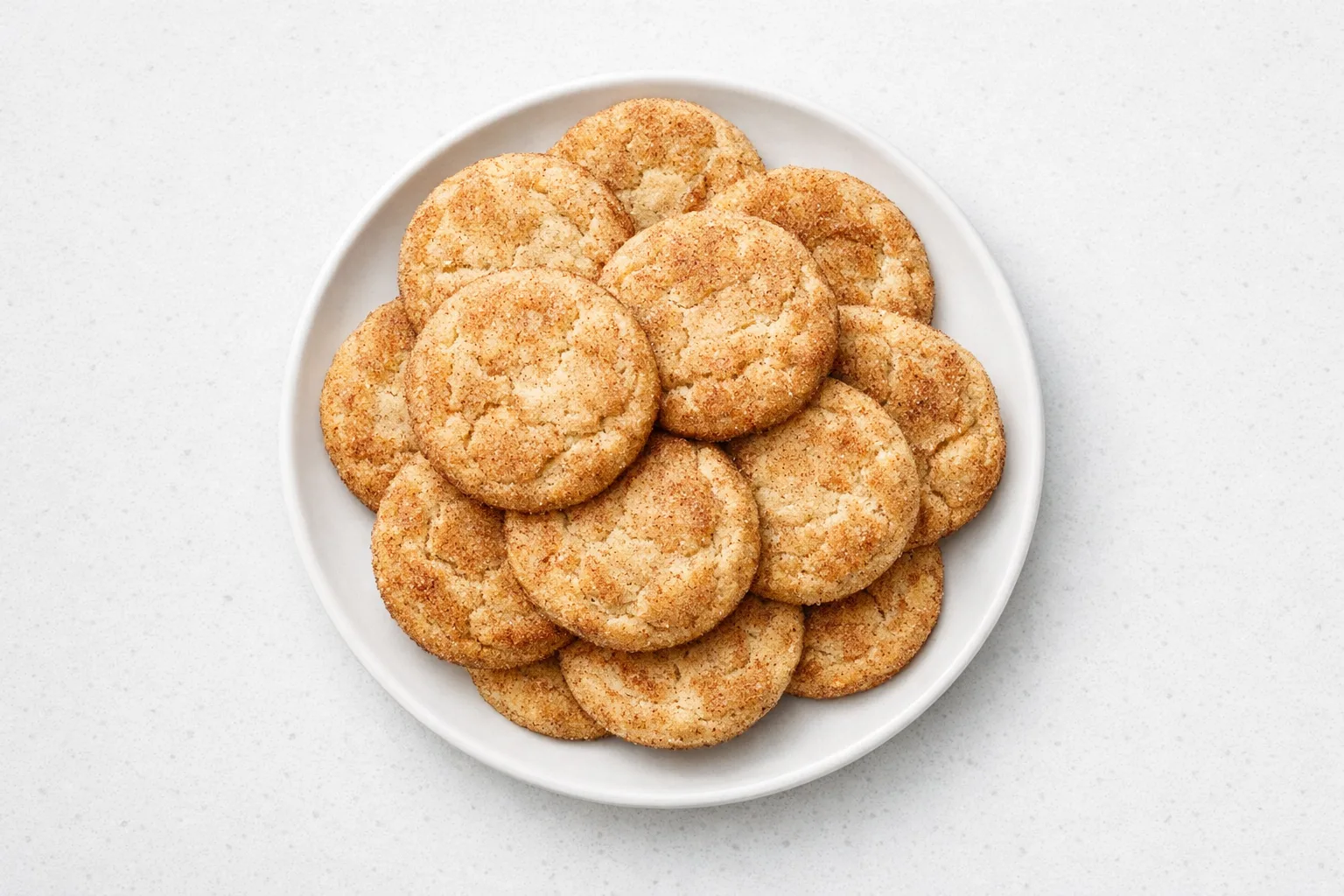
Christmas snickerdoodles are one of the most iconic American holiday cookies, a staple of cookie swaps and holiday tin assortments across the country. What sets them apart from every other cinnamon sugar cookie is cream of tartar: it reacts with the baking soda to produce a distinctive tang and a uniquely chewy, almost cakey texture that plain sugar cookies simply cannot replicate.
The snickerdoodle has been part of American baking since at least the late 19th century, with recipes appearing in New England cookbooks from the 1890s. The name's origin is cheerfully disputed, ranging from a Dutch or German derivation to the theory that it was simply a nonsense word invented for a whimsical cookie. Whatever the etymology, the soft snickerdoodle recipe remains unchanged in its essentials: a buttery dough, cream of tartar, and a thick coating of cinnamon sugar before baking.
This version uses a higher ratio of cream of tartar than most recipes and pulls the cookies from the oven while the centers still look underdone. That combination gives you the best snickerdoodle result: a slightly crisp cinnamon crust, a pillowy center, and that signature tang in every bite.
Equipment
Instructions
Tap each step to track your progress
- 1
Whisk together the flour, cream of tartar, baking soda, and salt in a medium bowl until evenly combined. Set aside.
- 2
In a stand mixer fitted with the paddle attachment, beat the softened butter and 1 1/2 cups sugar on medium speed for 3 minutes until pale, light, and fluffy. Scrape down the sides of the bowl halfway through.
- 3
Add the eggs one at a time, beating for 20 seconds after each addition. Add the vanilla extract and beat until just incorporated.
- 4
Reduce the mixer to low speed and add the flour mixture in two additions, mixing until just combined and no dry streaks remain. Do not overmix. The dough will be soft and slightly sticky.
- 5
Cover the bowl tightly with cling film and refrigerate for at least 1 hour, or up to 24 hours. This step is not optional; warm dough spreads flat in the oven.
- 6
When ready to bake, preheat your oven to 375 degrees F (190 degrees C). Line two baking sheets with parchment paper.
- 7
Stir together the 1/4 cup sugar and 2 tsp cinnamon in a small bowl to make the coating.
- 8
Using a medium cookie scoop (about 1.5 tablespoons of dough), roll portions into balls between your palms. Drop each ball into the cinnamon sugar and roll to coat thoroughly on all sides.
- 9
Place the coated dough balls on the prepared baking sheets about 2 inches apart. Do not flatten them; they will spread naturally in the oven.
- 10
Bake for 10 to 12 minutes until the edges are just set and the centers look slightly underdone and puffed. The tops should show light cracking. They will firm up as they cool, so resist baking until they look done.
- 11
Cool on the baking sheet for 5 minutes before transferring to a wire rack. The cookies will deflate slightly and develop their signature crinkled surface as they cool.
Tips & Tricks
Do not skip the cream of tartar
Cream of tartar is what makes a snickerdoodle a snickerdoodle and not just a cinnamon sugar cookie. It provides acidity that keeps the cookies soft and chewy for days and delivers the slightly tangy flavor that distinguishes the cookie. There is no substitute that achieves the same result.
Chill the dough before shaping
Even one hour in the refrigerator makes a significant difference in spread. Chilled dough holds a rounder shape and bakes up thicker with a better chew. Overnight chilling is even better and lets you bake the cookies in batches over two days.
Use a cookie scoop for uniform size
Uniform dough balls bake evenly. Uneven sizes mean some cookies are underdone while others are overbaked on the same sheet. A medium scoop (about 1.5 tablespoons) gives you the right thickness for the 10 to 12 minute bake time.
Roll generously in cinnamon sugar
Press the dough ball firmly into the cinnamon sugar and roll it several times so every part of the surface is well coated. A thin coating becomes invisible after baking; a thick coating forms the crackled crust that defines the cookie.
Pull them early
Every oven runs slightly differently. Start checking at 9 minutes. The cookies are done when the edges are set but the center still looks puffed and slightly raw. They will continue cooking on the hot pan for 5 minutes after you remove them from the oven, and will firm up completely as they cool to room temperature.
Troubleshooting
My snickerdoodles spread into flat discs
The dough was not chilled long enough, or the butter was too warm when you started. Butter should be soft enough to hold a thumbprint but still cool to the touch. If your kitchen is warm, chill the shaped dough balls on the baking sheet for 15 minutes before they go into the oven.
The cookies are crunchy instead of soft and chewy
They were overbaked. Snickerdoodles look underdone when they are actually done. Pull them when the centers are puffed and the edges are just barely set, even if the tops look wet. A 10-minute rest on the hot pan finishes the cooking. Next batch, reduce time by 1 to 2 minutes.
The cinnamon sugar coating is clumping and not sticking evenly
The dough balls are too dry or too cold from chilling. Let the portioned dough sit at room temperature for 5 minutes before rolling in the coating. The coating adheres best to slightly tacky dough.
My cookies taste flat, missing that signature tang
You may have skipped or reduced the cream of tartar. This ingredient is not substitutable in a snickerdoodle. It is the source of the characteristic sour note and chew. Baking powder does not replicate it.
The cookies are cakey and thick, not at all chewy
Too much flour was added. When measuring by volume, spoon the flour into the measuring cup and level off with a straight edge; do not scoop directly with the measuring cup, which packs in up to 20% extra flour. Alternatively, use a kitchen scale: 330g all-purpose flour.
Variations
Brown Butter Snickerdoodles
Brown the butter before using it: melt 1 cup of butter in a light-colored saucepan over medium heat, stirring often, until the milk solids turn golden and the butter smells nutty, about 5 to 7 minutes. Pour into the mixing bowl and refrigerate until solid but still soft, about 30 minutes. Proceed with the recipe as written. The result has a deeper, almost toffee-like flavor beneath the cinnamon coating.
Vegan Snickerdoodles
Replace the butter with vegan butter (stick-style, not tub-style) and substitute the eggs with 2 flax eggs (1 tablespoon ground flaxseed plus 3 tablespoons water per egg, rested for 5 minutes). The dough will be slightly softer, so extend the chill time to at least 2 hours. The cookies will be a touch less chewy but still hold their shape and develop good cinnamon-sugar crust.
Gluten-Free Snickerdoodles
Substitute a 1:1 gluten-free flour blend (such as a rice flour-based blend with xanthan gum already included) for the all-purpose flour. The texture will be slightly more delicate and the edges crisper. Chill the dough for 2 hours minimum, as gluten-free dough spreads faster. Bake at 350 degrees F (175 degrees C) to avoid over-browning.
Cardamom Snickerdoodles
Add 1/2 teaspoon ground cardamom to the cinnamon sugar coating and a pinch to the dough itself. The cardamom cuts through the butter with a floral, slightly citrusy note that feels particularly fitting for a Scandinavian-inspired Christmas cookie tin.
Serving & Gifting
Snickerdoodles are excellent on their own with a glass of cold milk or a cup of strong coffee. For Christmas parties, arrange them in a wide shallow bowl or on a wooden board so the crinkled cinnamon tops are visible. They travel and stack well, making them a practical choice for cookie swaps: layer in a tin between sheets of parchment to prevent the cinnamon coating from sticking together.
Storage & Freezing
Store cooled snickerdoodles in an airtight container at room temperature for up to 5 days; they stay soft because of the cream of tartar. For longer storage, freeze the baked cookies in a single layer until solid, then transfer to a zip-seal freezer bag and freeze for up to 3 months. Thaw at room temperature for 30 minutes. You can also freeze the unbaked dough balls (before rolling in cinnamon sugar) for up to 3 months; roll in cinnamon sugar directly from frozen and add 2 to 3 minutes to the bake time.
Common Questions
What is cream of tartar and can I substitute it?
Cream of tartar (potassium bitartrate) is a byproduct of wine production and is available in the spice aisle of most supermarkets. In snickerdoodles, it acts as an acid that reacts with baking soda for lift and contributes the distinctive tangy flavor and chewy texture. You cannot substitute it without fundamentally changing the cookie; if you leave it out, you will have a cinnamon sugar cookie, not a snickerdoodle.
How do I keep snickerdoodles soft for days?
Store them in an airtight container with a slice of white sandwich bread. The cookies will absorb moisture from the bread and stay soft. The cream of tartar already helps retain softness compared to most cookies, so at room temperature they stay tender for up to 5 days without this trick.
Can I make snickerdoodle dough ahead of time?
Yes. The dough keeps refrigerated for up to 48 hours before baking. You can also freeze the shaped dough balls (before coating in cinnamon sugar) for up to 3 months and bake directly from frozen; just roll in cinnamon sugar while still cold and add 2 to 3 minutes to the bake time.
Why do my snickerdoodles not have crinkles on top?
The signature crinkle forms as the puffed center sinks slightly during cooling. If your cookies are completely flat coming out of the oven, the dough spread too fast, likely because it was too warm or too little cream of tartar was used. Chilling the dough properly and measuring the cream of tartar accurately will fix this.
Are snickerdoodles the same as cinnamon sugar cookies?
No. Snickerdoodles contain cream of tartar and baking soda, which together create a chewy, slightly tangy cookie with a distinctive crinkled surface. A cinnamon sugar cookie made with baking powder will be crisper, less tangy, and does not have the same chew. The cream of tartar is the defining difference.
How many snickerdoodles does this recipe make?
This recipe yields approximately 36 cookies using a 1.5-tablespoon cookie scoop. The yield depends on how large you portion the dough. For a cookie swap or holiday tin, the full batch is a practical quantity that fills one standard cookie tin.