
 Greece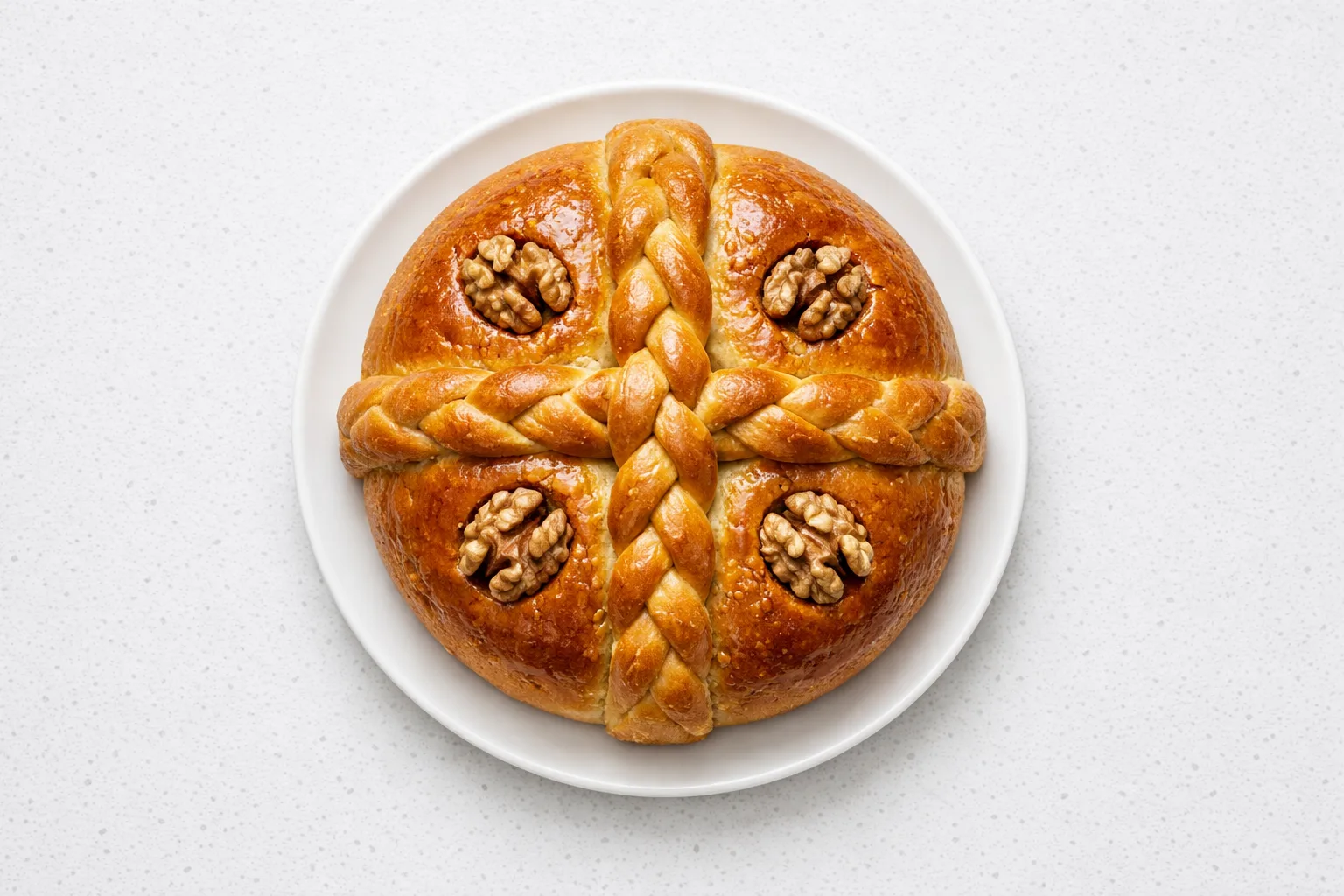
Christopsomo, which translates literally as "Christ's bread," is the ceremonial loaf that Greek families bake on Christmas Eve to be blessed and broken on Christmas morning. The christopsomo tradition predates modern Greece by centuries, rooted in Byzantine Orthodox practice where the head of the household would make the sign of the cross over the loaf before sharing it among family members, starting with the eldest. The bread is always round, symbolizing the sun and the fullness of the new year, and always marked with a large dough cross. Walnuts, pressed into each quadrant, represent prosperity.
The dough is enriched with eggs, butter, and honey, and spiced with ground anise and orange zest, which gives christopsomo its signature warm, slightly floral scent as it bakes. This is a yeasted sweet bread in the same family as Greek tsoureki, but simpler in texture and more rustic in presentation. The key technical step is shaping the cross decoration from separate dough ropes and pressing them firmly enough that they bake into the loaf without separating, while keeping the loaf tender inside.
Equipment
Instructions
Tap each step to track your progress
- 1
In a small bowl, combine the warm milk, warm water, honey, and instant yeast. Stir gently and let sit for 5 minutes. The mixture should turn slightly foamy; if it does not, your yeast may be inactive.
- 2
Weigh or measure the bread flour into a large bowl (or the bowl of a stand mixer). Add the salt, ground anise, orange zest, cinnamon, and clove, and whisk to distribute evenly.
- 3
Pour the yeast mixture into the flour. Add the 2 eggs. Using a dough hook on medium-low speed (or by hand), mix until a shaggy dough forms, about 2 minutes. Add the softened butter a few cubes at a time, mixing after each addition until incorporated. Once all the butter is in, increase to medium speed and knead for 8-10 minutes until the dough is smooth, elastic, and pulls cleanly from the bowl's sides. It will be slightly tacky but should not stick to your hands.
- 4
Shape the dough into a ball, place in a lightly oiled bowl, cover with plastic wrap or a damp towel, and let rise at room temperature until doubled, about 1 hour 30 minutes.
- 5
Once doubled, punch the dough down gently. Remove it to a lightly floured surface. Cut off approximately one-fifth of the dough and set aside for the cross decorations. Shape the remaining dough into a smooth, tight round ball by tucking the edges underneath and rolling it on the work surface. Place on a parchment-lined baking sheet.
- 6
Divide the reserved dough into two equal pieces. Roll each piece into a rope about 20 inches (50 cm) long and roughly 3/4 inch (2 cm) thick, keeping the thickness even. Lay the two ropes across the loaf in a cross pattern, pressing the ends firmly down the sides and underneath the loaf to secure them. The ropes should sit snugly against the surface of the loaf, not perch on top loosely.
- 7
Press one walnut firmly into the center of each quadrant created by the cross. Cover the shaped loaf loosely with plastic wrap and let rise for 45-60 minutes until noticeably puffed.
- 8
Preheat the oven to 375 F (190 C) while the loaf rises.
- 9
Brush the entire surface of the loaf generously with egg wash, taking care not to deflate it. Scatter sesame seeds over the surface if using. Avoid getting egg wash on the walnuts as it can make them look shiny and odd.
- 10
Bake for 40-45 minutes until the crust is a deep golden brown and the loaf sounds hollow when tapped on the bottom. If the top is browning too quickly after 25 minutes, tent loosely with foil. An instant-read thermometer inserted into the center should read 190-195 F (88-90 C).
- 11
Cool on a wire rack for at least 30 minutes before slicing. The crumb will set as it cools; cutting too soon produces a gummy interior.
Tips & Tricks
Use bread flour, not all-purpose
Bread flour has higher protein content (12-14%), which builds the gluten network needed to support an enriched dough with butter and eggs. All-purpose flour produces a loaf that is softer but less structured, and the decorative cross is more likely to sink into the loaf during baking.
Do not rush the first rise
The long first rise at room temperature develops flavor compounds that a quick rise in a warm oven does not produce. If you have time, a slow overnight rise in the refrigerator produces an even better tasting loaf. Take the dough out of the fridge 1 hour before shaping to come back to room temperature.
Press the cross ropes firmly
The single most common failure in christopsomo is a cross that separates or floats during baking. After placing the ropes, go back with your fingers and press gently but decisively down the length of each rope, paying particular attention to the center cross point and the ends. Then let the shaped loaf rest and puff before baking; the second rise bonds the ropes more securely.
Test doneness with a thermometer
Greek enriched holiday breads like this one can look done on the outside while still underbaked inside. A thermometer reading of 190-195 F in the center is the reliable indicator. This is especially important in the first time you bake this bread, as oven temperatures vary.
Make ahead and freeze the shaped unbaked loaf
Shape the loaf including the cross and walnuts, cover tightly with plastic wrap, and freeze on the baking sheet until solid, then transfer to a zip bag. The night before baking, transfer to the fridge to thaw, then bring to room temperature for 2 hours until puffed before baking with egg wash.
Troubleshooting
The cross ropes separated from the loaf during baking
The ropes were not secured firmly enough, or the loaf rose too aggressively in the oven and pushed them off. When attaching the ropes, tuck the ends underneath the loaf and gently press the full length of each rope into the surface. A light brush of water along the base of the ropes before placing them helps them adhere during the second rise.
My loaf is dense and barely rose
Either the yeast was inactive or the kitchen was too cold for the rise. Test yeast in warm liquid before mixing; if no foam forms after 10 minutes, start with fresh yeast. For the rise, the dough needs a warm environment around 75-78 F (24-26 C). If your kitchen is cold, place the covered dough in an oven with just the light on.
The crust is darkening too fast but the inside is still raw
The oven is too hot or the loaf is on a rack that is too high. Tent the loaf loosely with foil after the first 25 minutes and check the internal temperature rather than relying on color alone. The bread is done at 190-195 F (88-90 C) in the center.
The crumb is gummy when sliced
The loaf was cut too soon after baking. Enriched doughs like christopsomo need at least 30 minutes to finish cooking via carry-over heat after leaving the oven. The crumb continues to set as the steam redistributes. Wait until the loaf is barely warm to the touch.
The dough tears during shaping
The gluten is too tight from kneading. Cover the dough and let it rest 10 minutes before continuing. This allows the gluten to relax enough to stretch without fighting back.
Variations
Nut-Free Christopsomo
Omit the walnut decorations and press a single whole clove or dried fig into the center of each quadrant instead. The cloves are in keeping with the spiced flavor profile of the bread and are a common variation in some Greek island traditions.
Stuffed Christopsomo
Before shaping the round loaf, flatten the dough slightly and place a mixture of 1/2 cup chopped walnuts, 2 tbsp honey, and 1 tsp cinnamon in the center. Pull the edges up around the filling and pinch tightly to seal before shaping into a round. This produces a loaf with a sweet nutty center that reveals itself when sliced.
Vegan Adaptation
Replace the 2 eggs in the dough with 2 flax eggs (1 tbsp ground flaxseed mixed with 3 tbsp water each, rested 5 minutes). Substitute the butter with room-temperature coconut oil or a high-fat vegan butter. Use plant-based milk and replace the egg wash with a mixture of 2 tbsp olive oil and 1 tbsp maple syrup for a glossy crust. The loaf will be slightly denser but fully holds its shape.
Tsoureki-Style Christopsomo
Add 1/2 tsp mahlab (ground sour cherry pits, available at Greek and Middle Eastern grocery stores) and 1/4 tsp ground mastic to the dough for a flavor profile closer to Easter tsoureki. Mahlab gives a subtle cherry-almond note that is highly characteristic of Greek enriched breads.
Serving & Gifting
Christopsomo is traditionally blessed before the Christmas meal and broken or sliced by the head of the household, with the first piece set aside for the house and subsequent pieces distributed to family members. Serve warm or at room temperature with good Greek honey drizzled over the open crumb and a small dish of soft butter alongside. It pairs naturally with strong Greek coffee or sweet mavrodaphne wine. For a festive table, present the whole uncut loaf as a centerpiece before slicing.
Storage & Freezing
Christopsomo keeps at room temperature, wrapped in a clean cloth or stored in a paper bag, for up to 3 days before it begins to stale. For longer keeping, slice after the first day and store slices in an airtight bag or container; they can be toasted when slightly stale and taste excellent. The baked loaf freezes well for up to 2 months, tightly wrapped in plastic and then foil. Thaw at room temperature overnight and warm in a 300 F (150 C) oven for 10 minutes. Do not refrigerate the loaf as refrigeration accelerates staling in yeast breads.
Common Questions
What is christopsomo?
Christopsomo is a traditional Greek Christmas bread made from a honey and butter-enriched yeasted dough flavored with anise and orange zest. The loaf is round, decorated with a dough cross, and adorned with walnuts in each quadrant. It is baked on Christmas Eve and blessed before being shared at the Christmas meal.
What does christopsomo taste like?
The bread has a soft, slightly dense crumb, similar to brioche but less rich, with a warm spiced flavor from anise, orange zest, cinnamon, and clove. Honey adds gentle sweetness without making it dessert-like. The crust is golden and slightly crisp from the egg wash.
Can I use active dry yeast instead of instant yeast?
Yes. Use the same quantity (2 1/4 tsp) but proof it first: dissolve in the warm milk and water with the honey and let it sit for 10 minutes until foamy before adding to the flour. Instant yeast can go directly into the dry ingredients, but active dry yeast needs this activation step to ensure it is alive.
Is christopsomo only made at Christmas?
Traditionally, yes. Christopsomo is specifically a Christmas Eve bread with Orthodox Christian symbolism tied to the holiday. Similar ceremonial breads with different decorations are made for other occasions in Greek culture (such as New Year's vasilopita), but christopsomo with its cross and walnuts is specifically Christmas.
What can I use instead of anise seed?
If anise seed or anise extract is not available, fennel seed (used in the same quantity) is the closest substitute, with a similar licorice-adjacent flavor. For a milder loaf, simply omit it and increase the orange zest to 2 teaspoons. The bread will still be distinctly Greek in flavor from the other spices.
How is christopsomo different from tsoureki?
Both are Greek enriched yeasted breads made with honey, eggs, and butter. Tsoureki is typically braided, made for Easter, and flavored with mahlab and mastic. Christopsomo is round, made for Christmas, decorated with a cross and walnuts, and flavored with anise and orange. They are related in technique but distinct in shape, season, and spice profile.