
 United Kingdom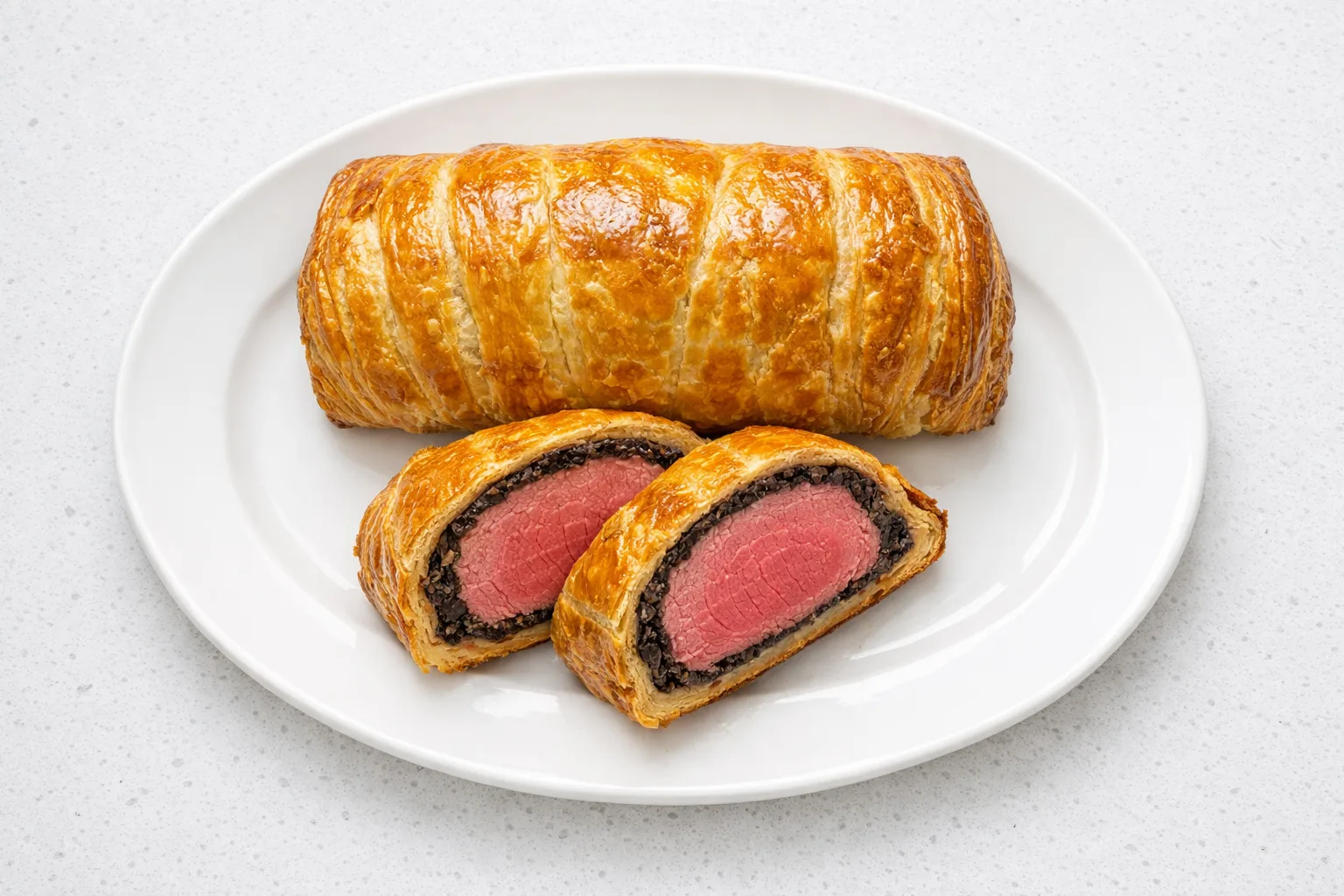
Beef wellington is the undisputed centrepiece of a British Christmas dinner. A whole beef tenderloin, seared hard, coated in a concentrated mushroom duxelles, wrapped in puff pastry, and baked until the crust shatters at the touch of a knife. The dish likely owes its name to the 1st Duke of Wellington, though food historians argue over whether the connection is genuine or simply patriotic branding. Regardless, it became a fixture of grand British dining in the mid-20th century and has never left the Christmas table.
What separates a good beef wellington from a soggy disappointment comes down to two things: driving all the moisture out of the duxelles and chilling the assembled roll thoroughly before it hits the oven. Skip either step and you get a wet, pale pastry instead of a crisp golden shell. This recipe walks you through both with specific visual cues so you know exactly when each stage is done.
Equipment
Instructions
Tap each step to track your progress
- 1
Season the beef tenderloin generously with salt and pepper on all sides. Heat 2 tablespoons olive oil in a heavy skillet over high heat until just smoking. Sear the tenderloin for about 45 seconds per side, turning to get a deep brown crust on all four sides and both ends. Transfer to a wire rack and let it cool completely, at least 30 minutes. The beef must be cold before wrapping.
- 2
While the beef cools, prepare the duxelles. Pulse the mushrooms in a food processor in two batches until very finely chopped, almost paste-like but not pureed. In the same skillet used for searing, melt the butter with the olive oil over medium-high heat. Add the shallots and cook for 2 minutes until translucent.
- 3
Add the chopped mushrooms, garlic, thyme, salt, and pepper. Cook over medium-high heat, stirring frequently, for 12 to 15 minutes. The mushrooms will release a large amount of liquid. Keep cooking until the pan is dry and the mixture looks like a thick, dark paste that pulls away from the pan. Add the sherry and cook until absorbed, about 1 minute more. Spread the duxelles on a plate and refrigerate until completely cool.
- 4
Lay a large sheet of cling film on your work surface. Arrange the prosciutto slices in a slightly overlapping rectangle, about 12 by 10 inches. Spread the cooled duxelles in an even layer over the prosciutto, leaving a 1-inch border at the top edge.
- 5
Brush the cooled beef tenderloin all over with the Dijon mustard. Place it along the bottom edge of the prosciutto rectangle. Using the cling film to help you, roll the prosciutto and duxelles tightly around the beef, tucking the ends in as you go. Twist the ends of the cling film tight like a Christmas cracker to compress the roll into a firm cylinder. Refrigerate for at least 30 minutes.
- 6
Roll out the puff pastry on a lightly floured surface into a rectangle large enough to fully enclose the beef roll, roughly 14 by 12 inches. Unwrap the chilled beef log and place it on the pastry, seam side down. Brush the exposed pastry edges with egg wash.
- 7
Fold the pastry around the beef, pressing the seam firmly to seal. Trim any excess pastry, then fold and seal the ends. Place the wellington seam-side down on a parchment-lined baking sheet. Brush the entire surface generously with egg wash. Use a sharp knife to score a few shallow diagonal lines across the top for decoration. Refrigerate for at least 20 minutes while you preheat the oven. This final chill is critical for a flaky crust.
- 8
Preheat the oven to 425 F (220 C). Bake the wellington for 25 to 30 minutes, until the pastry is deeply golden brown and an instant-read thermometer inserted through one end reads 120 F (49 C) for medium-rare or 130 F (54 C) for medium.
- 9
Remove from the oven and let the wellington rest on the baking sheet for 10 minutes before transferring to a cutting board. The internal temperature will rise about 5 degrees during resting. Slice with a sharp serrated knife into thick rounds and serve immediately.
Tips & Tricks
Dry the duxelles completely
This is the single most important step. If the mushroom mixture is even slightly wet, the steam will make your pastry soggy from the inside. Cook it until you can drag a spatula across the pan and the trail holds for several seconds before closing.
Use a meat thermometer
Guessing the doneness of beef wellington is a losing game because you cannot see or touch the meat through the pastry. An instant-read thermometer inserted through one end is the only reliable method. Target 120 F for medium-rare.
Chill at every stage
Cold beef goes into cold duxelles, wrapped in cold prosciutto, then chilled again before wrapping in cold pastry. Each chilling step keeps the layers distinct and prevents the pastry from becoming greasy or soft before it hits the oven.
Start with room-temperature pastry, then chill after assembly
Puff pastry should be cool but pliable when you roll it. If it is too cold, it cracks; too warm and it sticks. Roll it out, wrap the beef quickly, then immediately return the assembled wellington to the refrigerator for 20 minutes before baking.
Prep ahead for Christmas Day
Sear the beef and make the duxelles the day before. Wrap and assemble on Christmas morning, then refrigerate until 30 minutes before you plan to bake. This spreads the work across two days and keeps Christmas Day stress to a minimum.
Troubleshooting
The pastry is soggy on the bottom
The duxelles was too wet. Mushrooms are 90% water and you must cook them until the pan is completely dry. If the mixture still looks glossy or loose, keep cooking. Another cause is skipping the cling film chilling step, which lets juices seep into the pastry before it has a chance to set.
The beef is overcooked
Beef wellington cooks faster than most people expect because the pastry insulates the meat. Pull it from the oven when the thermometer reads 120 F for medium-rare. The temperature will climb to 125 to 128 F during the mandatory 10-minute rest. Also, make sure the beef was fully cold before wrapping; starting with warm beef throws off cooking times.
The pastry cracked or split open
The pastry was stretched too thin in places or the seams were not sealed properly. When wrapping, keep the pastry an even thickness throughout and press all seams firmly with egg wash as glue. The final 20-minute chill also helps the pastry firm up so it holds together in the oven.
The slices fall apart when cutting
Use a sharp serrated knife and cut with a gentle sawing motion rather than pressing down. Let the wellington rest for a full 10 minutes before slicing. Cutting too soon releases steam that loosens the duxelles layer, and the filling slides apart.
Variations
Individual Mini Wellingtons
Cut the tenderloin into 6 equal portions (about 6 oz each) and sear individually. Wrap each piece in prosciutto and duxelles, then in its own square of puff pastry. Reduce baking time to 18 to 22 minutes. These are easier to serve and eliminate the anxiety of slicing at the table.
Mushroom Wellington (Vegetarian)
Replace the beef with a large portobello mushroom cap per person, gill side scraped clean and roasted at 400 F for 10 minutes to drive out moisture. Layer the duxelles and prosciutto substitute (thin slices of roasted red pepper work well) and wrap in pastry. Bake for 20 to 25 minutes at 425 F.
Truffle Beef Wellington
Add 2 tablespoons of black truffle paste to the duxelles after cooking and stir in 1 tablespoon of truffle oil. The earthy intensity of truffle amplifies the mushroom layer without overpowering the beef. Use this variation when you want to make the dish feel truly extravagant.
Serving & Gifting
Slice beef wellington at the table on a large wooden board for maximum drama. Serve with roasted root vegetables, buttered green beans, or a simple watercress salad. A rich red wine gravy or a Madeira sauce on the side complements the beef without competing with the pastry. For a Christmas dinner party of 6, one whole wellington is the perfect amount; for 8 to 10 guests, prepare two and stagger the baking times.
Storage & Freezing
Leftover sliced wellington keeps in an airtight container in the refrigerator for up to 2 days. Reheat slices in a 350 F oven for 8 to 10 minutes; the microwave will make the pastry soggy. You can assemble the wellington up to the point of egg-washing, wrap it tightly in cling film, and refrigerate for up to 24 hours before baking. The uncooked, assembled wellington can also be frozen for up to 1 month; bake from frozen at 400 F for 40 to 45 minutes.
Common Questions
How do I know when beef wellington is done?
Insert an instant-read thermometer through one end into the center of the beef. For medium-rare, pull it at 120 F (49 C); the temperature will rise to about 125 to 128 F during the 10-minute rest. For medium, pull at 130 F (54 C). The pastry should be deeply golden brown at this point.
Can I make beef wellington ahead of time?
Yes. Assemble the wellington completely, including the egg wash and scoring, then wrap tightly in cling film and refrigerate for up to 24 hours. Remove from the fridge 15 minutes before baking to take the chill off slightly. You can also freeze the uncooked wellington for up to 1 month and bake it directly from frozen, adding 10 to 15 minutes to the bake time.
What cut of beef is best for wellington?
Centre-cut beef tenderloin (also called filet or fillet) is the standard choice. It is uniformly thick, very tender, and cooks evenly inside the pastry. Avoid cheaper cuts like sirloin or rump; they are tougher and have irregular shapes that make wrapping difficult.
Can I use store-bought puff pastry?
Absolutely. All-butter puff pastry from the freezer section works very well. Avoid brands made with shortening or margarine; the flavour and flakiness are noticeably inferior. Thaw the pastry in the refrigerator overnight rather than at room temperature, which makes it sticky and hard to handle.
Why is my beef wellington pastry soggy?
The two most common causes are wet duxelles and insufficient chilling. The mushroom mixture must be cooked until it is a thick, dry paste with no visible moisture. The assembled wellington also needs at least 20 minutes in the refrigerator before baking so the pastry firms up and the butter layers stay intact for proper puffing.
How many people does one beef wellington serve?
A 2 1/2 lb beef tenderloin wrapped in pastry serves 6 people generously with thick slices. For a larger gathering, it is better to make two smaller wellingtons than one enormous one, as a very long roll is difficult to handle and bakes unevenly.