 Czech Republic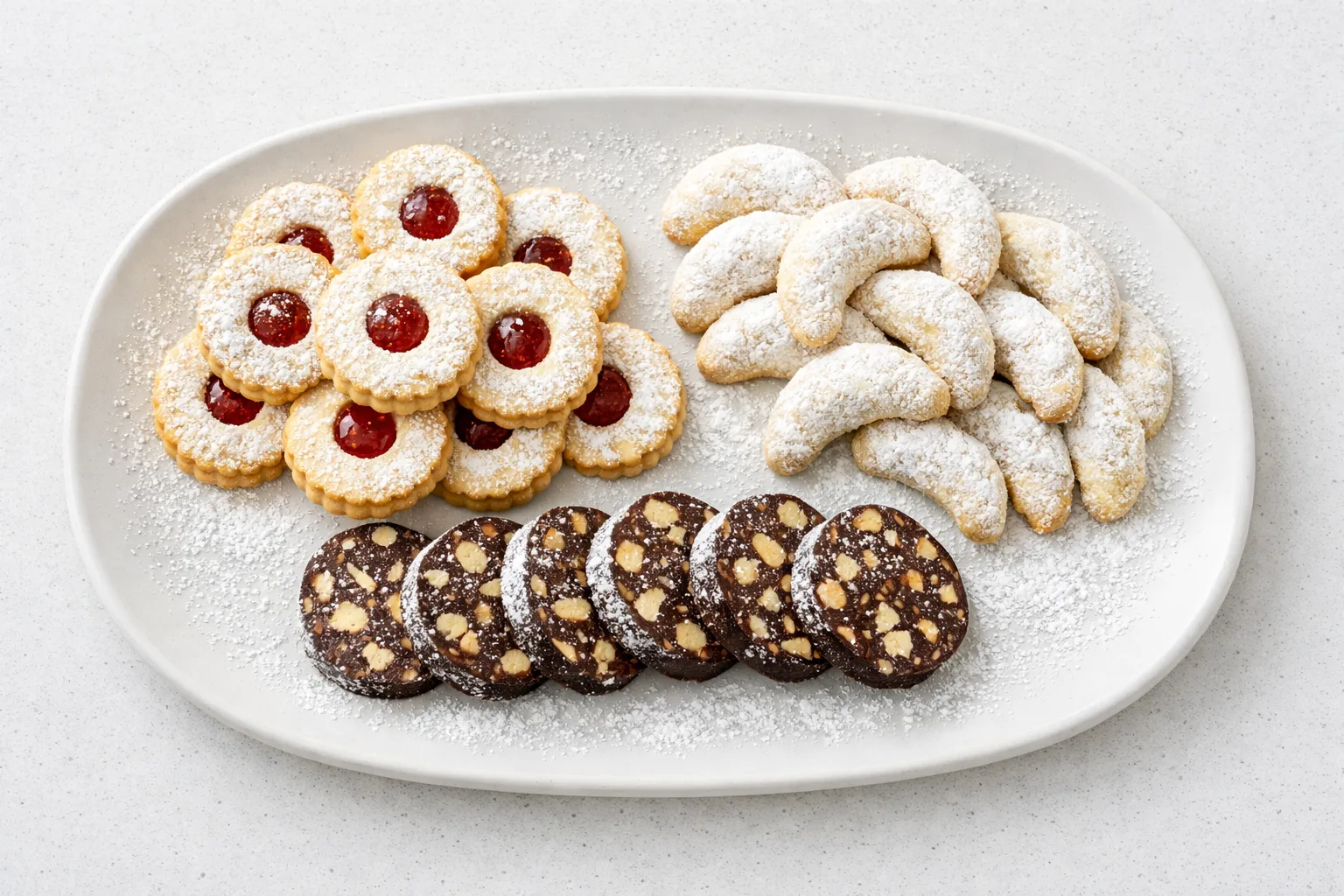
Czech Christmas cookies, called vanočni cukrovi in Czech, are not a single recipe but an entire tradition. In Czech households, the weeks before Christmas are consumed by baking sessions that produce dozens of different cookie types stored in tins, layered with parchment, and distributed to family and friends. The assortment typically includes 10 to 20 varieties, each with their own dough, filling, or coating. This recipe focuses on the essential trio that appears on virtually every Czech platter: linecke cukrovi (linzer eyes with jam), rohličky (vanilla crescents), and čokoladovy salám (chocolate salami).
The linzer eye is the centerpiece of Czech holiday baking. A rich, lard-and-butter shortbread dough is cut into rounds, one plain and one with a cut-out center, sandwiched around currant or apricot jam, and dusted with powdered sugar. The vanilla crescent is its counterpart: a nut-enriched dough shaped by hand, baked until barely golden, and rolled in vanilla-scented powdered sugar while still warm so the sugar adheres. Both require cold dough, a light hand, and patience.
Chocolate salami is the no-bake outlier in the trio, pressed from crushed tea biscuits, butter, cocoa, and rum, then rolled into a log, sliced when cold, and arranged on the platter like actual charcuterie. It requires no oven time and can be made weeks ahead. Together, the three cookies cover every texture: crisp and jammy, crumbly and fragrant, dense and chocolatey.
Equipment
Instructions
Tap each step to track your progress
- 1
**Make the linzer dough.** Pulse flour, powdered sugar, and salt in a food processor until combined. Add cold butter and lard in cubes and pulse until the mixture resembles coarse crumbs. Add the egg yolk and vanilla and pulse just until the dough starts to clump. Turn out onto a work surface and press into a flat disc. Wrap in plastic film and refrigerate for at least 1 hour, or overnight.
- 2
**Make the crescent dough.** In a food processor, combine flour, ground nuts, powdered sugar, and salt. Add cold butter cubes and pulse to coarse crumbs. Add egg yolk and vanilla and pulse until the dough just comes together. Press into a disc, wrap in plastic film, and refrigerate for at least 1 hour.
- 3
**Make the chocolate salami.** Melt the dark chocolate with the butter in a heatproof bowl set over a pot of barely simmering water, stirring until smooth. Remove from heat and let cool for 5 minutes. Stir in the powdered sugar, cocoa powder, and rum. Fold in the crushed biscuits and walnuts until everything is thoroughly coated. The mixture will be dense and sticky.
- 4
**Shape and chill the salami.** Lay a sheet of plastic film on a work surface and pile the chocolate mixture along one edge. Roll tightly into a log about 2 inches in diameter, twisting the ends of the plastic to compress. Refrigerate for at least 4 hours, or overnight, until completely firm.
- 5
**Roll and cut the linzer cookies.** On a lightly floured surface, roll the linzer dough to 1/8-inch thickness. Cut rounds using a 2-inch round or fluted cutter. For half the rounds, cut a small hole in the center using a smaller cutter (a bottle cap works well). Transfer all rounds to parchment-lined baking sheets. Refrigerate cut cookies for 15 minutes before baking.
- 6
**Bake the linzer cookies.** Preheat the oven to 350 F (175 C). Bake the chilled linzer rounds for 10 to 12 minutes until the edges are pale gold with no browning. The centers should look barely set. Transfer to a wire rack and cool completely before assembling. Note: the solid rounds and cut-out rounds can bake together on the same sheet.
- 7
**Shape and bake the crescents.** Pinch off walnut-sized pieces of crescent dough and roll each into a log about 2.5 inches long, tapered at the ends, then curve into a crescent shape. Place on parchment-lined baking sheets. Bake at 350 F (175 C) for 12 to 14 minutes until the bottoms are just barely golden. The tops should remain pale.
- 8
**Roll the crescents in vanilla sugar.** While the crescents are still hot from the oven (this step is time-sensitive), gently roll them in the vanilla powdered sugar mixture. The heat helps the sugar adhere and creates a soft, powdery coat. Work quickly and carefully as they are fragile when warm. Let cool completely on a rack.
- 9
**Assemble the linzer cookies.** Warm the jam briefly in a small saucepan until fluid but not boiling. Spread a thin layer of jam onto each solid round (the ones without cutouts). Dust the cut-out rounds heavily with powdered sugar, then press them gently onto the jam-covered rounds, cut-out side up. The jam should just peek through the window. Allow the assembled cookies to sit for at least 30 minutes for the jam to set.
- 10
**Slice the chocolate salami.** Remove the log from the refrigerator and unwrap. Dust the outside lightly with powdered sugar if desired (traditional for presentation). Using a sharp knife, cut into 1/3-inch rounds. Arrange on the platter alongside the linzer and crescent cookies.
Tips & Tricks
Make the doughs a day ahead
Both the linzer and crescent doughs improve with overnight refrigeration. The gluten relaxes, the flavors develop, and cold dough is far easier to roll and shape without sticking or tearing. Plan a two-day bake: doughs on day one, baking and assembly on day two.
Use lard in the linzer dough if you can find it
Traditional Czech linzer dough uses a combination of butter and lard. Lard creates a more tender, crumbly texture than all-butter versions and is less prone to shrinking in the oven. Rendered pork lard (not vegetable shortening) is the correct substitute, sold in most European grocers and increasingly available in specialty stores.
Work with cold dough and cold hands
Warm hands melt the butter in the dough, which makes it sticky, difficult to shape, and prone to spreading in the oven. If your kitchen is warm or your hands run hot, run them under cold water and dry before handling the dough. Refrigerate shaped cookies before baking whenever the dough feels soft.
Sieve the jam for a clean finish
Chunky jam leaks around the edges of linzer cookies and looks sloppy. Push the jam through a fine-mesh sieve before using. The resulting smooth paste stays in place and the jam window looks precise and jewel-like.
The salami biscuit size matters
Crush the tea biscuits roughly by hand or in a sealed bag with a rolling pin. You want a mix of small chunks and larger pieces: this gives the sliced salami its characteristic "mosaic" cross-section. If you process them to crumbs, the texture disappears and the salami looks grey and uniform rather than speckled.
Troubleshooting
My linzer dough tears when I roll it
The dough was too warm. Return it to the refrigerator for 20 minutes before continuing. Work quickly once it comes out, and flour the rolling surface and rolling pin lightly. If it continues to tear, the lard-to-butter ratio may be off: lard creates a more pliable dough than all-butter versions.
The crescents crumble when I roll them in sugar
They cooled too much before coating. The crescents must be coated while still hot from the oven: the residual heat is what makes the powdered sugar fuse to the surface. Work in small batches directly from the oven, keeping the rest on the tray inside the warm (turned-off) oven while you coat the first ones.
My linzer cookies are too hard after baking
They were over-baked. Linzer cookies continue to firm up as they cool, and they should feel slightly underdone when they come out of the oven. Check them at 9 minutes on the first batch. The color guide is: no browning at all on the top, only the faintest pale gold on the very edge of the bottom.
The chocolate salami is too soft to slice cleanly
It needs more time in the refrigerator. A minimum of 4 hours is required, but overnight is strongly preferred. If it is still soft after overnight chilling, your butter was too warm when incorporated. The chocolate mixture must cool to room temperature before folding in the biscuits, otherwise it never sets properly.
The jam leaks out of assembled linzer cookies
The jam was too thin or applied too heavily. Use a thick, sieved jam and apply a thin layer (just enough to cover the surface). If the jam is runny, cook it down in a small saucepan for a few minutes until it drops slowly off a spoon, then let it cool before using. Assembled linzer cookies firm up after a few hours as the jam sets.
Variations
Hazelnut Linzer Cookies
Replace 1/3 cup of the all-purpose flour in the linzer dough with finely ground hazelnuts. The dough will be slightly more delicate to roll but the flavor is noticeably richer. Fill with hazelnut-chocolate spread instead of jam for a departure from the traditional.
Walnut Crescents
The standard recipe uses walnuts, but ground almonds produce a slightly drier, more refined crescent that holds its shape better. Almond crescents are common across Austria and Germany and are often served alongside the walnut version on mixed platters.
Vegan Adaptation
For the linzer cookies, replace butter and lard with cold coconut oil or vegan butter, and substitute the egg yolk with 1 tablespoon of cold water. For the crescents, use vegan butter and omit the egg yolk (add 1 teaspoon of cold water instead). For the salami, replace butter with coconut oil and use vegan biscuits. Texture will be slightly more crumbly but the results are genuinely good.
Dark Chocolate Linzer
Add 2 tablespoons of Dutch-process cocoa to the linzer dough, reducing flour by the same amount. Fill with cherry jam or raspberry jam. The bittersweet dough and tart jam are a strong combination. Dust with plain powdered sugar before serving.
Serving & Gifting
Arrange the three cookie types in clusters on a large platter or in a traditional Czech cookie tin, separated by parchment. The visual contrast of the powdered-sugar-dusted crescents, the jam-windowed linzer eyes, and the dark salami rounds makes for a striking presentation. Serve alongside strong black coffee, <em>svarak</em> (Czech mulled wine), or black tea. For gifting, pack into tins lined with parchment, layering crescents and linzer cookies carefully since they are fragile. The salami rounds travel well and can be wrapped individually in parchment paper.
Storage & Freezing
Store each cookie type separately in airtight tins at room temperature: linzer cookies and crescents last up to 3 weeks, chocolate salami up to 4 weeks. Both the linzer dough and crescent dough freeze well, wrapped tightly in plastic film, for up to 2 months. Thaw overnight in the refrigerator before rolling. Do not freeze assembled and decorated linzer cookies: the jam softens unevenly when thawed. The chocolate salami can be frozen whole as a log and sliced from frozen.
Common Questions
What are vanočni cukrovi?
<em>Vanočni cukrovi</em> (Christmas cookies in Czech) refers to the tradition of baking and gifting large assortments of cookies in the weeks before Christmas. Czech households typically bake 10 to 20 different types, stored in tins and shared with family, neighbors, and colleagues. The tradition is deeply embedded in Czech culture and the quality of a household's cookie assortment is a point of genuine pride.
What are the most traditional Czech Christmas cookies?
Linzer eyes (<em>linecke cukrovi</em>) and vanilla crescents (<em>rohličky</em>) are the two that appear on virtually every Czech cookie platter. Other classics include <em>pracny</em> (dark gingerbread), <em>medvedie tlapky</em> (bear paw cookies with poppy seed filling), <em>špičky</em> (walnut horns), and <em>figurky</em> (shaped sugar cookies). The full traditional assortment can be 15 to 20 varieties.
Can I make Czech Christmas cookies ahead of time?
Yes, and you should. Most Czech Christmas cookies are specifically designed for make-ahead preparation: they improve in flavor after a few days in the tin as the textures soften and meld. Baking typically starts in late November or early December. The doughs freeze well, and finished cookies stay fresh in airtight tins at room temperature for 3 to 4 weeks.
What is the difference between linzer cookies and linzer eyes?
Linzer eyes (<em>linecke cukrovi</em>) are the Czech adaptation of Austrian linzer torte. The defining feature is the cut-out window in the top cookie that reveals the jam beneath. Regular linzer cookies (common in the US) are often just jam sandwiches without the window. Czech linzer eyes use a richer dough with lard and are typically smaller and more delicate than American versions.
Can I use butter instead of lard in the linzer dough?
Yes. Replace the lard with an equal amount of cold unsalted butter. The dough will be slightly less tender and may be a little harder to work with (it can crack more easily when cold), but the flavor is still excellent. All-butter linzer dough is the most common approach outside of Czech Republic.
How long do Czech Christmas cookies last?
Stored in airtight tins at room temperature, most Czech Christmas cookies last 2 to 4 weeks. Chocolate salami lasts the longest (up to 4 weeks), followed by crescents and linzer eyes (3 weeks). Cookies actually improve over the first week as flavors develop. Do not refrigerate them: the condensation ruins the texture.