
 Denmark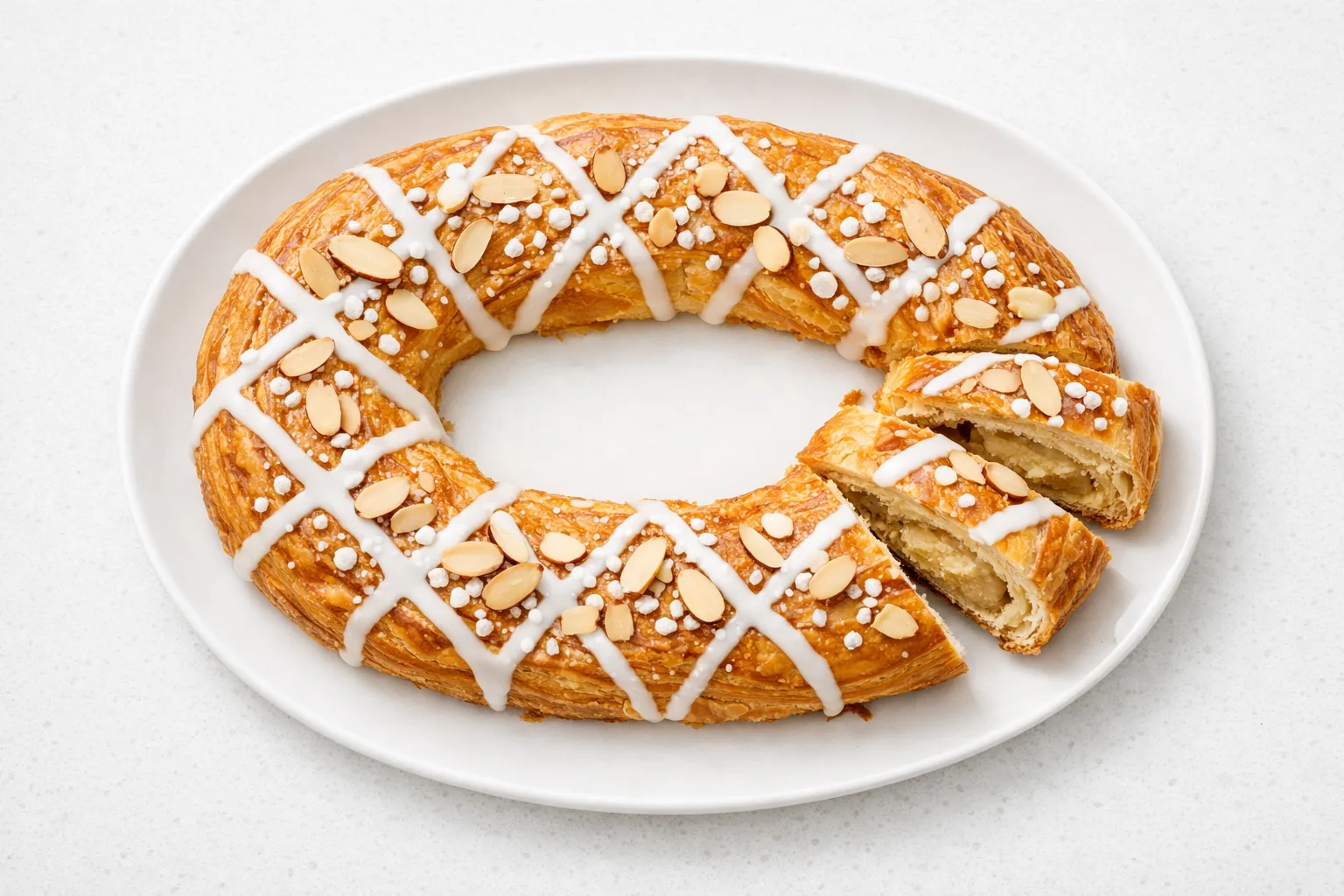
The kringle is Denmark's national pastry, and at Christmas it appears in every Danish bakery window and on nearly every holiday table. The real thing is a laminated yeast dough, the same family of technique as croissants, wrapped around a rich remonce filling made from butter, sugar, and almond paste, then shaped into an oval ring, baked golden, and finished with white icing and pearl sugar. It is not a quick project, but it is a forgiving one once you understand what the dough is doing.
The Scandinavian kringle has deep roots across the Nordic countries, but the Danish version distinguishes itself through the laminated dough. Outside Denmark, particularly in Wisconsin where Danish immigrants settled heavily, a flatter filled version became its own tradition. This recipe focuses on the original: a proper laminated danish kringle pastry with the shattering, buttery layers that make it worth the effort.
What makes this version work is giving the dough adequate resting time at each fold. Rushing the lamination compresses the butter layers and you lose the flakiness. Cold butter, cold dough, and patience are the whole secret.
Equipment
Instructions
Tap each step to track your progress
- 1
Make the dough: Whisk the flour, yeast, sugar, and salt in a large bowl. Add the cold milk, 1 egg, and vanilla extract. Mix with a fork until a shaggy dough forms, then turn out onto a lightly floured surface and knead briefly, about 2 minutes, just until the dough comes together. It should feel smooth but not elastic. Do not over-knead. Flatten into a rough rectangle, wrap tightly in plastic wrap, and refrigerate for 30 minutes.
- 2
Make the butter block: Place the cold butter between two sheets of parchment paper. Beat with a rolling pin until it flattens into a 6x6 inch square, about 1/4 inch thick. Keep working until it is pliable but still cold and holds its shape. Refrigerate while the dough rests.
- 3
Laminate the dough (first fold): On a lightly floured surface, roll the dough into a 12x8 inch rectangle. Place the butter block in the center. Fold the dough edges over the butter like an envelope, pinching the seams closed. Roll gently into a 18x8 inch rectangle, working from the center outward to avoid tearing. Fold into thirds like a letter (first fold). Wrap and refrigerate 30 minutes.
- 4
Complete the lamination: Repeat the roll-and-fold process two more times, resting the dough in the refrigerator for 20-30 minutes between each fold. After the third fold, wrap and refrigerate for at least 1 hour, or overnight. The dough should feel cold and firm, with distinct layers visible at the edges.
- 5
Make the almond filling: Beat the almond paste, softened butter, brown sugar, almond extract, and salt together with a fork or hand mixer until smooth and spreadable. The mixture should hold its shape but spread easily. Set aside at room temperature.
- 6
Shape the kringle: Remove the dough from the refrigerator and let it sit for 5 minutes. Roll into a long rectangle roughly 24x8 inches. Spread the almond filling evenly over the surface, leaving a 1-inch border along one long edge. Roll up tightly from the filled long edge, jellyroll style, into a log. Pinch the seam firmly to seal.
- 7
Form the oval ring: Gently stretch and coil the log into an oval ring on a parchment-lined baking sheet, placing the seam on the bottom. Tuck one end inside the other and pinch to seal into a closed ring. The oval should be roughly 14 inches long and 9 inches wide. Flatten the ring slightly with your palm so it is about 1 inch tall. Cover loosely with plastic wrap and let proof at room temperature for 45-60 minutes, until slightly puffed. Preheat your oven to 375F (190C) during this time.
- 8
Egg wash and bake: Beat the remaining egg with 1 tbsp milk. Brush the entire surface of the kringle gently but thoroughly. Bake for 22-27 minutes until deep golden brown, rotating the pan once at the halfway point. The pastry should feel firm when pressed lightly in the center. Transfer to a wire rack and cool for at least 20 minutes before icing.
- 9
Make the icing and finish: Whisk the powdered sugar, milk, and vanilla together until smooth and thick. It should fall from a spoon in a slow ribbon, not run freely. Drizzle over the cooled kringle in a back-and-forth motion. Immediately scatter the toasted sliced almonds and pearl sugar over the wet icing before it sets. Let the icing set for 15 minutes before slicing.
Tips & Tricks
Use European-style butter for the butter block
Standard American butter (80% fat) contains more water, which creates steam during lamination and can make the layers gummy rather than crisp. European-style butter (82-84% fat, such as Kerrygold or Plugra) produces cleaner, flakier layers. It is worth seeking out for the butter block specifically.
Work with a cold, firm dough
If at any point during lamination you feel the dough resisting or the butter starting to smear, stop and refrigerate. Five minutes of patience saves you from a dense, butterless pastry. The dough should always feel cool to the touch.
Almond paste, not marzipan
Almond paste (roughly 50% almonds, 50% sugar) is firmer, less sweet, and more intensely nutty than marzipan (which can be up to 75% sugar). Using marzipan results in a filling that is too sweet and runs more easily. Look for Solo brand almond paste or an import from a Scandinavian grocery.
Don't skip the overnight rest option
Laminated doughs benefit greatly from a long, cold overnight rest after the final fold. The gluten relaxes, the butter firms up completely, and the dough shapes much more easily the next morning. Make the dough the evening before and you'll have a dramatically easier time shaping it.
Shape loosely and let it proof fully
The kringle needs space to expand. If the ring is too tight when formed, the layers compress and the pastry won't open up properly. Shape it slightly looser than you think you need, and don't skip or rush the final proof. A fully proofed kringle bakes into a light, open crumb; an under-proofed one is dense and bready.
Troubleshooting
The butter breaks through the dough while rolling
The dough or butter got too warm. If you see the butter smearing rather than remaining in distinct layers, stop immediately, wrap the dough, and refrigerate for 20 minutes before continuing. Work faster and use a cool, lightly floured surface. In summer or warm kitchens, refrigerate between every roll.
The layers are not flaky after baking
You either over-kneaded the initial dough (developing too much gluten, which makes it tough rather than flaky) or the butter was too warm when laminated. Use cold dairy and cold eggs from the start, and knead the initial dough minimally.
The kringle unravels or opens up during baking
The seam wasn't sealed firmly enough when you rolled the log or joined the ring. Press and pinch the seam firmly with your fingers, dampening it slightly with water if needed. Also make sure you're proofing seam-side down with the weight of the ring holding the join shut.
The filling leaks out during baking
Too much filling was applied, or it extended too close to the edge of the dough. Keep filling 1 inch back from the long edge before rolling. If filling leaks, it will caramelize on the pan (not a disaster), but press the seam harder next time.
The pastry is raw in the center but golden on the outside
The kringle was too thick or under-proofed. Flatten the ring to about 1 inch before proofing, and make sure it is visibly puffed before baking. Reduce the oven temperature by 25F and add 5 minutes to the bake time if needed.
Variations
Walnut and Brown Butter Filling
Replace the almond filling with a mixture of 1 cup finely chopped walnuts, 4 tbsp brown butter (cooked until nutty and amber), 1/4 cup dark brown sugar, and 1 tsp cinnamon. Skip the almond extract. The result is earthier and less sweet, with a toasty depth that pairs well with strong coffee.
Cinnamon Remonce (Kanelsnurre Style)
Use a filling of 4 tbsp softened butter, 1/4 cup granulated sugar, and 2 tsp ground cinnamon in place of the almond paste mixture. This is a simpler, more everyday version that comes together in minutes and appeals to anyone who doesn't like the intensity of almond paste.
Gluten-Free Adaptation
A true laminated dough cannot be made gluten-free without significant structural compromise. For a gluten-free version, use a standard (non-laminated) enriched dough made with a blend of 2 cups gluten-free 1-to-1 baking flour and 1 cup almond flour. Add 1 tsp xanthan gum if your blend doesn't include it. The result will be denser and more cake-like, but the almond filling and icing will still shine.
Cream Cheese Filling
Swap half the almond paste for full-fat cream cheese (4 oz cream cheese + 4 oz almond paste, beaten together with 3 tbsp powdered sugar and a splash of vanilla). The filling will be creamier and tangier, closer to the Wisconsin-style kringle.
Serving & Gifting
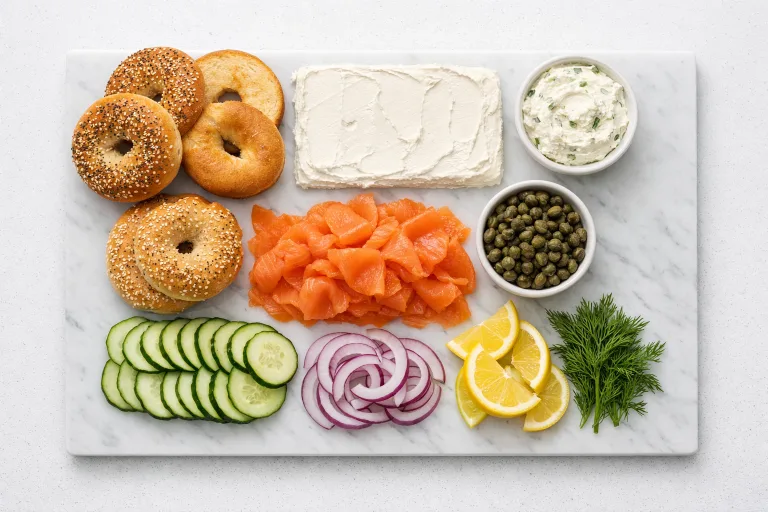
Serve the kringle at room temperature, sliced into 1.5-inch thick pieces. It pairs well with strong black coffee or tea, and is a natural centerpiece for a Danish-style Christmas morning spread alongside smoked salmon and soft cheeses. For gifting, leave uniced, wrap the whole baked ring tightly in cling film, and ice at the recipient's end before serving. It transports well whole.
Storage & Freezing
Uniced kringle keeps at room temperature, wrapped in cling film, for 2 days. Iced kringle is best consumed the same day but holds overnight loosely covered. The dough (after the final fold, before shaping) can be refrigerated for up to 24 hours or frozen for up to 1 month, tightly wrapped. The fully baked, uniced kringle freezes well for up to 6 weeks; thaw at room temperature overnight and warm briefly in a 300F oven before icing.
Common Questions
What is the difference between Danish kringle and American kringle?
The Danish original uses a laminated yeast dough (similar to croissants) shaped into an oval ring. The American version, particularly the Wisconsin-style kringle popular in cities like Racine, uses a flatter, non-laminated dough and is often filled with fruit or nuts. Both are delicious, but the texture and technique are quite different.
Can I use store-bought puff pastry instead of making laminated dough?
You can, but the result will be noticeably different. Store-bought puff pastry has no yeast and a higher butter-to-flour ratio, so it bakes up crisper and more cracker-like. The authentic kringle has a softer, brioche-like interior with flaky exterior layers. If you use puff pastry, skip the proofing step and bake at 400F.
How do I know when the kringle is done baking?
The pastry should be deep golden brown all over, including the underside (lift the edge gently to check), and feel firm but not hard when pressed lightly in the thickest part. An instant-read thermometer inserted through the side should read at least 190F (88C).
Can I make Danish kringle ahead for Christmas?
Yes. The most practical approach is to make the dough through the final fold (step 4), then freeze it. The night before serving, move it to the refrigerator to thaw, then roll, fill, shape, and proof in the morning. Alternatively, bake the kringle a day ahead, leave it uniced, and wrap it tightly. Ice on the day of serving.
Is there a nut-free version of the almond filling?
Replace the almond paste filling with the cinnamon remonce variation listed above: softened butter, brown sugar, and cinnamon. Skip the almond extract entirely. The pastry itself is nut-free; the only nut-based component is the filling and the almond garnish on top.
Why does my dough tear when I roll it?
The dough is either too cold and stiff (let it sit for 5 minutes at room temperature before rolling) or too resistant from over-kneading. If it tears, press the tear together, refrigerate for 10 minutes, and continue rolling more gently. Work from the center out rather than rolling end to end.