
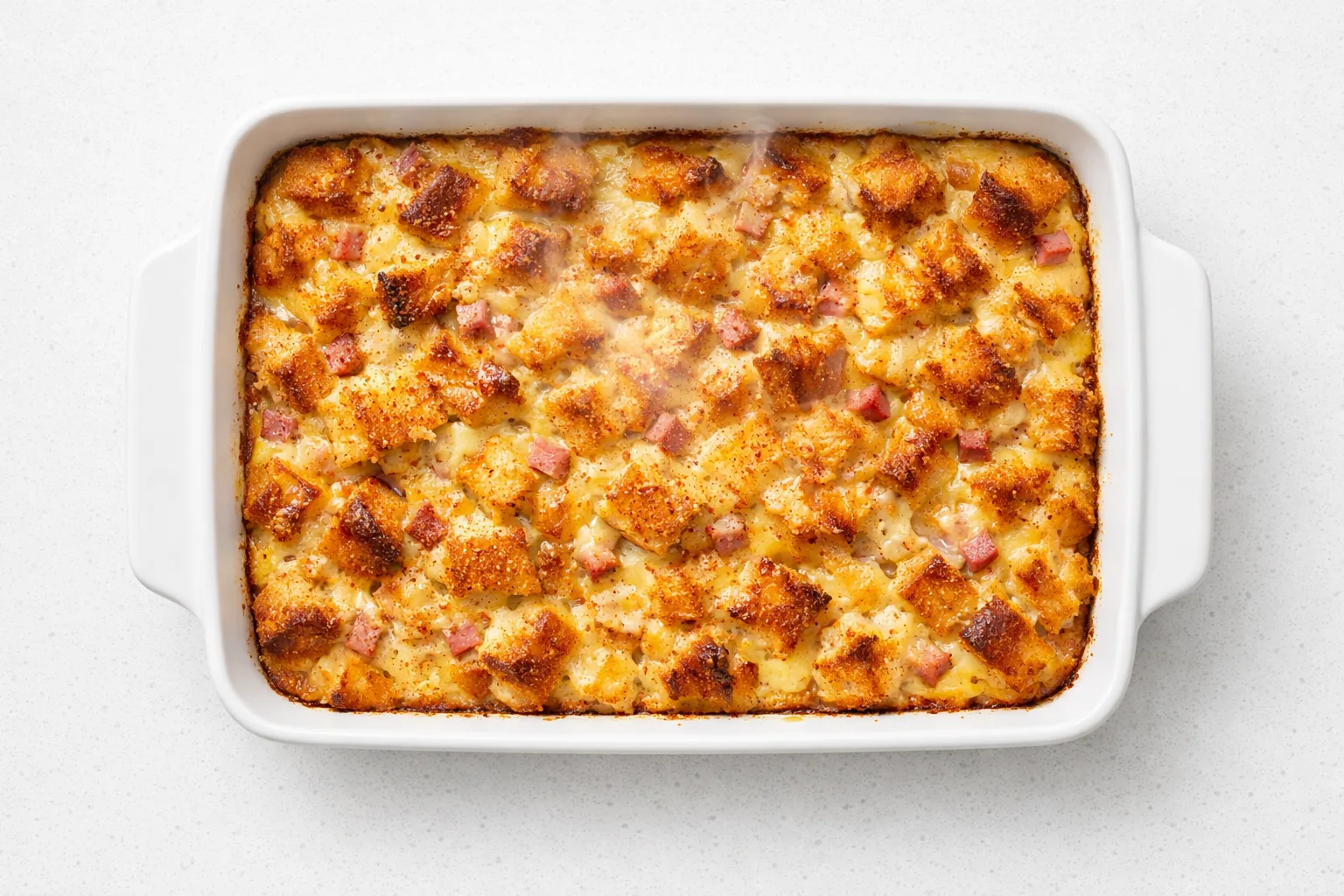
The ham and Swiss brunch bake is exactly the kind of Christmas morning recipe that actually works: assembled the night before, refrigerated overnight, and slid into the oven while the family tears through wrapping paper. It requires nothing of you on the day itself except pulling off the foil and setting a timer. The custard, built from eggs, whole milk, and a touch of Dijon, saturates cubed bread overnight until every piece is soaked through, and the Swiss melts into pockets of nutty, savory richness throughout.
This is an American Christmas brunch staple in the strata tradition, a style of layered bread-and-egg casserole that traces its modern popularity to church cookbooks and holiday entertaining guides of the 1970s and 80s. The ham and Swiss combination is the most enduring version: salty cured ham plays against the mild nuttiness of Swiss, and the custard binds everything into something that slices cleanly and holds on a buffet table for an hour without suffering. Use a good country ham or thick-cut deli ham rather than pre-sliced lunch meat, and the difference is considerable.
Equipment
Instructions
Tap each step to track your progress
- 1
Butter a 9x13 inch baking dish generously. Scatter half the bread cubes in an even layer across the bottom of the dish.
- 2
Distribute the cubed ham evenly over the bread. Sprinkle half the shredded Swiss and all the scallions over the ham. Add the remaining bread cubes in an even layer, then top with the remaining Swiss.
- 3
In a large bowl, whisk together the eggs, whole milk, heavy cream, Dijon mustard, salt, pepper, garlic powder, and smoked paprika until fully combined and no streaks of yolk remain.
- 4
Pour the custard slowly and evenly over the entire casserole, pressing down gently with a spatula to make sure the top layer of bread is well soaked. Dust a pinch of smoked paprika over the top.
- 5
Cover the dish tightly with plastic wrap and refrigerate for at least 8 hours, or overnight up to 18 hours. The bread should absorb nearly all the custard by morning.
- 6
Remove the casserole from the refrigerator 30 minutes before baking to take the chill off. Preheat the oven to 350 degrees F (175 degrees C).
- 7
Uncover the casserole and bake for 50 to 55 minutes, until the top is deep golden brown, the edges are set, and the center registers 160 degrees F (70 degrees C) on an instant-read thermometer. The center should not jiggle when the pan is nudged.
- 8
Remove from the oven and let rest for 10 minutes before cutting. This rest lets the custard firm up so the slices hold their shape cleanly.
Tips & Tricks
Use bread that is at least a day old
Fresh bread stays too soft and turns mushy after the overnight soak. Bread that has dried out slightly on the counter for 24 to 48 hours absorbs the custard more evenly and holds its structure during baking. Brioche gives the richest result; a sturdy white sandwich loaf is a close second.
Grate your own Swiss
Pre-shredded Swiss is coated in anti-caking starch that prevents it from melting smoothly. A block of Emmental or Jarlsberg grated on a box grater melts into the custard beautifully and gives better pull and texture in every bite.
Do not skip the overnight soak
Eight hours is the minimum; overnight is better. The custard needs time to penetrate every piece of bread to the center. A 2-hour soak produces uneven results with dry spots in the middle of the bread cubes.
Check the internal temperature
The visual cue of a golden top is not sufficient. A fully baked egg casserole should read 160 degrees F (70 degrees C) at the center. Without a thermometer, you risk either undercooking the eggs or drying out the edges while waiting for the center to set.
Troubleshooting
The center is still liquid after the bake time
The custard soaked through more bread than expected, or the dish was still cold from the fridge when it went into the oven. Always let the casserole sit at room temperature for 30 minutes first. If still underdone, tent with foil to prevent further browning and bake in 10-minute increments, checking with the thermometer each time.
The top is dark but the inside is wet
The oven is running hot, or the casserole went in too close to the top rack. Move it to the center rack and tent loosely with foil for the remaining bake time. Dark tops at 30 minutes usually mean the oven is 25 degrees hotter than the dial reads.
My bread cubes are floating up and not soaking through
Day-old bread that is too dry repels liquid initially. Press the bread cubes down firmly into the custard when pouring, then do it again an hour into the refrigeration. Genuinely stale bread from two or three days ago is better than bread dried in the oven; oven-dried bread tends to stay too rigid.
The slices fall apart when I serve them
The casserole did not rest long enough after baking. Ten minutes is the minimum; 15 is better. The egg proteins need time to firm up off the heat. A sharp knife and a thin metal spatula also help considerably.
It tastes bland
The ham's saltiness varies enormously by brand. Taste your ham before adding it; if it is on the milder side, increase the salt in the custard to 1 1/2 teaspoons and add a few more scallions. The Dijon is also non-negotiable for depth: do not substitute yellow mustard.
Variations
Turkey and Gruyere
Swap the smoked ham for an equal amount of sliced roasted turkey breast and replace the Swiss with Gruyere. Gruyere has a more pronounced, slightly sweet nuttiness that pairs especially well with turkey. Use the same quantity of each and follow the recipe exactly.
Vegetarian Version
Omit the ham entirely and add 1 cup of sauteed mushrooms (cremini or shiitake, cooked until all moisture has evaporated) and 1 cup of baby spinach wilted in the same pan. The custard and cheese carry the flavor; you will not miss the meat if the mushrooms are properly browned first.
Dairy-Free Adaptation
Replace the whole milk with unsweetened oat milk and substitute the heavy cream with full-fat coconut cream (the cream-only portion from a chilled can). Use a dairy-free Swiss-style cheese. The custard will be slightly less rich but will still set firmly. Add an extra egg if the custard feels thin.
Sourdough and Smoked Gouda
Use day-old sourdough instead of white bread and replace the Swiss with smoked Gouda. The tartness of the sourdough and the smokiness of the Gouda make a more assertive casserole that stands up well to strong coffee on Christmas morning.
Serving & Gifting
Serve the brunch bake directly from the dish, cut into squares. It pairs well with a simple green salad, fresh orange juice, or a pot of strong coffee. For a Christmas buffet table, the casserole holds at 200 degrees F (on the lowest oven setting) for up to an hour after baking without drying out. Add a small bowl of hot sauce on the side for adults who want heat.
Storage & Freezing
Leftovers keep in the refrigerator, covered, for up to 4 days. Reheat individual portions in a 325 degree F oven for 15 minutes or in the microwave for 90 seconds, covered loosely with a damp paper towel to retain moisture. The casserole can be frozen after baking: cool completely, wrap tightly in two layers of foil, and freeze for up to 2 months. Thaw overnight in the refrigerator before reheating covered in a 325 degree F oven for 25 to 30 minutes.
Common Questions
Can I assemble the ham and Swiss brunch bake and bake it the same day?
You can, but the result will be uneven. The bread needs at least 8 hours in the custard to absorb properly. A same-day bake will have dry bread pockets and a looser custard set. Plan the overnight soak and the recipe performs as intended.
What kind of ham works best in a ham and cheese breakfast bake?
Thick-cut smoked ham from the deli counter or a leftover baked ham cut into cubes gives the best texture and flavor. Avoid thinly sliced deli lunch meat, which turns rubbery and disappears into the custard. Pre-diced ham sold in vacuum packs works in a pinch; rinse off any excess brine before using.
Can I make this christmas morning brunch recipe for a larger crowd?
Yes. Double all ingredients and use two 9x13 pans, or use a half sheet pan (18x13 inches). Increase the bake time by 10 to 15 minutes and check the temperature in both the center and corners before pulling from the oven.
Is this make ahead brunch casserole gluten-free?
Not in its standard form, but it adapts easily. Use a gluten-free white sandwich loaf (the type that comes pre-sliced and holds its shape) and confirm your Dijon is labeled gluten-free. The rest of the ingredients are naturally gluten-free. The texture will be slightly denser but the casserole bakes and slices well.
How long does the ham swiss egg bake last in the fridge before baking?
The assembled, unbaked casserole keeps in the refrigerator for up to 18 hours before baking. Beyond that the bread begins to break down and the texture deteriorates. Stick to the 8-to-18-hour window for best results.
Can I substitute another cheese for the Swiss?
Yes. Gruyere is the closest in melting quality and flavor profile. Provolone is milder and stretchy. Havarti melts beautifully and adds a buttery flavor. Avoid hard aged cheeses like aged cheddar or Parmesan on their own; they do not melt as evenly into the custard.