 Italy
Italy 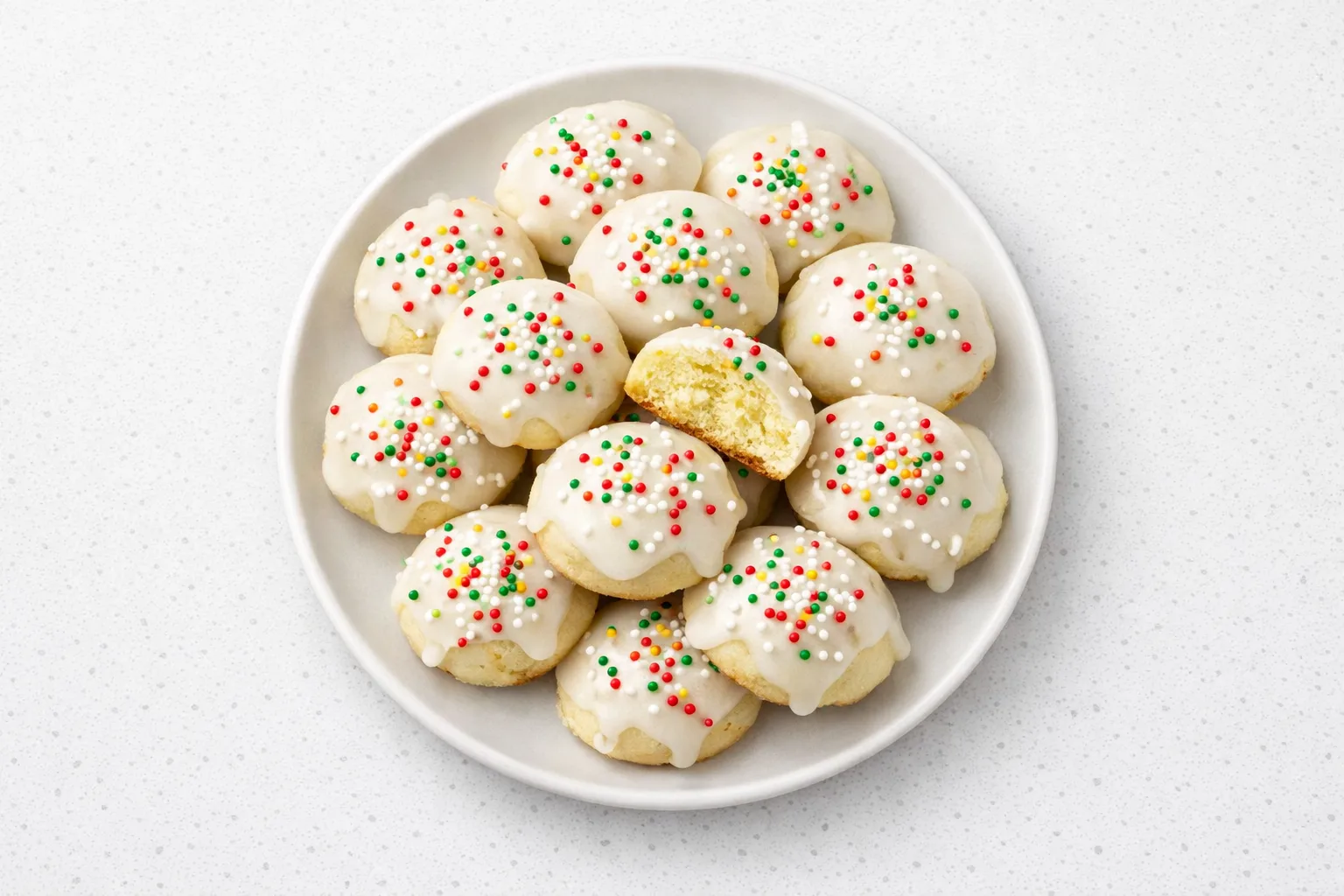
Italian Christmas cookies, known in many families simply as biscotti di Natale, are the backbone of the holiday cookie tray across Italy and its diaspora. These soft, cakey rounds get their signature tender crumb from ricotta cheese stirred directly into the batter, a technique that keeps them moist far longer than butter-only cookies. The tradition of baking massive batches during the weeks before Christmas is deeply rooted in southern Italian and Italian-American households, where a cookie tray without these lemon-glazed rounds would be considered incomplete.
This version uses a straightforward creaming method with ricotta folded in at the end. The lemon glaze sets firm enough to stack the cookies without sticking, and the rainbow sprinkles are not optional. They are part of the identity. The dough comes together in 10 minutes with no chilling required, which is exactly why these cookies have survived generations of holiday baking marathons.
Equipment
Instructions
Tap each step to track your progress
- 1
Preheat your oven to 350F (175C). Line two baking sheets with parchment paper.
- 2
Whisk together the flour, baking powder, and salt in a medium bowl. Set aside.
- 3
In a stand mixer fitted with the paddle attachment, cream the butter and granulated sugar on medium speed for 3 minutes until pale and fluffy. Scrape down the sides of the bowl.
- 4
Add the eggs one at a time, beating on medium-low until each is incorporated before adding the next. The mixture may look slightly curdled; that is normal.
- 5
Add the ricotta, vanilla extract, and lemon zest. Mix on low speed until just combined, about 30 seconds. The batter will look thick and slightly lumpy from the ricotta.
- 6
Add the flour mixture in two additions, mixing on the lowest speed until no dry streaks remain. Do not overmix. The dough will be soft and sticky, closer to a thick cake batter than a traditional cookie dough.
- 7
Drop rounded tablespoons of dough onto the prepared baking sheets, spacing them about 2 inches apart. Use a small cookie scoop for consistent sizing. You should get about 48 cookies across 3-4 batches.
- 8
Bake for 10 to 12 minutes until the bottoms are just barely golden and the tops are set but still pale. The cookies should not brown on top. They will feel soft when pressed but will firm up as they cool.
- 9
Let the cookies cool on the baking sheet for 5 minutes, then transfer to a wire cooling rack set over a sheet of parchment or wax paper (to catch glaze drips).
- 10
While the cookies cool, make the glaze: whisk together the sifted powdered sugar, lemon juice, and milk until completely smooth. The consistency should be thick enough to coat the back of a spoon but still pourable. Add milk by the teaspoon if it is too thick, or more powdered sugar if too thin.
- 11
Spoon about a teaspoon of glaze over each cookie, spreading it gently with the back of the spoon to cover the top. Immediately scatter rainbow nonpareil sprinkles over the wet glaze before it sets.
- 12
Let the glazed cookies sit at room temperature for at least 1 hour until the glaze hardens completely. The glaze should feel dry and firm to the touch before stacking or storing.
Tips & Tricks
Use whole-milk ricotta, not low-fat
The fat in whole-milk ricotta is what gives these cookies their soft, tender crumb. Low-fat or fat-free ricotta makes the dough wetter without adding richness, resulting in flat, bland cookies. If your ricotta is very wet (common with some brands), drain it in a fine mesh strainer for 15 minutes before using.
Do not skip sifting the powdered sugar
Lumpy powdered sugar makes lumpy glaze. Sift it before mixing. This takes 30 seconds and is the difference between a smooth, professional-looking glaze and one that looks homemade in the wrong way.
Room temperature eggs matter
Cold eggs will cause the creamed butter to seize up into clumps. Pull your eggs out of the fridge at least 30 minutes before starting. If you forget, place them in a bowl of warm (not hot) water for 10 minutes.
Scoop consistently for even baking
Use a small cookie scoop (1 tablespoon capacity) for uniform cookies. If some cookies are twice the size of others, the small ones will overbake by the time the large ones are done. Consistent scooping also gives you the right yield.
Glaze while still slightly warm
The best time to glaze is when the cookies have cooled enough to handle but are still faintly warm. The glaze adheres better to a slightly warm surface and sets smoother. If the cookies are completely cold, the glaze tends to pool and drip rather than coating evenly.
Troubleshooting
My cookies spread too flat
The butter was likely too warm or you used low-fat ricotta. Use room-temperature butter (not melted or microwave-softened) and always whole-milk ricotta. Drain the ricotta briefly in a fine mesh strainer if it seems watery. The dough should hold a mound on the baking sheet.
The glaze won't set firm
Your glaze is too thin. Add more powdered sugar, 2 tablespoons at a time, until it coats the spoon thickly. Humidity also slows drying. If the air is humid, let the cookies sit longer or place them near a fan. The glaze should be opaque and dry within 90 minutes in normal conditions.
The cookies are dry and crumbly
They were overbaked. These cookies should come out of the oven looking slightly underdone with no browning on top. They firm up significantly as they cool. Pull them at 10 minutes if your oven runs hot. The ricotta keeps them moist, but overbaking cancels that out.
The bottoms are too dark
Your oven temperature is too high or you are using a dark-colored baking sheet, which absorbs more heat. Use light-colored aluminum sheets lined with parchment. An oven thermometer is worth the investment; most home ovens run 10 to 25 degrees hotter than the dial reads.
Variations
Almond Amaretti-Style
Replace the vanilla extract with 1 teaspoon almond extract and fold 1/2 cup finely ground blanched almonds into the flour mixture. Skip the lemon glaze and instead dust the cooled cookies with powdered sugar. This gives a nuttier, more fragrant cookie that leans closer to amaretti.
Chocolate-Dipped Version
Skip the lemon glaze entirely. Melt 8 ounces of semisweet chocolate with 1 teaspoon coconut oil. Dip half of each cooled cookie into the chocolate, let the excess drip off, and place on parchment to set. These are richer and work well as a contrast on a mixed cookie tray.
Gluten-Free Adaptation
Swap the all-purpose flour for a 1:1 gluten-free baking flour blend (one that includes xanthan gum, such as Bob's Red Mill). Reduce the baking powder to 2 teaspoons since many GF blends contain their own leavening. The texture will be slightly denser but still soft.
Orange-Anise Twist
Replace the lemon zest and lemon juice with orange zest and orange juice. Add 1/2 teaspoon anise extract to the batter. Finish with the glaze as written but use orange juice in place of lemon juice. This is a classic southern Italian flavor combination that pairs well with espresso.
Serving & Gifting
Arrange these cookies on a tiered tray or large platter for a holiday cookie swap or Christmas Eve dessert spread. They pair well with espresso, cappuccino, or a glass of <em>vin santo</em>. For gifting, pack them in a single layer in a bakery box with parchment between layers. Each batch makes enough for a full cookie tray plus a generous gift box.
Storage & Freezing
Glazed cookies keep in an airtight container at room temperature for up to 5 days, with parchment or wax paper between layers to prevent the glaze from sticking. Unglazed cookies store for up to 1 week in the same way. For freezing, freeze the unglazed cookies in a single layer on a baking sheet, then transfer to a zip-top freezer bag for up to 3 months. Thaw at room temperature and glaze fresh before serving.
Common Questions
Can I make Italian Christmas cookies without ricotta?
You can substitute an equal amount of full-fat sour cream or mascarpone. Sour cream adds a slight tang but produces a similar soft texture. Mascarpone makes the cookies a touch richer. Cream cheese also works if softened and beaten smooth first, though the flavor leans less Italian.
How far in advance can I bake these cookies?
Unglazed cookies can be baked up to 3 days ahead and stored in an airtight container at room temperature. For longer storage, freeze the unglazed cookies for up to 3 months and glaze them fresh the day you plan to serve. Glazed cookies are best within 3 to 5 days.
Can I use store-bought ricotta or does it need to be fresh?
Standard supermarket ricotta works perfectly fine. Drain it briefly if it looks very wet. Fresh, hand-dipped ricotta from an Italian deli is excellent but not necessary. Avoid ricotta with added stabilizers or gums if possible, as they can affect the texture.
What is the difference between these and biscotti?
Traditional biscotti are twice-baked, hard, crunchy almond cookies meant for dunking. Italian Christmas cookies (sometimes also called <em>biscotti di Natale</em> despite the name overlap) are soft, cakey, single-baked rounds with a glaze. They are entirely different in texture and technique. This recipe is for the soft glazed variety.
Is there an egg-free version of this recipe?
Replace each egg with 1/4 cup unsweetened applesauce or 3 tablespoons aquafaba (chickpea brine). The cookies will be slightly denser and less domed. The ricotta provides enough moisture and binding that the egg substitution works better here than in most cookie recipes.
How do I get the sprinkles to stick to the glaze?
Apply the sprinkles immediately after glazing each cookie, while the glaze is still wet. Work in small batches of 4 to 6 cookies at a time: glaze them, sprinkle them, then move to the next batch. If you glaze all the cookies first and then go back to sprinkle, the glaze will have started to set and the sprinkles will slide off.