 Germany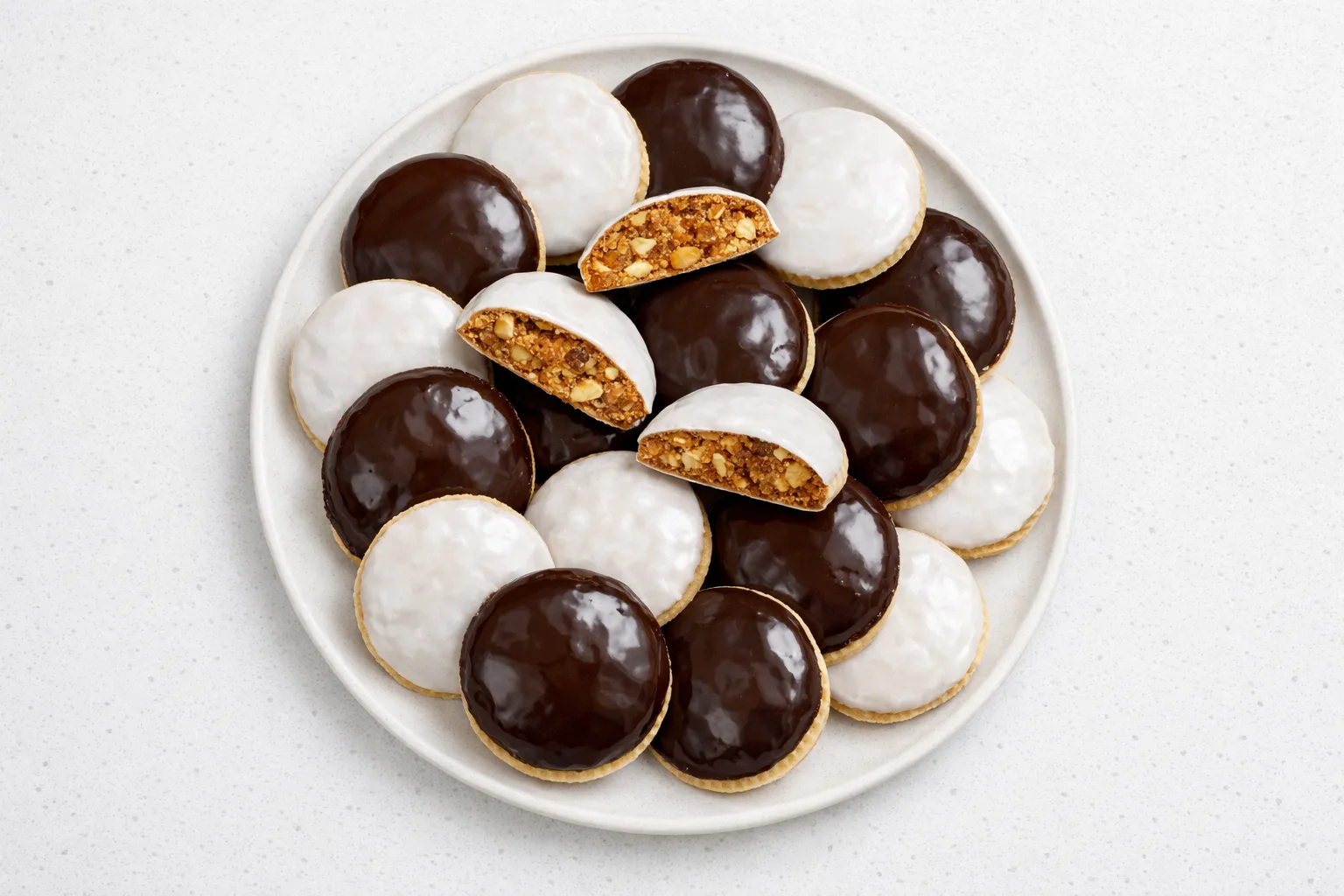
Lebkuchen is the spiced honey cookie that has defined Christmas in Germany since medieval times. Nuremberg became the capital of lebkuchen production by the 14th century, thanks to its position on major spice trade routes and the surrounding forests full of beekeepers. The city still holds a protected geographical indication for Nurnberger Lebkuchen, and the finest grade, Elisenlebkuchen, must contain at least 25% nuts and no more than 10% flour.
This recipe follows the Nuremberg tradition closely: a batter built on honey, ground almonds, and hazelnuts rather than creamed butter, spiced with the classic Lebkuchengewurz blend of cinnamon, cloves, allspice, and cardamom. The cookies bake on thin edible wafer discs called Oblaten, which keep the soft bottoms from sticking and add a subtle crunch. Finished with either dark chocolate or a simple sugar glaze, these keep for weeks and taste better after a few days of resting.
Equipment
Instructions
Tap each step to track your progress
- 1
Beat the eggs and dark brown sugar together in a large bowl with an electric mixer on medium-high speed for 4 to 5 minutes, until the mixture is thick, pale, and falls in a ribbon that holds its shape for 3 seconds when the beaters are lifted. This aeration is the only leavening structure in the batter, so do not rush it.
- 2
Warm the honey gently in a small saucepan or microwave until it is liquid and pourable (about 30 seconds in the microwave). Fold the warm honey into the egg mixture by hand using a spatula.
- 3
In a separate bowl, whisk together the ground almonds, ground hazelnuts, flour, baking powder, cinnamon, cloves, allspice, cardamom, nutmeg, and ginger. Add the candied orange peel, candied lemon peel, and lemon zest to the dry ingredients and toss to combine.
- 4
Fold the dry ingredients into the egg mixture in two additions, mixing gently until no dry streaks remain. Stir in the vanilla extract. The batter should be thick and sticky, similar to a dense muffin batter. Cover the bowl with plastic wrap and refrigerate for at least 2 hours or overnight. The rest firms the batter and develops the spice flavors.
- 5
Preheat the oven to 350F (175C). Line two baking sheets with parchment paper. Arrange the Oblaten wafers on the sheets, spacing them about 1 inch apart.
- 6
Scoop a generous tablespoon of batter (about 30g) onto each wafer and spread it into a smooth dome using the back of a wet spoon or a small offset spatula, leaving a thin border of wafer visible around the edge. Wet your fingers or the spatula frequently to prevent sticking. The batter should sit about 1/2 inch thick in the center.
- 7
Bake for 15 to 18 minutes, until the tops are set, slightly puffed, and lightly golden around the edges. The surface should feel firm when lightly pressed but the interior should still be soft. Do not over-bake; lebkuchen are meant to be soft and slightly chewy, not crunchy. Let the cookies cool completely on the baking sheets.
- 8
For the chocolate glaze, melt the chopped chocolate with the coconut oil in a heatproof bowl set over a pan of barely simmering water (or in 30-second microwave bursts, stirring between each). Stir until smooth and glossy. Dip the top of each cookie face-down into the chocolate, lift, and let excess drip off. Place chocolate-side up on a wire rack or parchment-lined sheet and let set at room temperature for about 30 minutes.
- 9
For the sugar glaze, whisk together the powdered sugar, lemon juice, and warm water until smooth and thick enough to coat the back of a spoon. Brush or spoon the glaze over the remaining cookies in a thin, even layer. Let dry for 20 minutes until the glaze is opaque and firm to the touch.
Tips & Tricks
Chill the batter overnight
A minimum 2-hour rest in the fridge is required, but overnight is better. The cold firms up the sticky batter so it holds its shape on the wafers, and the resting time allows the spices to bloom into the honey and nut base. If you skip this step, the batter spreads too thin and the cookies bake flat.
Grind your own nuts for better flavor
Pre-ground almond flour works, but freshly ground whole almonds and hazelnuts release more oils and give a noticeably more intense, almost toasty flavor. Pulse in a food processor in short bursts, stopping before the nuts turn into paste. A tablespoon of the recipe's flour mixed in while grinding helps absorb oil and keeps the texture powdery.
Source proper Oblaten
The thin edible wafer bases are essential to authentic lebkuchen. They are widely available online from German food importers and some specialty baking shops. Do not substitute communion wafers (too thin and fragile) or skip the wafers entirely, as the batter will stick to parchment and lose its characteristic base. Standard size is 70mm (about 2.75 inches).
The apple trick for keeping cookies soft
If your lebkuchen start to harden after a week, place a slice of fresh apple in the storage container. The moisture from the apple transfers to the cookies over 24 to 48 hours, restoring their chewiness. Replace the apple slice every 2 days to prevent mold.
Troubleshooting
My lebkuchen are hard and crunchy
The cookies were over-baked. Lebkuchen should come out of the oven feeling slightly soft and almost under-done in the center. They firm up as they cool but remain chewy inside. Pull them at 15 minutes if they look golden at the edges, even if the center still seems soft. If they have already hardened, store them in an airtight container with a slice of fresh apple for 2 days; the moisture from the apple will soften them.
The batter is too runny to hold its shape on the wafers
The eggs were either over-beaten past the ribbon stage (causing the foam to deflate when dry ingredients were added) or the batter was not chilled long enough. Refrigerate for at least 2 hours to firm it up. If it is still too loose, fold in 2 to 3 tablespoons of additional ground almonds to thicken it.
The chocolate glaze looks dull and streaky
The chocolate was overheated or had contact with water. Melt it slowly over barely simmering water, keeping the bowl completely dry. Adding 1 teaspoon of coconut oil or cocoa butter helps achieve a glossy finish. Let the chocolate cool to about 90F (32C) before dipping for the smoothest coating.
The wafers are soggy or chewy
Some softening is normal and expected, as the batter's moisture transfers into the wafer during baking. If they are unpleasantly soggy, the batter was spread too thickly or the oven temperature was too low. Calibrate your oven with a thermometer and keep the batter layer to about 1/2 inch at its peak.
Variations
Elisenlebkuchen (Flour-Free)
For the premium Nuremberg grade, replace all the flour with additional ground almonds (increase to 2 cups total) and ground hazelnuts (increase to 1 1/4 cups total). Omit the baking powder. The result is richer, denser, and more intensely nutty. These cost more to make but are the standard that Nuremberg bakeries are judged by.
Chocolate Lebkuchen
Add 3 tablespoons of Dutch-process cocoa powder to the dry ingredients and reduce the flour to 1 cup. The cocoa deepens the color and adds a bittersweet note that pairs well with the spices. Glaze with dark chocolate only for a fully chocolate version.
Vegan Adaptation
Replace the eggs with 3 flax eggs (1 tbsp ground flaxseed mixed with 3 tbsp warm water per egg, rested for 10 minutes). Use a dark chocolate that is dairy-free for the glaze. The batter will be slightly denser and the cookies will not puff as much, but the spice and honey flavors come through the same way.
Gluten-Free Version
Replace the all-purpose flour with an equal amount of fine oat flour or a 1:1 gluten-free baking blend. The Oblaten wafers themselves contain wheat, so substitute with small rounds of rice paper. Check that the wafers and flour blend are certified gluten-free.
Serving & Gifting
Arrange lebkuchen on a platter alternating chocolate and sugar-glazed for contrast, or stack them in a shallow bowl at a cookie swap. They pair well with hot spiced tea, strong coffee, or a cup of German <em>Gluhwein</em>. For gifting, pack in small boxes or tins lined with wax paper, alternating between the two glaze types for a traditional Nuremberg presentation.
Storage & Freezing
Store lebkuchen in an airtight tin or container at room temperature for up to 4 weeks. They actually improve after 2 to 3 days as the spices meld and the texture softens. If the cookies begin to dry out, add a slice of fresh apple to the container and replace it every few days. Lebkuchen freeze well for up to 3 months; freeze them un-glazed in a single layer, then thaw at room temperature and apply the glaze before serving.
Common Questions
What does lebkuchen taste like?
Lebkuchen has a complex, warm spice flavor dominated by cinnamon and cloves, with sweetness from honey rather than plain sugar. The ground nuts give it a dense, chewy texture that is softer than a typical cookie. It is closer to a soft spiced cake than a crisp biscuit, especially after resting for a few days.
Can I make lebkuchen without Oblaten wafers?
You can, but the result differs from the traditional version. Without wafers, drop rounded spoonfuls of batter onto parchment-lined baking sheets and flatten slightly. The bottoms will be stickier and less defined. Rice paper rounds are a workable substitute that provides a similar base.
How far in advance can I make lebkuchen?
Lebkuchen are ideal make-ahead cookies. Bake and glaze them 2 to 4 weeks before you plan to serve them. Store in airtight tins at room temperature. The flavor and texture genuinely improve over the first week as the honey and spices integrate. They also freeze un-glazed for up to 3 months.
What is the difference between lebkuchen and gingerbread?
Lebkuchen relies on honey and ground nuts as its base, with relatively little flour, while most gingerbread recipes are flour-heavy with molasses and butter. Lebkuchen is softer and chewier. The spice blend also differs: lebkuchen uses more cardamom and allspice, while gingerbread leans on ginger (which is minimal or absent in traditional lebkuchen).
Is lebkuchen the same as Elisenlebkuchen?
Elisenlebkuchen is the premium category. To qualify, it must contain at least 25% nuts by weight and no more than 10% flour. Regular lebkuchen can use more flour and fewer nuts. This recipe falls between the two but can be pushed to Elisen grade by replacing all the flour with additional ground nuts, as described in the Elisenlebkuchen variation above.
Can I make lebkuchen gluten-free?
Yes. Replace the all-purpose flour with oat flour or a 1:1 gluten-free blend, and use rice paper rounds instead of traditional Oblaten (which contain wheat). The texture will be slightly denser but the spice and honey flavor remains the same. Increase the ground almonds by 2 tablespoons to compensate for the different binding properties.