
 United Kingdom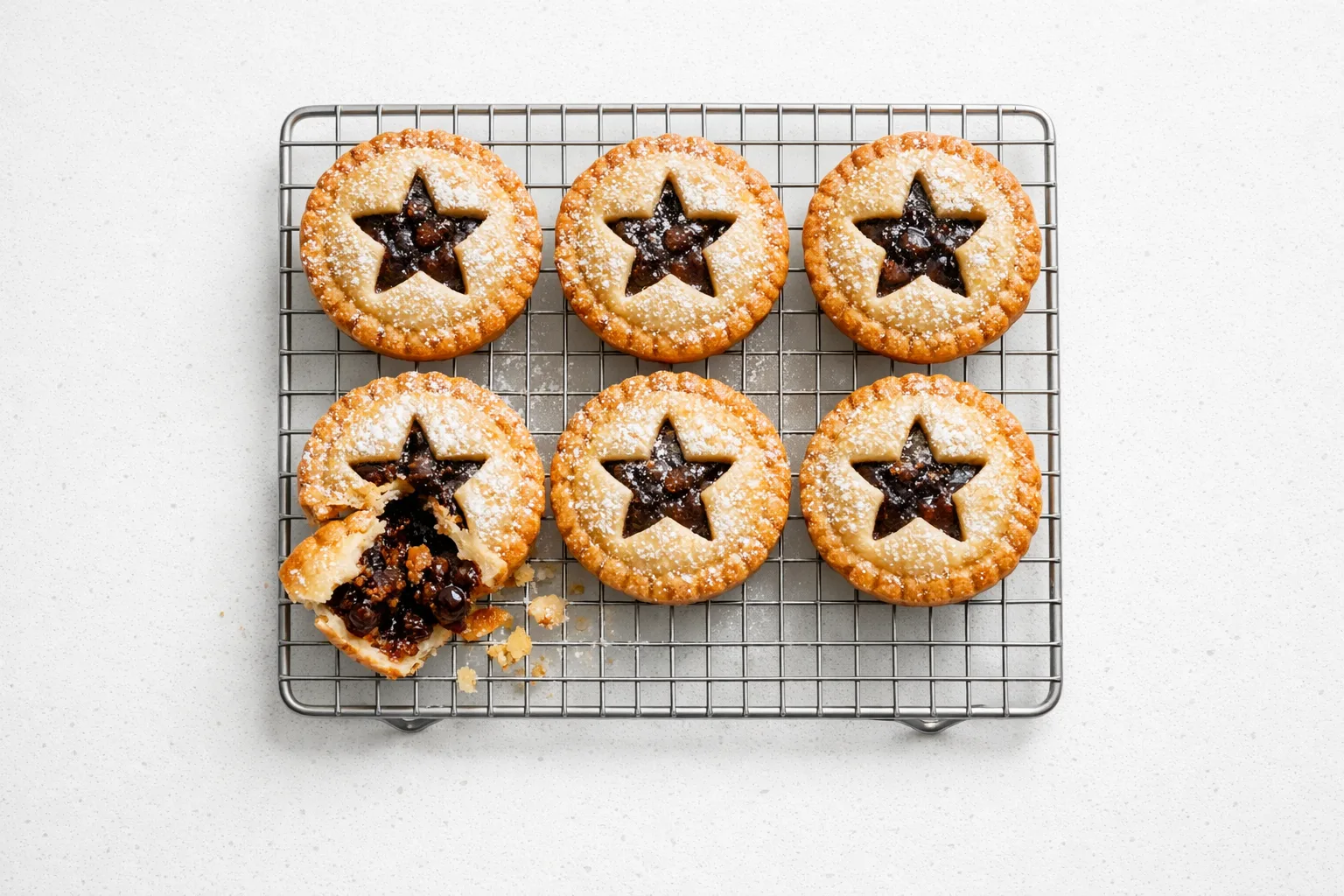
Mince pies are the single recipe that defines a British Christmas. They appear on every kitchen counter, every office desk, and every pub bar from late November until Boxing Day. The filling, a dense mix of dried fruits, candied peel, suet, sugar, and warm spices, dates back to the 13th century when returning Crusaders brought Middle Eastern spices to English kitchens. The "mince" originally included actual meat; by the Victorian era, the meat had mostly disappeared, but the name stuck.
This recipe pairs a quick, cold-butter shortcrust with a homemade mincemeat that takes 10 minutes to assemble. The pastry stays short and crumbly because the butter never warms up. The filling benefits from at least 24 hours of resting so the flavours merge, but it works same-day too.
Equipment
Instructions
Tap each step to track your progress
- 1
Make the mincemeat: combine the raisins, currants, candied peel, grated apple, brown sugar, suet, lemon zest and juice, orange zest and juice, mixed spice, cinnamon, and cloves in a large bowl. Stir thoroughly. Pour in the brandy and mix again. Cover with cling film and refrigerate for at least 2 hours, or ideally overnight. The fruit will plump and the flavours will deepen.
- 2
Make the pastry: pulse the flour, powdered sugar, salt, and cold butter cubes in a food processor until the mixture resembles coarse breadcrumbs, about 10-12 pulses. Add the egg yolk and 2 tbsp of ice water. Pulse until the dough just starts to clump together. If it is still too dry, add the remaining tablespoon of water. Do not over-process; visible butter flecks are good.
- 3
Turn the dough onto a lightly floured surface and press it together into a flat disc. Wrap in cling film and refrigerate for at least 30 minutes. The pastry must be cold when it goes into the tin or it will shrink.
- 4
Preheat the oven to 200C (400F). Lightly grease a 12-cup standard muffin tin or tartlet pan.
- 5
Roll out the pastry on a floured surface to about 3mm (1/8 inch) thickness. Cut 12 rounds using an 8 cm (3 inch) fluted cutter for the bases. Press each round gently into the muffin cups, leaving the pastry sitting just above the rim. Re-roll scraps and cut 12 smaller rounds or stars using a 6 cm (2.5 inch) cutter for the lids.
- 6
Spoon a heaped tablespoon of mincemeat into each pastry case. Do not overfill; the filling expands slightly during baking and will bubble over if packed too high. Leave about 3mm of space below the pastry rim.
- 7
Place the lids on top and press the edges together gently to seal. If using star shapes, just lay them on top of the mincemeat. Brush the tops with beaten egg white for a golden finish. Cut a small steam vent in each solid lid with a knife tip.
- 8
Bake for 18-20 minutes until the pastry is deep golden brown, not pale blonde. The filling will be bubbling through the vents. Remove from the oven and let the pies cool in the tin for 10 minutes before transferring to a wire rack. The filling is molten hot straight from the oven.
- 9
Dust with powdered sugar through a fine sieve before serving.
Tips & Tricks
Keep everything cold
Cold butter, cold water, cold hands. This is the entire secret to good shortcrust. If the kitchen is warm, chill the flour in the freezer for 10 minutes before starting. The butter should never soften; visible flecks in the dough mean flaky pastry.
Make the mincemeat ahead
Mincemeat improves the longer it sits. Making it a day or even a week in advance lets the brandy permeate the fruit and the spices bloom. Stir it once a day if resting for more than 24 hours. A month-old mincemeat will outperform one made that morning.
Do not skip the egg wash
The egg white wash is what gives the pies their deep golden color and slight sheen. Without it, the lids bake to a matte, pale finish that looks underdone even when fully cooked. Brush lightly; pooling egg white in the crevices turns rubbery.
Use a proper cutter, not a glass
A fluted pastry cutter gives a clean edge that helps the pastry release from the tin. A glass presses down on the dough and can seal the edge, making it thicker and tougher. If you only have a glass, twist it rather than pressing straight down.
Troubleshooting
My pastry shrinks in the tin
The dough was not cold enough when it went in, or it was stretched rather than pressed into the cups. Always chill the pastry for a full 30 minutes after rolling. Press it into the tin gently, letting the weight of the dough settle into the corners rather than pulling it.
The filling bubbles over
You overfilled the cases. A heaped tablespoon is enough; the filling swells as the sugar and butter melt. Leave a visible gap between the filling surface and the pastry rim. If it does bubble over, scrape the excess off the tin between batches so it does not burn and stick.
The pastry is tough, not crumbly
You overworked the dough. The butter needs to stay in distinct pieces within the flour for a short, flaky result. Process or cut just until the mixture looks like coarse breadcrumbs, then stop. Adding too much water also toughens pastry; use only enough to bring the dough together.
The bottoms are soggy
The oven was not hot enough, or the pies sat too long before baking after assembly. Preheat to a full 200C (400F) and bake within 10 minutes of filling the cases. Placing the muffin tin on a preheated baking sheet helps crisp the bases from underneath.
Variations
Frangipane-Topped Mince Pies
Replace the pastry lids with a thin layer of frangipane: beat 1/4 cup softened butter with 1/4 cup sugar, then mix in 1 beaten egg, 3/4 cup ground almonds, and 1/2 tsp almond extract. Spoon a teaspoon over each filled pie. Bake as directed. The almond sponge puffs up into a golden cap and adds a soft, nutty texture.
Vegan Mince Pies
Replace the butter in the pastry with cold coconut oil (solid, not melted). Use the egg-free method: substitute the yolk with 1 tbsp cold water. Replace suet in the filling with more grated frozen coconut oil. The pastry will be slightly less flaky but still short and crumbly. Use plant milk for the wash.
Puff Pastry Shortcut
Skip the shortcrust entirely and use a sheet of store-bought all-butter puff pastry. Roll it thin, cut the same rounds, and assemble identically. The result is lighter and crispier, more like a mincemeat turnover than a traditional pie. Reduce baking time to 15-17 minutes since puff pastry browns faster.
Boozy Upgrade
Double the brandy to 6 tbsp and add 2 tbsp of Pedro Ximenez sherry to the mincemeat. Let the filling soak for 48 hours instead of overnight. The pies will be darker, stickier, and markedly more alcoholic. Label them clearly at parties.
Serving & Gifting
Serve warm from the oven or at room temperature with a dusting of powdered sugar. In Britain, mince pies are traditionally paired with a glass of mulled wine, a cup of tea, or a small pour of brandy butter (softened butter beaten with powdered sugar and brandy). For parties, arrange them on a tiered cake stand. They are finger food; no plates required.
Storage & Freezing
Baked mince pies keep in an airtight container at room temperature for up to 5 days. Reheat in a 160C (325F) oven for 5 minutes to restore the pastry crispness. Unbaked, assembled pies freeze perfectly for up to 3 months; bake directly from frozen, adding 3-4 minutes to the baking time. The mincemeat filling on its own keeps in a sealed jar in the fridge for up to 4 weeks, improving with age.
Common Questions
What is mincemeat in mince pies?
Mincemeat is a mixture of dried fruits (raisins, currants, candied peel), grated apple, sugar, spices, and brandy or rum. Despite the name, modern mincemeat contains no meat. The name dates back to medieval recipes that included minced mutton or beef alongside the fruit and spices. Suet (beef fat) is the last trace of that tradition, and even that is often replaced with butter.
How long do homemade mince pies last?
Baked mince pies stay fresh in an airtight container at room temperature for about 5 days. Unbaked assembled pies freeze for up to 3 months and can be baked straight from frozen. The mincemeat filling on its own keeps in a sealed jar in the fridge for 4 weeks, getting better with age.
Can I make mince pies without suet?
Yes. Replace the suet with the same amount of cold grated butter. The filling will be slightly less rich and will not keep as long at room temperature, but the flavour is still excellent. For a vegan version, use frozen grated coconut oil.
What is the best pastry for mince pies?
Traditional mince pies use shortcrust pastry made with cold butter, which gives a crumbly, biscuit-like shell. All-butter puff pastry is a popular shortcut that produces a lighter, flakier result. Sweet shortcrust (with powdered sugar in the dough) is the best balance of structure and tenderness for holding the wet filling.
Can I make mince pies ahead of time?
Yes. Assemble the pies, place the filled muffin tin in the freezer until solid, then transfer the frozen unbaked pies to a freezer bag. Bake directly from frozen at 200C (400F) for 22-24 minutes. Alternatively, bake them fully and reheat at 160C (325F) for 5 minutes before serving.