
 United Kingdom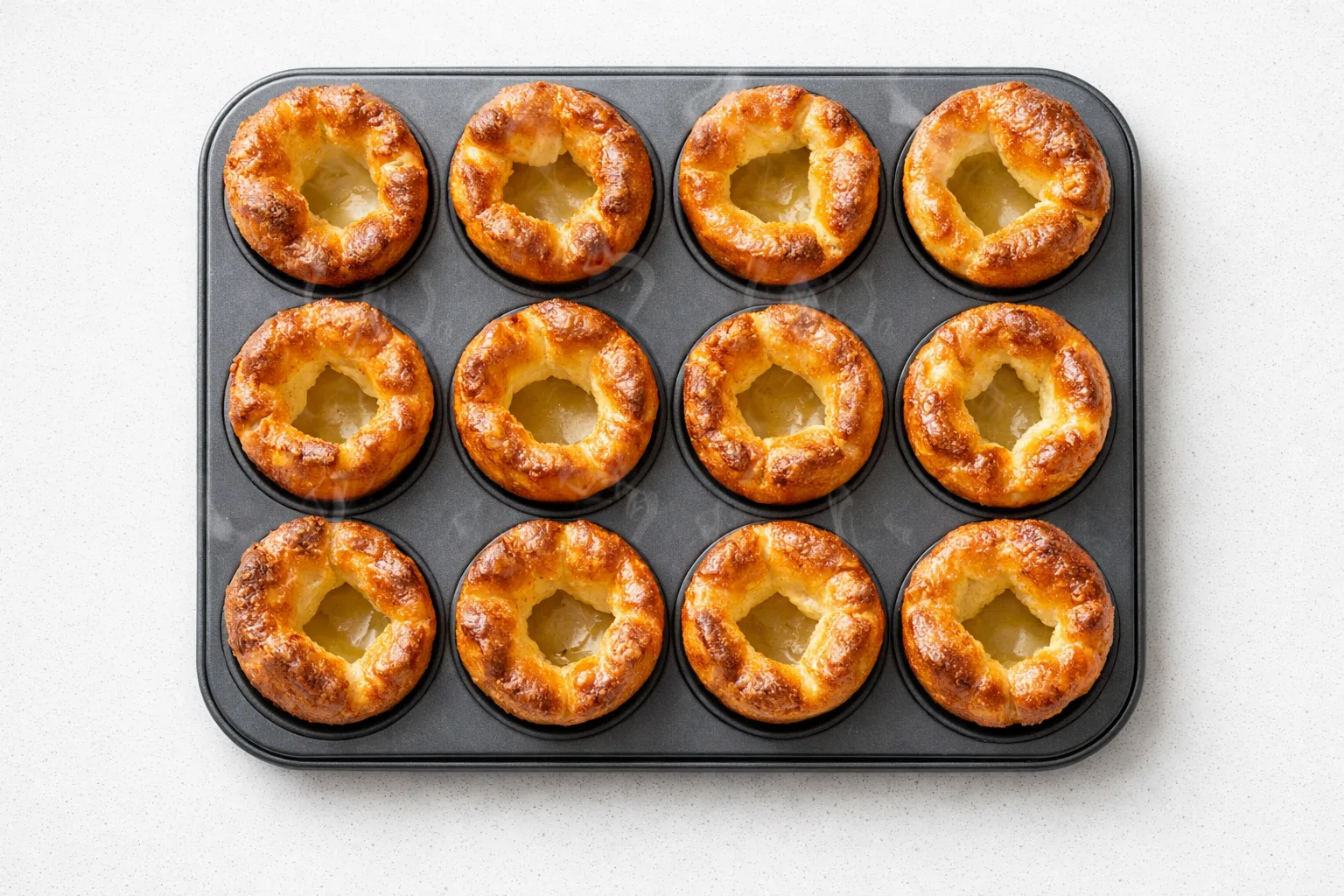
Yorkshire puddings are the centrepiece of the British Christmas roast, as essential as the turkey and arguably more anticipated. These baked batter puddings originated in Yorkshire, northern England, where cooks developed them in the 1700s as a way to use dripping fat from spit-roasted meat. A good Yorkshire pudding has a dramatic rise, a hollow centre you can fill with gravy, and a shell that's deeply golden outside and custardy soft inside.
The recipe is just four ingredients: eggs, flour, milk, and fat. The technique is where it gets exacting. The fat must be smoking hot, the batter must be at room temperature, and once the puddings are in the oven you do not open the door. Get those three things right and you will reliably produce puddings that rise to two or three times the height of the tin. This recipe uses a standard 12-hole muffin tin, which gives you the best surface-area-to-volume ratio for a crisp exterior with a hollow core.
Equipment
Instructions
Tap each step to track your progress
- 1
Make the batter at least 30 minutes before cooking, ideally 1 hour ahead. Whisk the flour and salt together in a large bowl. Make a well in the centre, add the eggs, and whisk them in. Gradually add the milk, whisking constantly, until you have a thin, smooth batter with no lumps and the consistency of single cream (light cream). Transfer to a jug for easy pouring. Let the batter rest at room temperature.
- 2
Preheat the oven to 450°F (230°C / 210°C fan). Place about 1/4 teaspoon of beef dripping or oil into each hole of a 12-cup muffin tin. Put the tin on the oven shelf and heat it for a minimum of 15 minutes. You want the fat to be smoking and shimmering hot when the batter goes in. Do not rush this step.
- 3
Working quickly, pull the tin partway out of the oven. Pour the batter into each hole, filling each about halfway. The batter should sizzle the instant it hits the fat. If it does not sizzle, your fat is not hot enough and the puddings will not rise properly.
- 4
Immediately return the tin to the oven. Do not open the oven door for at least 20 minutes. The sudden temperature drop from opening the door is the most common cause of collapsed puddings.
- 5
After 20 minutes, check through the oven window. The puddings should be tall, puffed dramatically above the tin, and deeply golden brown all over. If the colour looks pale, give them another 3 to 5 minutes. They are done when the exterior is a rich amber-gold and feels firm when you look at the tops through the glass.
- 6
Remove from the oven and serve immediately. Yorkshire puddings deflate slightly as they cool, so they should go straight from tin to table. Use a palette knife or butter knife to pop each one out of the tin.
Tips & Tricks
Room temperature batter is not optional
Cold batter hitting hot fat creates steam too rapidly on the outside and not enough inside, giving you flat puddings with thick walls. Take the eggs and milk out of the fridge at least 45 minutes before you start. If you forgot, submerge the milk jug in warm water for 10 minutes.
Rest the batter
Resting for at least 30 minutes (up to overnight in the fridge, brought back to room temperature before using) relaxes the gluten in the flour and allows the starch to hydrate fully. The result is a more stable, evenly risen pudding. Many professional cooks rest the batter overnight.
Beef dripping beats everything else
The flavour of lard or beef dripping is superior to vegetable oil and the higher smoke point means the fat is hotter when the batter goes in. Save the fat from your Christmas roast tin, strain it, and use it here. If you do not have dripping, use sunflower or vegetable oil, not olive oil, which burns.
Never open the oven door early
The steam inside the puddings is what creates the rise. Opening the door drops the temperature sharply, the steam condenses, and the puddings collapse. Set a timer for 20 minutes and do not touch the oven until it sounds.
Scale the batter by weight, not volume
For reliable results, use the equal-weight method: weigh your eggs, then use the same weight of flour and the same weight of milk. For 4 large eggs (approximately 220g), you would use 220g flour and 220g milk. This scales perfectly for any batch size.
Troubleshooting
My Yorkshire puddings did not rise
The fat was not hot enough, or the oven temperature is lower than it reads. Most domestic ovens run 10 to 25 degrees cooler than the dial says. Use an oven thermometer to verify, and extend the fat-heating time to 20 full minutes. The fat must be visibly smoking when the batter goes in.
My puddings rose then collapsed as soon as I took them out
This is normal if you removed them too early. The structure needs to set fully. If the puddings are collapsing significantly, add 3 to 4 minutes to the cook time. They should feel firm and sound hollow when tapped before you remove them.
The batter is lumpy
The eggs and milk were too cold, or the flour was added all at once. Strain the batter through a fine sieve before using. Cold ingredients cause the fat in the eggs to seize and create lumps; this is why room temperature batter is non-negotiable.
The bottoms are not crisp
The holes did not have enough fat, or the fat had cooled slightly before you poured in the batter. Each hole needs a thin but visible pool of shimmering fat. Work fast when pouring so the tin spends as little time out of the oven as possible.
My puddings are sticking to the tin
The tin is too old and non-stick has worn away, or it was not properly preheated. Use a good-quality, non-stick muffin tin and coat with enough fat. If sticking persists, use a silicone muffin tin, which releases puddings cleanly.
Variations
Dairy-Free Adaptation
Replace the whole milk with unsweetened oat milk or a 50/50 blend of oat milk and water. The puddings will rise slightly less dramatically and the interior will be a little less custardy, but the exterior crisps up well. Use a neutral vegetable oil rather than dripping.
Herb Yorkshire Puddings
Add 1 tablespoon of finely chopped fresh thyme and 1 teaspoon of finely chopped fresh rosemary to the rested batter just before pouring. The herbs add a subtle savoury note that pairs particularly well with lamb or beef. Do not add more than this or the moisture from fresh herbs can inhibit the rise.
Giant Yorkshire Puddings
Use a 6-cup large muffin tin or a popover pan and double the fat per hole. Cook at the same temperature but extend the time to 28 to 30 minutes. These produce dramatic, deep-walled puddings that work beautifully as edible bowls filled with roast beef, gravy, and horseradish at a Christmas dinner buffet.
Mini Party Yorkshire Puddings
Use a 24-cup mini muffin tin. Reduce the fat to a few drops per hole. Cook for 12 to 15 minutes. These bite-sized versions are excellent for Christmas party canapés. Fill with a sliver of rare beef and a dot of horseradish cream, or smoked salmon and creme fraiche.
Serving & Gifting
Serve Yorkshire puddings straight from the oven alongside Christmas roast beef, turkey, or goose with lashings of rich meat gravy poured into the hollow centre. They also work well as a starter at Christmas dinner: fill each pudding with a spoonful of beef dripping-roasted onion or a slice of roast beef and a dot of creamed horseradish. For buffet service, place them in a warm oven at 300°F (150°C) for up to 5 minutes to hold, though they are always best served within 2 minutes of coming out of the tin.
Storage & Freezing
Yorkshire puddings are not suited to make-ahead, but cooked puddings can be stored in an airtight container at room temperature for up to 24 hours and re-crisped in a hot oven (400°F / 200°C) for 4 to 5 minutes. They can also be frozen: cool completely, freeze in a single layer on a tray, then bag. Reheat from frozen in a 400°F oven for 6 to 8 minutes directly on the oven rack. Do not reheat in a microwave, it turns the exterior rubbery.
Common Questions
Why do Yorkshire puddings rise?
The rise comes from steam. When cold batter hits very hot fat, the moisture in the batter vaporises rapidly, creating steam that puffs the batter up before the exterior sets. The eggs and gluten in the flour then set around this expanded structure, holding the risen shape. If the fat is not hot enough, the batter cooks too slowly and the steam escapes rather than lifting the pudding.
Can I make Yorkshire pudding batter the night before?
Yes. Resting the batter overnight in the fridge actually improves results. The gluten relaxes, giving a more tender interior, and the starch hydrates fully for a more consistent rise. Bring the batter back to room temperature for at least 30 minutes before using.
What fat is best for Yorkshire puddings?
Beef dripping is the traditional choice and produces the most flavourful, crispiest exterior because of its high smoke point and its flavour. Lard is a good second option. Sunflower or vegetable oil works well for an everyday version or for a dairy-free adaptation. Do not use butter, it burns at the temperatures required.
Can I make Yorkshire puddings ahead and reheat them?
You can, but freshly baked is always best. If you must, cook them fully, cool on a wire rack, and store at room temperature for up to 24 hours. Reheat in a preheated 400°F (200°C) oven directly on the oven rack for 4 to 5 minutes. They will crisp up again but lose some of the dramatic rise.
How do I stop Yorkshire puddings from going flat?
The three causes of flat puddings are: fat not hot enough, batter too cold, or the oven door opened during cooking. Get the fat smoking before you pour in the batter, use room temperature ingredients, and do not open the door for at least 20 minutes. A properly working oven at 450°F / 230°C and 20 minutes of patience fixes almost every flat-pudding problem.
Are Yorkshire puddings the same as popovers?
They are very similar. American popovers use the same technique and a comparable batter, with slightly more milk relative to eggs. The main difference is the tin: popovers are baked in a deep, narrow popover pan with tall, steep walls, giving them an almost cylindrical rise. Yorkshire puddings use a wider, shallower muffin tin and have the distinctive shallow well in the centre. Either tin works for the other's recipe.