
North Pole: Where It Is and Why Santa Lives There
The geographic North Pole sits on drifting ice over 13,400 feet of Arctic Ocean. It belongs to no country, has no land, and gets six months of total darkness. Naturally, we decided Santa lives there.
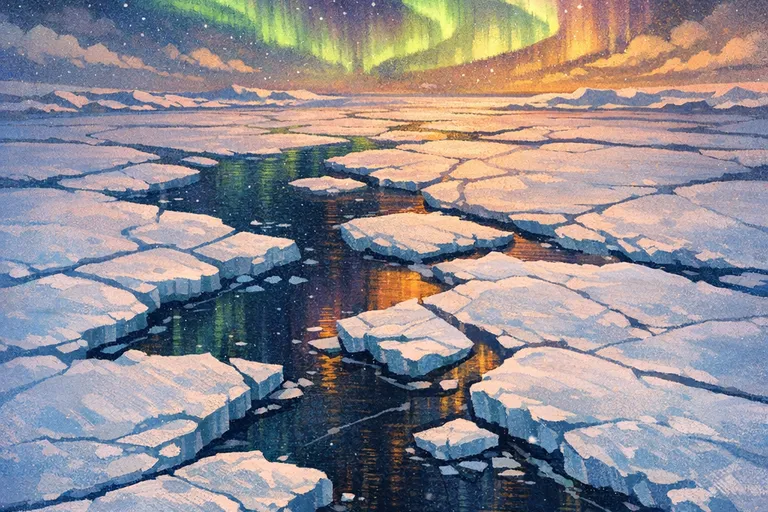
The North Pole is one of those places everyone knows about and almost no one has actually seen. It sits at 90 degrees north latitude, the single point where every line of longitude on Earth converges. There is no land there. Just a sheet of drifting sea ice floating on the Arctic Ocean, roughly 13,400 feet of dark, cold water beneath it.
Contents
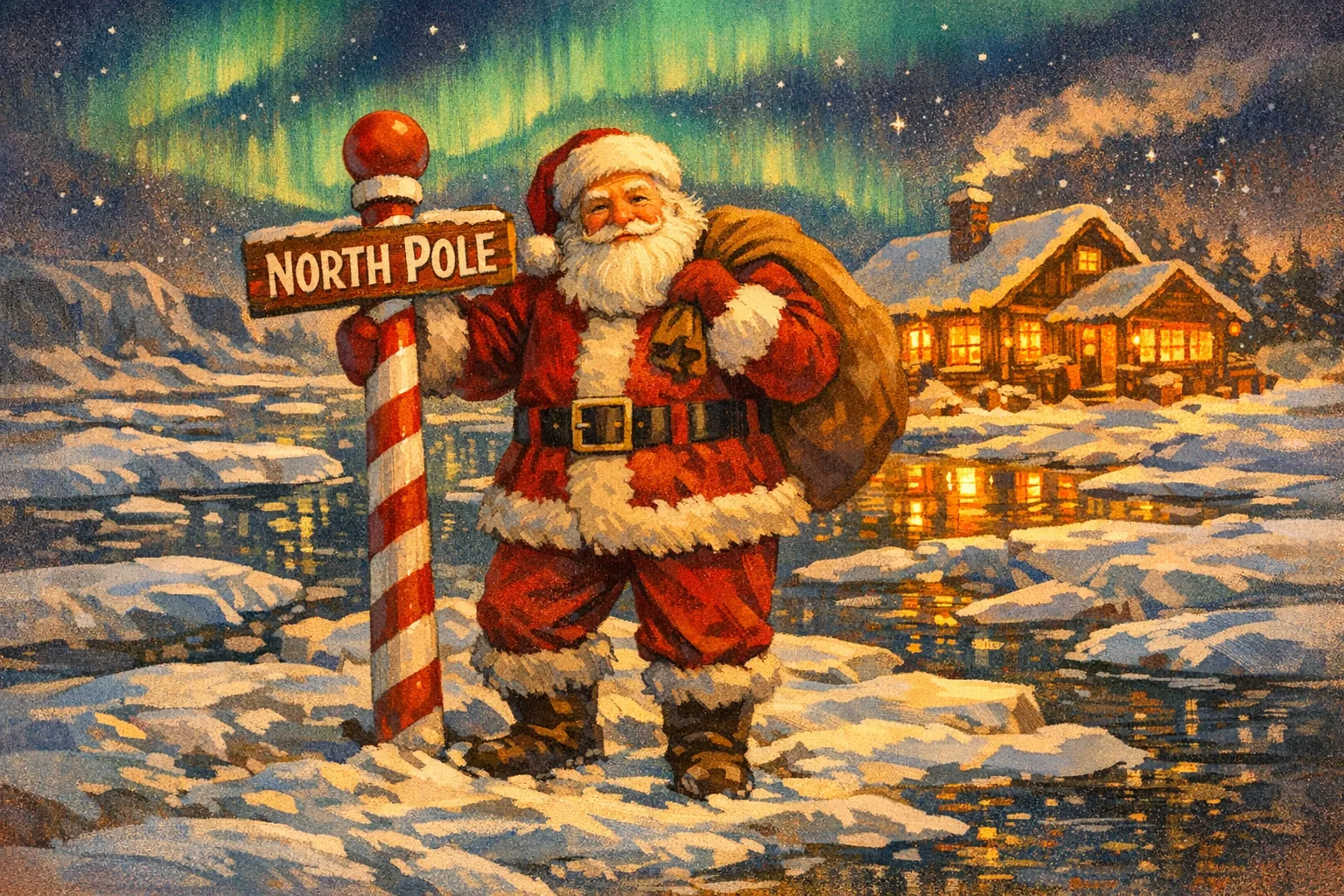
The nearest large landmass is Greenland, about 450 miles to the south. Every direction from the North Pole is south. It belongs to no country. And yet, since 1866, we've collectively agreed that this is where a jolly man in a red suit runs a toy factory staffed by elves.
Where Is the North Pole?
Before getting to Santa, it helps to understand what the North Pole actually is. The geographic North Pole marks the exact spot where Earth's rotational axis meets its surface. Unlike the South Pole, which sits on the Antarctic continent at an elevation of about 9,300 feet, the North Pole has no ground beneath it at all. It floats.
There's also more than one "North Pole." The geographic pole stays fixed at 90 degrees north, but the magnetic north pole, the one your compass needle tracks, wanders. As of January 2025, NOAA placed it at approximately 86 degrees north, 139 degrees east. Since the 1990s, it has been drifting from northern Canada toward Siberia at roughly 55 kilometers per year, up from about 15 kilometers per year before that. Nobody knows exactly why the pace accelerated, though shifts in the flow of molten iron in Earth's outer core are the leading explanation.
The first undisputed journey to the geographic North Pole came not on foot but by air. Roald Amundsen flew over it in an airship in 1926. Robert Peary's famous 1909 claim, long taught as fact in American schools, is now widely considered unverifiable by modern analysis. The first confirmed surface expedition didn't arrive until 1968, when Ralph Plaisted's team reached it by snowmobile. A year later, British explorer Wally Herbert's team made the journey on foot with dog sleds.
What's the Weather Like at the North Pole?
Brutal. Winter temperatures at the geographic North Pole average between minus 30 and minus 35 degrees Celsius (minus 22 to minus 31 Fahrenheit), with extremes plunging to minus 50 Celsius. Summer is comparatively balmy, hovering stubbornly around the freezing point. The Arctic Ocean beneath the ice acts as a thermal buffer, which is why the North Pole is actually warmer than Antarctica's interior, where temperatures have dropped to minus 89.2 Celsius.
The sun rises once a year, around the March equinox, and sets once, around September. That gives the North Pole roughly six months of continuous daylight followed by 179 days of total darkness. During polar night, the only natural light comes from the moon, stars, and the aurora borealis. It's a climate classified as a cold desert, with very little precipitation because the frozen ocean surface prevents meaningful evaporation.
The ice itself is disappearing at a pace that would concern even Santa's logistics team. In the 1980s, Arctic sea ice older than four years averaged three to four meters thick and dominated the ocean surface. By 2024, according to NOAA's Arctic Report Card, average fall ice thickness in the central Arctic had dropped to just 1.3 meters, down from 2.7 meters in 1980. The oldest ice, the thick multiyear variety that has survived more than four summers, has declined by over 95 percent. September sea ice extent is shrinking at 12.1 percent per decade.
Santa might want to look into flood insurance.
How Santa's Workshop Ended Up at the North Pole
Santa didn't always live at the North Pole. For most of his history as a Christmas figure, he had no fixed address. The 1823 poem "A Visit from St. Nicholas," published anonymously in the Troy, New York Sentinel on December 23 of that year, gave us the sleigh, the eight reindeer, and the chimney entrance. It said nothing about where Santa came from or where he went when he was done.
That detail came from Thomas Nast.
Nast, a German-born political cartoonist working for Harper's Weekly, created 33 Santa Claus illustrations between 1863 and 1886. His first, "Santa Claus in Camp," appeared in January 1863 and showed Santa visiting Union soldiers during the Civil War. But the one that changed Christmas geography ran in the December 29, 1866 issue: a double-page, 20-vignette spread titled "Santa Claus and His Works." In one panel, Santa's home bore the label "Santaclaussville, N.P."
The N.P. stood for North Pole.

Nast's choice was deliberate and smart. In 1866, Arctic exploration dominated headlines. Sir John Franklin's expedition had vanished in the Canadian Arctic two decades earlier, and the search for a Northwest Passage consumed public imagination. By placing Santa at the North Pole, a location belonging to no nation, Nast made him a universal figure above political borders. The illustration showed Santa making toys, sewing doll clothes, managing his workshop, and consulting his list of good and bad children. Nast essentially invented the entire concept of Santa's toy operation at the top of the world in a single spread.
His 1881 illustration "Merry Old Santa Claus," showing the red-suited, white-bearded figure we know today, remains one of the most reproduced Santa images in history. But it was the 1866 address that stuck. Every movie, song, and children's book since has simply accepted Nast's geographic assignment as fact.
How to Send a Letter to Santa at the North Pole
If you want to write to Santa, several postal services around the world will deliver the letter and write back.
The United States Postal Service has been answering children's letters since 1912, when Postmaster General Frank Hitchcock authorized local postmasters to open and respond to Santa mail. What started at a few post offices in New York now operates nationwide as Operation Santa, receiving roughly 150,000 letters per year. The official USPS address is Santa Claus, 123 Elf Road, North Pole, 88888. Since 2019, volunteers across the country can "adopt" letters online and fulfill the wishes described in them.
Canada Post went a different route. In 1973, postal employees in Vancouver started voluntarily answering 4,000 letters that had arrived at the undeliverable mail office addressed to Santa. By 1982, the program went national, and someone at Canada Post had a stroke of genius: Santa received his own postal code, H0H 0H0, designed to spell "HO HO HO." Since then, the program has answered more than 25 million letters in at least 39 languages, including Braille. Over a million arrive each year.
Finland makes perhaps the strongest geographic case. In 1950, Eleanor Roosevelt visited Rovaniemi in Finnish Lapland as a UN representative assessing post-war rebuilding. With just two weeks' notice, Finnish officials constructed a log cabin at the Arctic Circle for her visit. That hastily built cabin became the seed of Santa Claus Village, which officially opened in 1985 and now draws about 520,000 visitors annually. Finland declared Rovaniemi Santa's official hometown the same year. It sits right on the Arctic Circle, with a white painted line across the village grounds to prove it.
North Pole, Alaska: The Town That Took the Name
About 1,700 miles south of the actual geographic North Pole, a town of 2,243 people renamed itself in 1952 for a reason that is both absurd and completely logical. The Dahl and Gaske Development Company bought a homestead 13 miles southeast of Fairbanks, subdivided it, and called it North Pole. Their plan was to attract a toy manufacturer who could stamp products "Made in North Pole."
The toy factory never came. But the name stuck.
North Pole incorporated as a city on January 15, 1953. Con Miller, who had arrived in Fairbanks in 1949, opened the Santa Claus House trading post in 1952 and went on to serve as mayor for 19 years, the longest tenure in the city's history. His wife Nellie served as both postmaster and marriage commissioner, reportedly marrying thousands of couples at the Santa Claus House. Streets carry names like Santa Claus Lane, Snowman Lane, Kris Kringle Drive, and Mistletoe Lane. Streetlights are wrapped in candy cane stripes year-round.
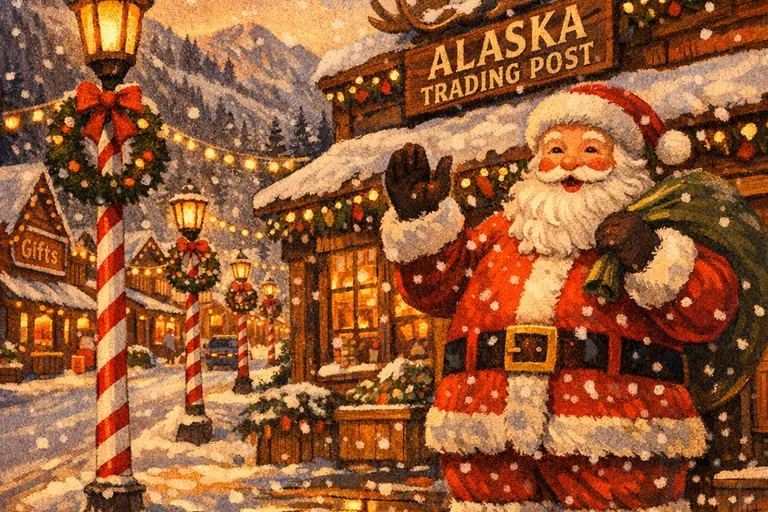
The post office at ZIP code 99705 receives hundreds of thousands of letters to Santa each year. It also handles a steady stream of Christmas cards from across the country, sent by people who want the "North Pole, AK" postmark on their holiday mail.
At one point, a local resident legally changed his name to Santa Claus and served on the North Pole city council. In this town, that barely qualifies as news.
Frequently Asked Questions
Where is the North Pole located?
The geographic North Pole sits at 90 degrees north latitude in the middle of the Arctic Ocean. There is no land there. It is covered by drifting sea ice floating over approximately 13,400 feet of ocean water. The nearest large landmass is Greenland, about 450 miles to the south.
How cold does it get at the North Pole?
Winter temperatures average between minus 30 and minus 35 degrees Celsius (minus 22 to minus 31 Fahrenheit), with extremes reaching minus 50 Celsius. Summer temperatures hover near 0 degrees Celsius. The North Pole gets about six months of continuous darkness and six months of continuous daylight each year.
Why does Santa live at the North Pole?
Political cartoonist Thomas Nast first placed Santa's home at the North Pole in an 1866 illustration for Harper's Weekly titled "Santa Claus and His Works." He chose the location because it belonged to no country, making Santa a universal figure above national borders. The idea caught on immediately and has been the standard ever since.
What is Santa's mailing address?
In the United States, the USPS Operation Santa program accepts letters sent to Santa Claus, 123 Elf Road, North Pole, 88888. In Canada, Santa's postal code is H0H 0H0, designed to spell "HO HO HO." You can also write to 1 Santa Claus Lane, North Pole, AK 99705, where the North Pole, Alaska post office handles Santa's mail.
Is North Pole, Alaska a real town?
Yes. North Pole is an incorporated city of about 2,243 people located 13 miles southeast of Fairbanks, Alaska. It was renamed in 1952 in an attempt to attract a toy manufacturer. The town maintains a year-round Christmas theme with candy cane streetlights, Christmas-named streets, and the Santa Claus House trading post founded in 1952.
Can you visit the geographic North Pole?
Yes, but it requires significant planning and expense. Most visitors reach the North Pole via icebreaker ship departing from Murmansk, Russia, or by chartered aircraft landing on the sea ice from Svalbard, Norway. There are no permanent structures, settlements, or facilities at the geographic North Pole since it sits on shifting sea ice.