
The Grinch: Origin, History, and Cultural Legacy
Theodor Geisel was 53, fed up with Christmas commercialism, and staring at his own sour face in the mirror. The character he created that morning became the most famous holiday villain in American culture.
On the morning of December 26, 1956, Theodor Seuss Geisel stood in his La Jolla, California bathroom and caught his own reflection. He did not like what he saw. "I noticed a very Grinch-ish countenance in the mirror," he later wrote in Redbook magazine. "So I wrote about my sour friend, the Grinch, to see if I could rediscover something about Christmas that obviously I'd lost."
Contents
- 1. How Did Dr. Seuss Create the Grinch?
- 2. Why Is the Grinch Green?
- 3. The 1966 TV Special That Made the Grinch Famous
- 4. Jim Carrey's Grinch: The 2000 Live-Action Film
- 5. The 2018 Illumination Animated Film
- 6. What Does "Grinch" Mean as a Cultural Term?
- 7. The Grinch's Lasting Hold on Christmas Culture
- 8. Frequently Asked Questions
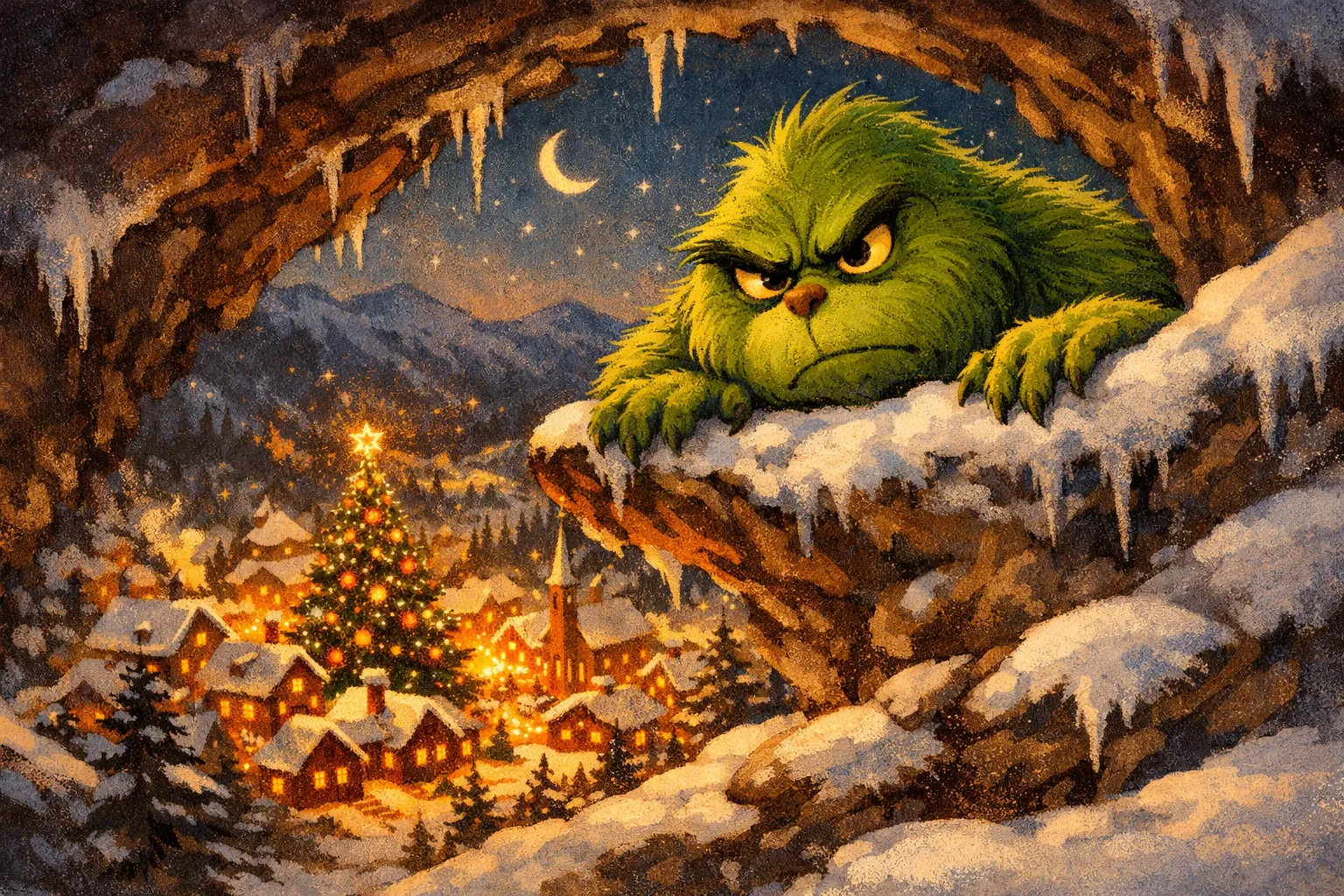
Geisel was 53 years old. His wife Helen was in declining health. The holiday season had left him irritated, not festive. What bothered him most wasn't Christmas itself but what Christmas had become: a consumer spectacle driven by department store displays and advertising. The character born from that frustration, a green, furry, cave-dwelling misanthrope with a heart "two sizes too small," would go on to become the single most recognizable symbol of holiday discontent in the English-speaking world.
How Did Dr. Seuss Create the Grinch?
The Grinch didn't arrive fully formed in 1957. Two years earlier, a creature called "the Grinch" appeared in a short illustrated poem titled "The Hoobub and the Grinch," published in the May 1955 issue of Redbook. That Grinch was a con artist, not a Christmas thief, but the name stuck in Geisel's mind.
By early 1957, he was writing what would become How the Grinch Stole Christmas! in his signature anapestic tetrameter. The 69-page book took shape quickly, with one exception: the ending. Geisel agonized over how to resolve the story without sounding preachy. He needed the Grinch's transformation to feel earned, not like a Sunday school lesson.
The solution was elegant. The Grinch steals every physical trace of Christmas from Whoville: the presents, the food, the decorations, even the logs for the fire. But on Christmas morning, the Whos sing anyway. Christmas, the story argues, doesn't come from a store. The Grinch's heart grows three sizes. He returns everything. He carves the roast beast.
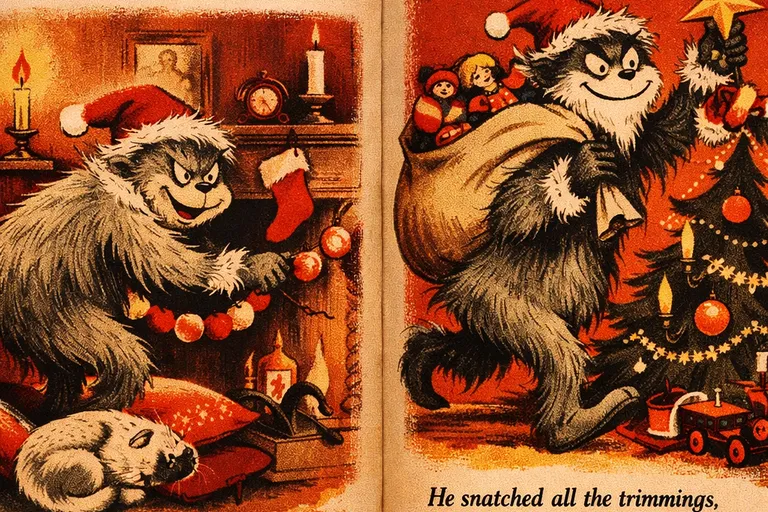
By mid-May 1957, the manuscript was in the mail to Random House. It debuted that December, published simultaneously as a book and in the pages of Redbook. Geisel illustrated it himself, entirely in black, white, and red. There was no green anywhere in the original Grinch.
Why Is the Grinch Green?
This is one of the most common questions about the character, and the answer is straightforward: the Grinch was not green until 1966. In Dr. Seuss's original book, printed only in black, white, and red ink, the Grinch has no specified color at all.
When animator Chuck Jones adapted the story as a 26-minute CBS television special, he needed to make a color choice. Jones selected a sickly, yellow-tinged green, reportedly inspired by the color of a rental car he found particularly unappealing. The logic was visual as much as emotional. Against the warm reds, whites, and pastels of Whoville, that particular shade of green made the Grinch look like he fundamentally did not belong there. His color marked him as an outsider before he spoke a single word.
Jones and Geisel both agreed the green was right. It has been the Grinch's color in every adaptation since.
The 1966 TV Special That Made the Grinch Famous
The book sold well. But the 1966 animated special, directed by Chuck Jones and first aired on CBS on December 18 of that year, is what turned the Grinch into a permanent fixture of American culture. Nearly 38 million people watched that first broadcast.
The production took over a year and cost CBS $315,000. Jones and his team created approximately 15,000 drawings and cels and 250 background paintings. The animation was produced at MGM's television and animation studios, with a small crew of veteran animators including Ken Harris and Ben Washam, both longtime Warner Bros. collaborators who had worked with Jones on Looney Tunes for decades.
The casting of Boris Karloff as both the narrator and the voice of the Grinch was a stroke of genius. Karloff, then 79 years old, was already the most famous horror actor in film history, known for playing Frankenstein's monster in 1931. His deep, resonant voice gave the Grinch a menace that balanced perfectly against the whimsy of Seuss's verse. Karloff could make "Stink, stank, stunk" sound genuinely threatening.
The Voice Behind "You're a Mean One, Mr. Grinch"
The special's breakout element was a song that Boris Karloff did not sing. "You're a Mean One, Mr. Grinch," with lyrics by Geisel himself and music by Albert Hague, was performed by bass vocalist Thurl Ravenscroft. If that name doesn't ring a bell, his other famous role will: Ravenscroft was the voice of Tony the Tiger for Kellogg's Frosted Flakes from 1953 until 2004.
Ravenscroft's performance is one of the great vocal recordings in television history. The song catalogs the Grinch's repulsiveness with inventive glee: "You're a monster, Mr. Grinch / Your heart's an empty hole." It works because Ravenscroft's voice is so rich and warm that the insults feel almost affectionate.
Here's the injustice: Ravenscroft received no on-screen credit. His name was left off the closing credits entirely, which led generations of viewers to assume Boris Karloff sang the song. When Geisel learned of the oversight, he personally called Ravenscroft to apologize and wrote letters to newspaper columnists across the country to correct the record. The misattribution persists anyway.
Jim Carrey's Grinch: The 2000 Live-Action Film
Universal Pictures released Ron Howard's live-action How the Grinch Stole Christmas on November 17, 2000, with Jim Carrey in the title role. The film expanded Seuss's lean 69-page story into a 104-minute feature by adding a backstory for the Grinch, including childhood trauma and a romantic subplot with a grown-up Whoville resident named Martha May Whovier.
The movie grossed $345 million worldwide on a $123 million budget, making it the highest-grossing film domestically that year. It won the Academy Award for Best Makeup, and that award was hard-earned in every sense.
Rick Baker, the legendary makeup effects artist, created a full-body prosthetic suit made of yak hair dyed green, glued onto a spandex base. The daily makeup application took two and a half hours. Carrey also wore enlarged yellow contact lenses. He later compared the experience to "being buried alive." Ninety-two days into production, Carrey put his foot through his trailer wall and told Howard he was quitting.
Producer Brian Grazer's solution was unconventional. He brought in Richard Marcinko, a Vietnam veteran and the first commanding officer of SEAL Team Six, whose post-military career included training people to endure extreme discomfort. Marcinko taught Carrey coping techniques: punching himself in the leg, abruptly changing stimuli in the room, eating compulsively. It worked. Carrey finished the film.
The 2018 Illumination Animated Film
Illumination Entertainment's The Grinch, released in November 2018 with Benedict Cumberbatch voicing the title character, took a softer approach. This Grinch was less menacing and more sympathetically lonely, redesigned with large expressive eyes and a rounder face. Pharrell Williams narrated.
Critics were mixed, but audiences turned out. The film grossed over $540 million worldwide against a $75 million budget, surpassing Home Alone to become the highest-grossing holiday film in box office history at the time. It proved that the Grinch remained commercially potent more than 60 years after his creation.
What Does "Grinch" Mean as a Cultural Term?
Merriam-Webster defines "grinch" (lowercase) as "a grumpy person who spoils the pleasure of others: killjoy, spoilsport." The dictionary traces the first general use of the word to 1966, the year the TV special aired. Dr. Seuss created a fictional character. American English absorbed it as a common noun.
Calling someone "a grinch" carries a specific shade of meaning that "scrooge" does not. A Scrooge is stingy. A Grinch actively resents other people's enjoyment. The Grinch doesn't just refuse to celebrate Christmas; he wants to stop everyone else from celebrating it too. That distinction matters. Every office has someone who rolls their eyes at the holiday party. That person is the Grinch.
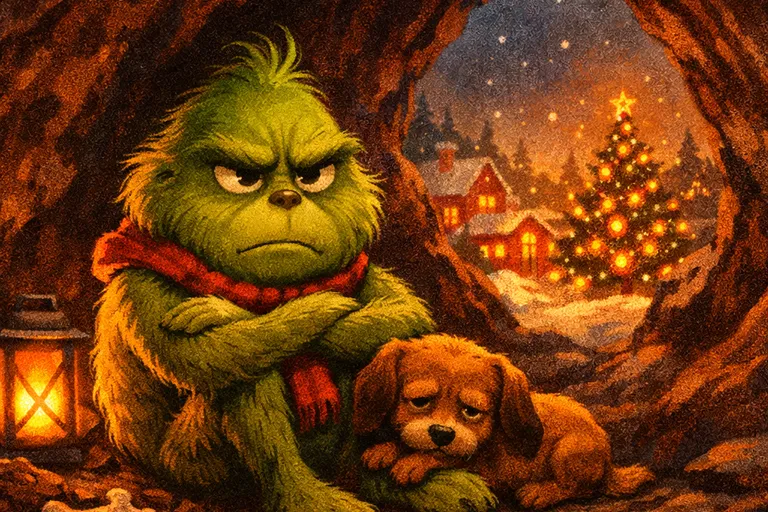
The character has also become a vessel for more sympathetic readings. Memes reframing the Grinch as an introvert who simply needs boundaries are everywhere on social media each December. "The Grinch didn't hate Christmas, he hated people" has become a popular refrain, particularly among younger audiences who identify with the character's desire for solitude over mandatory group cheer.
The Grinch's Lasting Hold on Christmas Culture
Three films, a Broadway musical, countless merchandise lines, and a permanent entry in the dictionary. Not bad for a character born from one man's bad mood on the day after Christmas. What keeps the Grinch relevant is the same thing that made him resonate in 1957: the tension between what Christmas is supposed to be and what it often becomes.
Geisel's original moral was never subtle. Christmas doesn't come from a store; it means a little bit more. But the Grinch himself is more interesting than his redemption arc. He lives alone on a mountain with a dog. He hates noise. He has strong opinions about the commercialization of holidays. In 2026, that profile describes half the internet.
The Grinch's heart grew three sizes. Geisel never said it stayed that way.
Frequently Asked Questions
Who created the Grinch?
The Grinch was created by Theodor Seuss Geisel, known as Dr. Seuss. The character first appeared in a short poem in the May 1955 issue of Redbook magazine, then starred in the children's book How the Grinch Stole Christmas!, published by Random House in December 1957. Geisel wrote and illustrated the book himself.
Why is the Grinch green?
The Grinch was not originally green. Dr. Seuss's 1957 book was printed only in black, white, and red ink. Animator Chuck Jones chose the now-iconic green color for the 1966 CBS television special, reportedly inspired by the unappealing shade of a rental car. The green made the Grinch visually contrast with the warm colors of Whoville, emphasizing his role as an outsider.
Who sang "You're a Mean One, Mr. Grinch"?
The song was performed by bass vocalist Thurl Ravenscroft, best known as the voice of Tony the Tiger for Kellogg's Frosted Flakes. Ravenscroft was not credited in the 1966 TV special, leading many viewers to incorrectly attribute the song to Boris Karloff, who narrated and voiced the Grinch. Dr. Seuss later apologized for the oversight and tried to correct the record publicly.
How many Grinch movies are there?
There are three major screen adaptations. The first is the 1966 animated TV special directed by Chuck Jones, with Boris Karloff narrating. The second is the 2000 live-action film starring Jim Carrey, directed by Ron Howard. The third is the 2018 Illumination animated film voiced by Benedict Cumberbatch, which grossed over $540 million worldwide.
What does "grinch" mean in everyday language?
Merriam-Webster defines "grinch" (lowercase) as a grumpy person who spoils the pleasure of others, synonymous with killjoy or spoilsport. The word entered common English usage around 1966, after the TV special popularized the character. It is now widely used to describe anyone who dampens holiday celebrations or resents others' enjoyment of festive events.
Is the Grinch based on Dr. Seuss himself?
Yes, at least partly. Geisel said he wrote the character after seeing a "Grinch-ish countenance" in his own mirror on December 26, 1956. He was 53 at the time, the same age he gave the Grinch in the story. His frustration with the commercialization of Christmas and his wife Helen's declining health contributed to the mood that produced the character.