

Candy Cane: History, Origin, Meaning and How They're Made
Candy canes weren't always striped, weren't always peppermint, and almost certainly weren't designed as secret Christian symbols. The real story is better than the legend.
The candy cane is one of the most recognizable Christmas symbols in the world. About 1.76 billion of them are produced every year in the United States alone, with 90% sold between Thanksgiving and Christmas. They hang on trees, fill stockings, dissolve in hot chocolate, and get licked down to dangerously sharp points by children in church pews. But the candy cane's origin story is murkier than you'd expect, tangled with legends that sound good but don't hold up to scrutiny.
Contents
The short version: candy canes probably originated in 17th-century Germany as plain white sugar sticks. The red stripes, peppermint flavor, and Christian symbolism all came later, each arriving centuries after the candy itself.
Where Did Candy Canes Come From?
The most widely repeated origin story places the candy cane in 1670 at the Cologne Cathedral in Germany. According to legend, the choirmaster handed out sugar sticks to young singers to keep them quiet during the long Living Creche ceremony on Christmas Eve. To justify giving candy to children in church, he had the sticks bent into the shape of shepherds' crooks, tying them to the nativity story.
It's a charming story. The problem is that no primary source from the 17th century confirms it. The earliest documented references to sugar sticks in Europe date to the 1400s, when pulled sugar confections were common at fairs and festivals. The crook shape may have been added for practical reasons (it's easier to hang a hooked candy on a tree than a straight stick) rather than theological ones.
What is well documented is the candy cane's arrival in the United States. In 1847, August Imgard, a German-Swedish immigrant living in Wooster, Ohio, decorated a small blue spruce with paper ornaments and candy canes. Local newspaper accounts from the time describe the tree and its decorations, making this the earliest confirmed appearance of candy canes on an American Christmas tree.

Why Are Candy Canes Shaped Like a J?
The "J for Jesus" explanation is one of the most popular pieces of candy cane folklore, and it's almost certainly wrong.
For at least 200 years, sugar sticks were straight. The crook shape appears in the historical record only in the late 1600s, and the most likely explanation is practical: a hooked candy can be hung on a Christmas tree branch or the edge of a cup. It also resembles a shepherd's crook, which made it easy to connect to the nativity. But there is no evidence that the shape was designed as a coded reference to the name of Jesus.
The "J" interpretation belongs to a broader tradition of reading Christian meaning back into objects that originally had none. It became popular in the 20th century, particularly through a widely circulated poem called "The Legend of the Candy Cane," which assigns symbolic meaning to every aspect of the candy. Snopes and the Smithsonian have both investigated these claims and concluded that the Christian origin story is a modern invention, not a historical fact.
What Do the Candy Cane's Stripes and Colors Mean?
According to the legend, the white represents Christ's purity, the red stripes represent his blood shed on the cross, and the three thin stripes represent the Holy Trinity. The large red stripe supposedly symbolizes God's love.
The reality is less poetic. For most of their history, candy canes were solid white. The red stripes didn't appear until the early 1900s, roughly 200 years after the candy cane first showed up in Germany. Nobody knows who added them or why. The most likely explanation is that red and white was simply an attractive color combination, and the peppermint flavoring (which also became standard around this time) made red a natural choice.
The Christian symbolism was layered onto the candy cane after the fact. This doesn't make it meaningless. Symbols gain meaning through use, and millions of people genuinely associate candy canes with their faith. But as a matter of history, the red-and-white candy cane was a commercial product before it was a religious symbol.
How Candy Canes Are Made
Until the 1950s, making candy canes was brutal manual labor. Workers heated corn syrup and sugar in large kettles, poured the molten candy onto cooling tables, kneaded in flavoring and starch, then pulled, twisted, and bent each cane by hand. The process was slow, the breakage rate was enormous, and the result was expensive.
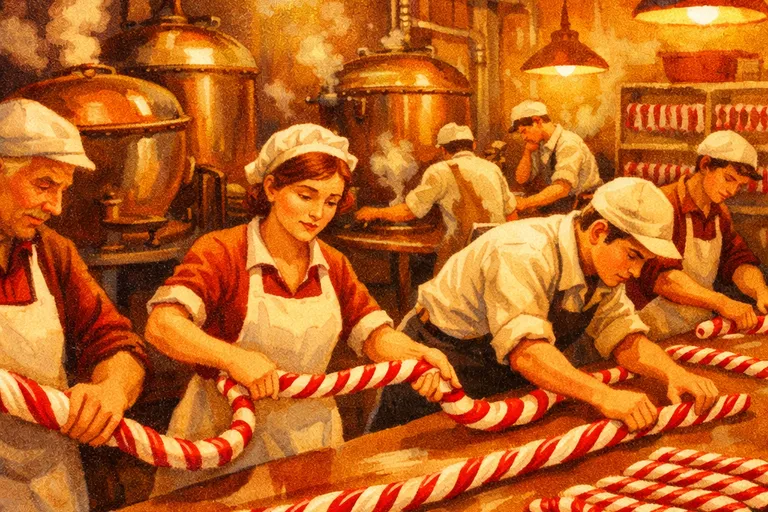
The man who changed everything was Bob McCormack, founder of Bob's Candies in Albany, Georgia. McCormack had been making candy canes by hand since 1919, and the crooking (bending) step was the bottleneck. Straight candy sticks were easy. Getting the hook right without snapping the candy required skill, patience, and a tolerance for waste.
The solution came from McCormack's brother-in-law, Father Gregory Keller, a Roman Catholic priest in the Diocese of Little Rock, Arkansas. In the 1950s, Keller invented the Keller Machine, which automated the twisting, striping, and bending process. He patented it in 1957. The machine turned candy cane production from a craft into an industry. Bob's Candies became the largest producer of candy canes in the world, and the price dropped low enough to make them a disposable holiday decoration rather than a luxury treat.
Modern candy cane production follows the same basic steps Keller mechanized. Sugar and corn syrup are boiled to about 300 degrees Fahrenheit (hard crack stage), poured onto cooling tables, and mixed with flavoring. A pulling machine aerates the white portion until it becomes opaque. Red-dyed candy is formed into thin ropes and laid alongside the white mass. The whole thing is fed through a batch roller that shapes it into a long log, then stretched, twisted, cut, and bent into individual canes. A single production line can produce thousands of candy canes per hour.
Why Are Candy Canes Associated with Christmas?
The candy cane's association with Christmas solidified in the 19th century, when German immigrants brought the tradition of decorating Christmas trees with edible ornaments to the United States. Candy canes were cheap, visually striking, and easy to hang on a branch. They became standard tree decorations alongside cookies, apples, and paper ornaments.
The National Confectioners Association reports that candy canes are the best-selling non-chocolate candy during the Christmas season. The second week of December is the peak selling period. According to the NCA, 54% of people eat their candy cane starting from the straight end, 30% start from the curved end, and 16% break the cane into pieces first.

Today's candy cane market has expanded far beyond the original peppermint. Manufacturers produce candy canes in flavors ranging from root beer and cinnamon to pickle, bacon, and ketchup. The novelty flavor market is small compared to traditional peppermint, but it generates outsized attention on social media every November. The original red-and-white peppermint candy cane still accounts for the vast majority of sales. After 350 years, the formula hasn't needed much improvement.
Frequently Asked Questions
Who invented the candy cane?
No single inventor can be credited with the candy cane. The earliest legend traces it to a choirmaster at Cologne Cathedral in Germany around 1670, who bent sugar sticks into crook shapes for young singers. The first documented candy canes on a Christmas tree in the U.S. appeared in 1847 in Wooster, Ohio, placed by German-Swedish immigrant August Imgard. The modern mass-produced candy cane was made possible by Father Gregory Keller, who invented the Keller Machine in the 1950s.
What does the candy cane symbolize?
A popular Christian interpretation holds that the J shape represents Jesus, the white represents purity, and the red stripes represent Christ's blood. However, historians at the Smithsonian and fact-checkers at Snopes have found no evidence that the candy cane was designed with this symbolism in mind. The red stripes didn't appear until the early 1900s, roughly 200 years after the candy cane originated. The Christian meaning was applied retroactively in the 20th century.
Why are candy canes red and white?
Candy canes were originally solid white. The red stripes appeared in the early 1900s, coinciding with the rise of peppermint as the standard flavor. No historical record explains who added the stripes or why. The most likely reason is visual appeal: red and white is a high-contrast, attractive combination that also signals peppermint flavoring to consumers.
How many candy canes are made each year?
Approximately 1.76 billion candy canes are produced annually in the United States, according to industry data. About 90% of candy cane sales occur between Thanksgiving and Christmas, with the peak selling period in the second week of December. Candy canes are the best-selling non-chocolate Christmas candy in the country.
When did candy canes become associated with Christmas?
Candy canes became linked to Christmas in the 19th century, when German immigrants to the United States brought the tradition of hanging edible ornaments on Christmas trees. The earliest confirmed use of candy canes as tree decorations in America was in 1847 in Wooster, Ohio. By the late 1800s, candy canes were a standard Christmas tree decoration across the country.
How are candy canes made?
Sugar and corn syrup are boiled to about 300 degrees Fahrenheit, poured onto cooling tables, and mixed with peppermint flavoring. The white portion is pulled by machine until opaque, then red-dyed strips are laid alongside it. The mass is rolled into a log, stretched, twisted to create the spiral pattern, cut into individual lengths, and bent into the classic crook shape. Modern production lines can produce thousands of canes per hour.