
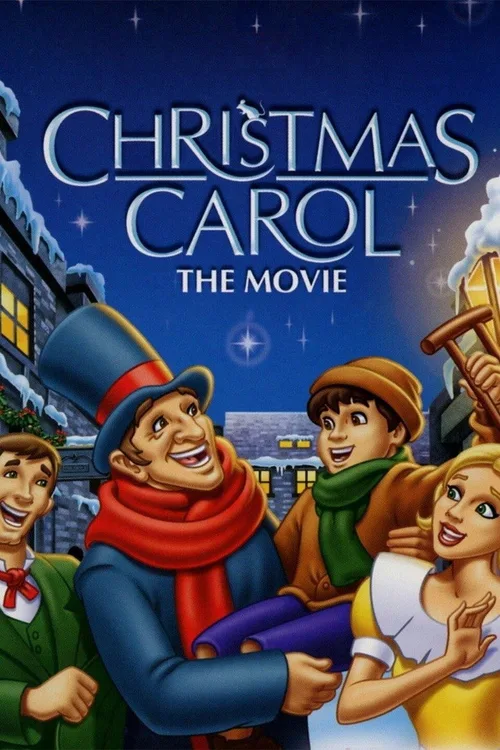
Christmas Carol: The Movie (2001)
Animated version of the classic Charles Dickens story. Warned by the ghost of his old business partner Marley that his sins would lead to punishment in the afterlife, the cruel and greedy Scrooge is visited by the Ghosts of Christmas Past, Present and Future to show him how the course of his life led him to where he is - and where it will lead if he doesn't change his ways.
 rating 4/10 User rating 74 votes 52%
 ❄ Christmas Connection
This is a direct animated adaptation of Charles Dickens's 1843 novella A Christmas Carol, the text that did more to shape the modern Christmas holiday than almost any other cultural artifact. The story of Scrooge, three spirits, and a reformed miser is inseparable from Christmas itself. There is no ambiguity here.
Where to Watch


Our Review
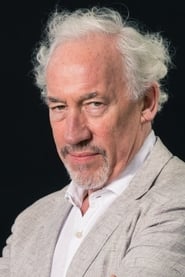
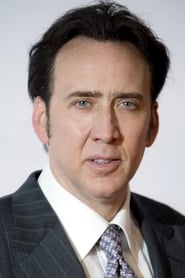
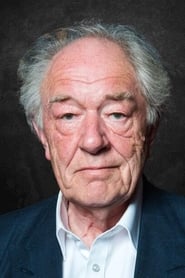
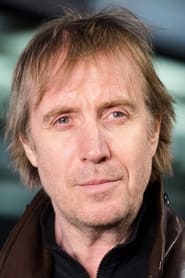
The 2001 animated film Christmas Carol: The Movie arrives with a cast list that reads like a producer's fever dream: Simon Callow as Ebenezer Scrooge, Nicolas Cage as the ghost of Jacob Marley, Kate Winslet as Belle, Michael Gambon as the Ghost of Christmas Present, and Rhys Ifans as Bob Cratchit. Then Jimmy T. Murakami, the director who gave the world the haunting animated adaptation of Raymond Briggs's When the Wind Blows, sits in the chair. The talent is extraordinary. The film that resulted is not.
It holds a 13% rating on Rotten Tomatoes. That number is not entirely fair, but it is not entirely wrong either.
What the Film Actually Is (and Isn't)
The film opens in live action. It is Boston, 1857. Charles Dickens himself, played by Callow with theatrical relish, stands at a lectern and addresses a theatre audience. He tells them that the story he is about to read them is one that began with a mouse named Gabriel. Then the film cuts to animation, and the mouse appears as a kind of small, cheerful narrator figure, threading through Scrooge's London world.
This framing device is genuinely unusual for a Dickens adaptation. Callow had spent years performing Dickens in one-man stage shows, and his feel for the man's rhetorical rhythms is palpable even in a brief live-action sequence. The irony is that the framing works better than much of the animated film it introduces.
The screenplay, by Piet Kroon and Robert Llewellyn, makes some interesting structural choices. Belle, normally a minor figure who appears briefly in the Christmas Past sequences to end her engagement to the young Scrooge, is here given a substantially larger role. She is reimagined as a nurse rather than a married woman with children, and the film positions a reunion between her and the reformed Scrooge as an emotional payoff. It is a genuinely different approach, and it almost works. The problem is that the film is too short and too thinly drawn to earn that emotional resolution.
The Animation Problem
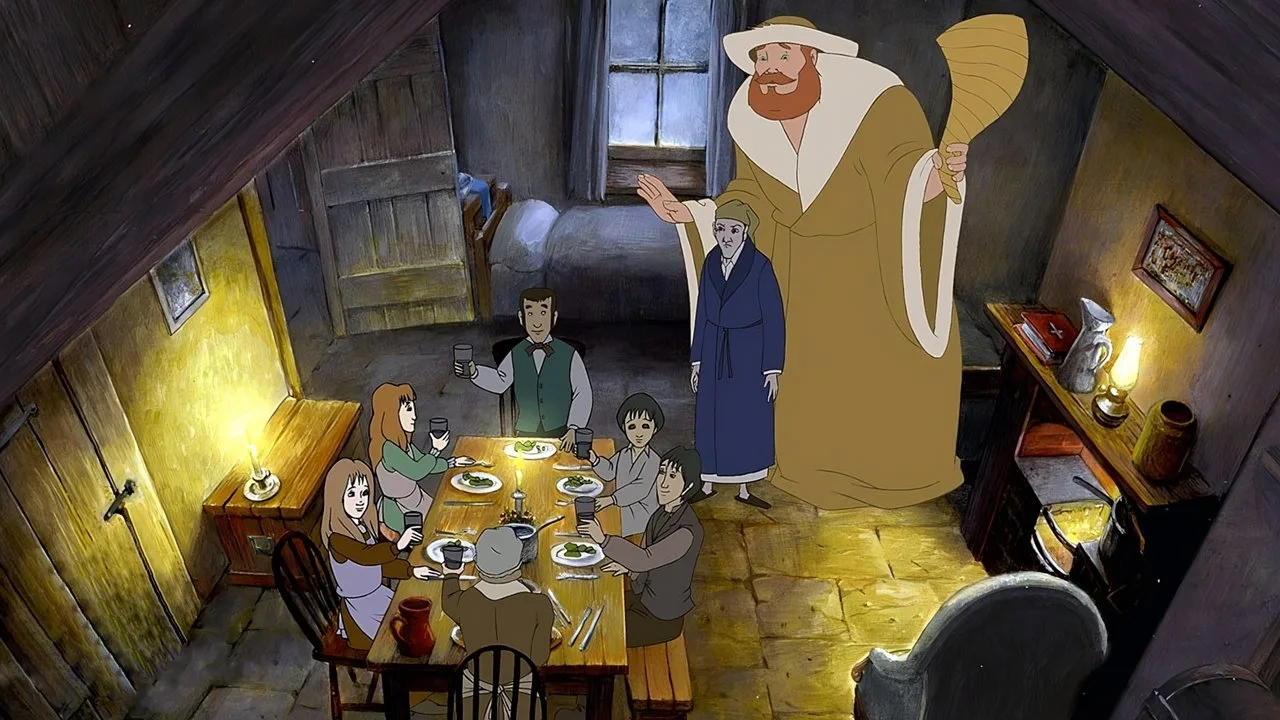
Murakami produced The Snowman as supervising director in 1982, and that film's visual poetry, Raymond Briggs's gentle watercolour world rendered in motion, remains a benchmark for British animation. Christmas Carol: The Movie is animated across studios in the UK, Czech Republic, Poland, Estonia, Spain, and South Korea. The result is what happens when animation is spread across too many facilities with too tight a budget: inconsistency. Scenes shift in visual quality. Character movement is stiff. The Victorian London streets look flat in a way that feels like a 1970s television special rather than a theatrical release.
There are exceptions. The sequences accompanying the supernatural visitations, particularly the Ghost of Christmas Present's journey, achieve some genuine visual atmosphere. The colour palette in these passages opens up, the design grows more imaginative, and the film briefly becomes the thing you hoped it would be throughout.
Then it cuts back to the standard scenes, and the gap is jarring.
Nicolas Cage, Jacob Marley, and the Casting Puzzle
The casting of Nicolas Cage as Marley is the kind of decision that demands explanation and never quite gets one. In 2001, Cage was coming off a run of action blockbusters: Con Air, Face/Off, The Rock. Marley in this version appears as a large blue spectre, wailing his warnings about the chain he forged in life. Cage leans into it. He gives the character a ghostly, trembling quality that is genuinely unnerving in the best possible way. His Marley is one of the few elements of the film that feels fully committed to its own strangeness.
Michael Gambon as the Ghost of Christmas Present is warm and booming, exactly what the role calls for. Jane Horrocks voices the Ghost of Christmas Past with a delicate, slightly otherworldly quality that suits the spirit's role as guide rather than accuser. Rhys Ifans is good-natured as Cratchit without being given much to do.
And then there is Simon Callow, who carries too much of the film. Callow is a gifted actor with a deep, genuine connection to Dickens. His Scrooge is theatrical rather than menacing, which is a choice, not a failure. The issue is that the character's transformation arc feels compressed. The three spirit sequences move briskly, and the emotional weight that should accumulate over the course of the story never quite lands.
Kate Winslet's Song Was the Real Story
The song "What If," performed by Winslet for the film's soundtrack, was released as a single in Germany on 12 November 2001 and in the UK two weeks later. It entered the UK Singles Chart at number six. Winslet had been quietly aiming for the Christmas number one spot, though she was beaten to it by Robbie Williams and Nicole Kidman's cover of "Somethin' Stupid." The song, a ballad tied to Belle's longing and loss, is better than the film that spawned it. One critic wrote that it was "the only ripe plum in an otherwise rum pudding."
That is slightly harsh, but the broader point stands. The song has outlasted the film in cultural memory by a considerable distance. In the years since 2001, "What If" has periodically resurged on streaming platforms around Christmas, accumulating an audience that likely has no idea it comes from a critically dismissed animated movie about Ebenezer Scrooge.
The Director's Complicated Legacy
Jimmy T. Murakami was born in San Jose, California, in 1933, to a Japanese-American family. When Pearl Harbor was attacked in 1941, Murakami was eight years old. His family was relocated to Tule Lake, a Japanese-American internment camp in California, where his younger sister Sumiko died of leukemia during the family's confinement. Murakami spent his career in animation across multiple continents, eventually settling in Ireland, where he was credited with helping establish the country's animation industry. He died in Dublin in February 2014 at the age of 80.
His best work, When the Wind Blows, is among the most devastating animated films ever made. Its quiet, terrible portrait of an elderly English couple trying to follow civil defence instructions during a nuclear attack still hits with the force of an open hand. Christmas Carol: The Movie does not belong in that company, and Murakami probably knew it. He once said he was "not one for kids' films" and that When the Wind Blows was much closer to his heart. This late-career Dickens project has the feeling of a commissioned job, competently steered but never ignited.
Is It Worth Watching?
For Nicolas Cage completists: yes, entirely. His Marley appearance is brief but memorably strange, and it belongs in the catalogue of odd corners Cage has explored throughout a career built on odd corners. For fans of Kate Winslet who haven't heard "What If": skip the film, find the song, and then maybe come back. For children encountering the Dickens story for the first time, there are better animated versions available, though this one is harmless and moves quickly enough to hold younger attention.
The film is a curiosity rather than a disaster. It had the pieces for something genuinely special and couldn't assemble them. That is a more interesting kind of failure than a film that had no ambition to begin with.
One image does stay. Near the end, after the reformed Scrooge has encountered Belle again, the two walk through a London that is, for a few frames, rendered with something approaching warmth. The animation quality lifts briefly, the light shifts, and you can see what the film was reaching for. Then the credits roll.
Fun Facts
Kate Winslet's "What If" entered the UK Singles Chart at number six in December 2001, beaten to the Christmas number one spot by Robbie Williams and Nicole Kidman's cover of "Somethin' Stupid." The song was released first in Germany on 12 November 2001.
Simon Callow appears in live-action sequences as Charles Dickens himself, framing the animated story as a public reading Dickens gave in Boston in 1857. Callow had spent years performing Dickens in acclaimed one-man stage productions before and after the film.
Nicolas Cage voiced Jacob Marley as a large blue spectral ghost. At the time the film was made, Cage had recently come off a string of major Hollywood action films including Con Air (1997) and Face/Off (1997).
The animation was produced across studios in six countries: Great Britain, the Czech Republic, Poland, Estonia, Spain, and South Korea, which accounts for the visible inconsistencies in visual quality between sequences.
Director Jimmy T. Murakami, a Japanese-American, was interned at the Tule Lake concentration camp in California as a child during World War II, where his younger sister died. He later became known as the "Father of Irish Animation" after founding Murakami Films in Dublin in 1989.
Murakami was also the supervising director on the 1982 Christmas special The Snowman, based on Raymond Briggs's picture book, which continues to air annually on Channel 4 in the UK and remains one of the most beloved animated films in British television history.
This version expands Belle's role significantly from the source text. In Dickens's original novella, Belle appears briefly to break off her engagement to the young Scrooge and is then seen years later with her husband and children. In the film, she is a nurse and remains unmarried, setting up a romantic reunion with the reformed Scrooge.
The film was released theatrically in the UK on 7 December 2001 by Pathe. In the United States, Metro-Goldwyn-Mayer released it directly to VHS and DVD in October 2003, bypassing cinemas entirely.
Cast