
 United Kingdom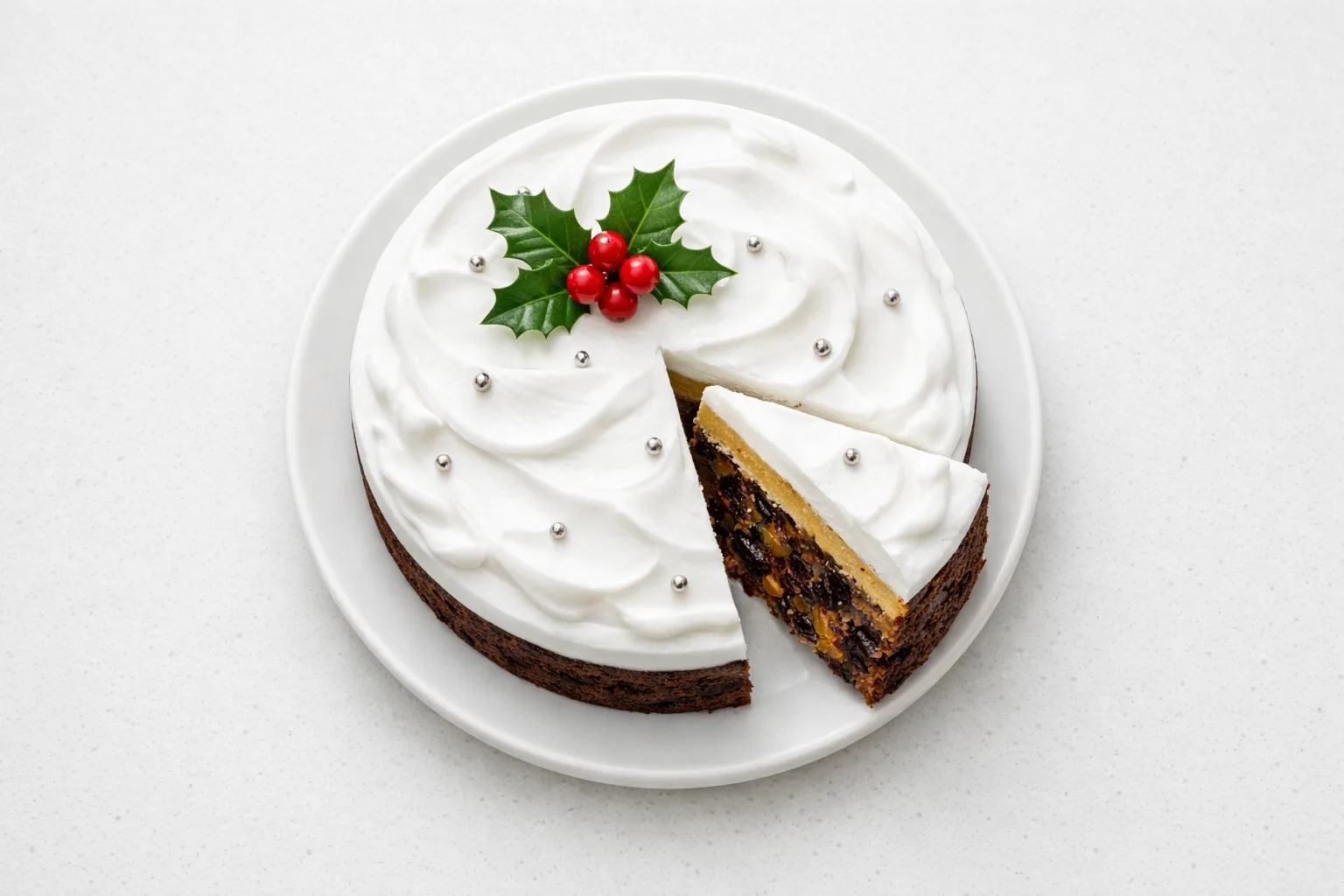
The British Christmas cake is a three-part construction: a dense, dark fruit cake soaked in brandy, wrapped in a layer of marzipan, and sealed under thick royal icing. It has been the centerpiece of Christmas tea in the United Kingdom since the Victorian era, when the white-iced cake became a symbol of celebration and plenty. Every family has their own recipe, their own timing, their own opinions about whether the icing should be flat or peaked.
This recipe covers the full process from fruit soaking through to the finished iced cake. The fruit cake base is baked weeks in advance and fed with brandy to develop deep, mellow flavor. The marzipan goes on a few days before Christmas, followed by the royal icing. The result is a cake with a rich, spiced interior, the sweet almond buffer of marzipan, and a crisp white shell that cracks satisfyingly when you cut into it.
Equipment
Instructions
Tap each step to track your progress
- 1
Combine the raisins, sultanas, currants, mixed peel, and cherries in a large bowl. Pour over the brandy, add the orange and lemon zest, and stir well. Cover tightly and leave at room temperature for at least 12 hours, or up to 48 hours. Stir occasionally.
- 2
Preheat the oven to 300F (150C). Grease a deep 8-inch (20 cm) round cake tin and line the bottom and sides with a double layer of parchment paper, letting the paper extend 2 inches above the rim. Wrap the outside of the tin with a double layer of brown paper or newspaper and tie with kitchen string.
- 3
Whisk together the flour, ground almonds, baking powder, salt, mixed spice, and cinnamon in a medium bowl. Set aside.
- 4
In a stand mixer fitted with the paddle attachment, cream the butter and muscovado sugar on medium speed for 4 to 5 minutes until light and fluffy. Scrape down the sides of the bowl at least once.
- 5
Add the eggs one at a time, beating well after each. If the mixture begins to curdle, add a tablespoon of the flour mixture to stabilize it. Beat in the treacle until just combined.
- 6
Fold in the flour mixture on low speed or by hand until no dry streaks remain. Do not overwork the batter. Add the soaked fruit and all remaining liquid, folding gently until the fruit is evenly distributed. The batter will be thick and heavy.
- 7
Scrape the batter into the prepared tin and smooth the top with a damp spatula, creating a slight hollow in the center so the cake rises evenly. Bake for 2 1/2 to 3 hours, checking after 90 minutes. If the top is browning too quickly, cover loosely with foil. The cake is done when a skewer inserted into the center comes out clean or with a few moist crumbs.
- 8
Let the cake cool completely in the tin. Once cool, remove and pierce the top in about 20 places with a thin skewer. Spoon 2 tablespoons of brandy over the surface. Wrap in parchment paper and then foil. Store in a cool, dry place and feed with 1 to 2 tablespoons of brandy every week until you are ready to ice it.
- 9
To apply the marzipan, warm the apricot jam with 1 tablespoon of water, strain through a sieve, and brush the top and sides of the cake. Dust a work surface with powdered sugar and roll out the marzipan into a circle large enough to cover the top and sides in one piece, about 14 inches across and 1/4 inch thick. Lift the marzipan over the rolling pin, drape it over the cake, and smooth it down the sides, pressing gently to remove air pockets. Trim the excess at the base. Let the marzipan dry for at least 24 hours before icing, ideally 2 to 3 days.
- 10
For the royal icing, whisk the egg whites in a large bowl until frothy but not stiff. Gradually beat in the sifted powdered sugar, a few tablespoons at a time, until the icing is thick, smooth, and holds stiff peaks when the whisk is lifted. Beat in the lemon juice and glycerine if using. Cover the bowl with a damp cloth until ready to use.
- 11
Spoon the royal icing onto the top of the marzipan-covered cake. Using a palette knife or offset spatula, spread the icing across the top and down the sides in a thick, even layer, about 1/4 inch thick. For the classic "snow peak" finish, dab the flat side of the palette knife into the icing and pull it upward to create rough peaks all over the surface. Let the icing dry for at least 6 hours, or overnight, before moving or decorating.
Tips & Tricks
Start the cake at least 6 weeks before Christmas
The feeding process is what transforms a good fruit cake into a great one. Baking in late October or early November gives the brandy time to meld with the spices and fruit, producing a deeper, more unified flavor. A cake made the week before Christmas will taste sharply of raw spirit and separate spices.
Use dark muscovado sugar, not ordinary brown sugar
Dark muscovado has a high molasses content that gives the cake its characteristic deep color and toffee-like richness. Light brown sugar or demerara will produce a paler, less complex result. Muscovado clumps easily, so break it up with your fingers before creaming.
Dry the glace cherries thoroughly
Rinse the cherries to remove their sticky syrup, then pat them completely dry with kitchen paper and cut them into quarters. If they go into the batter wet, they will sink straight to the bottom. The same applies to any particularly juicy soaked fruit.
Let the marzipan dry before icing
Applying royal icing over tacky marzipan causes the almond oils to bleed through, turning the white icing yellow. Give the marzipan at least 24 hours to firm up and form a dry skin. In a cold kitchen, 2 to 3 days is even better.
Add glycerine to the royal icing
Without glycerine, royal icing dries rock-hard and can be difficult to cut cleanly. Half a teaspoon makes the icing slightly softer on the inside while still drying to a crisp shell on the outside. You can find glycerine in the baking aisle of most supermarkets.
Troubleshooting
My fruit sank to the bottom of the cake
The batter was too thin to hold the weight of the fruit, or the fruit was too wet. Toss the drained fruit in a tablespoon of flour before folding it in. Make sure the creamed butter and sugar are thick and fluffy, not runny. If the eggs caused curdling, the batter loses its ability to suspend heavy ingredients.
The marzipan cracked when I draped it over the cake
The marzipan was too cold or rolled too thin. Knead it until pliable before rolling, and roll it to an even 1/4 inch thickness. If your kitchen is cold, warm the marzipan briefly in the microwave for 5 to 10 seconds. Brush the cake with apricot glaze first so the marzipan sticks and slides into place.
The royal icing is too runny and slides off
The icing needs more powdered sugar. Add it gradually, beating well after each addition, until the icing holds stiff peaks. Make sure you sifted the powdered sugar first, as lumps prevent it from thickening properly. Humidity can also affect icing consistency, so add extra sugar on damp days.
The cake is too dry after baking
The oven temperature was too high or the cake baked too long. Use an oven thermometer to verify your temperature, as many ovens run hot. If the damage is done, pierce the cake generously and feed it with brandy over several weeks. The moisture will redistribute and the crumb will soften considerably.
There are air gaps between the marzipan and the cake
The apricot glaze was not applied evenly, or air was trapped when the marzipan was laid on. Always brush the glaze over every surface, including the sides. Smooth the marzipan from the top downward, pressing gently, and prick any visible bubbles with a pin.
Variations
Lighter Golden Christmas Cake
Use golden sultanas and dried apricots instead of dark raisins and currants. Replace the treacle with golden syrup and swap muscovado for light brown sugar. The cake will be paler and milder, with a gentler spice profile. Good for those who find the traditional dark cake too intense.
Gluten-Free Christmas Cake
Replace the all-purpose flour with a 1:1 gluten-free baking blend and increase the ground almonds to 3/4 cup. Add 1/2 teaspoon xanthan gum if your blend does not already contain it. The high fruit-to-flour ratio in Christmas cake means the texture difference is minimal.
Fondant Icing Instead of Royal Icing
For a smooth, modern finish, cover the marzipan with ready-to-roll fondant icing instead of royal icing. Roll the fondant to about 1/4 inch thick and drape over the cake as you did with the marzipan. The finish is cleaner and easier to decorate with fondant shapes, but the texture is chewier and sweeter than traditional royal icing.
Alcohol-Free Version
Replace the brandy with a mix of fresh orange juice and 1 teaspoon of vanilla extract for soaking and feeding. The cake will not keep as long (3 to 4 weeks versus months), so plan your baking timeline closer to Christmas. Store in the refrigerator after the first week.
Serving & Gifting
Cut the Christmas cake into thin slices; it is rich and dense, so portions can be small. In the north of England, it is traditionally served with a wedge of sharp Wensleydale or Lancashire cheese, which cuts through the sweetness. The cake is also a fixture of afternoon tea alongside mince pies. For a formal presentation, add a ribbon around the base of the iced cake and a simple sprig of holly on top.
Storage & Freezing
The un-iced fruit cake, wrapped in parchment and foil and fed weekly with brandy, keeps in a cool dark cupboard for up to 4 months. Once covered in marzipan, it keeps for a further 2 to 3 weeks at room temperature. After applying royal icing, the cake is best consumed within 2 weeks, as the icing can soften over time. The fruit cake base (before marzipan) freezes well for up to 6 months; thaw overnight at room temperature while still wrapped.
Common Questions
How far in advance should I make my Christmas cake?
Bake the fruit cake base 6 to 12 weeks before Christmas. Feed it with brandy weekly. Apply the marzipan about 1 week before Christmas, let it dry for 2 to 3 days, then apply the royal icing 2 to 3 days before you plan to serve it. This timeline gives the best flavor and a properly set icing.
Can I make a Christmas cake without alcohol?
Yes. Replace the brandy with fresh orange juice mixed with 1 teaspoon of vanilla extract for both soaking and feeding. The cake will taste lighter and will not keep as long, so bake it 2 to 3 weeks before Christmas rather than months ahead. Refrigerate it after the first week to prevent spoilage.
What is the difference between Christmas cake and Christmas pudding?
Both use dried fruit, spices, and alcohol, but they are completely different textures. Christmas cake is a baked fruit cake covered in marzipan and royal icing, served at room temperature in slices. Christmas pudding is a steamed suet pudding, served hot with brandy butter or cream. They often appear at the same table but at different points in the meal.
Can I use ready-made marzipan and icing?
Store-bought marzipan works perfectly and is what most home bakers use. Ready-to-roll fondant is a popular alternative to royal icing and is easier to apply smoothly. However, traditional royal icing made from egg whites and powdered sugar has a crispness and flavor that fondant cannot replicate.
How do I stop the royal icing from going yellow?
Yellow discoloration comes from almond oils in the marzipan seeping into the icing. The fix is simple: let the marzipan dry for at least 24 hours before icing. Brush the dried marzipan with a thin coat of beaten egg white and let that dry for another hour before applying the royal icing. This creates a barrier.
How long does an iced Christmas cake last?
A properly made and iced Christmas cake keeps for several weeks at room temperature. The brandy in the fruit cake acts as a preservative, and the marzipan and icing create an airtight seal. Store it in a cool room (not the refrigerator, as the icing absorbs moisture) in a cake tin or under a dome.