
 United Kingdom
  Greece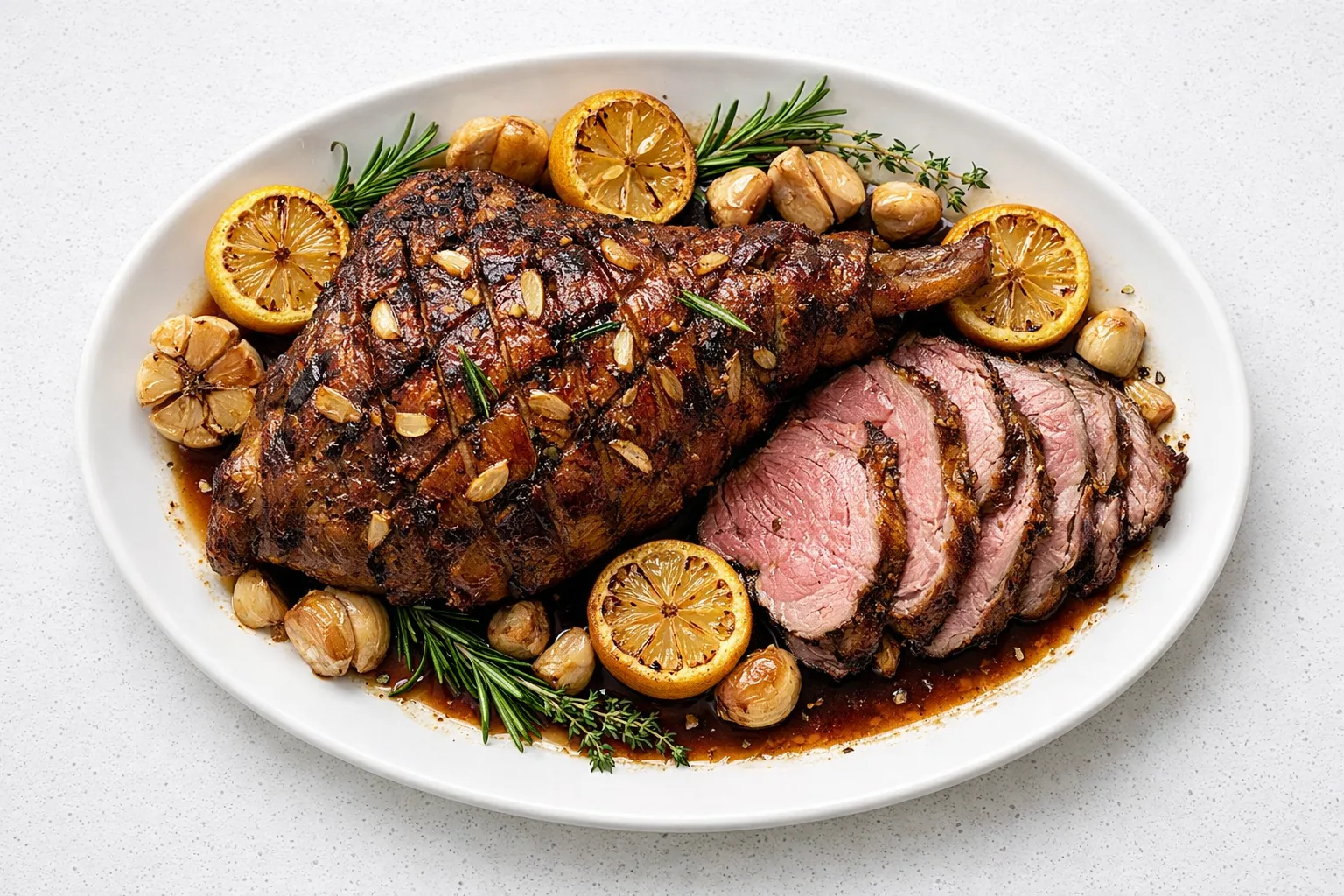
Christmas lamb holds a central place on the holiday table across much of Europe, but nowhere more so than in the United Kingdom and Greece. In Britain, roast lamb has been a Christmas dinner staple since well before the Victorians popularized turkey, particularly in Wales and northern England where sheep farming shaped the culinary calendar. In Greece, arni sto fourno remains the definitive Christmas Day centerpiece, slow-roasted with lemon and oregano until the meat pulls apart.
This recipe bridges both traditions: a bone-in leg of lamb scored and studded with garlic, rubbed with rosemary, lemon zest, and olive oil, then slow-roasted until the exterior is deeply bronzed and the interior stays pink and juicy. The method is forgiving, the ingredient list is short, and the result is a roast that looks impressive without demanding constant attention.
Equipment
Instructions
Tap each step to track your progress
- 1
Remove the lamb from the refrigerator 1 hour before cooking to bring it to room temperature. This is not optional; a cold roast will cook unevenly, leaving the outer layers overdone while the center stays raw.
- 2
Preheat the oven to 450F (230C). Using a sharp paring knife, make about 20 deep incisions all over the lamb, each roughly 1 inch deep. Push a sliver of garlic into each slit, pressing it below the surface.
- 3
Combine the olive oil, chopped rosemary, thyme, lemon zest, lemon juice, salt, pepper, and oregano in a small bowl. Rub this paste over the entire surface of the lamb, working it into the slits and any crevices around the bone.
- 4
Scatter the quartered onions, whole garlic cloves, and lemon halves in the bottom of a large roasting pan. Place the lamb leg on top, fat side up. Pour the wine and stock into the bottom of the pan around the lamb, not over it.
- 5
Roast at 450F for 20 minutes. This initial blast of heat builds a deeply browned crust. The kitchen will smell of rosemary and browning lamb fat within minutes.
- 6
Reduce the oven temperature to 325F (165C). Continue roasting for approximately 1 hour and 50 minutes to 2 hours for medium (internal temperature of 140F/60C at the thickest part, away from the bone). Baste the lamb with pan juices every 30 minutes using a large spoon.
- 7
Check the internal temperature with an instant-read thermometer starting at the 1 hour 30 minute mark. For medium-rare, pull at 130F (54C). For medium, pull at 140F (60C). The temperature will rise another 5 to 10 degrees during resting.
- 8
Transfer the lamb to a cutting board, tent loosely with foil, and rest for 20 to 25 minutes. Do not skip this step. Resting allows the juices to redistribute; cutting too early will result in dry meat and a pool of liquid on the board.
- 9
While the lamb rests, make the gravy. Set the roasting pan over medium heat on the stovetop (remove the lemon halves and any burnt bits). Mash the soft onions and garlic into the pan juices with a fork. Sprinkle in the flour and stir for 1 minute until it forms a paste.
- 10
Add the stock and vinegar, scraping up any browned bits from the bottom of the pan. Simmer for 4 to 5 minutes, stirring frequently, until the gravy thickens enough to coat the back of a spoon. Season with salt and pepper. Strain through a fine-mesh sieve for a smooth gravy, or leave it rustic.
- 11
Carve the lamb against the grain into thin slices, working parallel to the bone. Serve on a warmed platter with the gravy alongside.
Tips & Tricks
Temper the meat before roasting
Taking the lamb out of the refrigerator a full hour before cooking is the single most important step for even results. A room-temperature roast cooks more uniformly, giving you a consistent pink center rather than a gradient from grey edges to raw middle.
Use a meat thermometer, not a timer
Every leg of lamb is shaped differently, and oven temperatures vary. The only reliable way to know when your roast is done is an instant-read thermometer inserted into the thickest part of the meat, away from the bone. Target 140F (60C) for medium.
Do not skip the high-heat start
The initial 20 minutes at 450F creates the Maillard reaction on the surface, building a flavorful crust that seals in juices. Without this step, you get a pale, steamed-looking exterior. Make sure the oven is fully preheated before the lamb goes in.
Make the rub the night before
For even deeper flavor, rub the garlic, herb, and lemon paste onto the lamb the night before and refrigerate it uncovered. The salt will dry-brine the surface, concentrating flavor and helping the skin crisp during roasting. This is especially effective for a Christmas Day roast when you want to minimize morning prep.
Rest the meat properly
Tent the lamb loosely with foil and resist the urge to cut into it for at least 20 minutes. Tight wrapping creates steam and softens the crust. Loose tenting keeps the exterior crisp while the internal juices settle back into the muscle fibers.
Troubleshooting
The outside is burnt but the inside is raw
The oven was too hot for too long, or the lamb went into the oven straight from the refrigerator. Always temper the meat at room temperature for a full hour. The high-heat phase should be only 20 minutes; the rest of the cooking happens at 325F.
The meat is tough and chewy
The lamb was either undercooked (certain cuts need to reach a minimum internal temp to break down connective tissue) or carved incorrectly. Always slice against the grain. If the leg has a lot of connective tissue near the shank end, that section benefits from longer cooking.
The gravy is thin and flavorless
You likely had too much liquid in the pan. Before making gravy, pour off excess fat and reduce the pan juices by half over medium-high heat before adding flour. The caramelized bits on the bottom of the pan (the fond) are where all the flavor lives; scrape them up aggressively.
The lamb tastes gamey
This is a common complaint with older or grass-fed lamb. The garlic and lemon in this recipe counteract gameyness, but if you are sensitive, soak the leg in a mixture of milk and water in the refrigerator overnight, then pat it dry before rubbing. Alternatively, use spring lamb, which is milder.
Variations
Greek-Style with Potatoes
Add 2 pounds of quartered Yukon Gold potatoes to the roasting pan around the lamb before the low-temperature phase. Toss them with 2 tablespoons of olive oil, the juice of another lemon, and 1 tablespoon of dried oregano. The potatoes will absorb the lamb drippings and roast to a golden, crispy finish. This is the classic Greek <em>arni me patates</em>.
Herb-Crusted Lamb
After the initial high-heat sear, press a mixture of 1 cup fresh breadcrumbs, 2 tablespoons Dijon mustard, chopped parsley, and minced garlic onto the fat side of the lamb. The crust adds texture and catches the drippings beautifully. Reduce basting to avoid washing off the crust.
Slow-Cooker Adaptation
Brown the lamb in a large skillet on all sides, then transfer to a slow cooker with the onions, garlic, lemon halves, wine, and stock. Cook on low for 8 hours. The meat will be fall-off-the-bone tender rather than pink, which suits those who prefer well-done lamb. You will sacrifice the crispy exterior.
Dairy-Free and Gluten-Free Version
This recipe is already dairy-free. For a gluten-free version, replace the all-purpose flour in the gravy with 1 tablespoon of cornstarch (cornflour) mixed with 2 tablespoons of cold water. Stir this slurry into the simmering pan juices and cook for 2 minutes until thickened.
Serving & Gifting
Carve the lamb at the table for dramatic effect and serve on a warmed platter with the pan gravy in a separate jug. Traditional British accompaniments include roast potatoes, steamed green beans, minted peas, and redcurrant jelly. For a Greek-leaning spread, serve with roasted lemon potatoes, a horiatiki salad, and tzatziki on the side. The lamb also pairs well with a robust red wine: Cabernet Sauvignon, Bordeaux, or a Greek Agiorgitiko.
Storage & Freezing
Leftover lamb keeps tightly wrapped in the refrigerator for up to 4 days. Reheat slices gently in a covered dish at 300F with a splash of stock to prevent drying out. Cooked lamb freezes well for up to 3 months; slice before freezing for easier thawing and portion control. Thaw overnight in the refrigerator and reheat gently. The gravy freezes separately in an airtight container for up to 2 months.
Common Questions
Can I use a boneless leg of lamb instead?
Yes, but reduce the cooking time by about 20 to 30 minutes, as boneless roasts cook faster. A boneless leg is also easier to carve. If your boneless leg is butterflied, roll and tie it with kitchen twine at 2-inch intervals to ensure even cooking.
How long does it take to roast a leg of lamb for Christmas dinner?
For a 6 to 7 pound bone-in leg, plan for about 2 hours and 15 minutes total (20 minutes at high heat plus roughly 2 hours at 325F) for medium doneness. Add 20 to 25 minutes of resting time. Start checking the internal temperature with a thermometer at the 1 hour 30 minute mark of the low-temperature phase.
Is lamb or turkey more traditional for Christmas?
It depends on the country. In Greece, lamb is the default Christmas protein. In the UK, turkey became dominant in the 20th century, but lamb was the traditional Christmas roast for centuries before that and remains popular, especially in Wales and Scotland. Both are entirely appropriate for a Christmas dinner table.
What temperature should roast lamb be cooked to?
For medium-rare, pull the lamb at an internal temperature of 130F (54C). For medium, the most popular doneness for roast leg of lamb, aim for 140F (60C). The temperature will rise 5 to 10 degrees during the 20-minute rest. Well-done lamb should reach 160F (71C), though the meat will be less juicy.
Can I make the gravy ahead of time?
You can partially prepare it. Roast the bones and trimmings with onions to make a stock base a day ahead. On the day, use the actual pan drippings for the final gravy. The pan drippings are essential for flavor, so the gravy must be finished in the roasting pan after the lamb comes out.
How do I reduce the gamey taste of lamb?
The garlic, lemon, and rosemary in this recipe naturally mellow gamey flavors. If you are particularly sensitive, choose spring lamb or younger lamb (labeled "lamb" rather than "mutton" or "hogget"). Soaking the meat in milk overnight before cooking also reduces gaminess significantly.