
 United Kingdom
  Australia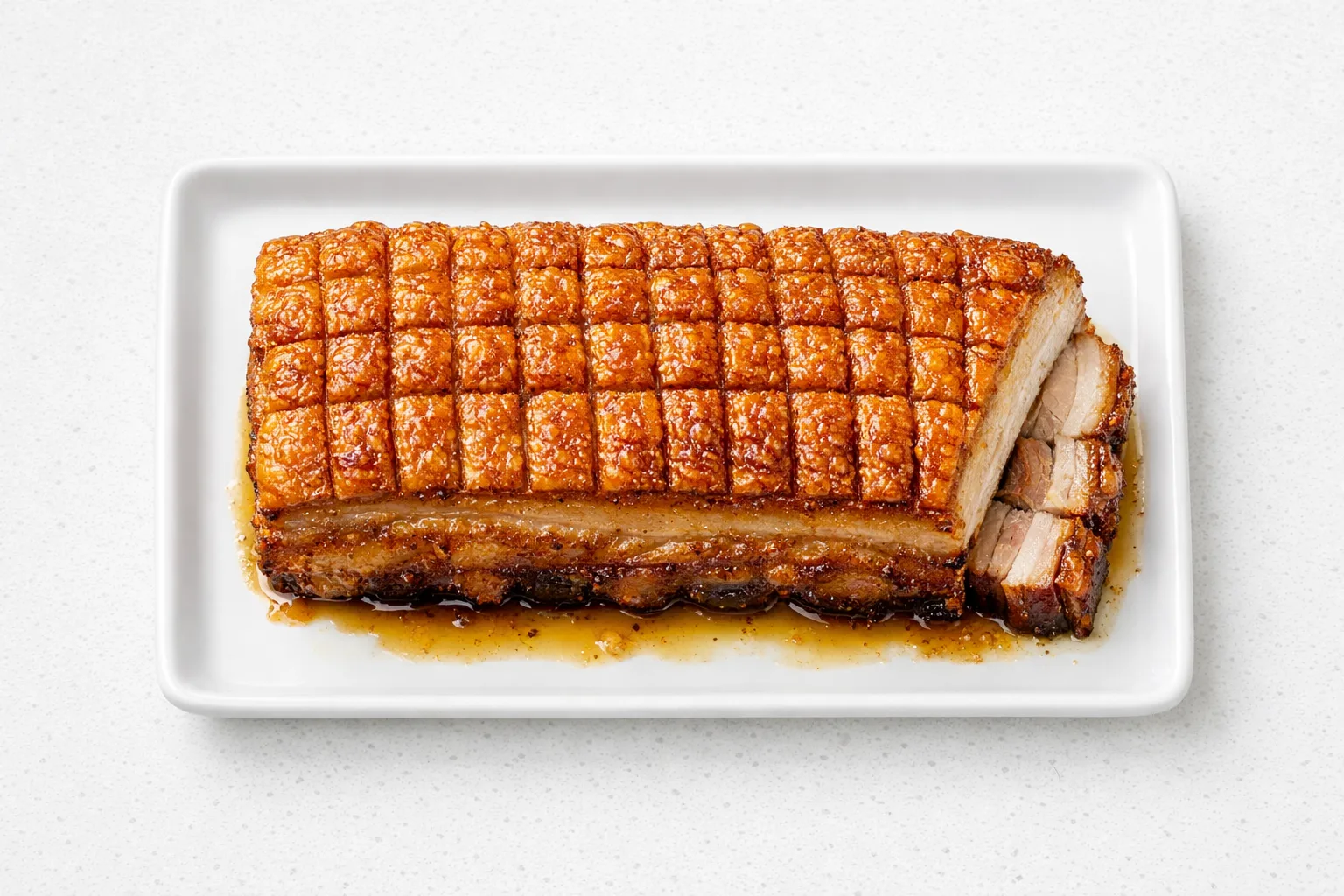
Christmas pork belly deserves a place alongside the turkey and the goose. Across the United Kingdom and Australia, roast pork belly has become a serious Christmas centrepiece: a thick slab of bone-in or boneless belly with crackling so shatteringly crisp it shatters audibly when you cut it. The reason it works so well for a Christmas roast is that it actually benefits from the extended oven time, unlike a lean loin that dries out if you're not watching the clock.
The technique here is a two-stage roast. You start at very high heat, 240C (460F), for the first 30 minutes to aggressively puff and blister the skin. Then the oven drops to 160C (320F) for 2.5 hours, giving the thick fat cap time to fully render and the meat underneath to become spoon-tender. No foil, no covering, no basting. The skin must stay exposed and dry the entire time.
What separates a crackling success from a rubbery disaster is drying the skin before it ever sees heat. Score it deeply the night before, leave it uncovered in the fridge overnight, and rub coarse salt into the scores the morning of the roast. Moisture is the enemy of crackling, and the fridge does the heavy drying work so the oven can finish the job.
Equipment
Instructions
Tap each step to track your progress
- 1
Score the pork skin with a very sharp knife or a clean Stanley knife blade, cutting parallel lines about 1/2 inch apart through the skin and just into the fat underneath. Do not cut into the meat. If your butcher has already scored it, deepen the cuts. Pat the entire piece completely dry with paper towels.
- 2
Place the pork skin-side up on a rack over a tray, uncovered, in the fridge for at least 8 hours or overnight. This drying step is non-negotiable for crackling.
- 3
Two hours before cooking, take the pork out of the fridge and bring to room temperature. Rub coarse sea salt firmly into every score line in the skin, packing it in.
- 4
Mix the garlic, olive oil, fine sea salt, fennel seeds, and black pepper into a paste. Flip the pork and rub this paste all over the meat side and the sides. Flip it back skin-side up. Do not get any oil or paste on the skin.
- 5
Preheat your oven to 475F (245C) with a rack in the middle-upper position. Scatter the onion and celery into a roasting tray and pour in the stock. Set a roasting rack over the vegetables and place the pork skin-side up on the rack.
- 6
Roast at 475F for 30 minutes without opening the oven door. The skin should begin to bubble and blister aggressively. If it is not blistering after 25 minutes, increase the temperature by 25F for the remaining time.
- 7
Without removing the pan, drop the oven temperature to 320F (160C). Continue roasting for 2 hours and 30 minutes. The internal temperature of the thickest part of the meat should reach 185F (85C) for fully tender meat.
- 8
Check that the crackling is uniformly puffed and golden across the entire surface. If any patches remain flat or pale, transfer just the pork to a baking tray and return it to the oven at 450F for 5 to 10 minutes with close supervision.
- 9
Remove the pork from the oven and rest uncovered on a wire rack for 20 minutes. Do not tent it with foil or the steam will soften the crackling. The resting juices will run clear.
- 10
To make a quick pan sauce, discard the vegetables and pour the pan drippings through a fine sieve into a small saucepan. Skim the excess fat from the surface. Bring to a simmer over medium heat, taste and season, and serve alongside.
- 11
Slice the pork with a sharp heavy knife or cleaver, cutting through the crackling in confident single strokes rather than sawing. Serve immediately.
Tips & Tricks
Dry the skin relentlessly
The overnight uncovered fridge rest is the single most important step in this recipe. A damp skin will steam before it crisps, and you cannot recover rubbery crackling easily once the roast is underway. If you are short on time, pat the skin dry, rub with salt, and blast it under a hot grill for 5 minutes before the oven stage to drive off surface moisture.
Score deeply enough but not into the meat
The score lines need to go through the skin, which is firm and leathery, and into the fat layer below. This allows the fat to render out and the skin to puff between the cuts. Cuts that only nick the surface will not open up in the oven. Each score should feel like a small channel you could fill with salt, about 3mm deep.
Do not oil the skin
Oil on the skin will prevent proper crackling. The fat under the skin is sufficient to baste the surface as it renders. Only the underside and sides of the pork get the olive oil and garlic paste. Keep the skin completely dry and only salted.
Rest the pork uncovered on a rack
Resting pork belly on a plate or in the roasting tray traps steam under the meat, which can transfer moisture back up through the fat and soften the crackling from below. A wire rack lets air circulate and the 20-minute rest is long enough for the juices to redistribute without losing the crunch.
Score on the day of purchase if possible
If you buy the pork a day ahead of cooking, score it and leave it in the fridge as soon as you get home. The longer the scored skin has to dry, the better. If you do not have time to score it yourself, ask the butcher to score it for you, but specify that you want deep cuts and intend to make crackling.
Troubleshooting
The crackling is soft and rubbery, not crispy
The skin was not dry enough when it entered the oven, or the initial high-heat blast was not hot enough. Two fixes: first, make sure to dry the pork in the fridge overnight, not just for a couple of hours. Second, if the crackling is still soft after the full cook, slice it off in one piece with a sharp knife and place it under a broiler at full power for 3 to 5 minutes, watching closely. It will crisp up fast.
The skin is blistering unevenly, some sections flat
The heat is not reaching all sections equally. This often happens if the pork is sitting in the pan juices instead of elevated on a rack, or if the belly is an uneven thickness. Rotate the pan 180 degrees halfway through the high-heat blast. If one end is much thicker, use a small ball of foil to prop up the thinner end so it sits level.
The meat is dry or tough
The cook time was too short for the thickness of the belly, or the temperature was too high throughout. Belly needs low, slow heat after the initial blast. If the internal temperature was below 180F when you pulled it, return it to the oven at 300F covered loosely with foil (crackling removed if already crisped) and cook for another 30 to 45 minutes.
The crackling keeps splitting before serving
This happens when the scoring cuts were too deep and went through the fat into the meat. The crackling fragments when sliced because there is nothing supporting it. Score only through the skin and just into the top layer of fat. Use a cleaver or heavy chef's knife for serving, and cut with confident downward pressure.
Too much smoke coming from the oven
The fat is dripping onto the bottom of the oven or onto the base of the pan at 475F. Make sure the rack is elevated high enough above the vegetables and stock so that the fat drips into the liquid, not onto a bare hot surface. A little smoke is normal at high heat; heavy acrid smoke means fat is burning on the oven floor.
Variations
Apple and Sage Pork Belly
Add 2 tart apples (Granny Smith or Braeburn), cored and quartered, to the roasting bed alongside the onion and celery. Swap the fennel seeds for 6 fresh sage leaves, finely chopped, added to the garlic paste. The apples collapse into the stock and create a naturally sweet, fragrant sauce base that needs no thickening.
Asian-Spiced Pork Belly
Replace the fennel and black pepper with 1 teaspoon five-spice powder and 1/2 teaspoon white pepper in the garlic paste. Add a tablespoon of soy sauce and a teaspoon of sesame oil to the underside rub. Serve with steamed jasmine rice and a ginger-scallion dipping sauce rather than pan juices.
Herb-Crusted Version
Increase the garlic to 6 cloves and add 1 tablespoon finely chopped fresh rosemary, 1 teaspoon dried thyme, and the zest of one lemon to the meat-side paste. The herb crust forms a fragrant, sticky layer on the underside while the top crackles. This variation is particularly well-suited to outdoor Christmas celebrations in warm-weather climates.
Dairy-Free Adaptation
This recipe is naturally dairy-free as written. The olive oil base and stock make it accessible without any substitutions. Verify your stock is dairy-free if using store-bought, as some chicken stocks contain butter or cream.
Serving & Gifting
Slice the pork belly into thick strips and serve the crackling in separate pieces so everyone gets a share. Roasted Christmas pork belly pairs naturally with apple sauce, braised red cabbage with caraway, and roasted potatoes. For a festive plating, slice the belly and fan the pieces slightly on the platter with the crackling scored pieces arranged on top. A sharp cider or dry sparkling white wine cuts through the richness better than a heavy red.
Storage & Freezing
Leftover pork belly keeps in the fridge in an airtight container for up to 3 days. Store the crackling separately, not in the same container as the meat, or it will soften from the moisture. To reheat the meat, place slices in a covered baking dish with a splash of stock at 325F for 15 to 20 minutes. To re-crisp the crackling, place it on a baking tray at 450F for 5 to 8 minutes or until it shatters again. Cooked pork belly freezes well for up to 2 months, but freeze the meat and crackling in separate portions.
Common Questions
How do I get really crispy crackling on pork belly?
The three factors that matter most are: dry skin before cooking, very high initial oven heat (at least 450F for the first 25 to 30 minutes), and deep scoring that allows fat to render out. Of these, drying the skin overnight in the fridge makes the single biggest difference. Wet skin steams before it crisps, and steaming ruins crackling.
Can I make Christmas pork belly ahead of time?
You can do all the prep the day before: score the skin, apply the meat-side seasoning, and leave it uncovered in the fridge overnight. The roasting itself is best done on the day, as fresh crackling cannot be fully replicated after refrigerating and reheating. If you must prepare it in advance, roast the belly, cool it, then re-crisp the crackling in a 450F oven for 8 minutes just before serving.
What temperature should pork belly be when it is done?
For fully tender, almost falling-apart pork belly, the internal temperature of the meat should read 185F to 190F (85 to 88C). At this temperature the collagen has broken down sufficiently. If you pull it at the standard pork safe temperature of 160F (71C), the belly will be cooked but the fat will not have rendered properly and the texture will be chewy rather than silky.
How long do I slow roast pork belly?
A 2.5 lb boneless pork belly takes approximately 30 minutes at high heat (475F) followed by 2.5 hours at 320F, for a total of about 3 hours in the oven, plus 20 minutes resting time. Larger pieces (over 3.5 lbs) may need an additional 30 to 45 minutes at the lower temperature. Always confirm doneness with an internal thermometer.
Do I need a roasting rack for crispy crackling?
Yes, a rack is important. The pork needs to be elevated above the liquid in the roasting tray so heat circulates evenly under and around the piece. Sitting the belly directly in the pan juices means the underside poaches instead of roasts, and steam from the liquid can work its way up to soften the skin. Even a rough bed of thick-cut onions can substitute for a rack in a pinch.
What can I serve with roast pork belly at Christmas?
Apple sauce is the classic pairing, its acidity cutting through the fat. Braised red cabbage with apple and caraway is traditional in the UK and Germany. Roasted root vegetables, mashed or crispy potatoes, and a sharp cider or dry sparkling wine all work well. For a complete Christmas spread, pork belly sits naturally alongside roasted Brussels sprouts with pancetta and a herb stuffing.