
 United Kingdom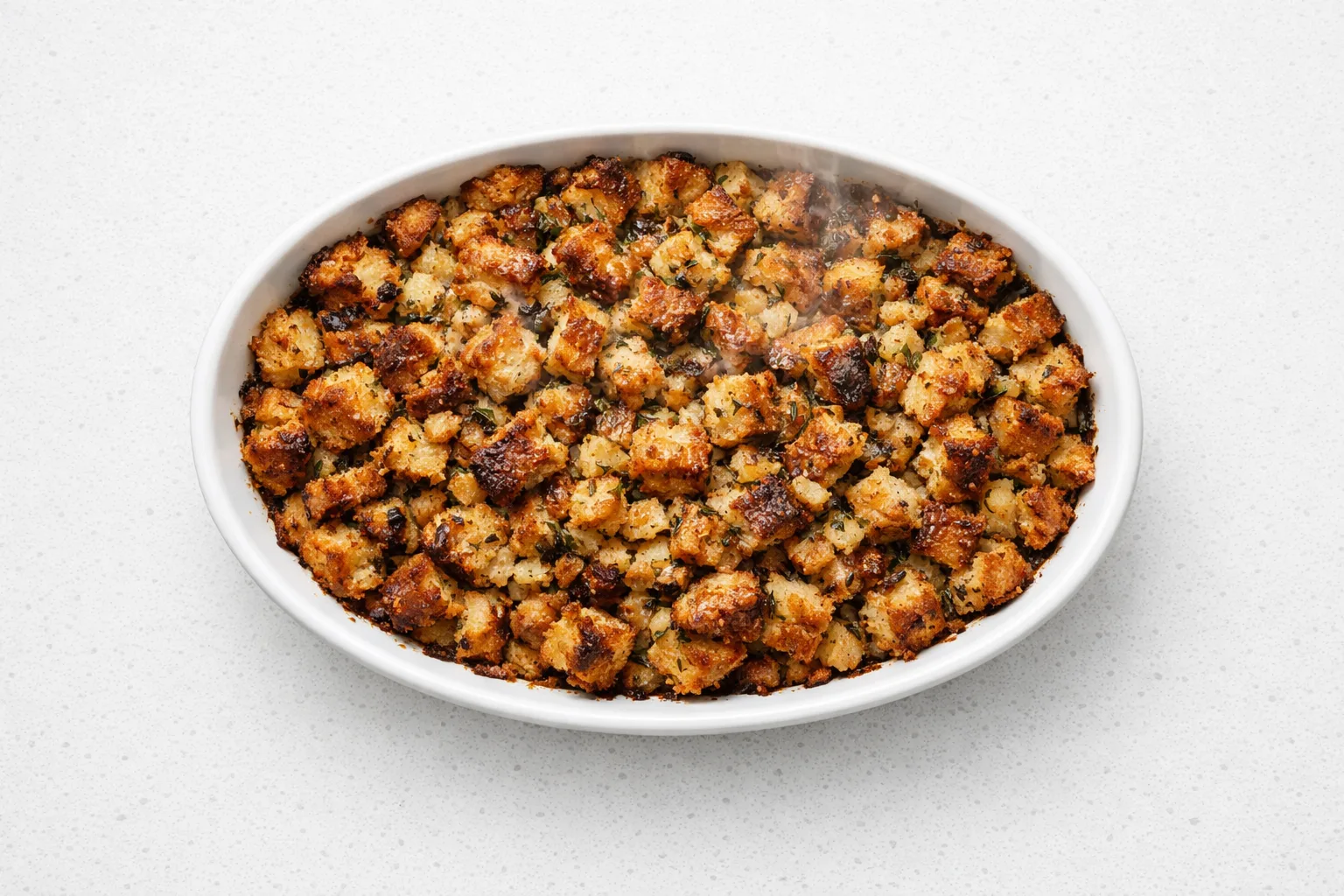
Christmas stuffing is the dish that divides the table more than any other: inside the bird or baked in a dish, bread or cornbread, sage-heavy or barely herbed. This recipe is firmly in the pain de mie tradition, built on stale crusty white bread, deeply caramelised onions and celery, and fresh sage. It is the version most Americans and British families would recognize as the classic, whether they call it stuffing or dressing.
The technique matters here more than the ingredient list. Drying the bread properly and building flavor in the aromatics pan are the two steps most recipes rush. Do both correctly and the result has crisp, golden edges, a custardy interior, and enough savoriness to hold its own next to turkey, gravy, and roasted vegetables.
Baked separately in a dish rather than inside the bird, this stuffing develops a proper browned crust that you simply cannot get from a cavity-cooked version. Make it the day before and you will free up oven space on Christmas Day.
Equipment
Instructions
Tap each step to track your progress
- 1
Spread the bread cubes in a single layer across two large baking sheets. Leave them uncovered at room temperature overnight, or toast in a 300 degrees F (150 degrees C) oven for 20 minutes until completely dry and slightly golden. The bread must be thoroughly stale: if there is any softness left, the stuffing will turn to mush.
- 2
Preheat your oven to 375 degrees F (190 degrees C). Butter a 9x13 inch (23x33 cm) baking dish generously.
- 3
Melt the butter in a large skillet over medium heat. Add the onions and celery with a pinch of salt. Cook, stirring occasionally, for 12 to 15 minutes until the onions are fully soft and beginning to turn golden at the edges. Do not rush this step: properly caramelised aromatics are what separate a bland stuffing from a great one.
- 4
Add the garlic and cook for 2 minutes until fragrant. Add the sage and thyme, stir for 30 seconds until the herbs bloom in the butter, then remove from heat. Stir in the parsley.
- 5
Transfer the dried bread cubes to a very large mixing bowl. Pour the onion and herb mixture over the bread and toss to combine, making sure every cube picks up some of the buttery aromatics.
- 6
Whisk together the warm stock, beaten eggs, salt, pepper, and nutmeg in a jug. Pour about two-thirds of the liquid over the bread mixture and toss gently. Let it sit for 2 minutes to absorb, then assess the texture: the bread should feel moist throughout but the cubes should still hold their shape. Add more stock gradually if it feels too dry. You may not need all of it, or you may need a splash more depending on how dry the bread was.
- 7
Transfer the mixture to the prepared baking dish. Do not pack it down: a loose pile gives you better crust coverage. At this point the dish can be covered with cling film and refrigerated for up to 24 hours.
- 8
Cover the dish tightly with foil and bake for 25 minutes. Remove the foil and continue baking for 20 to 25 minutes until the top is deeply golden and the stuffing is crisp at the edges. It should register 165 degrees F (74 degrees C) in the centre on an instant-read thermometer.
- 9
Rest for 5 minutes before serving. The interior will set slightly and make portioning much cleaner.
Tips & Tricks
Dry the bread properly or start over
This is the only non-negotiable in the recipe. Under-dried bread produces a wet, compact stuffing with no textural contrast. Bread that was cut and left out two days ago is ideal. If you forgot to prep ahead, a 300 degrees F oven for 20 to 25 minutes will get you there.
Use warm stock, not cold
Cold stock slows the absorption into the bread and makes it harder to judge how much liquid the mixture actually needs. Warm stock absorbs quickly, so you get a more accurate read on the texture after 2 minutes of resting.
Make it the day before
The assembled, unbaked stuffing develops better flavor overnight in the refrigerator. The bread has time to absorb the aromatics more fully, and you free up oven space and mental load on Christmas Day. Pull it from the fridge 30 minutes before baking to take the edge off the cold.
Fresh sage only
Dried sage has a musty, medicinal quality that overtakes the dish. Fresh sage cooked briefly in butter is herbal and slightly floral. If you genuinely cannot find fresh sage, use fresh thyme as the primary herb and accept a different result rather than reaching for the dried sage jar.
Taste the aromatics, not just the bread
After cooking the onion and herb mixture, it should taste well-seasoned and clearly savory on its own. This mixture is the flavor backbone of the entire dish. If it tastes underseasoned before it touches the bread, the finished stuffing will be flat regardless of how much you season the egg-and-stock mixture.
Troubleshooting
My stuffing came out soggy and dense
The bread was not dry enough before adding the liquid. Wet or fresh bread cannot absorb additional stock without becoming gluey. Next time, dry the bread overnight or toast it in the oven until it feels like croutons: completely hard with no give at all. If you are mid-recipe and the bread still feels soft, spread the cubed mixture on baking sheets and bake at 300 degrees F for 15 minutes before proceeding.
The top is browning too fast but the inside is still cold
Your oven runs hot or the dish went in cold from the refrigerator. If cooking from refrigerator-cold, add 10 minutes to the covered baking time before removing the foil. If the top is threatening to burn, lay a fresh sheet of foil loosely on top for the last 10 minutes rather than pressing it tight.
The stuffing tastes flat
You underseasoned the aromatics. Salt added at the beginning of cooking the onions draws out moisture and concentrates flavor; salt added only to the bread at the end cannot compensate. Taste the onion mixture before combining it with the bread, and again after mixing. It should taste aggressively seasoned at this stage: it gets diluted by the bread.
My stuffing is dry and crumbly after baking
You added too little liquid, or the bread absorbed more than expected due to being very stale. When assembling, the bread mixture should feel damp throughout before going in the oven, not just lightly moistened. If you notice dryness after baking, a spoonful of warm turkey drippings or butter poured over the top before serving partially rescues it.
The eggs scrambled instead of binding the stuffing
The stock was too hot when the eggs were whisked in. Let the stock cool to warm (you should be able to hold your hand near it comfortably) before whisking in the eggs. If you add eggs to boiling stock you will get strands of cooked egg throughout the stuffing.
Variations
Sausage and Herb Stuffing
Brown 8 oz (225g) of loose pork sausage meat in the skillet before adding the onions, breaking it up with a spoon. Remove the sausage and set aside, then cook the aromatics in the leftover fat, adding butter only if the pan looks dry. Fold the sausage back in with the bread. This is a heartier, more savory version and many families consider it the only acceptable Christmas stuffing.
Vegan Sage and Onion Stuffing
Replace the butter with a good-quality vegan butter (such as Miyoko's or Earth Balance). Use vegetable stock instead of chicken stock. Swap the eggs for 2 tablespoons of ground flaxseed whisked with 6 tablespoons of water and left to gel for 5 minutes. The binder works well and the stuffing holds its shape; the crust develops more slowly so give it an extra 5 minutes uncovered.
Gluten-Free Bread Stuffing
Use a sturdy gluten-free white sandwich loaf. Dry it more aggressively than standard bread (gluten-free bread releases more moisture during baking). Reduce the stock by about 1/4 cup initially and add more only if needed, as gluten-free bread absorbs liquid differently and can turn gluey if oversaturated. The result is slightly denser but still excellent.
Cornbread Stuffing
Substitute the crusty white bread with an equal quantity of day-old cornbread, crumbled into rough chunks rather than cut into cubes. The stuffing will be looser and sweeter, with a more pronounced Southern American character. Reduce the sage slightly and add 1/2 teaspoon of smoked paprika. This version is particularly good with ham rather than turkey.
Serving & Gifting
Serve directly from the baking dish with turkey, roast potatoes, and plenty of gravy poured generously over the top. For a Christmas buffet, portioning into a wide, shallow serving dish keeps the crust intact longer. This stuffing is also a strong the-day-after option: slice leftover cold stuffing into thick squares and pan-fry in butter until crisped on both sides, then serve under a fried egg for a Boxing Day breakfast that is genuinely worth waking up for.
Storage & Freezing
Leftover stuffing keeps in an airtight container in the refrigerator for up to 4 days. Reheat portions in a 350 degrees F (175 degrees C) oven for 15 minutes, covered with foil for the first 10 minutes to prevent the top from over-browning. The assembled but unbaked stuffing freezes well for up to 1 month: wrap the dish tightly in a double layer of foil and freeze. Thaw fully in the refrigerator overnight before baking, and add 10 minutes to the covered baking time.
Common Questions
Can I make Christmas stuffing inside the turkey?
You can, but this recipe is developed for a baking dish. If cooking inside the bird, reduce the stock to 1 1/2 cups (the turkey provides additional moisture), pack it loosely, and ensure the stuffing reaches 165 degrees F (74 degrees C) before pulling the turkey. The crust you get from a baking dish version is significantly better.
How far ahead can I make stuffing?
The assembled, unbaked stuffing can be refrigerated for up to 24 hours before baking. For longer ahead, freeze the unbaked dish for up to 1 month. Baked stuffing can be refrigerated for up to 4 days and reheated in the oven.
What bread is best for stuffing?
A crusty white loaf (sourdough, Italian, or a simple boulangerie-style loaf) gives the best texture and flavor. Avoid sliced sandwich bread: it dries out but never develops the structure needed for good texture. Brioche or challah makes an excellent enriched version if you want something richer, though the result is sweeter.
Can I make this stuffing vegetarian?
Yes. Substitute vegetable stock for the chicken or turkey stock. The stuffing is fully vegetarian as written; it contains no meat unless you add the sausage variation. For a vegan version, see the Vegan Sage and Onion variation above.
Is stuffing the same as dressing?
Technically, dressing is cooked outside the bird and stuffing is cooked inside it. In American cooking the terms are used interchangeably regardless of cooking method. In British cooking, stuffing almost always refers to a savory mixture cooked in a separate dish or shaped into balls.
How much stuffing do I need per person?
Allow approximately 1 heaped cup (about 150g) of stuffing per person as a side dish. This recipe makes enough for 10 generous servings alongside other Christmas sides. If stuffing is a particularly popular dish at your table, make 1.5x the batch.