
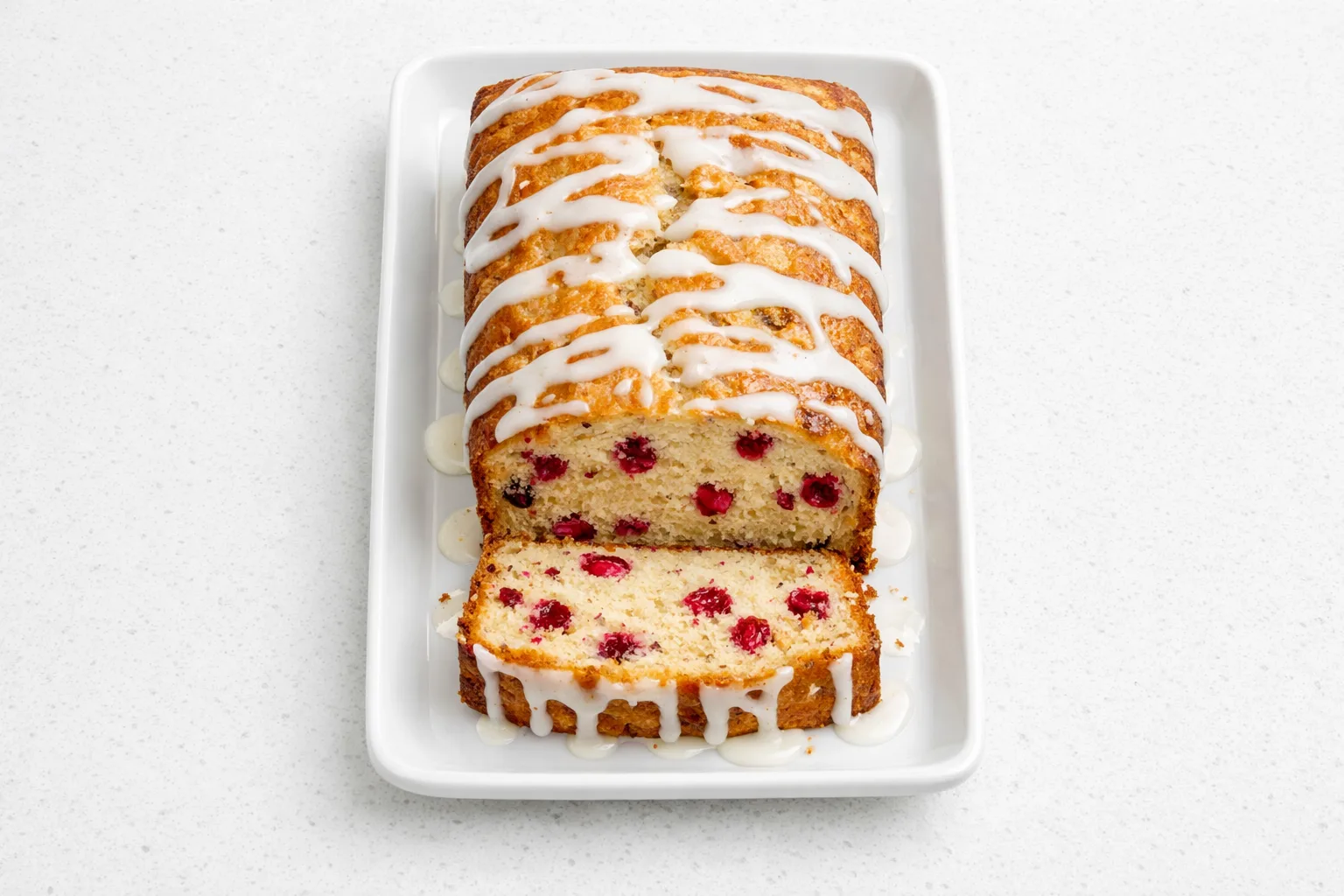
Cranberry orange bread is the holiday quick bread that earns a permanent spot on Christmas morning tables. The pairing is direct: tart cranberries need a citrus counterpoint, and orange delivers it cleanly. Fresh cranberries burst during baking and stain the crumb with pockets of jammy red that look as good as they taste. This is a recipe with American roots, common across the northeastern United States where wild cranberries grow in coastal bogs and show up at every Thanksgiving and Christmas table through December.
The technique here uses the muffin method: wet ingredients folded briefly into dry. Overmixing is the single biggest mistake with quick breads. Stop when you still see a few streaks of flour. The batter will look rough and that is correct. A properly mixed loaf bakes up open-crumbed and tender; an overmixed one turns dense and rubbery no matter how good your ingredients are.
The orange glaze is not optional. It sets into a thin crackly shell that seals in moisture, adds a clean hit of citrus sweetness, and gives the loaf the finish it deserves.
Equipment
Instructions
Tap each step to track your progress
- 1
Preheat your oven to 350 F (175 C). Grease a 9x5 inch loaf pan thoroughly with butter or non-stick spray, then line the long sides and bottom with a strip of parchment paper, leaving an overhang on each long side. This sling makes the loaf easy to lift out cleanly.
- 2
In a large bowl, whisk together 2 cups flour, sugar, baking powder, baking soda, and salt. Add the orange zest and rub it into the flour mixture with your fingertips for about 30 seconds until the flour smells fragrant and the zest is evenly distributed.
- 3
In a separate bowl or large measuring cup, whisk together the orange juice, egg, melted butter, and vanilla until combined.
- 4
Toss the halved cranberries with 1 tbsp of flour in a small bowl until lightly coated. This step prevents them from sinking to the bottom of the loaf during baking.
- 5
Pour the wet ingredients into the dry ingredients and fold with a rubber spatula using 10 to 12 strokes. Stop when the batter is about three-quarters combined. Add the floured cranberries and fold just until the last streaks of flour disappear. The batter will look lumpy. Do not smooth it out.
- 6
Transfer the batter to the prepared loaf pan and spread it to the edges. Tap the pan firmly on the counter twice to settle the batter and release air pockets.
- 7
Bake on the center rack for 55 to 65 minutes, until a wooden skewer inserted in the center comes out clean and the top is deep golden brown with a crack running along the top. If the loaf browns too quickly after 40 minutes, tent loosely with foil.
- 8
Cool the loaf in the pan on a wire rack for 15 minutes, then use the parchment sling to lift it out. Cool completely on the rack before glazing, at least 1 hour. Glazing a warm loaf causes the glaze to run off and soak in rather than set.
- 9
Make the glaze: whisk the sifted powdered sugar with orange juice and zest until smooth. The glaze should flow off the whisk in a thick, slow ribbon. If it is too thick, add orange juice a few drops at a time. Drizzle over the cooled loaf and let it set for 20 minutes before slicing.
Tips & Tricks
Use fresh orange juice, not bottled
Fresh juice has fragrant citrus oils that pasteurized bottled juice loses. Squeeze two medium oranges and zest them before juicing. This small step is the biggest single improvement you can make to this recipe.
Halve the cranberries
Whole cranberries release less flavor and sometimes roll out of slices when you cut the loaf. Halved cranberries distribute better, burst more evenly during baking, and create a more consistent flavor in every bite.
Do not open the oven before 45 minutes
Quick breads with berries are especially prone to sinking in the middle if exposed to cold air during the early bake. Leave the oven door closed until the 45-minute mark, then check quickly and tent with foil if needed.
Make it the day before
Cranberry orange bread actually tastes better on day two. The cranberry juices redistribute overnight and the orange flavor deepens. Bake it the day before you need it, wrap it unglazed, and glaze the next morning.
Troubleshooting
The loaf is dense and gummy inside
Overmixing developed too much gluten. Quick bread batter should be mixed as little as possible. Count your strokes and stop folding the moment the flour disappears. Also check your baking powder: if it is more than 6 months old, it may have lost its lift.
The cranberries all sank to the bottom
They were not coated in flour before adding, or the batter was too thin (orange juice was too watery or the butter was too hot when added). Toss cranberries in flour every time and make sure melted butter has cooled for at least 5 minutes before mixing into the eggs.
The top is cracking and browning too fast but the center is raw
The oven runs hot. Tent the loaf loosely with aluminum foil after 40 minutes and lower the temperature by 10 to 15 degrees. A digital oven thermometer will confirm whether your oven is calibrated correctly.
The glaze is running off and not setting
The loaf was still warm when you glazed it. Heat causes the glaze to thin and soak in instead of setting on top. Wait until the loaf is fully cool, at least 1 hour at room temperature.
The bread tastes flat despite following the recipe
The orange juice may have been bottled (pasteurized juice has a blunter flavor). Use freshly squeezed orange juice and add zest from an additional half orange to the batter. Zest holds more aromatic oil than juice and makes a bigger flavor difference than any other single change.
Variations
Dried Cranberry Version
Use 1 cup of dried cranberries instead of fresh or frozen. Soak them in hot water for 10 minutes first, then drain and pat dry before adding. Dried cranberries are sweeter and less tart, so reduce the sugar to 1/2 cup. The texture of the loaf will be slightly denser.
Vegan Adaptation
Replace the egg with a flax egg (1 tbsp ground flaxseed mixed with 3 tbsp water, rested 5 minutes until gel-like), and substitute the butter with refined coconut oil or a neutral vegetable oil. The loaf will be slightly more dense but still moist with the same cranberry-orange flavor.
Nut and Cranberry Version
Fold in 1/2 cup of roughly chopped toasted walnuts or pecans along with the cranberries. The nuts add texture and a slight bitterness that balances the sweet glaze. Toast them first in a dry skillet for 3 minutes over medium heat to bring out their flavor.
Lemon Cranberry Variation
Substitute lemon juice and lemon zest for the orange in both the bread and glaze. Use 1/3 cup fresh lemon juice and top up with milk or buttermilk to reach 3/4 cup total liquid. The lemon version is sharper and brighter, almost like a lemon cranberry pound cake in flavor.
Serving & Gifting
Slice with a serrated bread knife for clean cuts through the cranberry pockets. Serve alongside a strong black coffee, Earl Grey tea, or a glass of sparkling orange juice for a Christmas morning spread. For gifting, wrap the unglazed loaf tightly in plastic wrap and glaze only after it arrives at its destination. Pack sliced loaf on a small cutting board inside a clear cellophane bag tied with a ribbon for a simple and presentable Christmas gift.
Storage & Freezing
Store the glazed loaf wrapped in plastic wrap or in an airtight container at room temperature for up to 3 days. Refrigerate for up to 1 week; bring to room temperature before serving since the cold dulls the orange flavor. Freeze the unglazed loaf tightly wrapped in plastic wrap, then foil, for up to 3 months. Thaw at room temperature overnight and glaze just before serving. Do not freeze the glazed loaf as the glaze becomes sticky and weeps when thawed.
Common Questions
Can I use frozen cranberries instead of fresh?
Yes. Use them straight from the freezer without thawing. Thawed cranberries release too much liquid and can make the bread gummy. Halve them while still frozen and fold them into the batter cold.
Can I make this as cranberry orange muffins instead of a loaf?
Divide the batter into a greased 12-cup muffin tin, filling each cup two-thirds full. Bake at 375 F (190 C) for 18 to 22 minutes. The higher temperature gives muffins a domed top. Check with a skewer at 18 minutes.
How long does cranberry orange bread keep?
At room temperature in an airtight container, 3 days. Refrigerated, up to 1 week. Frozen (unglazed), up to 3 months. For gift-giving, bake no more than 2 days before you plan to deliver it.
Does this recipe work with orange extract instead of fresh juice?
It works, but the result is quite different. Replace the 3/4 cup orange juice with 3/4 cup milk and add 1 tsp orange extract. The bread will be less moist and the flavor more artificial. Fresh juice is strongly recommended.
Can I reduce the sugar to make it less sweet?
You can reduce the granulated sugar to 1/2 cup if you prefer a less sweet loaf. The cranberries are tart enough to carry the bread without the full amount of sugar. Omit the glaze or use a thinner version (add an extra tablespoon of juice) if reducing sugar.
Is this the same as a cranberry orange loaf cake?
The line between quick bread and loaf cake is mostly about sugar content and richness. This recipe sits closer to a quick bread: tender and moist but not buttery or sweet like a pound cake. If you want it richer, increase the butter to 1/2 cup and the sugar to 1 cup.